Price Management
Unofficial Seller Management
Are all genuine products allowed? Three requirements for parallel importation and the verification steps

💡 In this article, you can find the following information.
"It is authentic"—How far can we trust the seller's answer?
A US case where even with identical ingredients it became a problem; how would it be viewed in Korea?
Parallel imports: What should you check on the sales page vs. the actual product?
What are the standards and limits for taking issue with parallel imports?
To go beyond just accepting "It is authentic" as an answer
When monitoring product prices, if you find a seller selling your product at a price lower than the standard price, you will find yourself checking several things before taking action. Sometimes they are unofficial sellers selling counterfeit goods cheaply, and sometimes they are official partners selling them at a lower price by applying their own discount coupons. Among them, there is one seller that makes brand managers particularly troubled: the parallel import seller. Even if you ask them about their supplier, you often receive only a single-line reply saying, "It is genuine," without a transaction statement or an import declaration certificate. Since they say it is genuine, you feel there is not much else you can do.
In such cases, rather than trying to persuade the seller, it is better to utilize the platform's verification procedures, as mentioned previously. The problem is when that product is indeed genuine. Often, because there is no clear reason to report them to the platform, you end up just leaving a record and letting it go.
However, just because it is genuine does not mean it is a lawful parallel import. The Supreme Court holds that three things are required for parallel imports not to constitute trademark infringement. The goods must have had the trademark affixed by the foreign trademark owner or an authorized user, it must be possible to consider that they indicate the same source as the domestic registered trademark, and there must be no substantial difference in quality from the domestic trademark owner's goods. The seller's confident response, "It is genuine," is merely the seller's claim regarding the first of these, i.e., that it is 'a product to which a legitimate rights holder has affixed the trademark.' That single line alone makes it difficult to consider that the actual manufacturing and distribution history has been verified.
In this article, we have summarized what you can verify in such frustrating situations instead of just letting it go. We will look at things in order, from how far judicial precedents view it as a problem to what you can cross-check between the sales page and the actual physical product.
The Seller's Reply "It is genuine," How Far Can We Trust It?
What is the Difference Between Genuine Products and Lawful Parallel Imports?
Parallel import typically refers to a form of trade where a third party separately imports and sells genuine products that have been legally distributed abroad, without going through the domestic trademark owner or the official distribution network. In judicial precedents, such genuine products are called 'authentic goods.'
'Exhaustion of trademark rights' is commonly cited as the reason why it is difficult to prevent the resale of genuine products. This is a legal principle that if a trademark owner or the like transfers goods bearing a registered trademark in the domestic market, the trademark rights do not extend to the subsequent use or transfer of those goods, unless special circumstances exist. Simply put, once a trademark owner has sold a product domestically, it is difficult to block subsequent sales by anyone else using trademark rights. The article dealing with how parallel import sellers handle official retailer indicators also started from this legal principle. However, the exhaustion mentioned in this ruling presupposes goods transferred domestically. Parallel imports bringing in goods distributed abroad are judged separately based on the aforementioned three requirements, namely, who affixed the trademark, whether the source is the same as the domestic trademark, and whether there is any substantial difference in quality.

Whether the source is the same depends on the relationship between the domestic and foreign trademark owners and whether there is a separate company (exclusive licensee) that has been granted the exclusive right to use the trademark domestically. It is easy to understand if you look at an actual case. This was a case involving the parallel import of game software CDs, where the Supreme Court first verified that the US and domestic trademark owners were the same company. Next, they examined who consumers believed this trademark belonged to. If the domestic exclusive licensee has built up its own unique goodwill, consumers may come to regard the products bearing this trademark as belonging to the exclusive licensee rather than the original trademark owner. If that happens, the products brought in from abroad and the domestic products are considered to have different sources. In this case, the Supreme Court stated that it could not be seen that consumers came to regard it as such, and therefore judged that the import and domestic goods had the same source.
So, if a seller replies that it is genuine, start by clarifying where your brand stands in relation to these two aspects. You can check under whose name the domestic trademark right is registered and whether an exclusive license is registered by issuing a trademark register from Kipris. However, since the register only shows the registered rights relationships, the actual relationship with the foreign trademark owner can only be understood by looking separately at materials such as contracts or group structures.
To What Extent Does 'Difference in Quality' Apply in Parallel Imports?
If you have verified whether the source requirement is met, next is the turn to look at 'difference in quality,' the last of the three requirements for determining whether parallel import is permitted. The Supreme Court viewed this difference in quality as differences in the performance or durability of the product itself. It stated that differences in services attached to the product, such as customer support, free repairs, and parts replacement, are not included here.
This standard can also be verified in the game software CD case mentioned earlier. The Supreme Court accepted the lower court's judgment that there was no difference in quality, citing that even if there are some differences in incidental information depending on the country of sale, the main content of running the game is the same. It viewed that the conclusion would not change even if domestic genuine products had additional incidental services such as CD key post-management.
After-sales service (A/S) is a basis frequently thought of when taking issue with parallel imports. Differences such as "domestic genuine products are eligible for free A/S, but parallel imports are not," or "genuine product registration is not possible." However, looking at this ruling's standard, it is difficult to claim that there is a substantial difference in quality based on these differences alone.
Therefore, to use the quality requirement as a basis, you must be able to show that the quality of the product itself, such as the performance or durability of the imported product, is different from the domestic genuine product. It is more accurate to view differences in warranty or A/S conditions not as a quality issue, but separately as an issue of how the sales page presents those differences to consumers.
💡 Execution Tip
If you have a draft report or internal review document that uses differences in warranty or A/S as a basis, check again whether that basis refers to differences in the product itself, such as performance or durability. If only service differences are written, it is safer to reinforce the basis or review other paths together.
US Case where the Same Ingredients Still Became a Problem, How is it Viewed Domestically?
Two Basis of Judgment in the Gilead Ruling: Label Differences and Quality Control
If so, what happens to parallel imported goods that have identical products but different labels? There is a foreign case worth referring to regarding this. This is a case of dispute over pharmaceuticals with identical ingredients.
In August 2026, the US Court of Appeals for the Fourth Circuit delivered a noteworthy judgment regarding genuine products for foreign domestic consumption. It was a case where Turkey-domestic-use products among pharmaceutical company Gilead's HIV treatments were supplied to US patients through a foreign procurement method. The court recognized that the product was manufactured with Gilead's authorization and was chemically identical to the version sold in the US. Nonetheless, it determined that this product was highly likely not to be recognized as Gilead's 'genuine goods' under US trademark law. The court separately reviewed two things: whether there were meaningful differences to consumers compared to the US-use products, and whether they were distributed outside the trademark owner's quality control system.
Labeling: It was written in Turkish and lacked the prescription drug indicators, National Drug Code (NDC), warnings, and storage methods found on US product labels.
Quality Control: Only official distributions within the US are transported in temperature-controlled, sealed containers, and if they deviate from the standards, the manufacturer enters a quality check procedure. The products procured from abroad were outside this management system.
Regarding label differences, the standard of judgment was also set low. The court viewed that even a minor difference that consumers would consider relevant when making a purchasing decision is sufficient.
This decision is not a final judgment but maintains a preliminary injunction issued temporarily before the trial ends, and being a foreign case, it does not bind domestic courts either. However, while the domestic precedents we looked at earlier used the quality of the product itself, such as performance or durability, as a standard, this ruling cited non-product elements such as labels and quality control systems as a basis, making it worth comparing with domestic standards.
In Korea, Label Differences are Reviewed Under Labeling Obligations
Of course, this does not mean that this ruling can be applied directly to Korea. Based on domestic precedents, it is difficult to claim that there is a substantial difference in quality simply because there is no Korean on the label. Instead, for items where labeling obligations are defined by law, such as cosmetics and food, label differences can be examined as an issue separate from trademark rights.
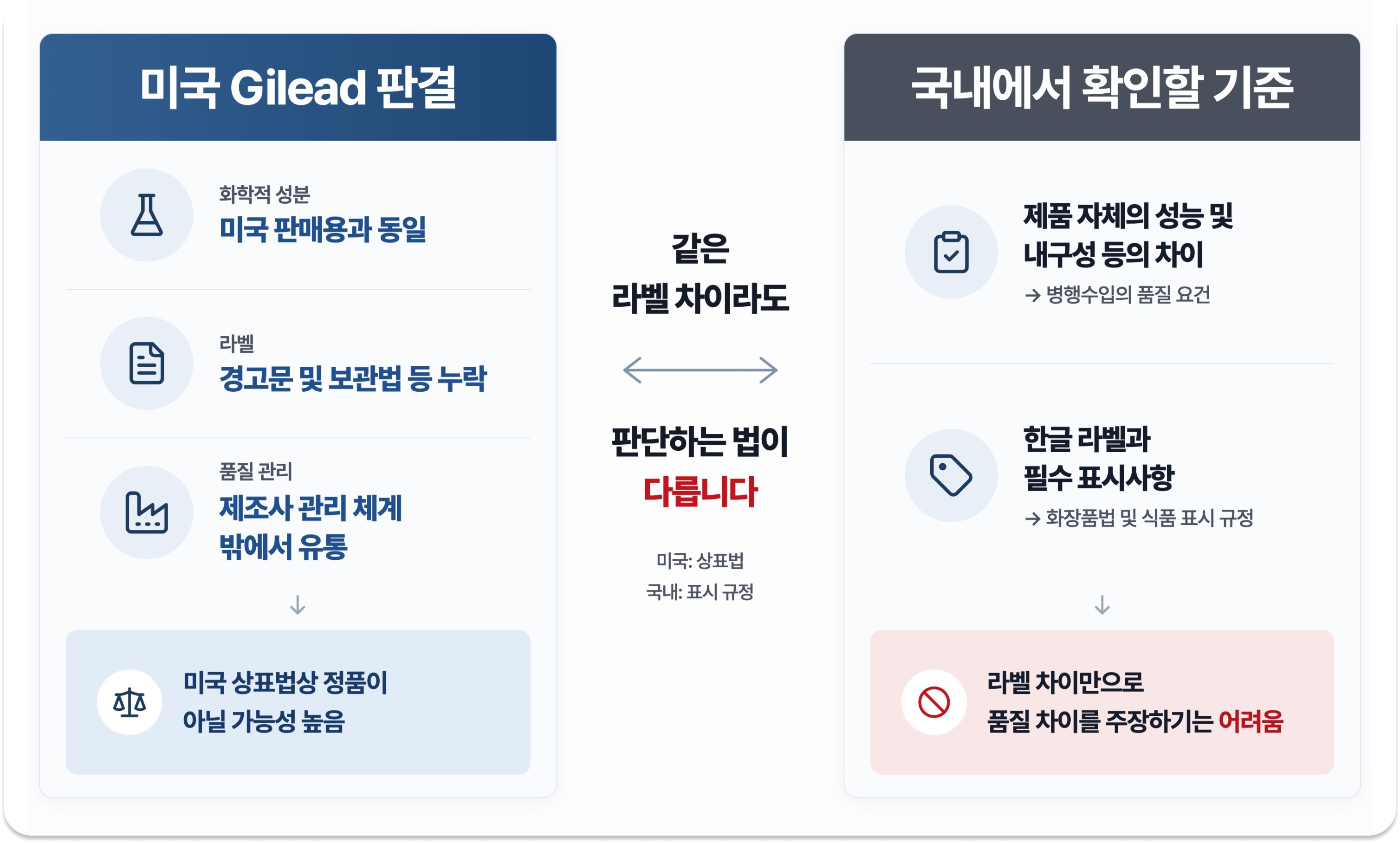
For cosmetics, Article 10 of the Cosmetics Act requires the name, business name and address of the entrepreneur, all ingredients, volume, batch number, expiration date, etc., to be indicated on the packaging, and Article 12 requires these to be indicated accurately in easy-to-read Korean. And Article 16, Paragraph 1, Item 2 prohibits anyone from selling cosmetics that violate these standards, or keeping or displaying them for the purpose of sale. The fact that the prohibition is not limited to importers but applies to any seller is important in practice. Since there are cases where only some items need to be indicated, such as packaging of cosmetics with small volumes, the required written items may vary depending on the packaging type.
For food and health functional food, Article 4 of the Act on Labeling and Advertising of Foods defines labeling items such as product name, volume, business name, and expiration date, and prohibits selling, or keeping or displaying for the purpose of sale, products that lack labeling or violate labeling methods. For health functional foods, items such as intake amount, intake method, precautions for intake, and health functional food indicators are additionally required. Imported food can have stickers printed in Korean attached in accordance with the Labeling Standards for Foods, etc., but they must be attached securely so they do not fall off, and they must not cover major indicators such as the product name or expiration date of the original packaging.
Apart from packaging labels, there is also information that must be written separately on online sales pages for each item. Sales page items for cosmetics and health functional foods are summarized in the Distribution Enforcement Guide: Cosmetics Edition and Health Functional Foods Edition.
However, the determination of labeling violations and subsequent actions are made by the competent authorities. Therefore, rather than viewing this path as a means to block parallel imports, it is more accurate to view it as another branch for examining differences difficult to dispute with trademark rights through potential violations of labeling regulations.
Parallel Imported Goods, What to Verify on the Sales Page and the Physical Product Respectively?
Step 1: What to Look at First on the Sales Page
Then, how can we actually verify these differences in parallel imported goods? For parallel imported goods, it is important to perform a cross-checking task of setting the domestic genuine product as a baseline and writing down the differences visible on the sales page item by item. Before verifying the physical product sent by the seller, there are more items than you think that can be caught through the detail page and thumbnail images alone.
Labels and Labeling Items: If it is an item subject to labeling obligations, such as cosmetics or food, check whether the label shown in the image is in its original language or if it has Korean labeling items. If a Korean sticker is visible, also note down whether it covers the original labeling.
Components: Compare whether the volume, quantity, and accessories shown in the product description or image match the domestic genuine product composition.
Warranty and A/S Guidance: Check whether they are guiding as if the same warranty as the domestic official distribution product is available. If so, this could lead to labeling and advertising issues discussed in the previously introduced article on handling official retailer indicators.
If you found differences here, you now have a basis to ask the seller again. Even if you received a reply that it is genuine, you can specifically ask how the Korean labeling is attached and whether the components are the same as the domestic genuine product. Since sales pages can be modified or deleted, capture the screen so that the URL, product name, options, and verification date are visible for each verified difference.
Step 2: What is Verified Only with the Physical Product
If you found differences in Step 1, the next step is to purchase the seller's product directly and verify it. This is because the sales page images are photos selected by the seller, so they may differ from the product actually delivered.
Label Attachment Condition: Verify whether the Korean sticker is attached securely so it does not fall off, and whether it does not cover the product name or expiration date on the original packaging.
Enclosed Items: Check whether a warranty, user manual, and genuine registration guidance are included, and in what language they are written.
Components: Cross-check whether the actual quantity and specifications match the sales page description and the domestic genuine product.
Leaving the purchase date, order number, and photos before and after opening together allows you to link which sales page the product came from later. In other words, it is a record accumulated based on the product, not the seller.
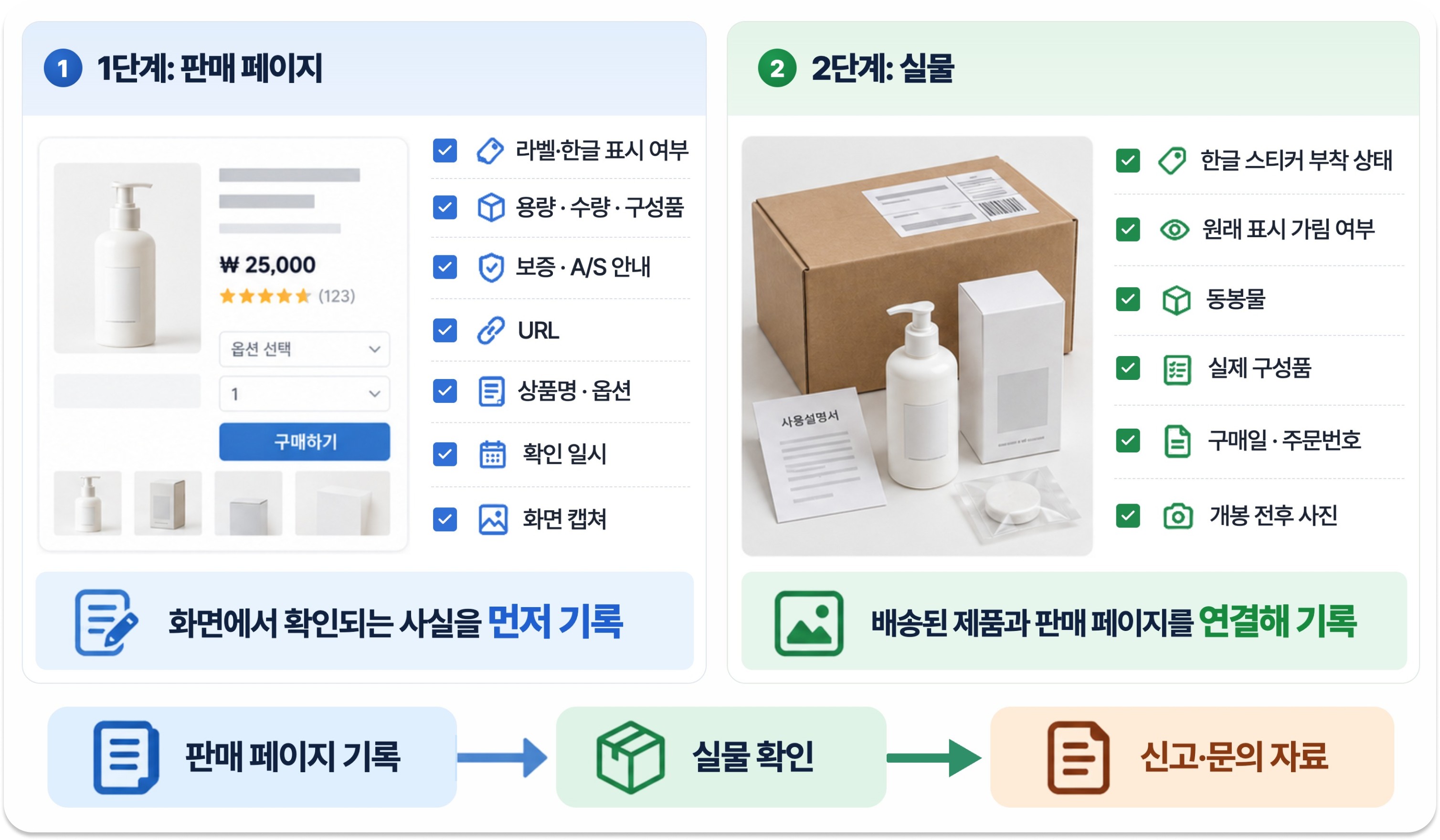
When reporting to platforms or competent authorities with records collected this way, rather than concluding that it is an illegal product and demanding measures, it is safer to attach the verified facts and request verification on whether the corresponding labeling items or guide texts meet the standards.
❗️This article is general information summarizing factual relations, related precedents, and labeling regulations to verify when reviewing parallel import products. Trademark infringement, labeling violations, legality of import and sale, and platform action possibilities for individual products may vary depending on the trademark rights structure, actual product labeling and composition, distribution history, applicable item regulations, and submitted materials. It is necessary to separately verify the latest laws, competent administrative agencies, and platform standards before specific disputes or reports.
To What Extent Can Parallel Imported Goods Be Challenged?
Q. If a product is legitimately made abroad, are all parallel imports allowed?
Not necessarily. If the party that affixed the trademark abroad and the domestic trademark owner are not tied to the same source, it is not recognized as a parallel import.
A case involving the import and sale of golf clubs made in Japan domestically is such an instance. The trademark owner of the domestic registered trademark and the company that affixed the trademark to the golf clubs in Japan were different companies. The court determined that the two companies could not be seen as having a close relationship legally or economically, and thus the trademark of the imported golf clubs could not be seen as indicating the same source as the domestic registered trademark. The importer claimed it should be allowed as a parallel import, but it was not accepted, and the Supreme Court also upheld this judgment.
Conversely, the game software CD case seen in the main text was a case where the source requirement was met because the US and domestic trademark owners were the same company.
Q. Can parallel imported cosmetics be sold if they do not have Korean labeling?
If they are cosmetics sold domestically, it can be a problem. Article 10 of the Cosmetics Act defines items that must be written on the packaging. These include the name, business name and address of the entrepreneur, all ingredients, volume or weight, batch number, expiration date or period of use after opening, price, and precautions for use.
For cosmetics with separate outer packaging, the container holding the contents must also display four items: name, business name of the entrepreneur, batch number, and expiration date or period of use after opening. Packaging of cosmetics with small volumes, etc., may only list the name, business name, price, batch number, and expiration date or period of use after opening.
No one may sell, or keep or display for the purpose of sale, cosmetics that do not display these items in Korean. Therefore, when verifying the physical product, do not just look at whether there is Korean labeling, but write down separately which items are written on the outer packaging and the container respectively. The determination of violations and actions is made by the competent authorities.
Q. What labeling do we verify on the packaging of parallel imported health functional foods?
We look at items defined by Article 4 of the Act on Labeling and Advertising of Foods and the Labeling Standards for Health Functional Foods. These include health functional food indicators or designs, product name, business name and location, expiration date and storage method, volume, nutritional information, functional information, intake amount and method, precautions for intake, raw material names and content, text indicating that it is not a medicine for prevention and treatment of diseases, and precautions for consumer safety.
To Avoid Stopping at the Reply "It is genuine"
If you only ask a parallel import seller whether 'the product they are currently selling cheaply is indeed our brand's genuine product,' the moment the reply saying yes comes back, the basis to ask further questions disappears. However, according to the precedents and regulations seen in this article, you can review additional measures by verifying whether it is identical in label, composition, and quality to the product we sell domestically.
Of course, this question does not apply identically to all products. For items with defined labeling obligations like cosmetics or food, label differences can be disputed through labeling regulations. For other items, you must be able to show that the quality of the product itself, such as performance or durability, is different to use the quality requirement as a basis.
Therefore, if you discover a parallel import seller, look at our product first before looking at the seller. This is because you must first know what labeling obligations are tied to our product and to what extent the product the seller is selling is identical to the domestic genuine product. Although the answers coming back from sellers are always similar and may make you feel frustrated each time, there is much more that a brand can directly verify.