Unofficial Seller Management
Price Management
Why you shouldn't blindly report the lowest-price seller: 6 causes of price collapse and practical response strategies in the market and practical countermeasures

💡 In this article, you can check the following content.
Why classifying the cause comes before reporting when the price collapses
6 causes and characteristics of price collapse encountered in the field
How to write a confirmation request message to unauthorized sellers
9 record items that must be kept for future use as evidence
Priority actions by cause and Frequently Asked Questions (FAQ)
Today, like any other day, many of you might have been monitoring prices as usual, only to be surprised by a sudden drop in the lowest price and ended up clicking in here. The seller's name is unfamiliar, but their stock seems plentiful, the delivery is normal, and they've even accumulated quite a few reviews. It's difficult to judge whether this is a simple pricing error or a distribution issue that requires immediate verification.

In times like this, the first thing people usually reach for is the platform's 'Report' button. If you've filed reports a few times, you probably know exactly what happens next. You only receive a standard principled response saying "We will take action after checking," and even after several days, the sales page remains perfectly active. Meanwhile, the product keeps selling, and upper management presses for progress.
There are also situations where acting too hastily can lead to embarrassment. You might file a report judging them to be an unauthorized seller, only to find out that the account actually belonged to one of your own authorized dealers. It was simply an account that was not on the headquarters' official list, not an unauthorized seller. Once you experience this, you begin to hesitate in front of the report button.
On the surface, the phenomenon of collapsing prices looks almost identical. The lowest price has been broken, an unknown seller is selling it, and inquiries keep coming in. However, if you start by sending a certification of contents to a legitimate business partner who is simply clearing out inventory, you will only damage a perfectly good relationship. On the other hand, if you just take down a single page when the stock has leaked from the distribution network, the same product will reappear under a different account two weeks later.
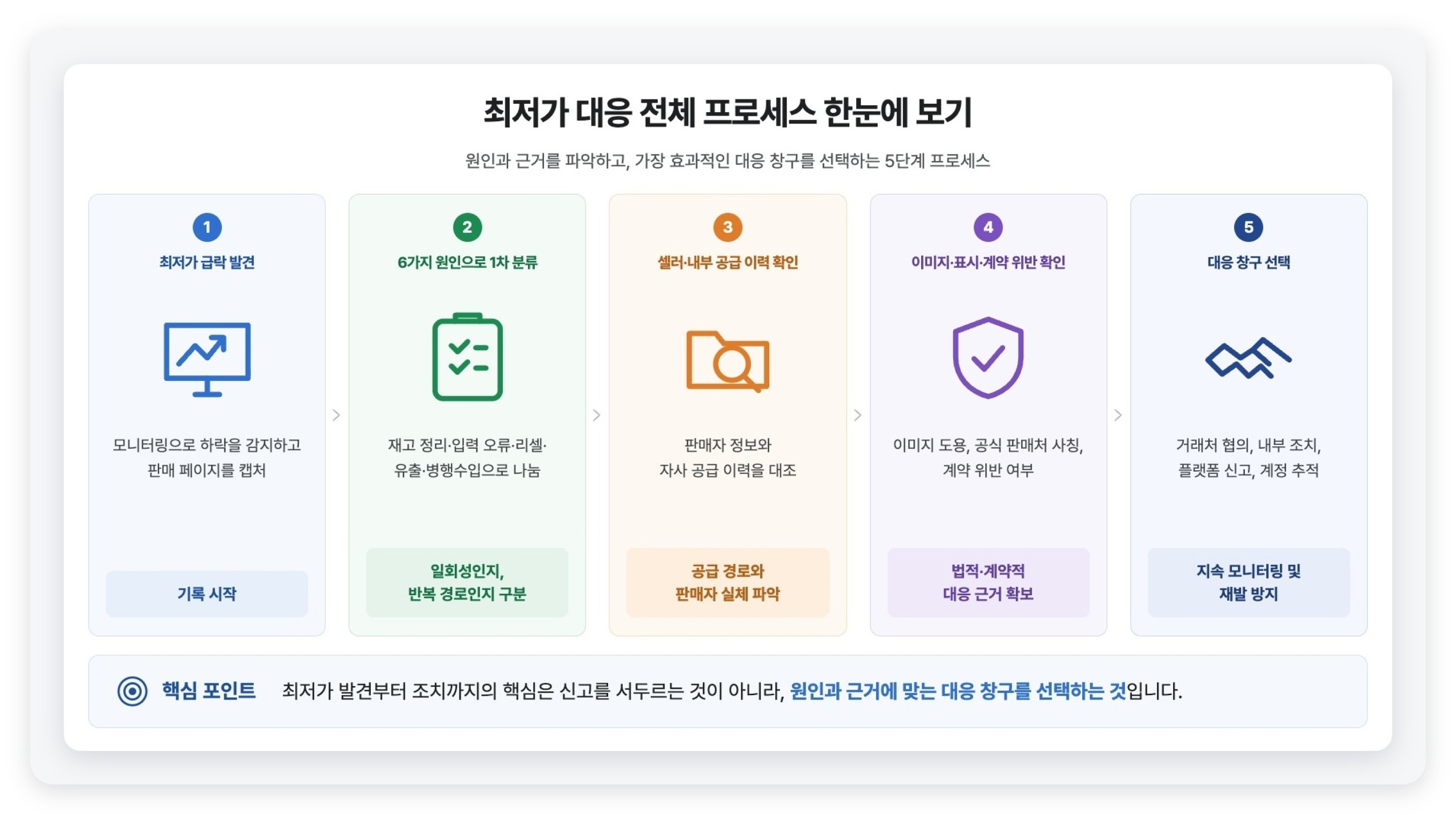
Therefore, in practice, before reporting, you must first verify the reason why the price has dropped.
The reasons why product prices collapse online are broadly divided into six categories: inventory clearance, price entry errors, reselling of sale items, leaks through internal channels, parallel imports, and leaks through unofficial distribution networks. Distinguishing these six categories beforehand makes the subsequent direction of response much clearer.
Why should we identify the cause first when prices collapse?
The core is to first check 'through what channel that stock entered the market' rather than focusing solely on the result that 'the price has dropped.' This is because the legal basis and response methods that a brand can utilize vary depending on the source of the stock.
The reason response methods differ lies in the limitation that it is difficult to take immediate action based solely on the fact that 'the price is low.' You might feel frustrated wondering why you cannot control the price of your own product. This is because there are provisions in the Monopoly Regulation and Fair Trade Act that restrict brands from arbitrarily blocking selling prices.
Article 46 of the Monopoly Regulation and Fair Trade Act prohibits resale price maintenance in principle, but allows exceptions for justifiable reasons and for published works notified by the Fair Trade Commission. Paragraph 20 of Article 2 of the same Act defines this as an act where a business operator, in trading goods or services, forces the counterparty business operator or business operators at subsequent stages of transaction to sell or provide them at a fixed price, or places other restrictive conditions on the transaction.
To put it simply, presenting a recommended retail price for reference is generally fine, but if you disadvantageously change supply conditions or impose business disadvantages just because they did not adhere to that price, the nature of the act changes. The Fair Trade Commission's review guidelines and related precedents also look significantly at whether there were coercive means used to actually enforce the price.
However, this does not mean that brands have absolutely no enforcement measures at their disposal. The justification for enforcement must be found in 'other violations' rather than 'price.' For example, you should look into whether they unauthorizedly used your detailed page images, falsely represented themselves as an official seller, or if an existing business partner violated a resale prohibition agreement. In reality, the grounds leading to sales suspension or platform action are mostly identified within these violations.
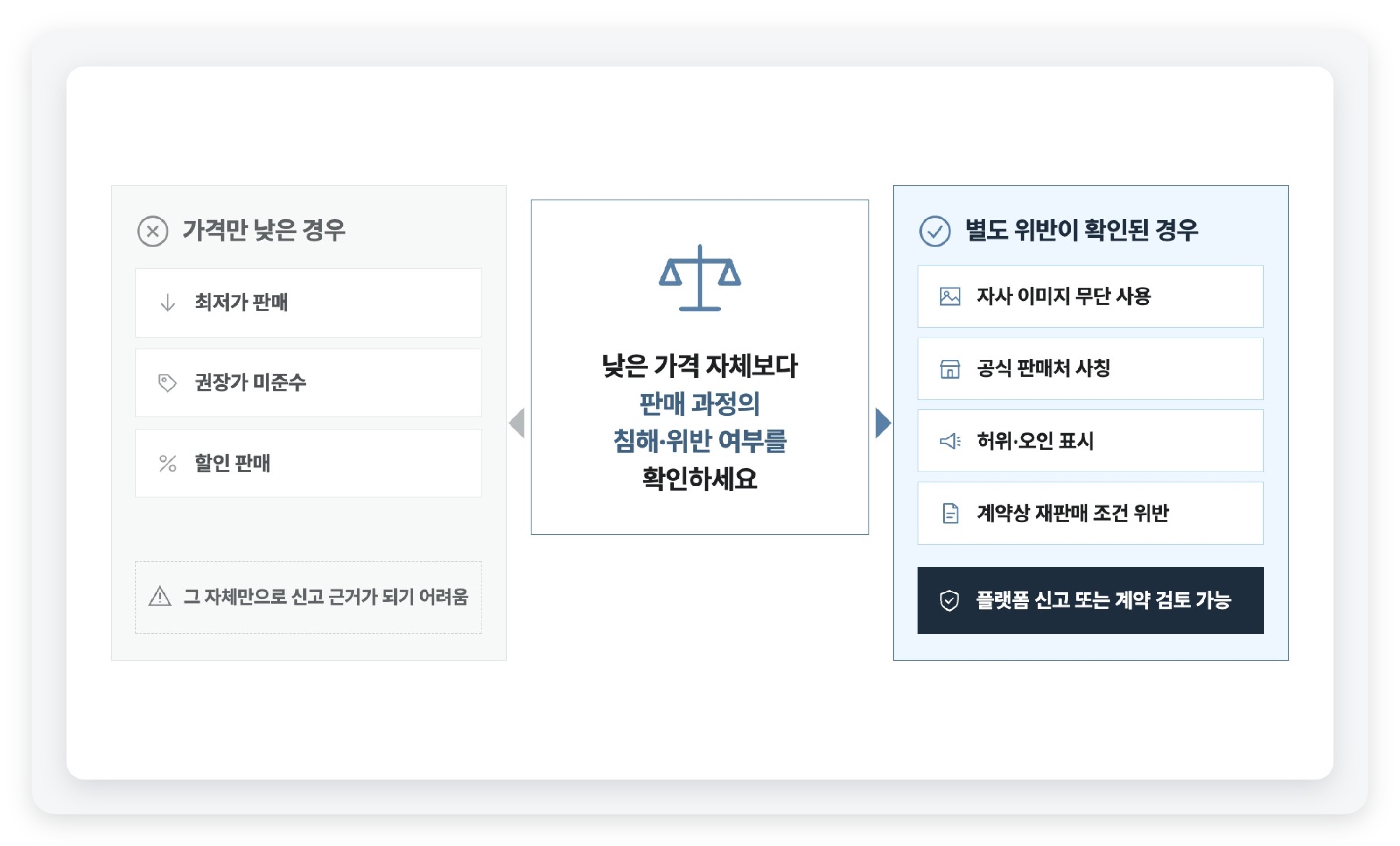
Ultimately, classifying the causes is not a process of finding 'who did wrong,' but rather a process of deciding what grounds to use and what procedures to follow.
How do you distinguish unauthorized sellers? 6 cases where prices collapse
The six causes of price collapse introduced earlier can be grouped into two directions. One is where the situation ends once all current stock is sold, and the other is where the supply channel remains open, causing the same problem to recur.
Rather than trying to guess the six causes perfectly from the beginning, first try to distinguish whether this issue is "something that will end with this batch of stock" or "if there is a channel through which stock keeps coming in." This is where you decide where to direct your energy and what to track.
Cases that resolve once stock runs out
① Inventory clearance & end-of-season stock
This is when an authorized partner clears out remaining stock due to the end of a season or an approaching expiration date. Discounted sales are often concentrated on specific options, colors, or past season products, and the seller's name is often on the list of white sellers (official sellers approved and managed by the brand).
In this type of case, the situation often resolves naturally once the held stock is exhausted. If you protest immediately upon discovery, you might feel relieved momentarily, but creating unnecessary friction with normal business partners can make it difficult to get their cooperation when a real leak problem occurs later.
It is appropriate to start by recording the sales page, price, and verification date, and simply monitor whether stock continues to be supplied.
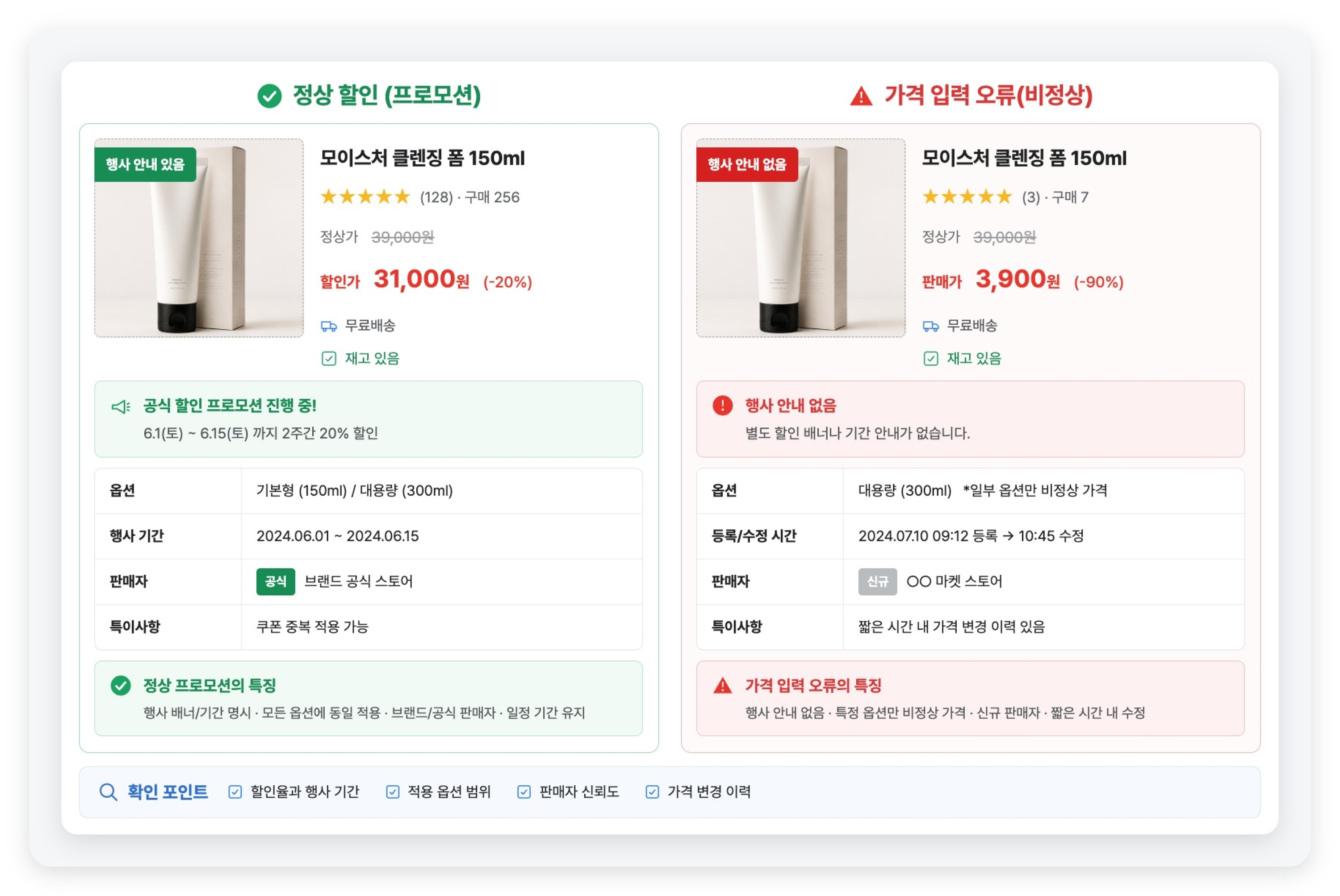
② Price entry error
This is when an abnormal price way below cost is suddenly displayed. It spreads quickly through communities or price comparison sites, and the price is sometimes corrected in as short as a few hours. The problem lies in the stock that has already been sold before the error is corrected. While it is difficult for a brand to undo a transaction that has already been concluded, capturing the screen at that time allows you to connect the dots if that stock reappears in the resale market later.
In this case, it's good to record not just the price, but also the product name, options, displayed quantity, and seller information. If products with the same options and quantities repeatedly appear later, it serves as a clue to investigate whether it is reselling following a simple error.
③ Reselling of brand sale items
This is when a person who purchased products in bulk during a discount event run by the brand resells them on open markets. In practical consultations, many managers express that they find this type the most frustrating. If the product is genuine, the purchase process was normal, and they are selling with photos they took themselves without using the brand's images, it is very difficult to find a point of dispute.
Once a brand (trademark owner) normally sells a genuine product in the market once, the trademark rights for that product are considered to have exhausted their purpose. In legal terms, this is called 'exhaustion of trademark rights' (Supreme Court Decision 2002Do3445, decided April 11, 2003). Therefore, unless there are special circumstances, it is difficult for a brand to legally restrict a resale act where a consumer legitimately purchases a genuine product and resells it based on trademark infringement.
Of course, there are exceptions. The same ruling states that trademark exhaustion is not recognized if the product is processed or repaired to the extent of damaging its identity with the original product, effectively constituting a new production act. If the product condition has changed, components are missing, or warranty-related indications differ from the truth, these must be looked into separately. If no such circumstances exist, rather than wasting energy trying to stop this specific sale, it is more realistic to review how to design purchase quantities or per-session limits for the next discount event. Even if you cannot stop this batch, you can reduce the likelihood of the same thing happening again.
Cases where the supply channel remains open and recurs
The previous three types share one common feature: the situation ends once the currently released stock is fully exhausted.
The three types we will look at now are different. Even if you take down one sales page, the channel through which goods keep coming in remains, so responding case-by-case means repeating the same work. If the same product is discovered again under a different account shortly after you completed measures and submitted an internal report, you should suspect this side.
④ Leak of employee discount, special sales, or closed mall stock
This is when stock from channels not intended for external distribution, such as employee sales, welfare malls, or corporate special sales, leaks into open markets. The reason this situation is difficult in practice is that the starting point of the problem might not be an external infringer, but your own supply channel. Of course, if the leaking entity is a contracting party, you can raise an issue for breach of contract, and if a special sales partner violated resale prohibition conditions, you can respond based on the contract terms. However, if the final buyer is an individual or the intermediate path is cut off, fixing internal supply policies can be faster than taking action against external sellers.
Thus, the first question in this type is directed inward, not outward. First check with the logistics or sales department to see which channel—employee mall, welfare mall, or special sales—the product was supplied to. You must cross-reference the stock that left your company with the timing before chasing the seller.
⑤ Parallel import & overseas inflow
This is when genuine products are brought in from overseas and sold domestically. Article 5 of the Korea Customs Service's "Notification on the Processing of Export/Import Customs Clearance for the Protection of Intellectual Property Rights" states that importing goods produced by a person who has the legitimate right to use the trademark is not considered trademark infringement if the domestic and foreign trademark owners are in a relationship defined by the notification, such as being the same person, an affiliate, or an import agent (Korea Customs Service Notification No. 2025-61, Enforced on November 24, 2025). Therefore, if it is a legitimate parallel import product that meets the above requirements, it is difficult to block the stock and sales itself based on customs clearance stages or trademark infringement.
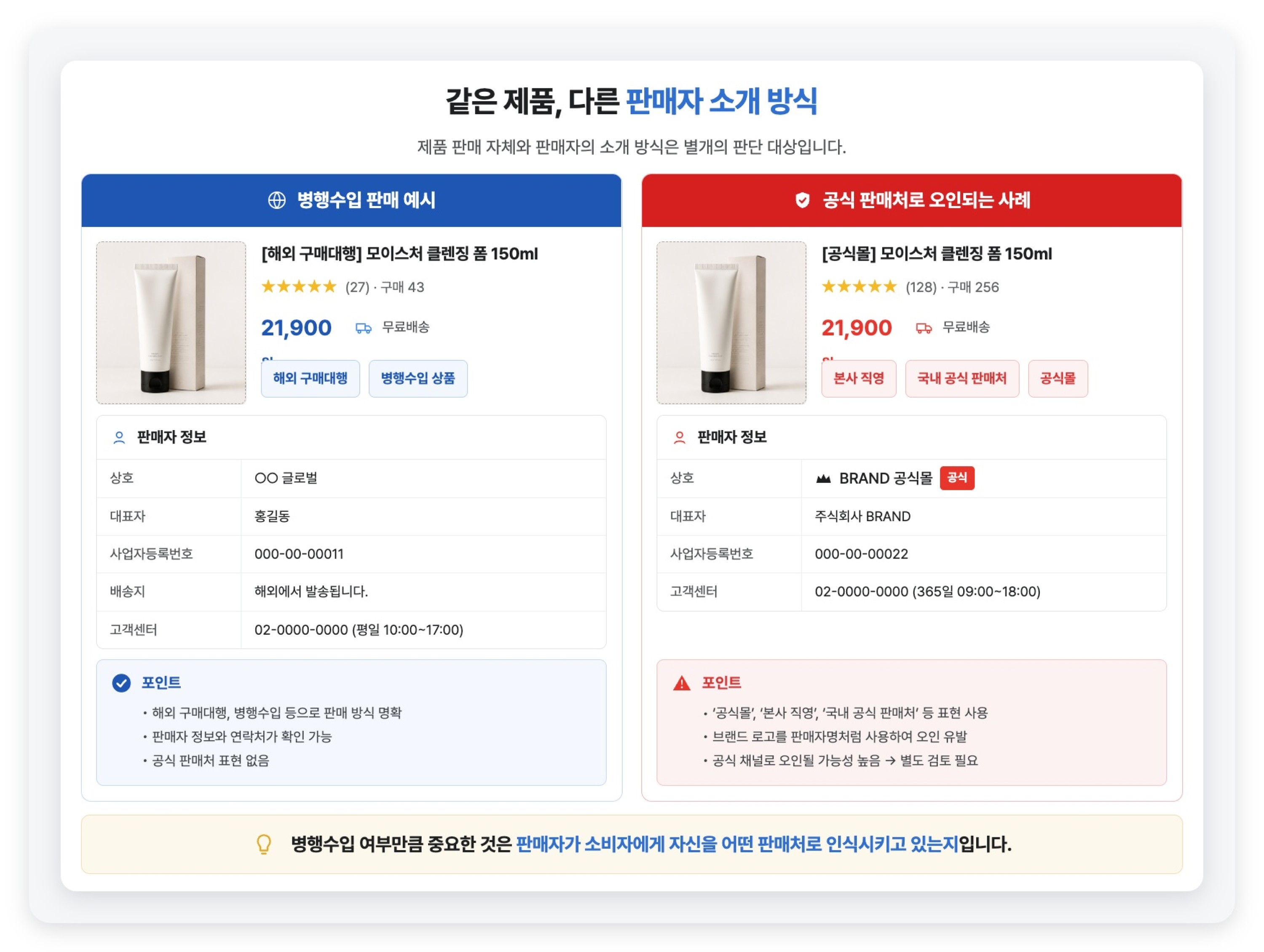
Many people often conclude "there's nothing we can do if it's parallel import" and give up here. But it is too early to give up. The aforementioned regulations are criteria for the customs clearance stage, so satisfying these requirements does not mean all legal issues, including indications and advertising, disappear. Even if it is difficult to block the product sales itself, there is still room to dispute how that seller is exposing themselves. If the seller is displaying themselves as a 'domestic official seller' or 'headquarters direct store,' you can review and take action against violations of the Unfair Competition Prevention Act. Therefore, when you find a parallel import seller, you must check the indication phrases on the sales page first rather than the price.
⑥ Leak through unofficial distribution networks
This is when multiple sellers appear at similar times with similar prices, rather than just a single seller. Instead of assuming each seller accidentally chose the same price, you should investigate the possibility that stock is flowing in multiple directions from a certain point upstream. This is the case with the largest scope of response among the six types.
In this situation, taking down individual sales pages is close to a temporary measure. Even if you take down one, if the supply channel remains, other accounts can reappear. The actual solution starts with reverse-matching supply histories rather than responding to individual sellers. First, capture the pages of each seller selling the same product, and record the initial appearance timing, price, and options together. Placing the appearance order of multiple accounts side by side can reveal supply flows that were not visible at first.

💡 Something to try today
Try briefly indicating which of the six causes applies next to the sales page currently exposed at the lowest price. If you are not sure, it is fine to leave it as a question mark.
Rather than guessing the exact answer right now, it is important to record it so you can re-verify whether this case is "something that will end with this batch of stock" or "something where a supply channel remains." If the same indication piles up multiple times over several days, that itself becomes a clue for your next judgment.
This is the range that can be judged using only brand internal information. From there, you must request verification from the seller and cross-reference their reply with your supply history.
What should we request from the seller, and how do we read their reply?
A brand does not have separate legal authority to arbitrarily force online sellers to submit purchase sources or transaction statements. If the obligation to submit is stipulated in a contract or platform terms, the story changes, but without such grounds, the seller is not obligated to answer the brand's request. In the lawsuit stage, you can apply for a document submission order under the Civil Procedure Act, and if there are circumstances where evidence might disappear or become difficult to use later, you can review preservation of evidence.
Until then, what the brand can do is indirectly request verification through the platform's reporting process, or keep a record of having requested verification from the seller.
If you do not know these distribution structures and legal limitations, you will waste a lot of time in the response process. Sending a message to the seller, sending it again because there is no reply, calling them, and then weeks pass by. However, from their perspective, they have no obligation to reply, so not replying is a natural choice. It is a structure where only the brand gets anxious.
But this does not mean that contacting them directly is meaningless. You must set a different goal. The purpose of the inquiry is not necessarily to get an answer, but to create a verification record that can be utilized in subsequent procedures. If a reply comes, you get data to judge the supply channel; if no reply comes, a record remains of when and with what content you requested verification but received no reply. If you organize the purpose this way, even non-responses can be managed as part of the response process.
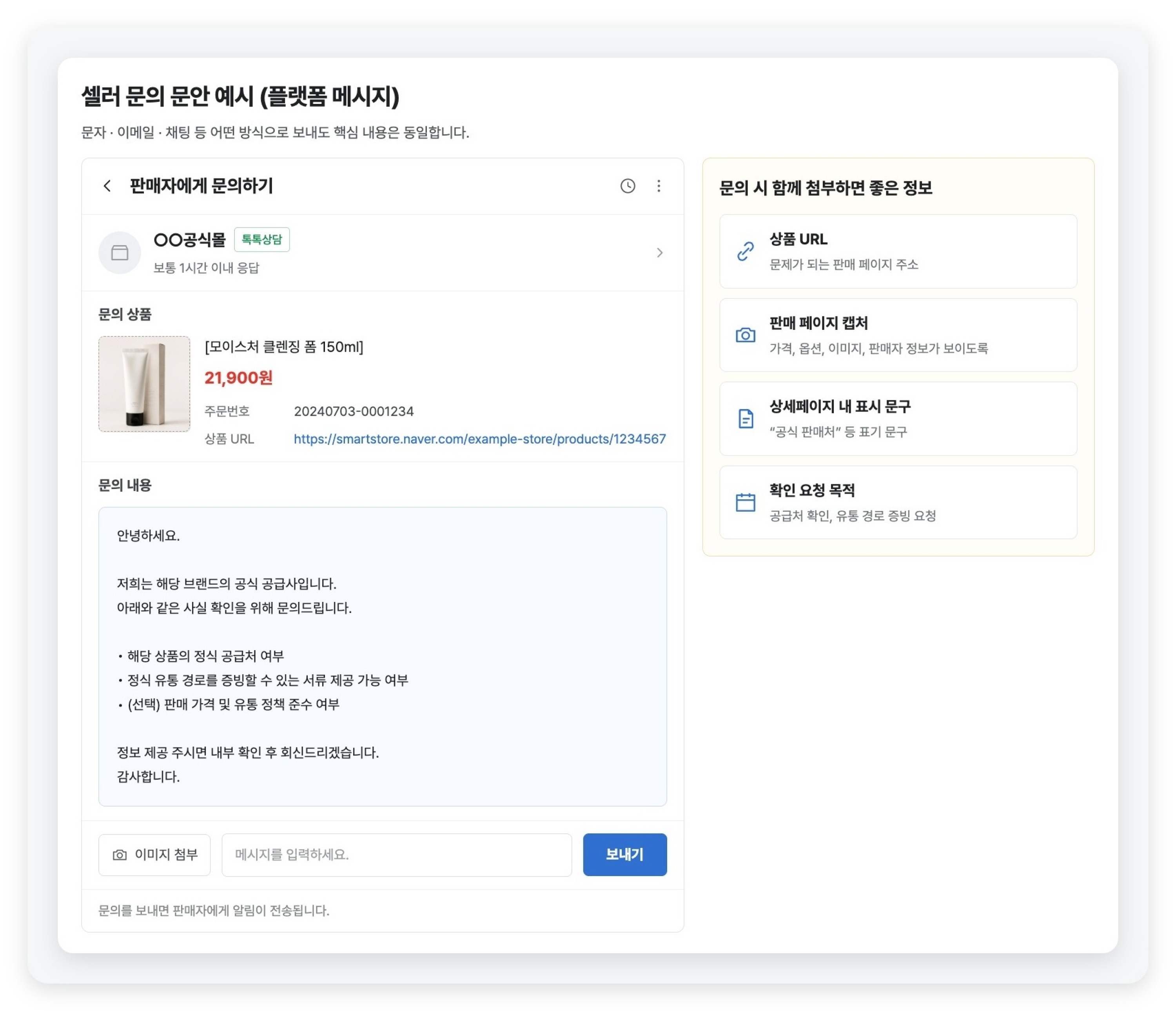
A verification request is a text that can easily become mixed with emotions. However, if the protesting tone is strong, it may become difficult to attach as-is for platform reports or legal review materials later. It is better to keep only the facts and requested items, as shown below.
📋 Inquiry Template Example
Hello, this is the distribution management manager of the ○○ brand.
We request verification regarding the product below currently on sale in your store.· Product URL / Product Name / Option / Verification Date and Time
Please reply in a format that holds data verifying the supplier and purchase path of the product.
Example: Transaction statement, tax invoice, import declaration certificate, etc.Regardless of whether you reply, this verification request history will be kept as our distribution management record.
The last sentence seems minor, but it makes a difference in subsequent procedures. It leaves a progress record of what information the brand requested and when, and whether the seller responded to that request.
How do we read their reply?
① When official documents are provided immediately
First, cross-reference them with your supply history. An unexpectedly common issue revealed at this point is that the official seller list held by the brand is not up to date. There are cases where a dealer opened a new account or a distributor increased their resellers, but this was not reflected in the headquarters' list.
This is where the situation of mistaking your own dealer for an unauthorized seller and reporting them arises, as examined earlier. If the official seller list is scattered only in document format, fast cross-referencing can become difficult as the company grows.
② When documents exist but do not match your supply history
This could mean there is one more unverified supply stage between the current seller and the brand. If a partner with a contractual relationship is connected, you can look into it as a breach of contract issue, and if it does not connect to your supply records at all, you must verify the leak channel separately.
In this case, rather than continuously demanding data from the final seller, it may be faster to reverse-track the supply stages from the verified purchase source. This is because the seller is highly likely to be the last stage of the distribution process.
③ When they only reply "It is genuine" and do not submit documents
This is the most common type encountered in practice. Many managers stop here, unable to proceed further. However, from this point on, you must shift your direction from persuading the seller to utilizing the platform's verification procedures.
According to Coupang's Intellectual Property Protection Policy, once a report is received, the operator can review the content and request documents from the seller that can prove the product's source. During the distribution channel verification or explanation stages, they can demand genuine certificates and data that can verify the supply chain. If policy violations are confirmed, it can lead to the suspension of product sales/exposure or seller account suspension, and in cases of counterfeit issues, withholding of settlement payments may apply. (This content is based on verification in July 2026, and you should re-verify the latest policy before actually reporting.)
There is a practically important difference here. The platform can demand distribution channel data from the seller according to its own policy, which is something the brand cannot arbitrarily demand. Therefore, rather than trying to persuade the seller to get the documents, if the grounds for reporting are verified, utilizing the platform's official procedures can be more realistic.
However, this does not mean the platform discloses all the data it receives to the reporter. The scope of disclosure may vary depending on the platform and case, and the brand might only receive the action results rather than specific documents.
Still, this procedure is meaningful because the seller's explanation can be reflected in the platform's judgment on action, and the brand can keep the report receipt history and results as its own record.
Also, reporting strictly requires specific reasons. Often, the fact that the price is low does not constitute a reason for reporting. You must verify whether your images were used without authorization, or if they displayed themselves as if they were an official seller. To report based on unauthorized image use, you must also first check if the copyright of that image belongs to your company. Outsourced creations may differ in judgment depending on the rights attribution clause in the contract. Ultimately, this connects back to why we said you must classify the causes first.
👉🏻 Check out this article too! Reasons why reports are rejected and required documents: Proofs needed for reporting open market trademark infringement
④ When there is no reply
No reply is not a failure of verification, but a progress record. If you record the sending date, sending path, requested content, and the period of non-response, you can utilize this later as data to explain what verification procedures the brand went through in certifications of contents or platform reports. While the time spent waiting for a reply does not itself become evidence of infringement, it leaves a progress history showing that there was no explanation despite requesting verification.

💡 Something to try today
When sending a verification request, do not use only platform messages, but also send the same content to the representative email displayed in the seller information. This is because reviewing past messages can become difficult depending on the platform account status or policy. Keeping both the email sending history and platform message screens together makes it much easier to explain when and what request was delivered.
What items should we record so we can use them later?
When you get to this point, another question arises. To what level should we keep records so they can actually be used for real responses later?
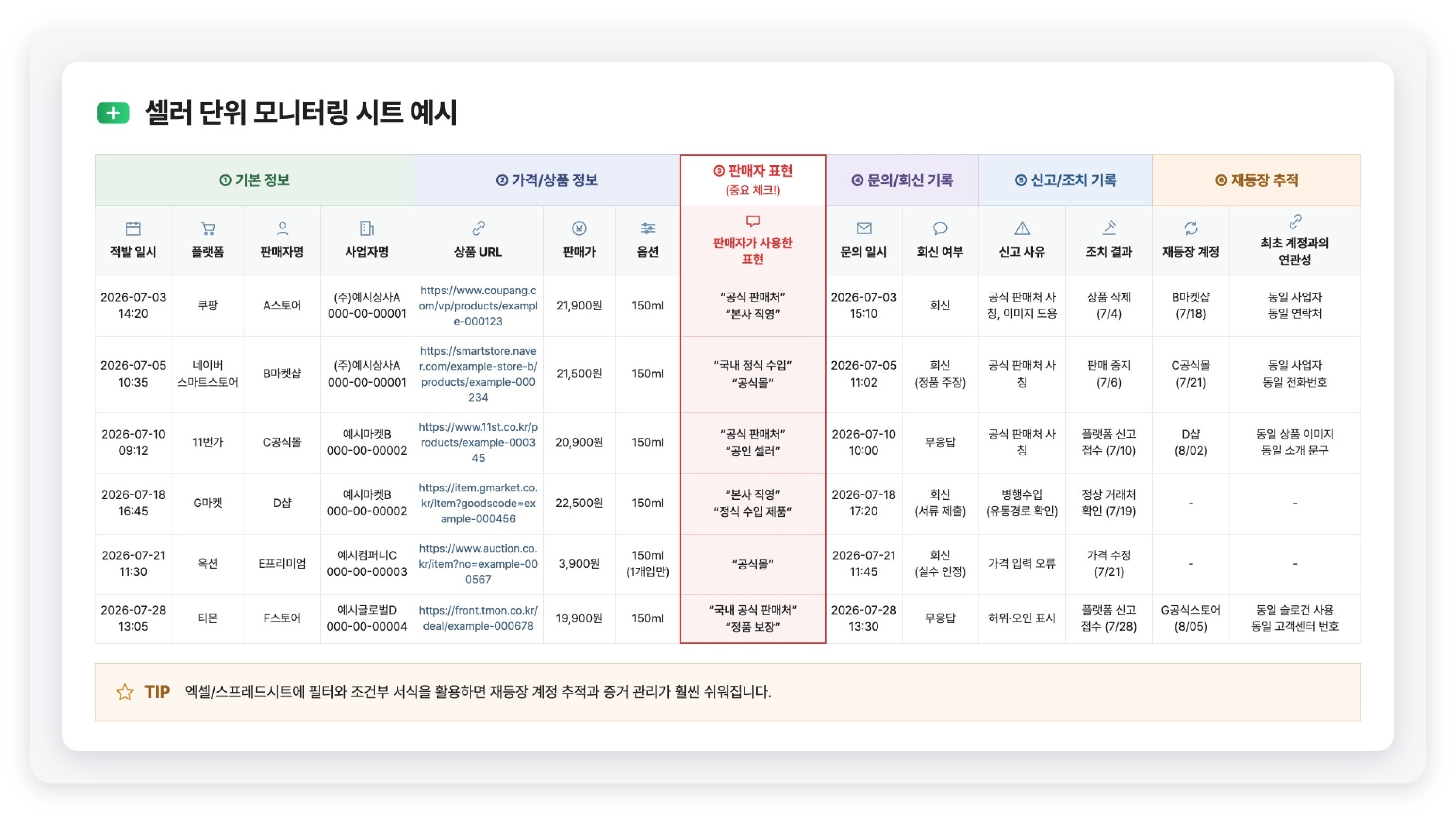
Price collapse records must be built around the seller, not the price. While price snapshots are meaningful as display data of that moment, showing repeatability requires history on a seller basis.
When recording a sales case, it is good to keep the following items together.
Date/time of detection and sales page URL: Record not just the date, but also the time if possible. This is because the price or content of the same URL can change a few days later.
Seller name and business registration details: Do not write just the store name; record the company name and representative name displayed in the seller information section as-is. Store names can change overnight.
Selling price and product options: Options must be recorded so you can reverse-verify which stock it is.
Screen capture: Save it so the URL bar and capture time are visible together. If it does not fit on one screen, divide the sections and save it in multiple sheets.
Original text of expressions used by the seller: Record the phrases they use to introduce themselves exactly as they are without modification.
Date and content of requested verification
Reply date and original text of the reply
Action request path and result: Record which platform's window you reported to, for what reason, and what reply you received.
Whether they reappeared and the account name at the time of reappearance
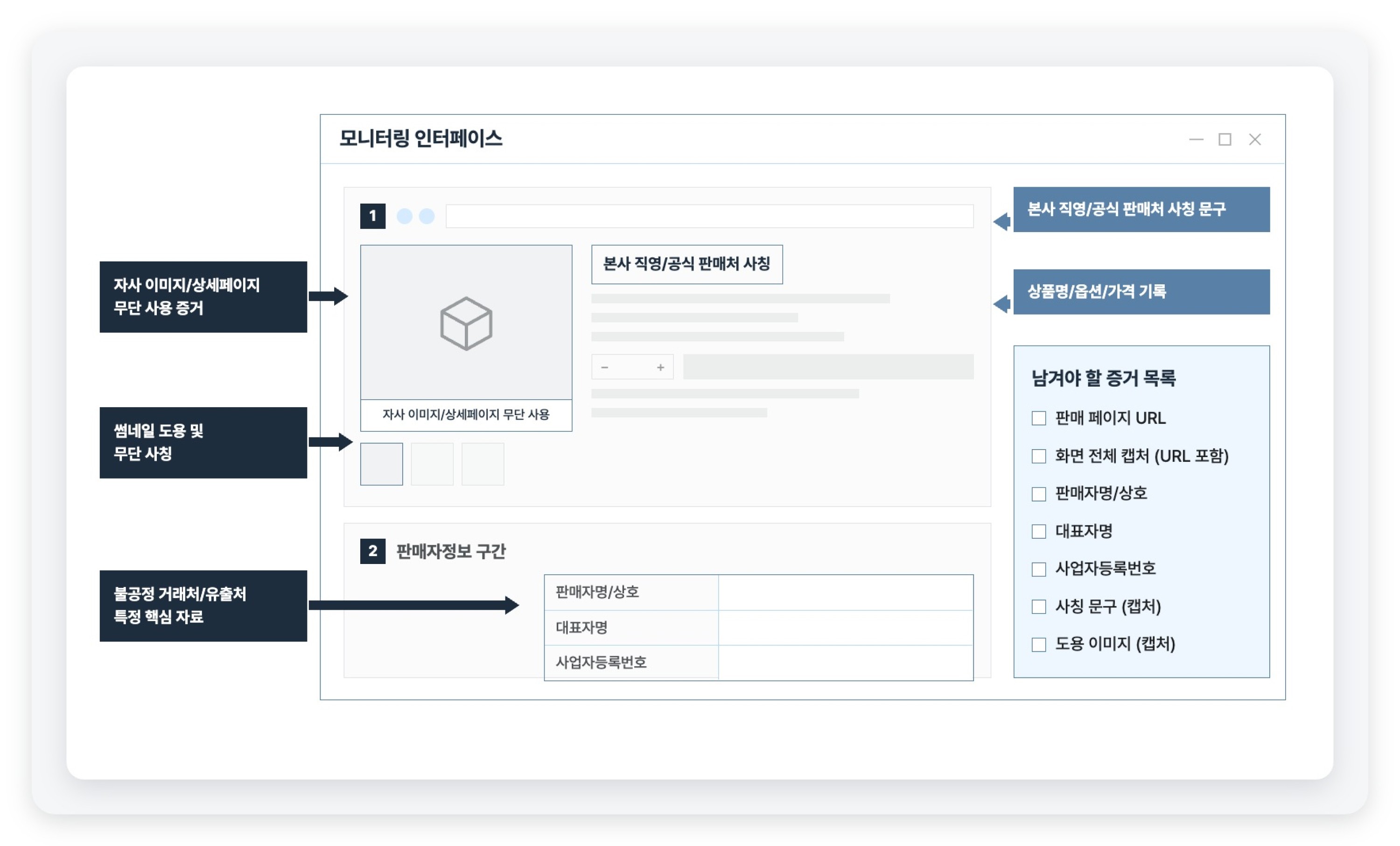
While supporting distribution responses for various brands, I often see data passed over with number 5 missing. Phrases sellers use to introduce themselves, such as "○○ Official Seller," "Domestic Official Import," "Headquarters Direct Store," "Authorized Seller." While prices and URLs are recorded relatively well, these phrases are easily passed over as trivial. You must remember that if the sales page is taken down or the text is modified, those expressions also disappear. When proceeding with sales suspensions or legal enforcement later, these impersonation phrases of the seller can actually become decisive evidence of infringement.
The Supreme Court ruled that even if the parallel import itself is lawful, if the trademark use method functions as a business mark and there is a risk that general consumers might mistake the business for a domestic authorized dealer of the foreign headquarters, it can constitute an act of confusing business entities under Article 2, Subparagraph 1 (b) of the Unfair Competition Prevention Act (Supreme Court Decision 99Da42322, decided September 24, 2002).
Earlier, we mentioned that blocking the sales of parallel import products itself can be difficult. The point where we said indications could be a separate issue is right here. However, if you did not capture the actual phrases used in their original form, even reviewing the indication method becomes difficult. This is because if the sales page is already modified when you go in to collect data later, you cannot show what expressions were used to guide consumers at that time.
When do we switch from case-by-case responses to account-unit responses?
This is not a standard uniformly set by law or platforms. However, from a practical management perspective, you can look at the following three timings.
When the same type of problem is identified twice or more in the same account
When the accounts are different, but the detailed page structure or display phrases are repeated
When the same product is uploaded again after actions have been completed

If these situations are verified, you can organize the reason for reporting not simply as "a problem with this product page," but in a way that states "the same act is being repeated by this seller."
The 9 items recorded earlier become time-series data at this point. This is because you can explain at once when each event occurred, what verification and action it went through, and in what form it reappeared afterward. Conversely, without records, even if you find the same seller again, you must respond to it as if it were a first-time event every time.
👉🏻 Check out this article too! How to manage recurring problems as account-level assets: Managing unauthorized seller infringement histories
💡 Something to try today
Try adding a column named "Expressions Used by Seller" to the monitoring sheet you are currently using. Every time you find the lowest price, just copy one line of how the seller introduces themselves on the detailed page. Although it seems like a small record right now, over time it can become core data explaining official seller impersonation or repeating accounts.
What should we do first for each cause?
If we organize the six causes examined earlier based on the nature of the cause and the first action criteria, they are as follows. Immediately after discovery, look at 'Nature,' 'What to do first,' and 'Through which window' first, and when the same problem recurs, check the 'When recurred' item.
Cause | Nature | What to do first | Through which window | When recurred |
|---|---|---|---|---|
① Inventory clearance | Ends with this batch | Capture & record date | Partner consultation | Discuss prior notification conditions |
② Price entry error | Ends in short term | Immediate capture, record options/quantities | Record without separate action | Track appearance of resale paths |
③ Reselling of sale items | Ends with this batch | Record sales history | Internal (design next event) | Redesign purchase conditions for next event |
④ Employee/special sales leak | Supply channel may remain | Request verification of internal supply channel | Review contract after internal verification | Reorganize internal policies & contract terms |
⑤ Parallel import & overseas inflow | Supply channel may remain | Capture original text of display phrases | Report to platform upon verifying indication/image infringement | Review separately based on display method |
⑥ Unofficial distribution leak | Supply channel may remain | Capture all related sellers & record appearance timing | Report to platform upon verifying infringement reasons & reverse-track supply chain | Cross-reference supply history, respond on account unit |
Four points where judgment often gets blocked here
Although the overall sequence is organized, there are points where judgment halts when trying to take action. Let's point out four questions that frequently arise in practice.
Can we request a seller selling at the lowest price to raise their price?
You must be careful. As seen earlier, the Monopoly Regulation and Fair Trade Act prohibits resale price maintenance in principle. If means of giving disadvantages, such as supply suspension or quantity restriction, are coupled with the reason for not keeping the price, it can differ in nature from simple price guidance.
The Supreme Court ruled that even minimum resale price maintenance acts can be exceptionally allowed if there are justifiable reasons, such as promoting competition among trademarks to increase consumer welfare (Supreme Court Decision 2009Du9543, decided November 25, 2010; Supreme Court Decision 2010Du9976, decided March 10, 2011). However, the business operator must prove that there are justifiable reasons, and it is generally not easy to get this recognized in actual cases. If you are reviewing disadvantages due to price non-compliance or requesting a price increase, it is safe to go through a legal review before execution.
Can we take action against a seller selling genuine products?
If it is genuine, it is difficult to block the sales itself.
Although trademark exhaustion is not directly stipulated in the Trademark Act, it is a legal principle established by precedent. Unless there are special circumstances, if the trademark owner or a person who received their consent transferred the product displaying the registered trademark in the country, the trademark rights for that product are considered to have achieved their purpose. Therefore, the effect of trademark rights does not in principle extend to the act of reusing, transferring, or renting that product, which is the intent of Supreme Court Decision 2002Do3445, decided April 11, 2003.
However, trademark exhaustion may not be recognized if the product is processed or repaired to the extent of damaging its identity, creating what is practically a new product. If the seller used your detailed pages or pictorials without authorization, you can approach it as a copyright issue, and if they displayed themselves as if they were an official seller, you can review it separately as an issue under the Unfair Competition Prevention Act. When using image theft as grounds, you must first check if the rights of that image belong to your company.
In practice, rather than trying to block the sales of genuine products itself, it is more realistic to check whether they used your intellectual property rights or official seller indications without authorization.
To what extent can we raise issues with parallel import sellers?
Parallel imports that satisfy the requirements set by the Korea Customs Service notification are not considered trademark infringement at the customs stage.
However, this is a standard for the customs clearance stage. Simply being a parallel import product does not mean that all subsequent display and advertising methods automatically become lawful. If the trademark used by the seller functions as a business mark beyond simply explaining the product, and there is a risk that consumers might mistake that seller for a domestic authorized dealer or official seller of the foreign headquarters, it can become an act of confusing business entities.
Of course, this does not automatically establish just because they used a specific phrase. You must look at the actual trademark use method, the overall structure of the sales page, and the possibility of consumer confusion together. Therefore, when verifying parallel import sellers, you should check how that seller is introducing themselves, rather than just looking at whether it is imported.
Can we stop supplying to a partner who violated the base price?
While suspending supply does not automatically become illegal, you must review multiple elements together.
Article 45, Paragraph 1, Subparagraph 1 of the Monopoly Regulation and Fair Trade Act prohibits unfair refusal to deal as an unfair trade practice. Article 52 [Annex Table 2] of the Enforcement Decree of the same Act distinguishes joint refusal to deal from other refusals to deal, and stipulates cases such as refusing to initiate transactions with a specific business operator, suspending ongoing business relationships, or significantly limiting the quantity or content of transactions.
However, illegality is not determined solely by the fact that transactions were suspended. It comprehensively examines the reasons for suspending transactions, the actual purpose and method, the counterparty's transaction dependence, and the effect of restricting competition in the market. Whether there are related grounds in the contract is an important check item, but the mere existence of contract clauses does not resolve all issues. If you are reviewing supply suspension or quantity restriction because they did not adhere to the base price, it is safe to receive legal advice on individual cases.
One thing you can do first tomorrow morning
With the content delivered today, you probably have a general picture of what to look into first when the lowest price occurs. The framework of cause classification and response, and the standards for looking at situations will also have been organized to some extent. Now, the first thing you will do tomorrow morning is go down to the bottom of the lowest price sales page and capture the seller information section. Company name, representative, business registration number, and even the sentence that seller uses to introduce themselves.
This task does not take long, but if the sales page is taken down or modified, the expressions of that time disappear with it. No matter which type you classify the cause into, what is ultimately needed in subsequent procedures is data showing what seller was selling the product with what phrases and price at that point in time.
Properly saving a single screen before pressing the report button. The response a brand can make first at the moment the price collapses starts right here.
▶︎ Reference Laws, Precedents, Policies
This content was written based on the laws, precedents, administrative rules, and platform policies below (as of verification in July 2026). Laws and administrative rules are based on current content as of July 2026, and platform policies may be revised, so please check the latest content before actually responding.
Resale Price Maintenance and Price Control
Monopoly Regulation and Fair Trade Act Article 2, Subparagraph 20, Article 46
These provisions define resale price maintenance acts, their prohibition principles, justifiable reasons, and exceptions for published works. (National Law Information Center)Fair Trade Commission 「Review Guidelines for Resale Price Maintenance Acts」(Instruction No. 482)
These are administrative rules presenting the criteria for judging the coerciveness of price compliance and actual review directions. (National Law Information Center)Supreme Court Decision 2009Du9543, decided November 25, 2010 / Supreme Court Decision 2010Du9976, decided March 10, 2011
These precedents present the requirements for recognizing exceptions to resale price maintenance acts and the criteria for judging justifiable reasons. (Inquirable by case number in Supreme Court Comprehensive Legal Information)
Partner Enforcement and Transaction Restrictions
Monopoly Regulation and Fair Trade Act Article 45, Paragraph 1, Subparagraph 1 and Enforcement Decree of the Same Act Article 52 [Annex Table 2]
These provisions regulate the criteria where unfair refusal to deal and transaction restrictions can become unfair trade practices. (National Law Information Center)
Parallel Import and Official Seller Impersonation
Supreme Court Decision 2002Do3445, decided April 11, 2003
This precedent presents the criteria that the principle of trademark exhaustion applies to the resale of genuine products legitimately distributed.Supreme Court Decision 99Da42322, decided September 24, 2002
This precedent presents the criteria for judgment when a parallel import seller displays themselves like an official seller, causing consumer confusion about the source.Unfair Competition Prevention and Trade Secret Protection Act Article 2, Subparagraph 1 (b)
This provision regulates acts of confusing business entities that cause people to mistake them for official sellers as unfair competition acts. (National Law Information Center)Korea Customs Service 「Notification on the Processing of Export/Import Customs Clearance for the Protection of Intellectual Property Rights」 Article 5
This notification regulates the criteria where parallel imports are allowed at the customs stage. (Korea Customs Service)
Securing Evidence and Practical Response
Civil Procedure Act Articles 344, 347, 375
These are the governing provisions concerning document submission orders and preservation of evidence. (National Law Information Center)
Platform Policy
Coupang Intellectual Property Protection Policy (As of verification in July 2026)
This is the official policy guiding intellectual property reporting procedures, seller's proof of source, distribution channel explanation procedures, etc.
▶︎ This content is intended to provide general information based on practical experience supporting brand distribution responses, and conclusions may vary depending on specific factual relationships. For detailed cases, we recommend seeking consultation from experts such as attorneys or patent attorneys.