Industry Cases
Counterfeit
[Distribution Crackdown Guide #02] How to Spot Counterfeit Health Functional Foods: 3 Key Points Easily Missed on the Product Detail Page

💡 In this article, you can find the following information.
Even if it looks genuine, the data fingerprint cannot lie—this is where illegal sellers get caught
Just one incorrect ingredient can lead to a recall or expulsion.. How the global market handles official notification data
Violations that can't be spotted with the naked eye—how Reatrics catches them: NLP and OCR-based distribution monitoring strategies
A market sorted by 'evidence' rather than suspicion—how to restore distribution order with data
As mentioned in the previous Cosmetics edition, malicious sellers in the recent e-commerce market are adopting a high-price strategy that maintains around 90% of the genuine price, neutralizing simple price monitoring systems. This tactic is particularly prominent in the health functional food market. Because of the nature of products that directly affect the body when consumed, consumers would rather harbor doubts if the price is excessively cheap. Accordingly, intelligent malicious sellers set prices similar to genuine products, but subtly manipulate or omit legally required notification information on the detailed page to conceal the distribution channel.
In fact, even when brand managers capture circumstances suspected of counterfeits and request sanctions from platforms, cases are frequently rejected on the grounds of "insufficient clear evidence." This is due to the structural limitation where the burden of proof lies with the brand company. At this time, the decisive basis for converting subjective suspicion into objective material evidence is the 'E-commerce Product Information Disclosure'. Article 22 of the E-commerce Disclosure strictly regulates that detailed items, from the nutritional ingredients of health functional foods to side effects and precautions, must be indicated without omission.
Even if a seller decorates the thumbnail and detailed page to look like a genuine product, it is practically difficult to perfectly match the consistency of detailed data in accordance with laws and regulations. Ultimately, capturing the microscopic discrepancy between these pieces of information, i.e., the gap in data, becomes the practical starting point to end the exhausting battle of suspicion and protect the brand.
A data fingerprint that cannot be fooled even if it looks like a genuine product—illegal distribution sellers get caught here
In order to find the 'data discrepancy' which is the decisive clue to prove illegal distribution, a process of verifying whether the items regulated in Article 22 of the E-commerce Disclosure exquisitely match the brand's official data (Master DB) must precede. The three key items that practitioners must intensively inspect to increase enforcement efficiency are as follows.
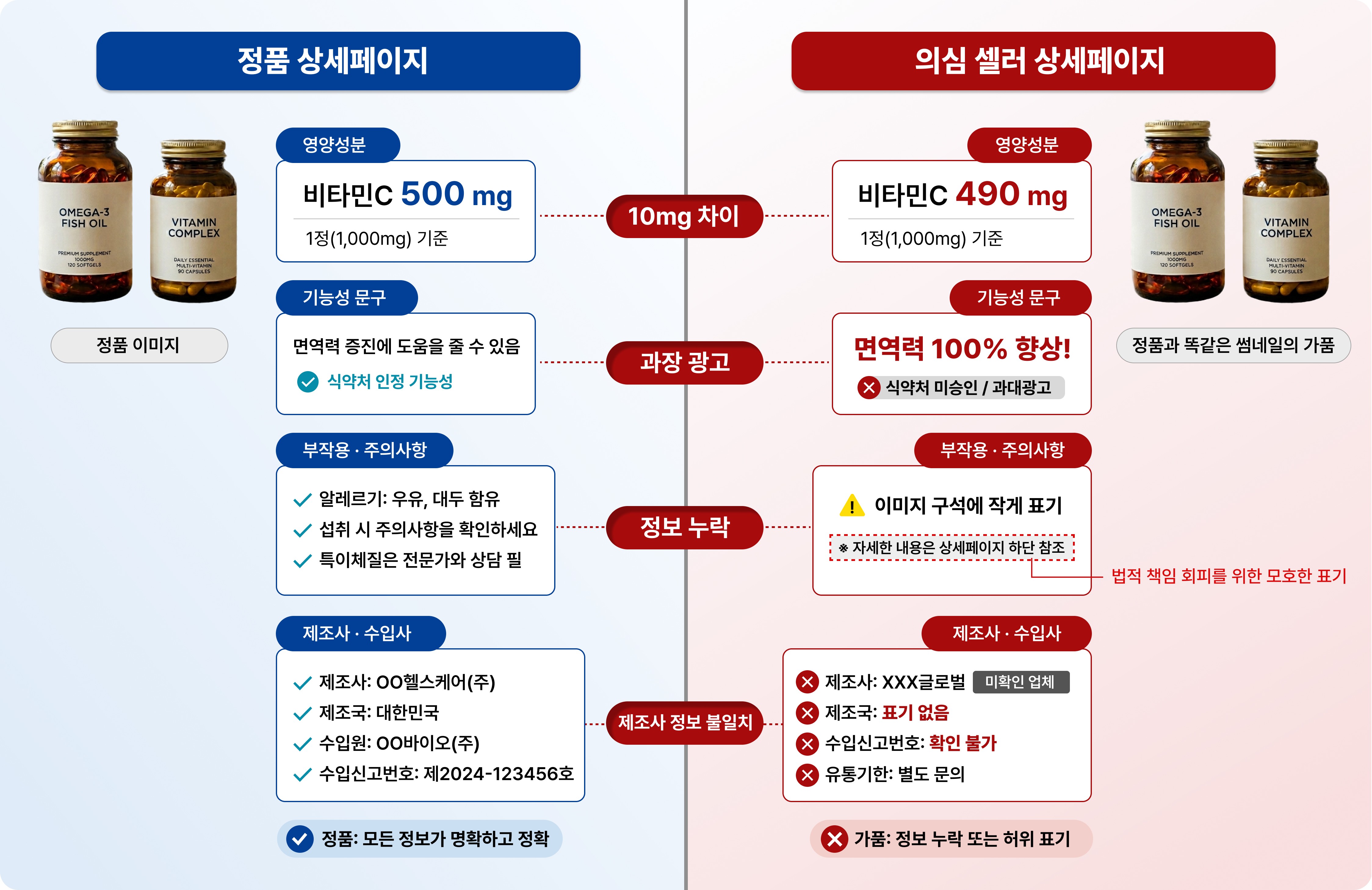
First, is the nutritional ingredient content or functional statement even 1mg different from the genuine product?
On the detailed page of health functional foods, nutritional ingredients and functionality must be accurately stated in accordance with Articles 1-6 and 1-7 of the Disclosure. Some counterfeit merchants subtly write the ingredient content slightly differently to meet manufacturing costs, or sneak in efficacy that has not received official approval. As such, the minute numerical differences found between the genuine data and the text on the sales page posted by black sellers become the clearest and most objective material evidence that can be reported to the platform as a 'disclosure violation'. In particular, the act of arbitrarily stating functional phrases outside the scope of approval by the Ministry of Food and Drug Safety is a clear enforcement point that can lead to violations of the 'Act on Fair Labeling and Advertising'.
Second, have the side effects and precautions been replaced by an ambiguous expression such as 'Refer to detailed page'?
Providing consumer safety information is the core purpose of the disclosure. Accordingly, Articles 1-8 and 1-10 of the Disclosure regulate that safety information, such as the possibility of side effects, allergen-inducing ingredients, and precautions for patients with specific diseases, must be notified in detail as well as the intake method. However, many malicious sellers show a pattern of intentional omission, such as treating this part in a small image to evade legal liability or replacing it with ambiguous expressions like 'Refer to detailed page'. The absence of such essential disclosure information is one of the strongest grounds on which platforms can take immediate sales suspension measures.
Third, is the import declaration statement or manufacturer information transparently disclosed?
In the case of imported health functional foods, the phrase "Import declaration completed in accordance with the Special Act on Imported Food Safety Control" must be included pursuant to Article 3 of the Disclosure, and the name and location of the manufacturing facility must also be clearly stated pursuant to Article 1-2. Parallel importers or counterfeit merchants who find it difficult to transparently disclose the distribution process leave a loophole here: the mismatch of legally required entries. If an unverified company name other than the official importer is stated, or if the import declaration number differs from reality, it is a clear violation of regulations. According to Article 3 of the General Principles of Disclosure, items for which information cannot be provided must present specific reasons, and simple 'unable to confirm' markings are not recognized, making this a highly effective enforcement point in practice.
From recalls to expulsion for just one wrong ingredient... How the global market handles disclosure data
Not only in the domestic market but also in the global e-commerce market, the consistency of disclosure data for health functional foods is a powerful regulatory target that determines the survival of a brand beyond a simple operational guide. Since it is a field of health functional foods directly related to consumer health and safety, inconsistency in disclosure information sometimes leads to fatal consequences, such as heavy legal sanctions or platform expulsion, triggered by simple labeling mistakes. Let's look at the severity through representative overseas cases.
Case 1. [US FDA] Sanctions for ingredient content discrepancy and consumer deception
The US Food and Drug Administration (FDA) considers it 'Adulterated' or 'Misbranded' and imposes immediate and strong sanctions if the ingredient content disclosed on the online detailed page differs from the actual ingredients of the product.
Indeed, the FDA has repeatedly initiated recalls and sales suspensions for cases where undeclared pharmaceutical ingredients (antidepressants, NSAIDs, etc.) were detected in weight loss and energy supplement health functional foods. From a legal standpoint as well, there is a clear trend of judging the discrepancy of disclosure data itself as a serious consumer deception, with 'misbranding' lawsuits being upheld based solely on a single test result showing that the actual content differs from the labeled nutritional ingredients.
In particular, global platforms like Amazon operate strict guidelines to expel sellers with a confirmed history of such FDA recalls or ingredient discrepancies without an opportunity for explanation.
Case 2. [EU] Classifying the omission of allergen precautions as a harmful act subject to 'criminal punishment'
The European Union (EU) legally and strictly mandates the display of allergen-inducing ingredients when selling food and health functional foods online. In fact, the UK Food Standards Agency (UK FSA) repeatedly implements recalls and sales bans on products with omitted labeling of allergens such as nuts or milk, and in some cases, even executes criminal penalties, sending a strong warning message.
These crackdowns go beyond mere recommendations and are executed based on clear legal grounds, namely the EU Food Information to Consumers Regulation (FIC Regulation, No 1169/2011). According to this regulation, if even a single piece of allergy information is omitted from an online detailed page, it is not regarded as a simple labeling mistake but as a 'harmful act that directly threatens consumer safety.' Accordingly, the seller cannot avoid huge fines, as well as administrative sanctions close to market expulsion.
The preceding global cases show that the paradigm of market cleansing is changing fundamentally. Global advanced markets already prioritize 'the integrity of disclosure data directly linked to consumer safety' as the highest value and absolute standard for brand protection, rather than cracking down on dumping sales that cut prices.
Now, the essence of brand protection lies not in price defense, but in building consumer trust through securing data integrity.
Disclosure violations that cannot be found with the naked eye, how does Retrix catch them—NLP and OCR-based distribution monitoring strategy
Information discrepancies, such as nutritional ingredient errors or missing side effect disclosures discussed earlier, are fragmented across numerous detailed pages, making them extremely difficult to identify individually with the naked eye. Retrix compares key items regulated by Article 22 of the E-commerce Disclosure against official brand data (Master DB) to detect subtle violations and visualizes the grounds of illegal distribution into objective indicators.
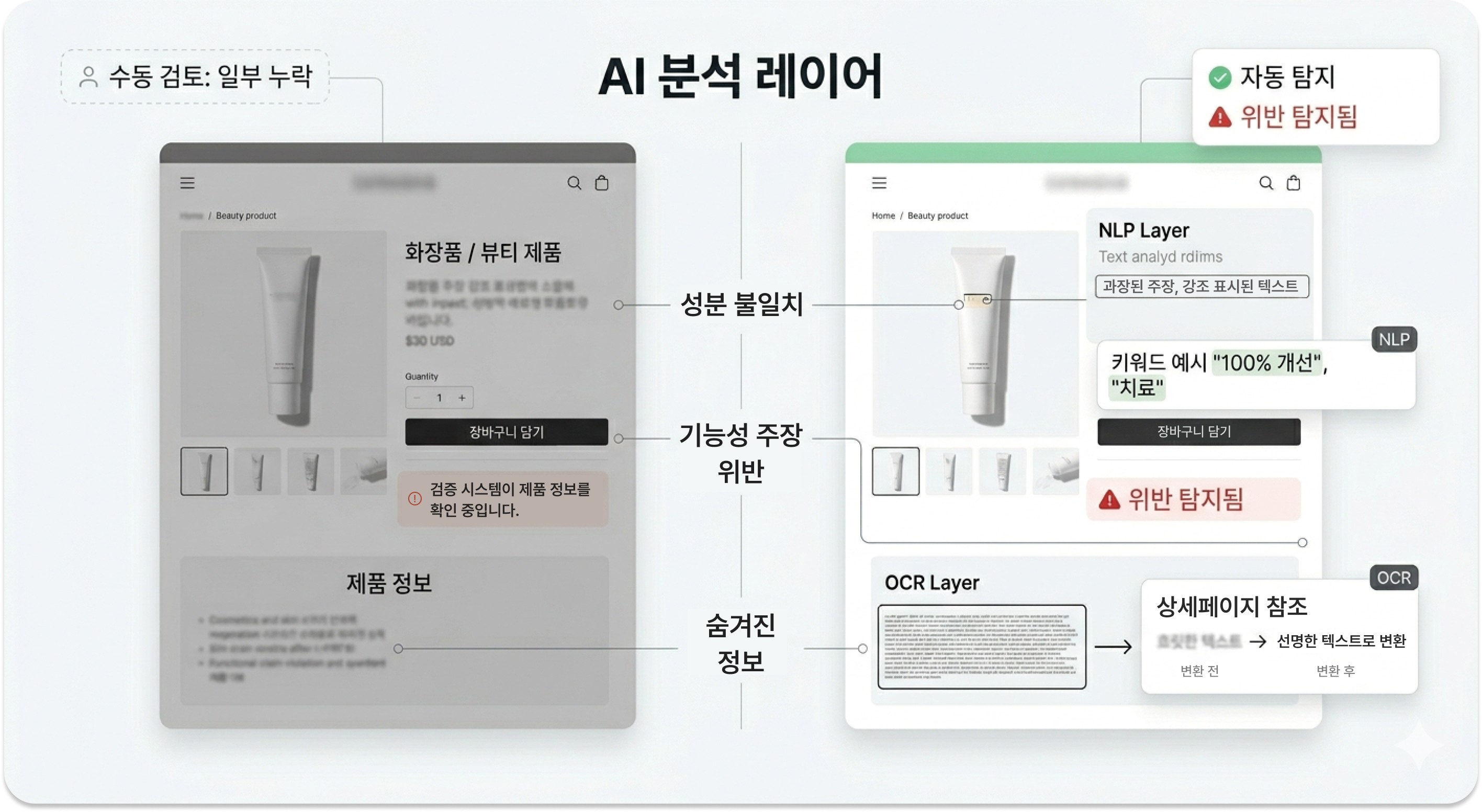
1. Exaggerated advertising and illegal keywords that cross the line of MFDS guidelines, NLP catches them
In the health functional food market, exaggerated advertisements hinting at medical efficacy such as 'therapeutic effects' or 'disease prevention' beyond the scope of Article 1-7 (Functional Information) of the Disclosure frequently occur. Retrix's Natural Language Processing (NLP) engine precisely analyzes the text within detailed pages to immediately identify sellers who violate MFDS guidelines or use illegal efficacy keywords. Through this, brands can secure consumer safety while quickly acquiring legal risk management data that can lead to platform sanctions.
2. Essential disclosure information and precautions hidden in the corners of images, OCR tracks them to the end
To evade regulations, malicious sellers often place allergen and side effect precautions (Article 1-10 of the Disclosure) or import declaration confirmation statements (Article 3 of the Disclosure) in small font at the bottom of images instead of text. Retrix utilizes OCR technology that reads characters within images to track whether disclosure information hidden as images rather than text has been altered or omitted. We precisely inspect whether information different from the actual genuine product is included in areas lumped together as 'Refer to image' or 'Refer to detailed page,' and whether essential phrases for consumer safety are accurately written, capturing violations in the illegal distribution process without miss.
3. Creating a distribution environment that blocks malicious sellers through repeated violation detection
The purpose of Retrix's strategy is not just to make one-time reports but to continuously turn disclosure violation signals into data and manage them. By spreading a strong enforcement signal in the market that "this brand thoroughly manages even the integrity of disclosure data," it creates an environment where malicious sellers, who must bear the risk of violation, give up handling the brand on their own. This goes beyond simple monitoring and leads to a fundamental self-purification process that corrects the distribution order of the entire market.
A market settled by ‘evidence’, not suspicion—How to restore distribution order with data
Currently, the health functional food market is cloudier than ever due to widespread illegal distribution along with the expansion of e-commerce. Malicious sellers who damage brand value hide behind sophisticated price strategies and subtly evade the law. However, before the clear standard of Article 22 of the Product Information Disclosure, even the most meticulous seller is bound to reveal traces of violation. The data extracted by Retrix based on the MFDS guidelines becomes the most decisive evidence that converts subjective suspicion into irrefutable material proof.
This data-driven enforcement system does not stop at temporary measures such as simply deleting violating pages. It fundamentally blocks acts of concealing distribution channels at the cost of consumer safety, and the precise inspection, which uncovers everything from a 1mg error in nutritional ingredients to omitted side effect disclosures hidden in the corner of images, imprints on malicious distributors that handling the brand itself poses significant legal risks.
As seen in the cases of the US FDA or the EU, global standards already treat 'safety data integrity' as the absolute benchmark for brand protection. Please leave the consuming task of searching for evidence until your eyes hurt while looking at thousands of detailed pages to Retrix. With Retrix, you can fully protect the brand value lost in unseen places through the most objective means: data.
Now is the time to break away from the repeated battle of attrition and focus on more valuable work, such as planning the brand's next growth strategy. Check your brand's distribution health through Retrix's data solutions right now to restore a safe and transparent market order.