Unofficial Seller Management
Can a parallel importer selling genuine products be blocked from displaying 'Official Retailer'?

💡 In this article, you can find the following information.
We can't stop them from selling genuine products, but what about them using the term 'Official Retailer'?
Which expressions used by parallel import sellers are problematic?
On what grounds can we take issue with impersonating an official retailer?
What do we need to prepare to report the phrase "Official Retailer"?
How should we capture the phrases used by the seller so they can be used as evidence later?
Three common obstacles encountered when dealing with parallel import sellers
When you encounter a genuine product seller again, what will you look at first?
When monitoring, if you catch a parallel import seller selling your product, it gets on your nerves. Since it is being sold cheaper than on official channels, the standard price fluctuates, and inquiries about price and quality also increase. Therefore, you consider taking action, but the judgment here becomes ambiguous. If it is counterfeit, you can report it, but since it is a genuine product brought in from overseas, you cannot do that either. As we looked at in the previous post, a parallel import that meets the requirements is not regarded as trademark infringement at the customs stage, and demanding a price increase can also lead to resale price maintenance issues. So in many cases, people just leave a record and move on.
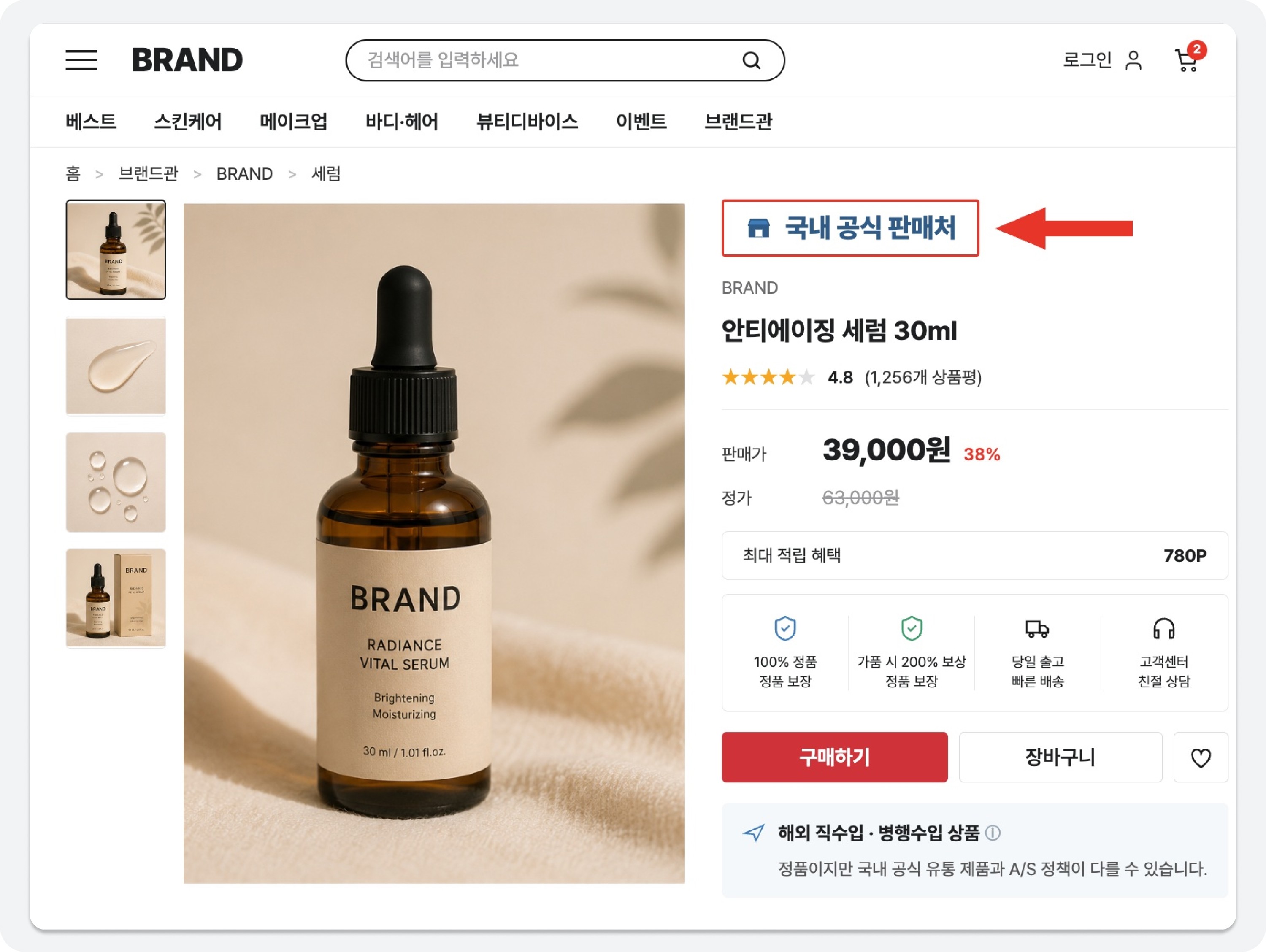
However, you cannot just sit idle. While occasionally looking in to see if sales continue, if you carefully examine the product detail page, you might discover 'Official Domestic Seller' written at the top. Even though it is a seller with whom we have no contractual relationship.
Selling a product is a different story from stating that you are an official distribution channel of the brand. Therefore, most people think, "Even if we can't stop the sale, we can make an issue out of this phrase."
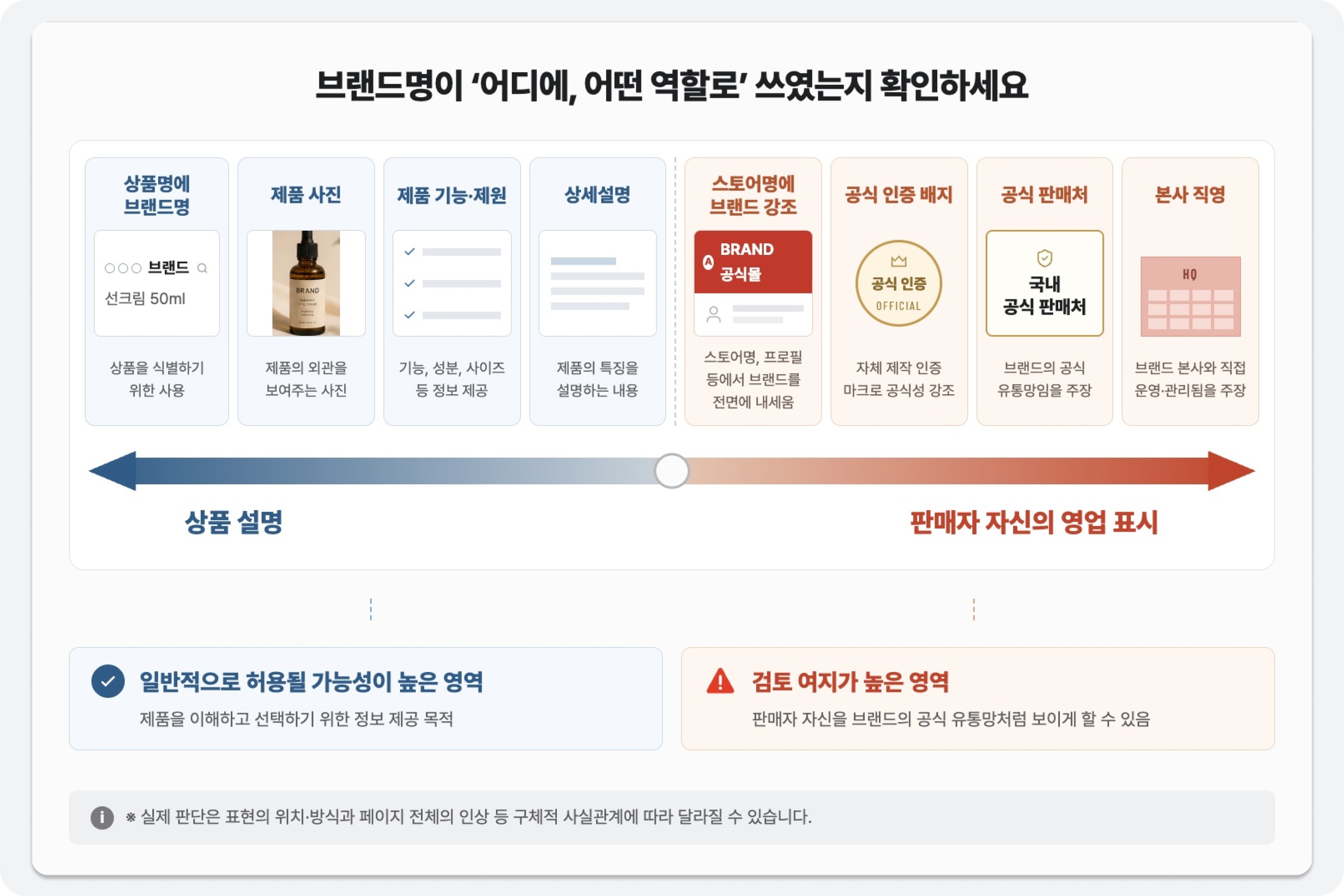
The direction is correct. However, how far you can make an issue of it is not as simple as you think. This is because you must distinguish between using the brand name to explain the product and making the seller themselves look like an official distribution channel.
So in this post, instead of just saying "you can make an issue of that phrase," we want to organize how far you can dispute the phrases used by the seller, and what grounds our brand can use.
I can't stop them from selling genuine products, but what should I do about them writing 'Official Seller'?
Just because genuine products can be sold does not mean it is okay to display the trademark in any way during the sales process. Trademark exhaustion is a legal doctrine holding that once a brand or a party authorized by the brand sells a genuine product domestically, the trademark rights are deemed to have served their purpose for that product (this may not apply as is if the product is processed or repaired to differ from the original, or if there is a difference in quality compared to the domestic genuine product). This is the part explained in the previous post as the reason why it is difficult to stop resellers who resell genuine products. However, the permission of resale is a separate issue from how a seller can present themselves.
The Trademark Act also distinguishes this. Article 2, Paragraph 1, Subparagraph 11 of the Trademark Act divides the use of a trademark into several types, of which Item (d) separately regulates the act of displaying, exhibiting, or widely publicizing a trademark on advertisements, price lists, business documents, or other means concerning goods. In other words, the act of selling genuine products and the act of using trademarks in advertisements or sales pages are not legally viewed as the same issue.

Then, what meaning does this distinction have in practice? When facing a seller of genuine products, if stopping the sale itself is difficult, what needs to be checked is 'how the seller is introducing themselves.' As mentioned earlier, using a brand name for product description and making the seller themselves look like an official distribution channel can be different issues.
However, having criteria to distinguish them is a different issue from having them recognized in actual cases. If you look at how far courts have actually recognized them, it may differ from your expectations.
What expressions of parallel import sellers become a problem?
To start with the conclusion, if the brand name is used at the level of 'delivering product information,' it is generally difficult to make an issue of it.
In a case where a parallel importer used product photos, promotional images, and product descriptions of an exclusive distributor on its website and internet sales pages, the Seoul Central District Court did not accept either the copyright infringement or unfair competition claims (Seoul Central District Court Judgment on August 26, 2022, Case No. 2020Gahap576954).
There were two major points the court focused on.
First, the creativity of the product photos and description texts. Even if the photos were clearer or had a sharper contrast than those taken by the general public, such characteristics were viewed as expressions typically found in advertising photos for the relevant product group. It also judged that the text describing the product's features and specifications was unlikely to have creative individuality in its expression.
Next is whether there was confusion regarding the business entity. The plaintiff argued that consumers would mistake the defendant for the official Korean sales agency, but the court held that because the description texts merely explained the features and specifications of the product, it was insufficient to consider them as indications representing the plaintiff's business. In the end, instead of isolating a single phrase, they examined the overall displayed content of the sales page and the possibility of consumers mistaking the seller for an official agency altogether.
What can be read from this judgment is that you cannot immediately dispute it just because it looks similar to your detail page. In particular, phrases describing product specifications or features are bound to be similar no matter who writes them, so that similarity alone can hardly serve as a basis.
Then, in which cases does room for review arise? The Supreme Court explains the boundary as follows: Although the use of trademarks by a parallel importer accompanying the sale of goods may be permitted in principle, it changes if the aspect of its use exceeds the function of describing goods and reaches a level of representing the seller's own business (Supreme Court Judgment on September 24, 2002, Case No. 99Da42322).
However, this judgment was an offline store case. The court deemed it acceptable to use it on indoor signs, packaging, shopping bags, and promotional advertisements, but found it problematic to use it on the outer signs of offices, business places, stores, and on business cards. Which area corresponds to a signboard on an online sales page was not directly addressed by the judgment, so it must be weighed in individual cases.
For reference, there are lower court cases where the prohibition of use was granted by making an issue of the displays of 'Official Store' and 'Official Agency' in online open markets. However, lower court decisions can change in higher courts and are highly dependent on individual facts, so it is difficult to take them as a general standard.
💡 What to try today
Open the suspicious sales page right now and classify where the brand name is used by location. Dividing and writing down what is used in the product name or detailed description versus what is used in the seller introduction area will make subsequent reviews much easier.
Impersonating an official seller, what grounds can you use to make an issue of it?
When reviewing display issues, there is more than one legal basis to check. There is a path to directly make an issue of expressions that lead to confusion as an official seller, and you can also check whether the seller's identity information is properly displayed. It can be divided into three major categories depending on the brand situation.
A. Acts causing confusion of business entity
What is practically important here is the phrase "widely recognized in Korea." To use this provision, our brand's mark must be widely known in Korea, and the court judges this comprehensively based on the period, method, volume of use, scope of transactions, etc. There is no threshold such as sales over a certain amount, and since it is viewed case-by-case, it is precise to receive a lawyer's review with your own data.
This provision has a wide scope. Precedents hold that confusion includes not only cases of making people believe the business entities are identical, but also cases of making them believe there is a close capital, organizational, or contractual relationship between the two. This is precisely where expressions like 'Official Seller' or 'Directly Managed by Headquarters' can become problematic.
B. False, Exaggerated, or Deceptive Labeling/Advertising
Article 3, Paragraph 1 of the Act on Fair Labeling and Advertising prohibits labeling and advertising that are likely to deceive or mislead consumers and are likely to harm fair trade order. These are four types: false/exaggerated, deceptive, unfair comparison, and slanderous labeling and advertising.
This path does not require the aforementioned "widely recognized in Korea" requirement. This means you can review it regardless of how well-known the brand is. If they actually displayed themselves as an official seller when they are not, it can constitute false, exaggerated, or deceptive labeling/advertising depending on the specific facts.
When supporting field operations, we see sellers who establish officiality by placing genuine product guarantees and self-made certification marks in a large size on their sales pages. They put a genuine certification badge at the top along with phrases like "We sell 100% genuine products only" and "200% compensation if proven to be counterfeit." Upon verification, some of these sellers are not even in our brand supply history.
Such phrases themselves do not immediately become a problem. If they sell actual genuine products, the expression "100% genuine" can also be true. However, if they use self-made certification badges or expressions like 'Official Certification' or 'Headquarters Certification' together to make it look as if the brand directly certified the seller, the story can change. You can review B based on the actual relationship and the overall impression of the page.
There is one more point to look at together. Parallel imported products may have different AS and warranty conditions from domestic officially distributed products. Therefore, if they are emphasizing officiality on the sales page, it is also necessary to examine whether consumers are likely to accept that the actual warranty scope is identical to the officially distributed products.
However, a violation is not confirmed by a single expression alone. The presence or absence of actual official status, the overall impression of the advertisement, the likelihood of consumer misconception, and the impairment of fair trade must be recognized together.
C. Verification of Business Identity Information
Lastly, it is also necessary to check who the seller is. Article 13, Paragraph 1 of the Electronic Commerce Act stipulates that when a mail-order distributor advertises to receive offers for transactions, they must include their trade name, representative's name, address, telephone number, email address, mail-order business report number, and information to verify the reporting authority. In cases where mail-order brokerage takes place, like in open markets, the broker also has an obligation under Article 20, Paragraph 2 to verify the seller's identity information and provide it to consumers.
This path does not dispute the impersonation itself, but it is a point that can be checked together when discovering a seller whose information is omitted or does not match actual information. Just comparing the business registration information and the mail-order business report information first helps identify the reality of the seller.
Comparison of Three Review Points
Review Item | Basis | Renown Required | Response/Verification Channel |
|---|---|---|---|
A. Confusion of Business Entity | Unfair Competition Prevention Act Article 2, Subparagraph 1, Item (b) | Required | Civil/Criminal, Platform Reporting |
B. False, Exaggerated, Deceptive Labeling/Advertising | Fair Labeling and Advertising Act Article 3 | Not Required | Fair Trade Commission |
C. Business Identity Information | Electronic Commerce Act Article 13, etc. | Not Required | Fair Trade Commission, Platform |
In summary, A is a path to review when you can back up the point that the business mark is widely recognized in Korea, and B and C do not require this renown requirement. If you are at a stage where it is still difficult to use renown as a basis, it is more realistic to look at B and C first.
💡 What to try today
Pick one suspicious seller and check just three things: whether they displayed themselves as if they have an official relationship with our brand, whether there are 'official' expressions that differ from the facts, and whether the seller's identity information is properly displayed. If you first categorize which item they fall into, it becomes much easier to set the next direction of response.

What should I prepare to report the "Official Seller" phrase?
If you have reviewed the possibility of falling under false, exaggerated, or deceptive labeling/advertising, the next step is the actual reporting phase. Reporting to the Fair Trade Commission can be proceeded with separately from platform reporting.
There are two ways to report. Either way, the first step is to download and fill out the "Unfair Labeling/Advertising Report Form" from the civil petition participation menu on the Fair Trade Commission website. You can attach this report and supporting materials to the e-People portal to submit, or mail them to the regional Fair Trade Office of jurisdiction. As of the Fair Trade Commission's guide in August 2026, it is guided to fill out the report form and submit it along with supporting materials, so please check the latest procedure once before proceeding.
In the report, you write down the following in detail: the reported business name and address, sales page URL, the date and location where the advertisement was posted, the phrase and image you see as a problem, why you see that expression as false, exaggerated, or deceptive, and how consumers can be misled.
What is important here is not the expression itself, but the material showing that the expression is different from the facts. This is because you must be able to explain that the seller displayed as an official seller is not in your supply history or contractual relationship. Therefore, you must be able to cross-reference your official seller list with the seller's contract and supply history.

One thing to keep in mind is that reporting to the Fair Trade Commission is an administrative procedure. If a violation is confirmed after investigation, sanctions such as corrective orders or surcharges may be imposed, but it is not a procedure to directly order compensation for the reporter's damages.
If you want damages, you must review civil procedures separately, and the Fair Labeling and Advertising Act also has a ground clause. Article 10 stipulates that business entities bear liability for damages to persons who suffer harm due to unfair labeling/advertising violating Article 3, Paragraph 1, and they cannot escape liability by claiming no intent or negligence. Article 11 allows courts to recognize a reasonable amount of damages if the occurrence of damage is recognized but it is difficult to prove the amount of damage.
💡 What to try today
Even if you do not proceed with reporting right away, gather materials first to explain that the expression is different from the facts. Without materials such as official seller lists, supply contracts, and transaction history, it will be difficult to explain no matter which channel you go to.
How should I capture the phrases used by the seller to use them as evidence later?
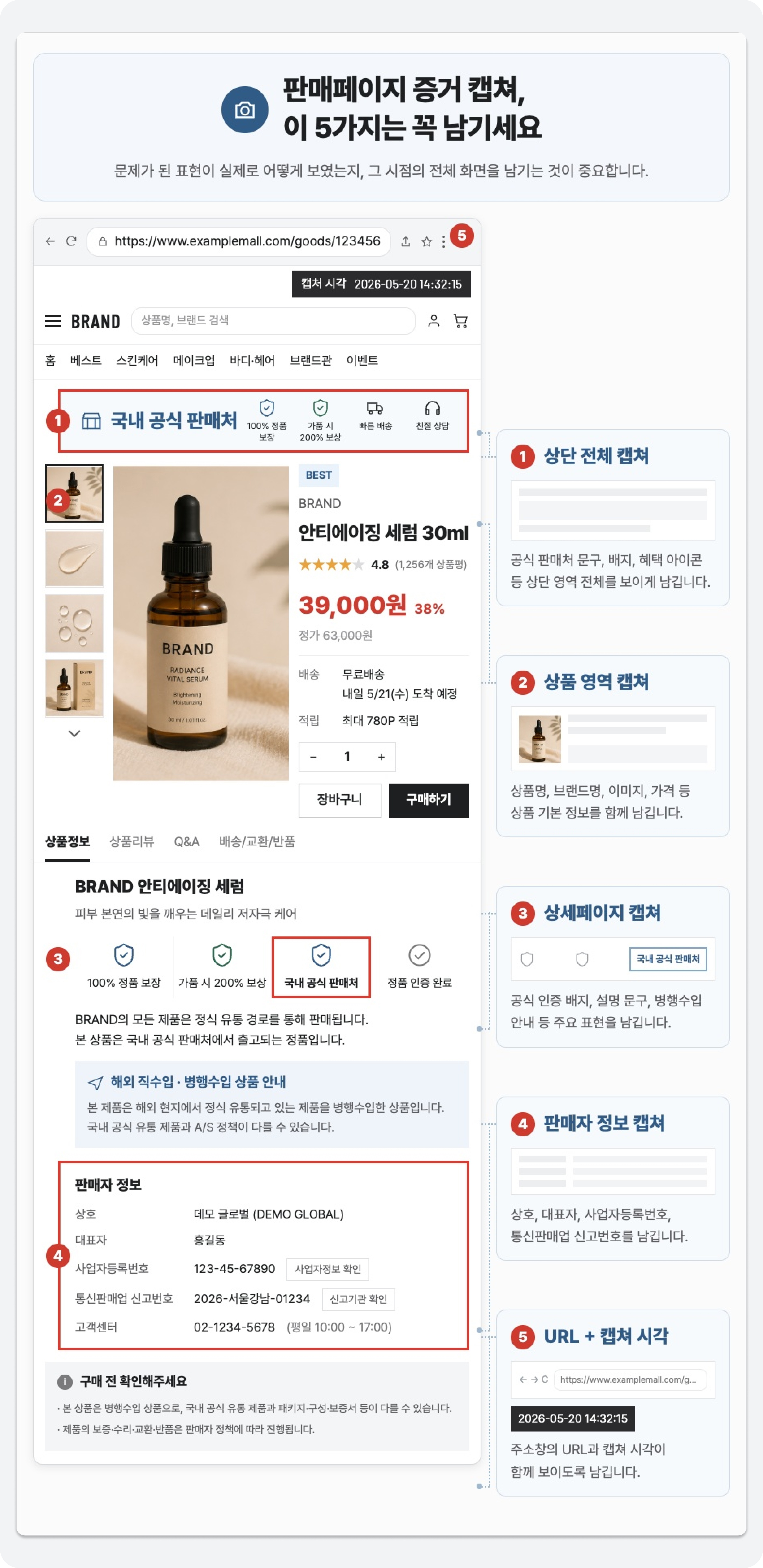
Whichever you review, what is needed in common is capturing the screen at that moment containing 'how the problematic phrase actually looked.' Sales pages can be modified or taken down, and if the phrases change, there will be no way to show what the expressions were before.
In the previous post, while organizing items to leave behind when finding a seller whose price has collapsed, I told you to copy and write down the phrases the seller used to introduce themselves. When reviewing labeling issues, that alone is not enough. You must see at what position and in what size the phrase was placed. As seen earlier, how and where they wrote it is just as important as what phrase they wrote.
Therefore, it is good to leave the following together:
The entire screen containing the phrase — Do not crop only the phrase, but capture it so that you can see where that phrase was on the page.
Screens by location where the brand name is used — Keep the product name, thumbnail, detailed description, and seller name/store introduction area separated respectively.
The entire seller information section — Trade name, representative, mail-order business report number. This is used as is when reviewing path C.
Whether parallel/direct import is displayed — This is a circumstance considered in the aforementioned judgment. Checking whether it exists or not helps subsequent judgments.
Capture time and URL — Leave it so that the address bar and time are visible together.
When supporting the distribution responses of various brands, there are surprisingly many materials where only the phrases were cropped and kept. Then, it becomes difficult to explain what role that phrase played on the page later.
Three things frequently encountered in the process of responding to parallel import sellers
How can we know if our brand is "widely recognized"?
As seen earlier, there is no threshold that can be judged by sales or advertising costs alone. So when reviewing this part, instead of just claiming how well-known it is, it is better to check what materials are available to show it first. It is a way of gathering brand usage periods, advertisement execution materials, major distribution channels and sales scope, media exposure, or market data, and then receiving expert review. If materials are not sufficient, you can review from B and C paths which do not require renown.
What is the difference between platform reporting and reporting to the Fair Trade Commission?
The purpose and results are different. Platform reporting is a procedure to seek action against the relevant sales page or account, while reporting to the Fair Trade Commission is an administrative procedure that makes an issue of the business entity's labeling/advertising act itself. The two are not mutually exclusive and can be pursued together, but since the materials to prepare and the time required are different, it is better to set an order.
Can we respond in the same way to sellers operated by overseas business entities?
Procedures based on domestic law depend on whether the counterparty has a place of business or property domestically for enforceability. Specific judgments vary depending on individual cases and jurisdiction, so expert consultation is required. However, reporting according to the policies of the platform where the sales take place can be reviewed separately.
This post is content for general information purposes, and conclusions may vary depending on specific facts.
When you meet a genuine product seller again, what will you look at first?
Next time you discover a parallel import seller, do not just look at whether they are selling, but check whether that seller is explaining the product or making themselves look like an official distribution channel of the brand. Even if it is difficult to stop the sales itself, the methods you can review vary depending on how the seller introduced themselves.
And there is one thing to do before making a judgment: capturing the screen at that time precisely before the problematic expression disappears. That record becomes the starting point of subsequent responses.
▶︎ Reference Laws/Precedents
This content was created based on the laws and precedents below. The laws are current as of August 2026 and may be amended, so please check the latest content before actual response.
Trademark Use and Advertisement/Display
Article 2, Paragraph 1, Subparagraph 11, Item (d) of the Trademark Act — A provision defining the act of displaying, exhibiting, or widely publicizing trademarks on advertisements, price lists, business documents, etc. concerning goods as the use of a trademark. (National Law Information Center)
Confusion of Business Entity and Parallel Import
Article 2, Subparagraph 1, Item (b) of the Unfair Competition Prevention and Trade Secret Protection Act — A provision regulating acts that cause confusion by using marks identical or similar to another person's business mark widely recognized in Korea as unfair competition. (National Law Information Center)
Supreme Court Judgment on September 24, 2002, Case No. 99Da42322 — A precedent presenting the judgment criteria when the parallel importer's use of a trademark exceeds the function of describing goods and functions as a business mark. (National Law Information Center)
Seoul Central District Court Judgment on August 26, 2022, Case No. 2020Gahap576954 — A precedent that did not recognize copyright infringement and unfair competition in a case where a parallel importer used product photos and description texts on an online sales page. (Korea Copyright Commission Precedent Introduction)
Labeling/Advertising and Business Information
Article 3 of the Act on Fair Labeling and Advertising — A provision prohibiting false/exaggerated, deceptive, unfair comparison, and slanderous labeling and advertising. (National Law Information Center)
Article 13, Paragraph 1 and Article 20, Paragraph 2 of the Act on Consumer Protection in Electronic Commerce — Provisions defining mail-order distributors' obligation to provide identity information when labeling/advertising, and mail-order brokers' obligation to verify and provide seller information. (National Law Information Center)
▶︎ This content is intended to provide general information based on practical experience supporting brand distribution responses, and conclusions may vary depending on specific facts. It is recommended to seek advice from experts such as lawyers or patent attorneys for detailed matters.