Industry Cases
Counterfeit
[Distribution Crackdown Guide #01] Finding 'Hidden Counterfeits' in Detail Pages: Strategies for Detecting Violations of the Cosmetics Act Information Disclosure Notice

💡 In this article, you can find the following information.
How to catch intelligent counterfeits hidden behind price tags
The key basis for reporting that platforms cannot refuse: 'Product Information Disclosure'
A 2.7 billion won fine for a single ingredient error? Why global brands are obsessed with 'data integrity'
How does Reatrics find that '1% difference in data'?
Distribution governance where data becomes a shield
How to Catch Intelligent Counterfeits Hiding Behind Price Tags
Today, the tactics of counterfeit and replica sellers in the e-commerce market are becoming sophisticated enough to exceed the expectations of brands. In the past, a significantly lower price compared to the genuine product was the primary indicator for identifying counterfeits, but recently, malicious sellers have been adopting a 'high-price maintenance strategy' that intentionally keeps prices around 90% of the genuine price. This not only bypasses the platform's price comparison system and filtering but is also a deliberate psychological warfare that creates the illusion of a 'reasonable discount' for consumers.
It is certain that price monitoring, which tracks the market's lowest price trends in real-time, is a crucial tool that must never be missed to protect the foundation of a brand's distribution strategy. However, in this situation, requesting a platform to suspend sales or impose sanctions based simply on the suspicion of a low price is an incredibly draining process for a brand. Due to the structural limitation where the burden of proof lies with the brand, reports without clear physical evidence are often rejected, reducing the efficiency of brand protection.
Therefore, future online distribution management strategies must take a step beyond subjective price judgments and expand to objective, fact-based responses termed 'data consistency prescribed by laws and regulations'. In particular, all ingredient lists, country of origin, and functional safety review information, which are strictly regulated by the Cosmetics Act and the Notification on E-commerce Product Information Provision, are essential data and legal fingerprints that sellers must not arbitrarily modify or omit. Reatrics tracks precisely this point—the 1% difference in data integrity hidden behind the price tag—to secure the most definitive evidence for filtering out intelligent counterfeit sellers.
Then, what is the specific legal basis that brands should secure first in the field of practical operations?
The Core Basis for Reporting That Platforms Cannot Reject: 'Notification on Product Information Provision'
The most objective legal basis for protecting brand assets in the e-commerce market is the product information by category specified in the 'Notification on the Provision of Information on Products, etc., in Electronic Commerce, etc.'. As a brand manager, you often experience situations where reports to platforms are rejected due to a "lack of evidence" despite suspected counterfeits. The Information Provision Notification is highly useful in these moments. In particular, Category 18, 'Cosmetics,' requires legally labeling a vast and stringent array of items compared to other industries due to the nature of products that directly touch the skin, and it has a very high correlation with the Cosmetics Act.
Even if intelligent malicious sellers can cunningly disguise prices or thumbnail images to look genuine, it is practically difficult for them to perfectly match the consistency of detailed data in accordance with laws and regulations. Accordingly, we have summarized three core items that malicious sellers frequently violate and that practitioners should focus on to increase the efficiency of cracking down on illegal distribution.
First, the accuracy of 'All Ingredient Labeling.'
According to Articles 10 and 13 of the Cosmetics Act and Article 7 of the Notification, mail-order distributors must provide all ingredients that must be written and displayed under the Cosmetics Act, without exception. This goes beyond simply listing ingredient names; it means using precise, standard names in the order of descending formulation content.
For counterfeit sellers, this is the most troubling point. If they copy and list the actual ingredient list of the genuine product, they can be exposed to charges of 'Fraud' and 'Violation of the Labeling and Advertising Act' for deceiving consumers as if it were genuine despite containing different actual ingredients. On the other hand, if they list the actual low-cost ingredients used to lower manufacturing costs, the discrepancy with the genuine database is instantly identified by Reatrics' data matching algorithm. In particular, it captures subtle differences in the presence of allergen-causing ingredients or the order of extract labeling to secure objective grounds for action. Finding these minute gaps between the genuine data and the ingredient text posted by the seller is the start of cracking down.
Second, the integrity of the 'Functional Safety Review Completed Phrase.'
According to Article 8 of the Notification, whitening, wrinkle improvement, and UV protection products must state the phrase "Completed functional cosmetics review (or report) in accordance with the Cosmetics Act." This is not a mere promotional phrase but a legal mechanism certifying that it has undergone the strict approval procedures of the Ministry of Food and Drug Safety. Many counterfeit sellers arbitrarily alter this phrase or evade a definitive answer with ambiguous expressions such as 'refer to detail page' or 'efficacy proven' to avoid direct legal responsibility.
Third, the transparency of 'Country of Manufacture and Cosmetics Responsible Distributor' information.
Articles 5 and 6 of the Notification stipulate that the manufacturer, responsible distributor, and country of origin must be clearly disclosed. Parallel importers or counterfeit sellers who need to hide their distribution channels often reveal loopholes in this item. This is because unverified businesses that are not official importers are frequently listed as responsible distributors, or countries different from the origin of the genuine products are labeled. According to Article 3 of the General Principles of the Notification, items for which information cannot be provided must present specific reasons, and simply labeling them as difficult to confirm is a clear violation of the regulation. Reatrics compares data from thousands of storefronts to quickly locate places that have labeled information differently from the official records. A statement of fact that "the legal notification obligation has been violated" is a more efficient way to prompt platform action than arguing that "the price is suspicious."
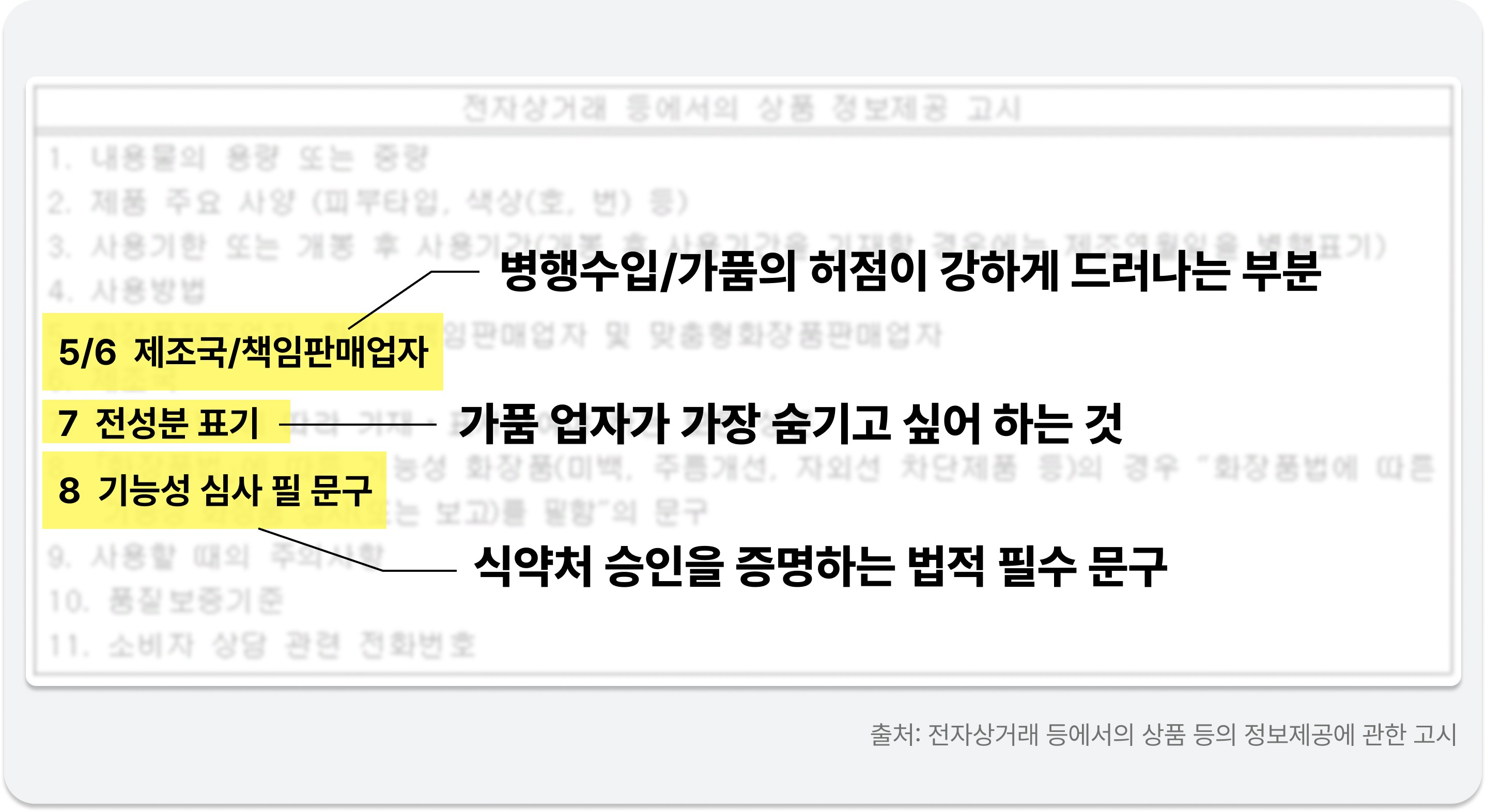
In addition to the three core items that brands should focus on, 'expiration date,' which is the third item of the Notification, is also an area handled very strictly. In fact, in early 2024, the Fair Trade Commission issued warnings to major beauty platforms that ambiguously labeled cosmetics expiration dates for 'violating the product information provision notification,' showing that the consistency of information provision notification data is becoming an uncompromising standard for brand protection.
A 2.7 Billion Won Fine for a Single Misspelled Ingredient? Why Global Brands Obsess Over 'Data Integrity'
Even in the global e-commerce market, 'product information notifications' are a critical standard that determines the stability of brand operations. Especially in advanced markets like the US and Europe, even minute discrepancies in data written on detail pages are regarded as consumer deception, leading to a trend of imposing strong administrative sanctions. Examining the reasons why global brands emphasize 'information notification integrity' as much as price crackdowns through actual cases reveals effective response directions against counterfeit and illegal distribution sellers.
The most representative case is the US Federal Trade Commission's (FTC) crackdown on violations of the 'Made in USA' labeling regulations. In January 2024, the FTC imposed an all-time high fine of $2 million (approx. 2.7 billion KRW) on a company that falsely labeled imported materials as 'Made in USA' on its detail pages and product labels. What is noteworthy in this case is that the regulatory authorities took issue with the 'consistency of notification data' itself rather than the seller's intent. If the manufacturing country information on the detail page differs even by 1% from the actual supply chain data, platforms consider this an immediate ground for sales suspension. The same applies to South Korea. The country of manufacture and manufacturer information specified in Articles 5 and 6 of the Cosmetics Notification are mandatory fields that sellers cannot arbitrarily alter.
Furthermore, discrepancies in the cosmetic ingredient list (INCI) have also led to brand recalls. At the end of 2023, the US Food and Drug Administration (FDA) ordered mandatory recalls and sales suspensions for multiple beauty products whose actual ingredients did not match the ingredients notified on their detail pages. Because misspelling ingredient names or changing their order is directly linked to consumer safety, regulatory bodies classify this as a much more serious violation than price dumping. As such, cases where immediate sanctions are imposed overseas for even a single incorrect ingredient name on a detail page are frequent.
Ultimately, looking at global market trends, we can see that the core of brand protection lies in 'data integrity' rather than price. Prices can fluctuate depending on market conditions or be strategically adjusted by sellers, but legally mandated ingredient lists and manufacturing country data are like fingerprints that can never be manipulated. Brands that secure meticulously collected notification data tend to block malicious sellers from the market much faster.
How Does Reatrics Find '1% Data Differences'?
There are clear physical limits to finding the cosmetics notification violations discussed earlier by having humans manually compare detail pages. Having staff open thousands of pages one by one to check the order of ingredients or whether expiration dates are labeled is bound to be a highly draining task for practitioners.
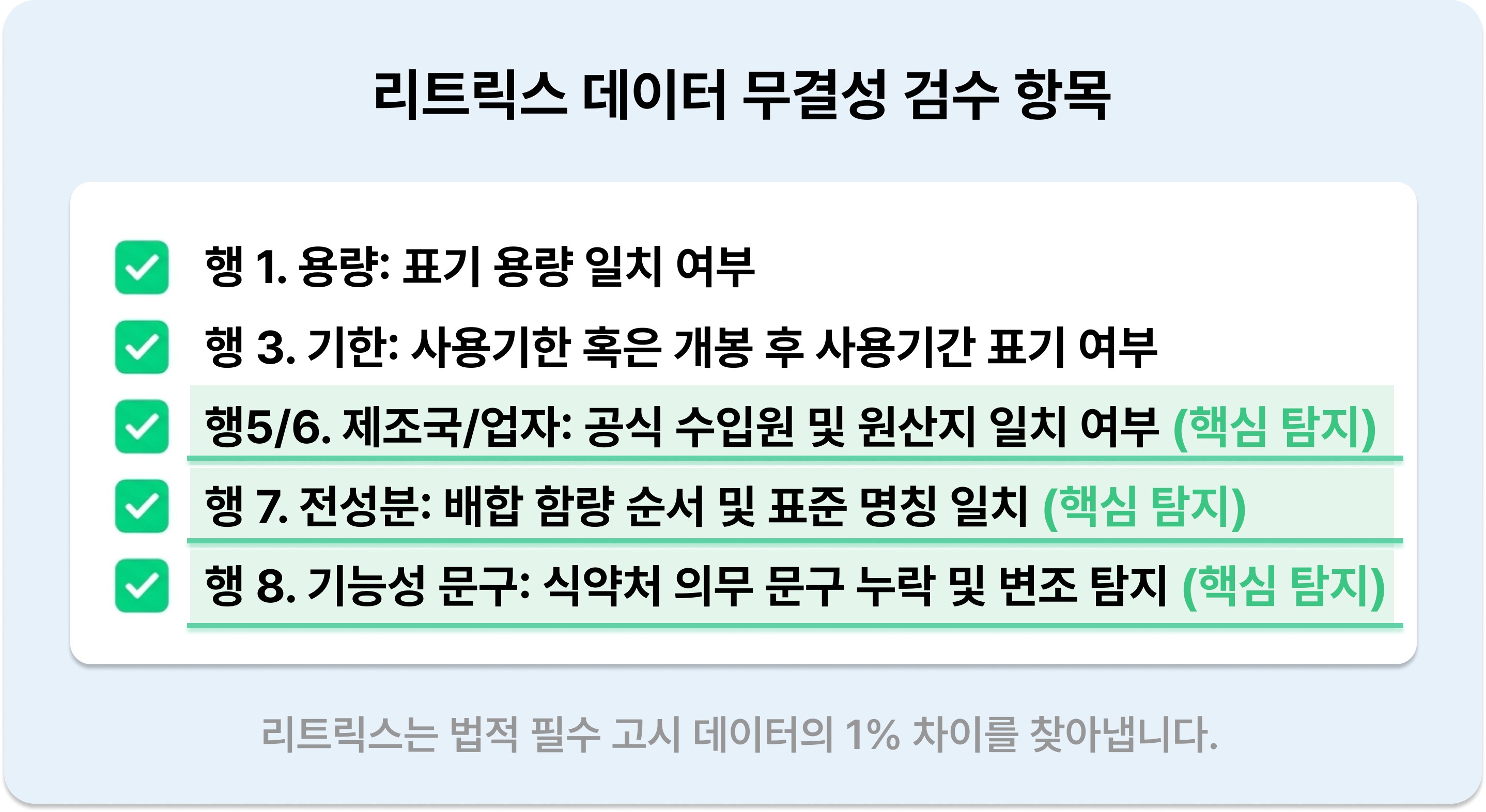
Reatrics automates this tedious process, which was previously difficult for managers to identify manually, by collecting information scattered across tens of thousands of storefronts and precisely comparing it with the brand's official data (Master DB). In this process, it finds legal loopholes that intelligent sellers are likely to overlook, turns them into clear grounds for crackdowns, proves invisible distribution blind spots with objective data, and presents an efficient standard for brand protection.
1) Data Matching That Verifies Down to a Single Character and Sequence
While counterfeit sellers can disguise prices to look genuine, it is practically difficult for them to perfectly comply with the regulations of the Cosmetics Act. Reatrics extracts the ingredient lists of tens of thousands of sales locations and compares them 1:1 with the brand's official data, verifying beyond simple keyword inclusion down to the legally regulated order of ingredients and whether the name of the responsible distributor matches. Through this, even for detail pages that seem fine at first glance, it can capture instances where the order of preservative ingredients is different or where unverified businesses rather than official importers are listed, securing objective grounds for suspected counterfeits.
2) OCR Reading That Detects Violations Hidden in Images
To avoid legal responsibility, some sellers place mandatory notification information in tiny print in the bottom corner of an image instead of using text, or evade obligations with ambiguous phrases like 'refer to detail page.' Reatrics reads even the fine print embedded in images to verify whether mandatory legal phrases like "Whitening/Wrinkle Improvement Review Completed" are properly included, and detects alterations of 'functional review completed' phrases or omissions of mandatory items like 'precautions during use' hidden within detail pages. It also identifies violation patterns that use ambiguous expressions like "efficacy proven" instead of approved Ministry of Food and Drug Safety phrases, establishing a basis for requesting immediate product removal.
3) Establishing Distribution Order Through Continuous Responses
Sellers who evade expiration date notification obligations with vague words like "sequentially shipping recently manufactured products" cause great difficulty in brand management. Reatrics does not stop at simply notifying violations; it provides standardized data so that distribution and marketing teams can respond immediately, sending continuous response signals to sellers who violate consumer choice and helping to induce platform penalties. Such repetitive responses instill an awareness in malicious sellers that the brand thoroughly manages even notification data, creating a distribution environment where they choose to give up handling the products on their own.
Distribution Governance Where Data Becomes a Shield
As we have explored so far, an effective way to respond to intelligent black sellers is to target the loopholes in the 'legally mandated notification data' that they are likely to overlook. Responses to notification violations often do not end as one-off actions. However, when violations are continuously captured and response signals are sent through Reatrics' constant monitoring network, the market trend shifts. This is because it can clearly instill an awareness in the market that a specific brand is managing notification regulations extremely thoroughly.
This continuous response causes malicious sellers to perceive handling that brand's products as a legal risk and an inefficient act, resulting in them voluntarily dropping out of the distribution ecosystem. This is the core of establishing a healthy distribution order that Reatrics aims for.
Leave the repetitive, draining task of evidence collection that occurred daily to Reatrics' 24/7 monitoring system. Brand managers can establish market strategies based on verified, flawless data and focus entirely on core operations that drive the essential growth of the brand.
An environment where data becomes a shield for your brand—Reatrics will build it with you.