Unofficial Seller Management
Price Management
What is lowest price seller monitoring? 6 factors for checking sales below the standard price

💡 In this article, you can find the following information.
What is the difference between simply looking at the lowest price and keeping a record of the lowest-price sellers?
6 essential elements that must not be missed in monitoring lowest-price sellers
What is missing from our company's lowest-price seller monitoring?
Can lowest-price seller monitoring be completely outsourced to a solution?
Lowest-price seller monitoring is about saving the seller's time
"We are definitely checking for the lowest prices every day, so why does the same thing keep happening?"
If you are a representative who searches for our products in open markets every morning, you have probably experienced this situation at least once. When you find a store you've never seen before listing our brand's ampoule at a price much lower than the standard price, you take a screenshot, check if they used the detail page image without permission, report it, and watch the sales page disappear. However, about two weeks later, a product with the same configuration and a similar price appears again in a store with only a different name. Then, you screenshot again, report again... and repeat this step continuously.
Even after repeating this for several months, it is difficult to answer important questions such as whether the two stores that violated the standard price are connected sellers, or since when the first store had been selling.
Is it because the representative is not diligent enough to remember every single piece of information? No. It is because the only record left during that time was the ‘price’. The lowest price by date was recorded without fail, but who created that price and where it reappeared afterwards is not linked in the records. To answer the previous questions, you must keep records centered on the seller, not the price. Instead of comparing yesterday's and today's lowest prices, you must be able to view yesterday's seller and today's seller in connection.
In this article, we will look at what elements make up the lowest price seller monitoring that fills this gap, and summarize how to find missing elements in our company's monitoring through recurring symptoms.
What is the difference between just looking at the lowest price and recording the lowest price seller?
Lowest price seller monitoring is an activity in which we periodically identify sellers who sell our products at the lowest price or prices lower than the standard price, and accumulate that seller's sales history to use as a basis for determining responses.
If you only record the place that sells the cheapest every day, the representative is left with only the number one lowest price and its sales page. Let's bring back the ampoule situation discussed earlier. The representative reported the store that was selling cheaper than the standard price, so the sales page was taken down, and about two weeks later, the same product reappeared in a store with only a different name. But what if this store had actually been listing the same product at a slightly higher price since two weeks ago? Since it wasn't number one, it wasn't in the records, and it only catches the representative's eye after the store that was reported first disappeared. It looks like a store that suddenly appeared out of nowhere in two weeks.
If you had recorded based on the seller, you would have known since when the store that appeared later had been selling, and whether its sales period overlapped with the store that was reported first. You need these records so that you do not stop at taking down sales pages one by one, but can respond based on the fact that the same seller is repeating.
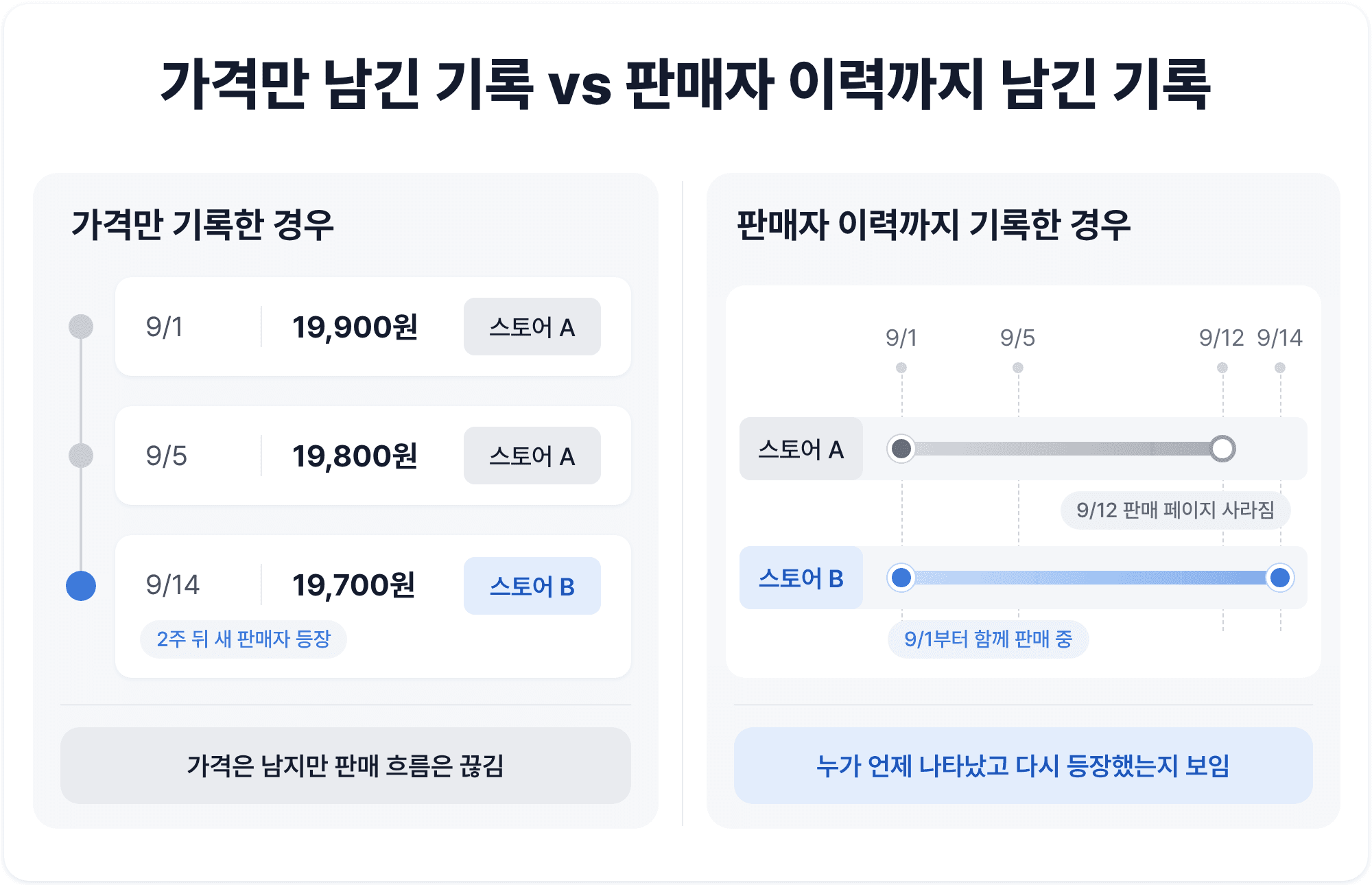
The lowest price seller mentioned here does not mean only sellers you see for the first time. It could be an official distributor contracted with the brand selling it the cheapest by applying their own coupon, or it could be a seller selling products brought in from overseas. No matter who ranks first, you must keep records in the same way, so that you can later distinguish whether it is an issue to be resolved with the distributor or an issue to respond to an external seller.
Ultimately, lowest price seller monitoring does not stop at checking today's lowest price ranking, but is about recording when a seller appeared, disappeared, and showed up again. Only then can you decide how to respond based on the accumulated records, instead of repeating reports as they happen. This is clearly distinguished from asking the seller to match the price.
6 Elements That Must Not Be Missed in Lowest Price Seller Monitoring
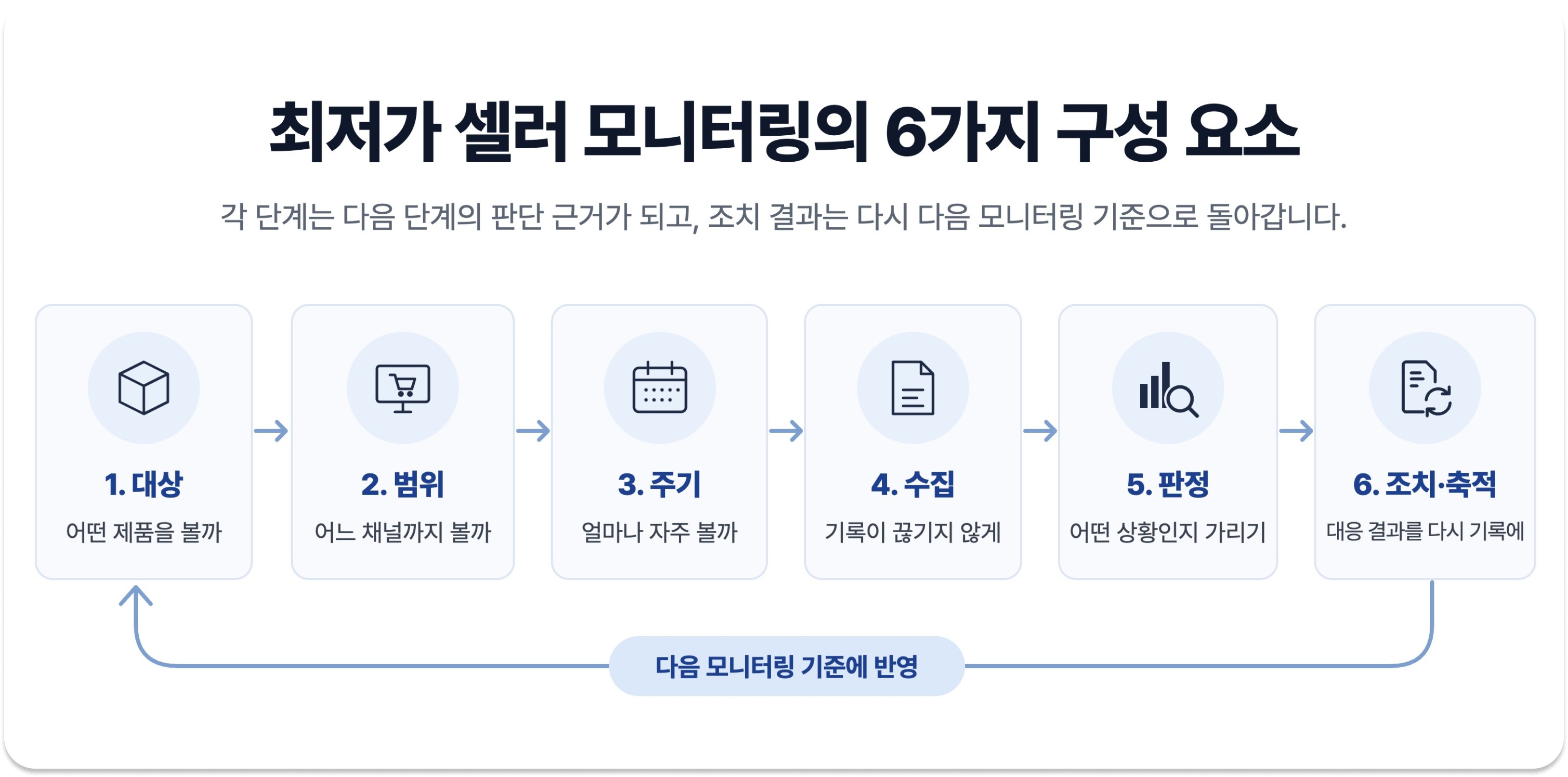
Seller records do not accumulate automatically just because a representative checks them meticulously every day. The following six elements must be in place together.
Target: Which product to look at
Scope: Which channels to look at
Cycle: How often to look
Collection: How to gather data
Judgment: What kind of situation the discovered case is
Action and Accumulation: What to do and what to leave behind
Since the result of each step becomes the basis for judgment in the next step, it is good to view the flow in order.
1. Target: Which product's seller to record
The target is the element that determines the product for which seller records will be kept.
The depth of recording changes for products designated as targets. Instead of leaving just the ‘one cheapest place’ of the day, you will keep records of all sellers selling lower than the standard price. Looking at the previous ampoule case, the representative only checked the number one lowest price every day for the ampoule, just like other products. Since the ampoule was not designated as a separate target, not all sellers selling lower than the standard price were recorded. That is why the store that had been selling right below number one since two weeks ago was not recorded.
However, keeping all products as targets is not the answer. If you keep records of all product sellers at the same depth, the records you actually need to see will be buried under other records, and if there is no target, history will not be created for any product. Therefore, at first, it is realistic to set products with repeated price inquiries or reports, or core products with a large share of sales, as targets.
2. Scope: To which channels to connect and view the same seller
Scope is the element that determines to which channels you will keep the seller records of the target product.
People often think the reason for expanding channels is only to find missed sellers, but in seller records, connecting already found sellers with each other also plays a major role. If you look only within one open market, stores with different names are likely to appear as separate sellers that only differ in timing. You need to look at sales records from other channels side-by-side to see if one seller sold on multiple channels at the same time, or if they disappeared from one place and reappeared in another.
Conversely, if you only increase channels without grouping them by seller, you will only end up with more lists managed separately for each channel. Therefore, it is more accurate to view scope as whether you can record the same seller in a single line across channels, rather than the number of channels.
3. Cycle: How closely to record the seller's appearance timing
Cycle is the element that determines how often to check the target product to create new seller records.
What the cycle determines in seller records is not just the frequency of checking, but within what range of time you record when the seller appeared. For example, if you check once a week, even if you discover a new seller, you cannot know since when last week that seller started selling.
However, checking frequently unconditionally is not always good. If the number of checks increases, it takes that much time and cost, and if it is a product where sellers do not change often, there will not be many new records even if you look frequently. Therefore, it is better to decide the cycle by looking at how often sellers change for each product. The interval is narrowed for products with frequent price competition, and widened for products with little variation. Above all, it is important to keep the set interval consistent. The interval must be consistent to narrow down the time the seller appeared to a clear range.
4. Collection: Is the record continuous without interruption?
Collection is the element that determines how to actually fetch sales information according to the set target, scope, and cycle. Representatives can search directly, or you can build a collection program internally or use external tools.
Whichever method you choose, the first thing to consider in seller records is whether they continue without interruption. It is difficult to recover later what seller sold at what price during the period when collection was stopped, unless there are separately left materials. What is more troublesome is that when blank days occur in the records, you cannot distinguish just by looking at the records whether there were no sellers on that day or if you failed to check. No matter how closely you set the cycle, if collection is not done as set, that period remains blank. If you are using a collection program built internally, such gaps occur more often than you think. When a platform changes its page structure or blocks automatic collection, the program stops, and if you do not notice this immediately, the records during that time will be completely blank.
Therefore, when choosing a collection method, it is better to first look at whether the records will continue without interruption even if the representative changes or the platform environment changes, rather than whether it is easy to start right away. If blank days have occurred, you should at least leave an indication that that day was a collection gap so that there is no confusion when reading the records later.
5. Judgment: How to classify the sales situation with the accumulated records
Judgment is the element that distinguishes under what situation the discovered sale occurred.
In this case, the ingredients for judgment are the records left by the previous four elements. With records, you can distinguish whether this sale is a one-time event, a continuous trend, or a case related to a distributor. In the ampoule case, if there was a record that the store reported first and the store that appeared later were selling the same product together for two weeks, you could have judged that it might be a single connected sale rather than viewing the two stores separately.
It is also worth remembering that judgment does not end with a single decision. A sale that initially looked like inventory clearance may change in judgment if it continues with other sellers a few weeks later. Therefore, it is better to leave the basis and date of such judgment together, rather than just writing down the judgment result. When a judgment changes, you must be able to explain with records what changed to cause the change, so that you can consistently convey the same message to distributors or platforms.
6. Action and Accumulation: Do you record the response results back in the seller records?
Action and accumulation are the elements where you take responses such as reporting or contacting based on the judgment, and write down the results together in the records organized by seller.
What is often missed here is keeping the response history separate from the records by seller. If report submission history is on the platform screen, messages exchanged with the seller are in the inbox, and price records are in a sheet, you have to start by matching these three when you meet the same seller again. If the report history remains together in that seller's records, you can check what you have already tried and what the results were first when the same seller or a similar sales trend appears again.
As records accumulate, the direction for the next monitoring also begins to show. If the same seller repeats for a specific product, you keep that product as a target, and if you see channels where new sellers appear, you add them to the scope. As the accumulated records become the basis for resetting the target, scope, and cycle, the six elements connect back to the beginning.
What is Missing in Our Company's Lowest Price Seller Monitoring?
If you read the six elements one by one, you might think, 'We are doing this much too, aren't we?' However, in actual work, it is not easily revealed which element is empty. If you are checking and even reporting every day, it is easy to feel that monitoring is running well. In this case, you can identify the empty elements in your current monitoring by looking at the symptoms that are usually repeated. Check the symptoms that apply to our company in the table below.
If these symptoms repeat | Elements highly likely to be missing |
|---|---|
Cannot answer since when a newly appeared seller has been selling | Target, Cycle, Collection |
Do not know if the same seller is also selling on other channels | Scope |
There are blank days in the records, but do not know whether there were no sellers or if we failed to check | Collection |
Judgment changes every time we look at the same seller, and it is difficult to explain why we made such a judgment | Judgment |
When meeting the same seller again, start searching from past report histories again | Action and Accumulation |
The products and channels being monitored have remained the same for months, but we have missed newly appeared sales trends before | Action and Accumulation |
When a single symptom is linked to multiple elements, it is faster to check the elements in the earlier order first. Not knowing the sales start time may look like a cycle or collection issue, but there are also cases where that seller was not included in the record targets in the first place. If you only fix the later steps while the earlier steps are empty, the same symptoms may appear again.
Lowest Price Seller Monitoring, Can We Leave It All to a Solution?
Q. Can we leave lowest price seller monitoring entirely to a solution?
The scope of what can be left depends on how well the solution can capture our brand's judgment criteria. For collection, it is first and foremost that it continues without interruption even if the platform environment changes, and to lead to judgment and action, the brand's criteria must be added to this. This is because the criteria for where to set the standard price for each product, which distributor's discount to view as a promotion and pass over, and which seller to immediately review for reporting differ for each brand.
Therefore, when comparing solutions, it is better to first look at whether they can reflect the criteria set by our brand, and whether the judgment basis and action results remain together by seller according to those criteria, rather than how many channels they collect and how often. If the criteria are not reflected, even if you receive results every day, a human must sort through which of them is a problem one by one again.
Q. When starting lowest price seller monitoring for the first time, there are no past records, so what should we do?
Since it is difficult to fill in records by seller for the past period later, you can start by clearly writing down the start date as the reference date of the records. With a reference date, you can distinguish later that there were no records before that date, not that there were no sellers. Instead, clues scattered inside the company can be moved over. If you collect records where seller names remain, such as past report submission histories, messages exchanged with sellers, and purchase locations written in CS inquiries, by seller, you can start with at least a few lines of history rather than a blank state.
Q. Which department should handle lowest price seller monitoring?
Rather than one department handling all tasks, it is realistic to place the responsibility of managing seller records in one place and have multiple departments contribute information. Price verification is often done in distribution or sales, inquiries about authenticity in CS, and reporting and legal review in legal or brand protection, but if each keeps separate records, information on the same seller will be scattered across departments. If it is set to be added to one seller record place no matter who verified it, the history continues even if the representative changes. However, while doing their assigned tasks, if each department also has to take care of seller records, it is easy for records to be delayed or missed during busy periods. Therefore, many companies operate in a way that leaves collection and seller record management to solutions, allowing each department to focus on judging and responding based on the accumulated records.
Lowest price seller monitoring is about leaving behind the seller's time
Even if you record the lowest price today, it becomes a past value tomorrow, but the more seller records accumulate, the more useful they become. This is because when the same seller appears again, you do not have to examine them from the beginning, but can start responding from the already remaining history.
If your company's monitoring stops at checking and reporting, try filling in one of the empty elements in the checklist above first. The seller's time begins to accumulate from then on.