Unofficial Seller Management
“Coupang’s prices are fine, but…” Why our brand’s prices are collapsing on Musinsa and Ably

💡 In this article, you can find the following information.
I protected the Coupang price, so why is it collapsing on Musinsa?
Surpassing 2 trillion KRW in transaction volume... Why products are flowing into vertical platforms
Why is price deviation on Musinsa and Ably so hard to spot?
3 ways to directly find price-deviating sellers that Naver Price Comparison misses
Conclusion: As channels increase, expand your scope of observation accordingly
Coupang Price Kept Safe, but Why Do Things Fall Apart on Musinsa?
Even for brands whose prices are managed relatively stably on Coupang and Naver Smart Store, the situation can sometimes look quite different when you look into platforms like Musinsa or Ably.
The shaking of brand price control policies on vertical platforms is nothing new. For example, in the past, a domestic distributor of a French luxury brand entered Musinsa on the condition of 'no parallel import sales allowed,' but Musinsa itself parallel-imported the brand and sold it alongside at a different price range.
Even when the distributor requested to take down the exposure, it reportedly repeated a cycle of going down and coming back up. A price policy that the brand had clearly drawn a line on was not kept as-is on the platform.
These cases show that the price a brand believes is well-managed can shape up completely differently outside of comprehensive shopping malls. The problem is that with the recent rapid growth of vertical platforms, the resulting price disruption is spreading into more complex forms beyond simple parallel imports, such as unauthorized sellers or counterfeit goods of unclear origin.
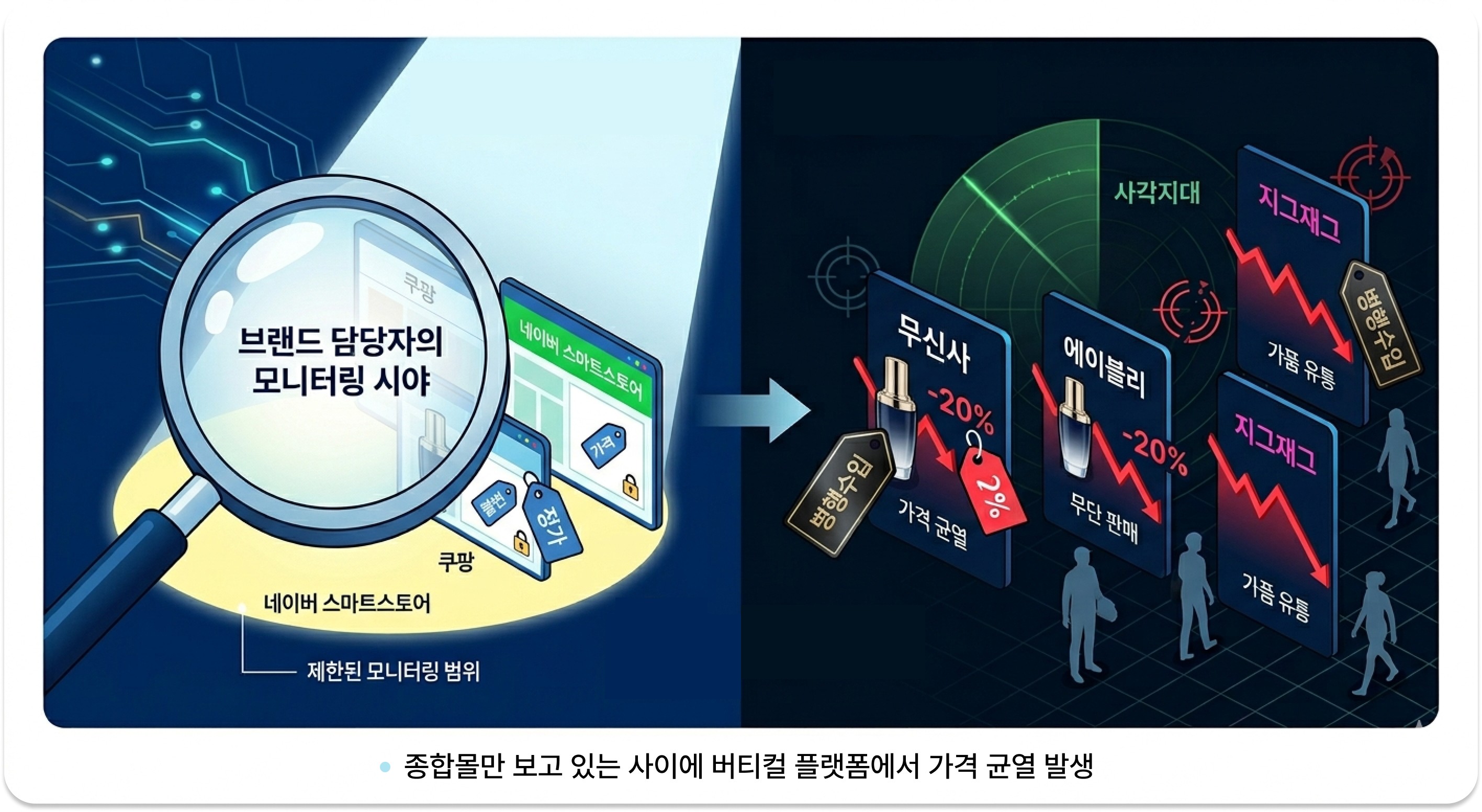
Despite such rapidly changing circumstances, the monitoring scope of many brands is still stuck only on traditional comprehensive malls like Coupang or Smart Store. While the channels where products are sold are expanding uncontrollably into vertical platforms, if the scope of scrutiny remains the same, price deviations occurring outside of comprehensive malls will inevitably remain in the blind spot forever. Then, why on earth did these vertical platforms become a giant blind spot in distribution management, and what should brand managers start doing right now?
Transaction Volume Surpasses 2 Trillion Won... Why Products Flow into Vertical Platforms
To understand why vertical platforms become blind spots, we first need to point out how fast they have grown. This is because platforms starting with a focus on specific categories like fashion and beauty have now built giant ecosystems comparable to existing comprehensive malls.
The flow is revealed even more clearly in actual figures. Ably Corporation, which operates Ably, recorded its highest performance ever in 2025 with a transaction volume of 2.8 trillion won, and Kakao Style, which operates Zigzag, also surpassed an annual transaction volume of 2 trillion won in the same year. Musinsa also achieved its highest performance in history in 2025 with consolidated revenue of 1.4679 trillion won, up 18.1% year-on-year.
The point we really need to pay attention to here is that they no longer stay only in the single category of fashion. In the case of Zigzag, after opening a specialized beauty store in 2022, it has steadily expanded its categories, increasing its entered brands to about 2,400 as of early 2025. As a result, the beauty category transaction volume in 2025 increased by about 50% year-on-year, and brand fashion also grew by more than 40%. Platforms that started in fashion are expanding their territory into cosmetics and the like, essentially evolving into something no different from comprehensive malls.
This evolution of platforms has naturally changed even the purchase flow of consumers. Instead of turning on comprehensive malls first when buying products in specific categories, an noticeably increasing number of consumers directly open Musinsa, Ably, or Zigzag. Since it is a natural sequence for brand products to flow into places where the mainstream consumer base gathers, the channels where brand products are exposed and transacted are spreading widely outside of comprehensive malls as well.
In the end, as the market landscape shifts, this also means the number of channels brands need to manage has increased by that much. In the past, monitoring just Coupang or Naver Smart Store was enough to grasp the entire distribution flow of the online and offline markets. Today, however, the same product is often uploaded to multiple vertical platforms simultaneously. Because channels have increased and scattered here and there, looking into just one or two places like before makes it difficult to grasp the overall status of where and at what price our products are actually being sold.
Why Is Price Deviation on Musinsa and Ably So Hard to See?
If so, why didn't brands control these channels earlier? Looking back at the Musinsa parallel import case mentioned earlier, we can point out that the situation was not easily resolved even after the brand recognized the issue and requested action. At the time, even though sales were suspended at the distributor's request, the situation where products and listings were repeatedly posted again after a short while continued for several months. This means that even if a brand discovers a price deviation, it takes far more time and effort than expected to fully correct it.
A bigger problem is that the cause shaking the distribution order is not limited solely to parallel imports. Recently, beyond unauthorized sellers, cases where counterfeits that are not genuine at all are openly distributed on vertical platforms are being confirmed one after another. Indeed, the British fashion brand 'Charles Jeffrey Loverboy' even sued an Ably entrant seller with the police for trademark infringement facilitation, claiming that the platform did not properly sanction the seller even though they sold hundreds of counterfeits bearing the same trademark. This shook the industry as the first case of a famous foreign brand taking legal action against a domestic online platform regarding counterfeit goods.
Of course, Ably explained that they immediately stopped exposure after recognizing the infringing goods, and applied penalties to the seller along with a 'sale prohibited' measure to make re-display and re-sale impossible. While the platform runs its own filtering system and response framework, it also serves as proof that it is practically close to impossible to flawlessly filter out tens of thousands of products pouring in daily in advance.
Comprehensive Malls vs. Verticals: What Is the Difference?
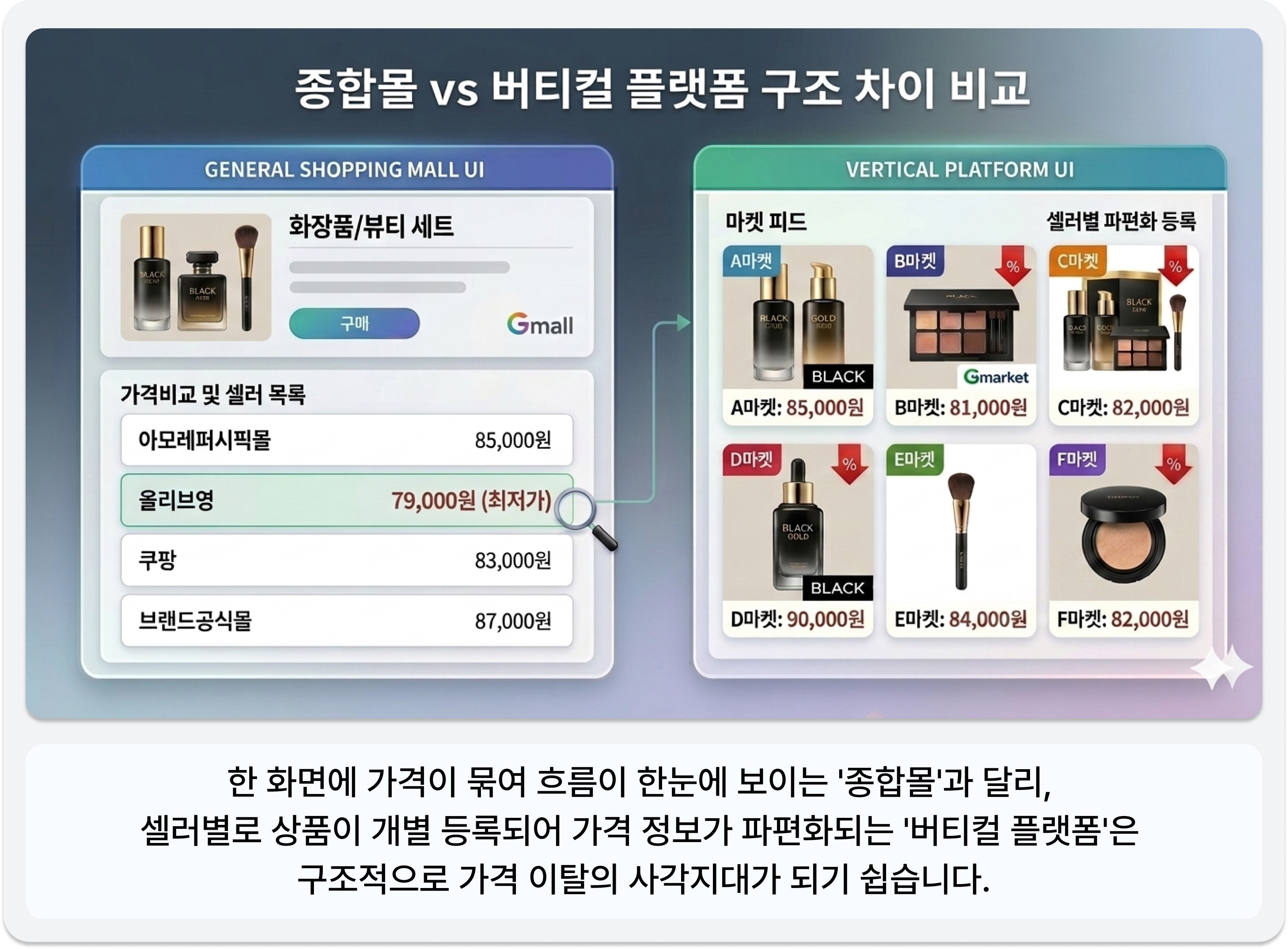
There is a systemic structural difference behind why distribution disruption behaviors are carried out particularly more covertly on vertical platforms than on comprehensive malls. On comprehensive malls like Naver or Coupang, it is common for multiple sellers to be grouped together under the same product, bringing the lowest price to the top. Thus, who is selling for how much is relatively well-exposed through a single price comparison screen, making it easy to see the price flow of the same product in one place. On the other hand, on vertical platforms, because sellers or entered markets register each product separately, even for the same product, price information is not collected in one place but is scattered and exposed by seller. As a result, it is difficult to gather at a glance which seller is selling for how much.
Adding to this, the 'open-market' structure where anyone can freely enter makes the management difficulty even higher. Since there is no separate strict prior approval process, countless sellers flow in over a short period, and it becomes impossible for platforms to inspect the product sources or price policy violations of each one. A distribution industry official also expressed the view that as entered sellers quickly increase, inspection or management is not sufficiently carried out, and platform self-regulation clearly has limits. Rather than the platform sitting idle, it is a situation where it is difficult to look into all quickly increasing products in advance with limited manpower. Structurally, it is an environment where monitoring overload is bound to happen.
Under these circumstances, for brand managers to catch price deviations or unauthorized sales, they practically have to manually click and check each platform and every seller within them. When there were only two or three channels to manage, manual work was manageable to some extent, but in the current situation where vertical platforms have mushroomed, the method of a person directly visiting one by one is bound to be overwhelming just to keep up with the monitoring cycle. Since we cannot just leave it alone, finding realistic methods to increase efficiency even with limited manpower should be the priority.
Price Deviation Sellers Not Caught on Naver Price Comparison: 3 Ways to Find Them Directly
Due to the structural differences described above, traditional monitoring methods are bound to show limits. The 'Naver Price Comparison' that many brand managers rely on basically collects information centered on products that have gone through formal integration processes between platforms. In other words, sales cases of unauthorized sellers who sell products independently within vertical platforms without following that procedure do not show up on the Naver screen at all. The moment you feel relieved looking only at comprehensive mall monitoring results, thinking "Our brand price is being well-kept," you might miss price deviations occurring on vertical platforms entirely.
Of course, there are various paths through which prices diverge between platforms. As in the case of the Chinese color cosmetics brand 'Flower Knows', brand-intended price gaps also occur because of headquarters policies, such as the brand directly moving official mall volume to Musinsa Beauty in bulk and selling it up to 28% cheaper than the official mall. There are price gaps that arise intentionally by the brand like this, and there are price gaps that happen outside of control like unauthorized sellers or parallel imports. Whether it is an internal strategic choice or disruption by external unauthorized sellers, the essence is the same: if you only stare at comprehensive malls, you can never notice these price cracks in time.
Then, in a situation where the distribution blind spot has expanded so extensively, what should brand managers start doing right now? Of course, manually visiting countless vertical platforms every day is close to impossible in the long run. However, just because a perfect monitoring system is not in place does not mean we can leave the immediate price deviations unattended. Even without bringing in grandiose tools or budgets, there are realistic ways to find distribution flows right now simply by changing the manager's 'perspective' and 'approach.' Here are 3 action guides you can apply directly to work.
❶ It won't be caught just with the brand name — Try drafting search terms from the 'seller's perspective'
Simply searching honestly for the brand name on vertical platforms makes it easy to miss things. This is because sellers who actually destroy prices deliberately hide the official brand name to avoid monitoring nets. They use tricks like slightly modifying the brand name or changing spacing to avoid getting caught in search filters, cleverly mixing English and Korean, or writing only 'nicknames' or 'abbreviations' of products that consumers frequently call instead of the brand name. Therefore, if you search only by the official name, the official entered sellers show up while the problematic products on sale are excluded.
Therefore, when using the search bar, you must thoroughly become the 'seller' and expand your keywords. Try entering not only the official brand name but also possible typos, spacing variations, representative product nicknames or model names, and combination keywords that sellers often attach to titles to aim for top exposure, such as 'brand name + genuine' or 'brand name + same-day shipping/discount'. Actually, even for the same product, simply changing the search keyword combination a little often reveals new sellers that were invisible before.
Also, it is better not to limit the boundaries of monitoring only to the inside of the platform. Transactions disrupting the distribution order take place not only in open markets but also through SNS group purchases like Instagram or Kakao Open Chat. Periodically searching for hashtags or SNS keywords where our brand products are usually mentioned allows us to grasp distribution channels in blind spots that were not caught by existing price comparison portals.
❷ Once discovered, leave a record of 'When, Where, Who, and How Much' on the spot
By refining search keywords in this way, abnormal sales links that were out of sight will start to be captured one by one. The problem is that once they notice enforcement or run out of stock, they vanish without a trace in an instant. Because sellers on vertical platforms frequently take down and re-upload products and change prices fluidly to avoid crackdowns, it becomes difficult to find evidence again later if you do not record the moment of discovery.
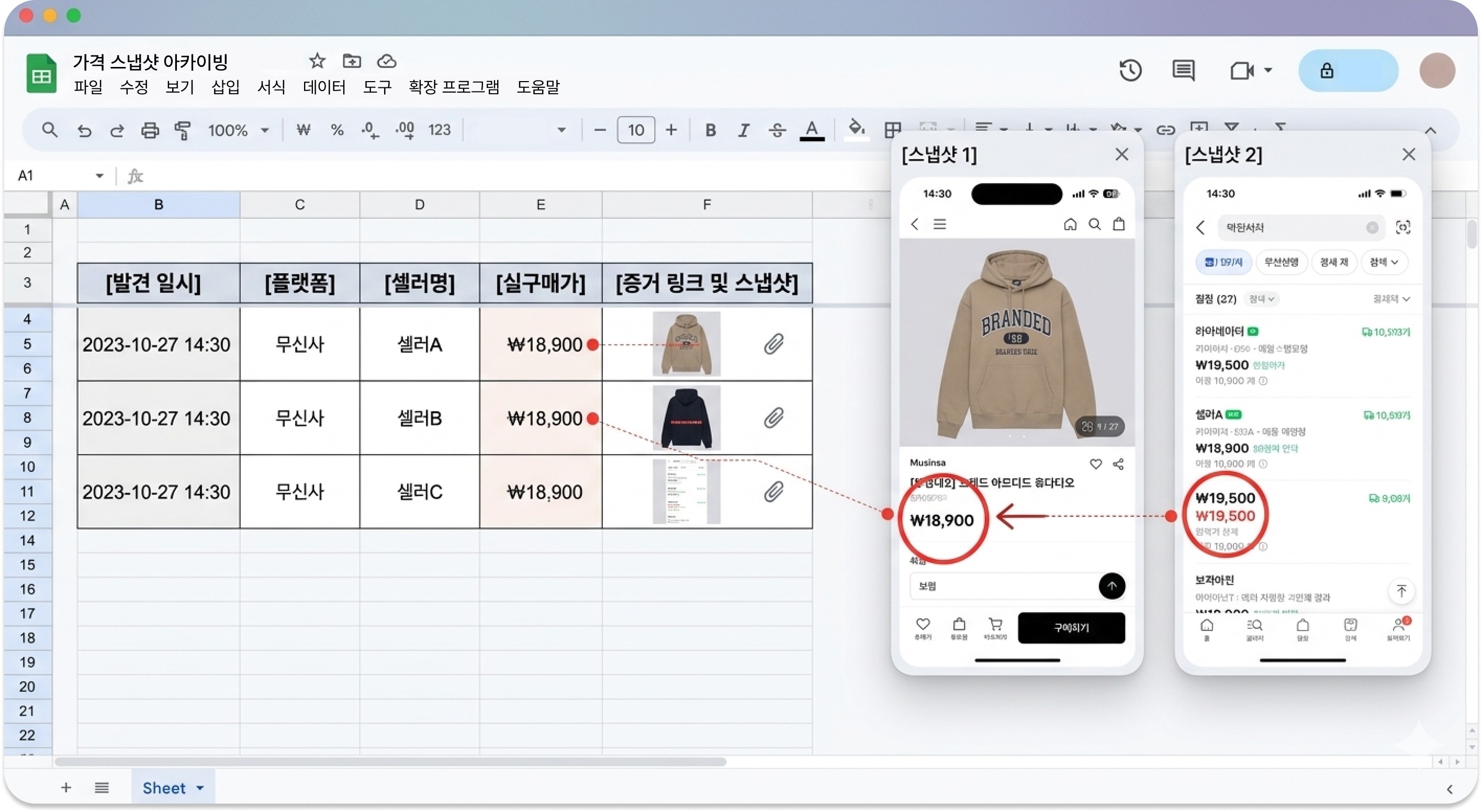
Therefore, the moment you find a suspected price deviation, it is good to record 'when, where, who, and at what price' it was being sold on the spot. You should bundle and archive the discovery date and time, platform name, seller name, and actual purchase price, as well as the product URL and full screen capture. It is in the same context as the 'price snapshot' covered in the previous article, and leaving the screen of that point in time is particularly helpful on vertical platforms. If you capture the image so that the price and date are visible together, it becomes much easier to compare when you encounter the same seller again later.
❸ Find repeating patterns from accumulated records
At first, these piecemeal records may look meaningless, but once data begins to accumulate, hidden distribution flows finally start to show. You will begin to notice regularities, such as whether a specific seller is repeatedly disrupting the distribution order across multiple platforms or if price deviations are systematically concentrated only during specific vulnerable times like weekends or late nights. Distribution disruptions that looked like mere accidental sales through one or two searches can be classified as 'deliberate and repeating patterns' or 'one-time inventory liquidations' once records accumulate.
The presence or absence of this pattern also makes a big difference in the effectiveness of future responses. When requesting sanctions from platform customer service or demanding corrections from a seller, presenting accumulated data showing "violations were repeated several times over a specific period" explains the situation much more concretely than putting forward a single capture image. Instead of stopping at a one-off response, you can set priorities based on data regarding which seller to deal with first.
Conclusion: As Channels Increase, Expand the Search Scope Together
The manual monitoring methods suggested above cannot perfectly solve all distribution issues a brand faces. This is because there are clear limits of time and physical stamina in the method where a person manually changes keywords and records them. There are quite a few clever sellers who barely reveal themselves only when searched with different terms, and even the sales found that way change shape by taking down and re-uploading products or switching to new sellers. As channels increase, the method of a person directly visiting is bound to hit a wall in the end.
Nevertheless, the reason why this manual monitoring process is absolutely necessary is that it is the only way for the manager to directly feel the reality and patterns of how widely our brand products are scattered and distributed outside of comprehensive malls. Actually, this fatigue and limitation in the field are experienced not only by brands but also by platforms in the same way.
In March 2026, Musinsa fully introduced an AI-based 'product similarity inspection system' to respond to chronic 'tag-switching (label swapping)' suspicions and copy product issues raised among some entered brands. They began running constant AI monitoring targeting vast product data of over 1.2 million items registered on the platform. This is equivalent to the platform itself admitting that the market can no longer be controlled with a structure where humans manually inspect the authenticity of countless products.
As the market environment changes to such automated management systems, it is time for brands to also contemplate fundamental changes to their monitoring methods. Brands that have experienced the limits of manual work while looking into channels with bare hands can much more clearly face the core task of brand distribution management: 'how to automate and scale up the monitoring process in the future.'
However, what must precede introducing a highly advanced system right now is a change in perspective to accept that the channels requiring inspection have increased. Just through the small action of recognizing price fluctuations occurring outside comprehensive malls and recording them with objective data, the vision for looking at brand distribution status can become much wider than before. As consumer purchase touchpoints have diversified, expanding the brand's inspection scope together—that is the most practical first step to maintain distribution order and continuously protect the brand's value.