Official Seller Management
Price Management
[Global Pricing Term Guide] MSRP·SRP·RRP·MAP·MRP, Fine for Violation vs. Simple Reference?

💡 In this article, you can find the following information.
MSRP on Coupang, RRP on Amazon, MRP on Indian direct import malls.. Why are the standards different for the exact same product?
Fines for violation vs. simple reference? 5 global pricing languages that practitioners must know
The structure of how global languages shake up our market
You can catch price-violating sellers without expensive tools: 3 methods used by practitioners
Price management starts not with a perfect system, but with 'opening the search bar right now'
Coupang has MSRP, Amazon has RRP, Indian direct purchase malls have MRP... Why are the standards different for the exact same product?
When managing online distribution in a global e-commerce environment, you will encounter situations where different price standard terms are attached to the exact same product. It is 'MSRP' on US-based platforms, 'RRP' in the UK and Europe, 'MRP' on Indian e-commerce, and even 'MAP' in supply contracts. Different terms are used to display price standards for the exact same brand's product depending on the platform and country.
At first glance, they all seem like similar terms. In many cases, they are loosely understood as a 'recommended price' or a 'standard price'. However, these terms actually have different characteristics. Some terms are prices that must be legally observed, while others are merely at a recommended level. Whether you can request and force sellers to adhere to this price, whether you can actually take action in case of violation, and whether you can design a distribution policy based on this price also differ depending on the term. Some prices are merely references that cause no issues if violated, while other prices serve as absolute standards where selling even 1 KRW over can violate local laws and result in fines, making it inevitably a massive headache for practitioners.
If you do not know these differences when establishing a pricing policy, situations will arise where you manage distribution based on policies that actually have no binding force. This is also where it becomes difficult to even grasp under what standard prices are being displayed on which channels. This is why starting by accurately organizing the terms is the practical starting point for brand price management.
In this article, we will organize the pricing policy terms used interchangeably in global e-commerce one by one, and look at what the differences between each term mean for actual distribution management.
Fines for violations vs. simple reference? 5 languages of global pricing
A guide to confusing global pricing policy terms: MSRP·SRP·RRP·MAP·MRP
In order to establish price guidelines in the global market, you must first accurately understand the 'language of price' used by each platform and country. Let's compare the concepts and characteristics of the 5 core terms most frequently encountered in practice.
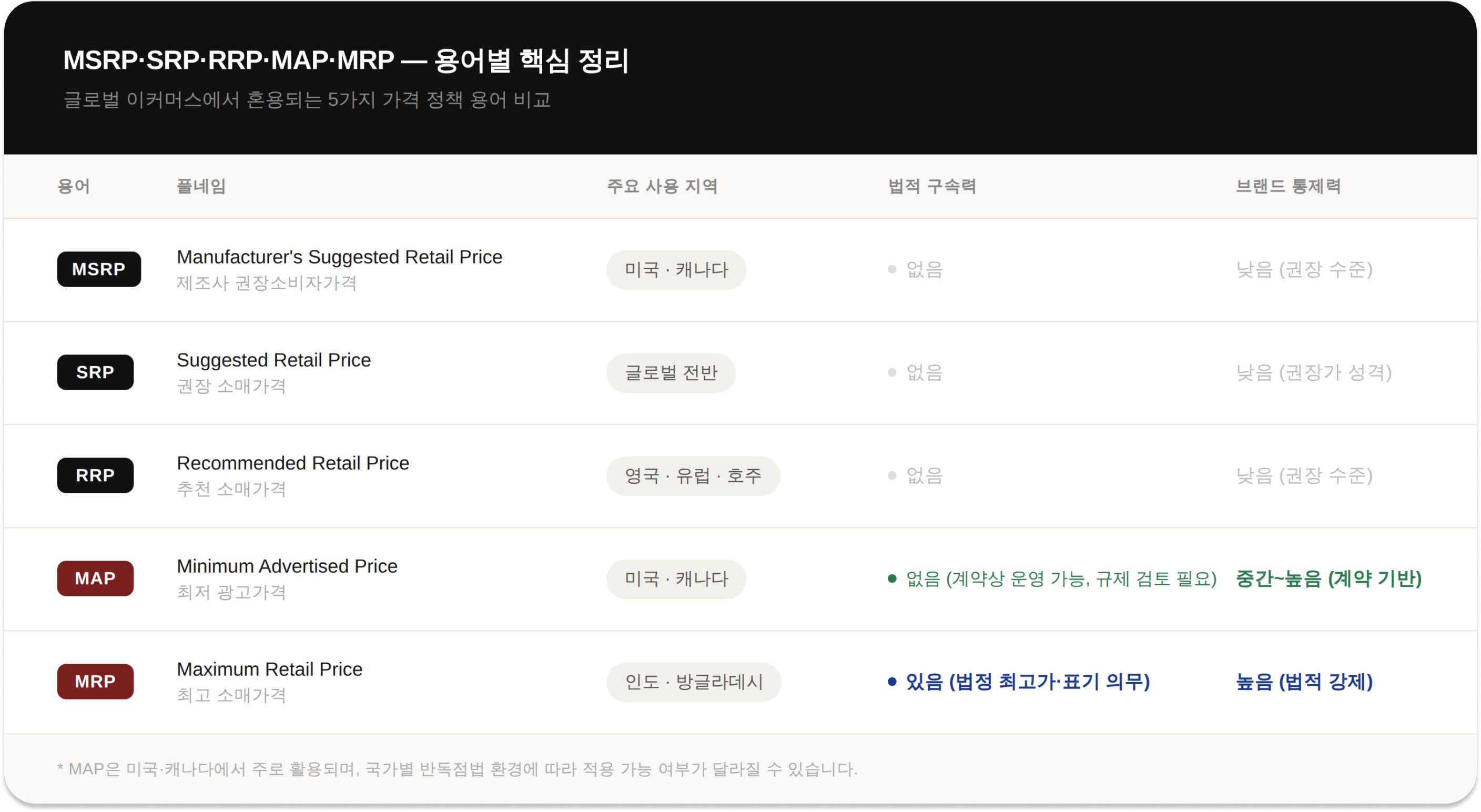
1. MSRP & SRP (Manufacturer's Suggested Retail Price)
MSRP and SRP are used interchangeably as virtually the same concept in practice, but it is difficult to see them as completely identical standard terms across all markets and industries. Both concepts are basically prices recommended by the manufacturer or brand to retailers saying, "Please sell it at this price," and they have no legal binding force. Therefore, even if a distributor sells lower than this price in the actual sales field, it is difficult for the brand to legally punish or enforce it. Instead, brands can respond and manage price order indirectly through product supply conditions or authorized reseller contract conditions. However, since these measures are also affected by competition laws and transaction practices of each country, careful design is required for each market.
There is one more thing that is good to know. In places like the United States, MSRP is often used as a baseline for discount marketing. It is used to emphasize the savings to consumers in ways such as "MSRP $100 → Sale Price $70 (30% Off!)". While this approach looks like a discount from the consumer's perspective, from the brand's perspective, MSRP is consumed merely as a reference figure, not as the actual sales price standard. This is why simply setting an MSRP has its limits if the purpose is to protect the brand's price image and value.
🤔 How do MSRP and SRP differ?
MSRP (Manufacturer's Suggested Retail Price): This is the recommended retail price suggested by the manufacturer. It is widely used in the US market and by global manufacturing brands.
SRP (Suggested Retail Price): This is a more general expression meaning suggested retail price. It is also used as a recommended price referred to by various entities in the supply chain, such as manufacturers, distributors, and wholesalers, considering market conditions and distribution structures. Therefore, some countries or industries with complex distribution structures tend to use SRP more frequently than MSRP.
Although the two terms are used interchangeably in practice, it is important to remember that the nuance can change depending on who suggested it and what the market practice is.
2. RRP (Recommended Retail Price)
This is a term mainly used in the European Union (EU) including the UK, and Australia instead of MSRP. Just like MSRP, it remains merely at a recommended level. While presenting the RRP itself as a recommended price may be allowed, operating it virtually like a fixed price or operating it in a way that pressures distributors to comply can be considered 'Resale Price Maintenance' under EU and UK competition laws, which can lead to problems. Since the European market strictly protects the market competition system, it is safe to specify that RRP is strictly a "reference guideline" when managing distribution channels.
3. MAP (Minimum Advertised Price)
Among the 5 terms, this is the policy tool that brands can utilize most practically. Under US legal provisions, fixing the price itself may be illegal, but demanding "do not expose below this price" to preserve brand value can be a legal contract condition. In other words, the core of MAP is that it is a policy that sets the lower limit for advertised and exposed prices that consumers first encounter, not the 'actual selling price'. Since it does not directly bind the actual sales price, it is distinguished from Resale Price Maintenance (RPM), and this is why MAP can be utilized legally in the US and Canada. Although it has no legal binding force, if specified as a clause in the supply contract, measures such as halting supply can be taken against violating sellers. However, since antitrust issues may vary depending on the enforcement method or country, it is recommended to check the legal environment of the corresponding country before practical application. The differences between MSRP and MAP and how to apply them in practice were covered in detail in the previous article, so please refer to it as well.
4. MRP (Maximum Retail Price)
This is a concept you must know when targeting the Indian market or managing Indian direct purchase channels. It is fundamentally different in nature from the other terms. MRP is a legally declared price for packaged goods based on India's Legal Metrology Act, and it must be printed on all finished product packages. Distributors cannot sell exceeding this price under any circumstances, and violations can lead to fines or imprisonment. When dealing with products whose country of origin is India, you must check what MRP was set and shipped.
If these terms were simply differences in expression depending on the region, they might not pose a major problem. However, in the actual distribution field, this difference leads to quite concrete problems. For example, if you try to apply a MAP policy designed based on the US market to a European distributor, it may be halted at the contract stage due to EU competition law issues. Conversely, when a product marked with India's MRP enters through a parallel import route, conflicts may arise with the price managed by official channels.
For a brand distributed simultaneously in the global market, situations actually exist where MSRP and MAP are applied in the US, RRP in the UK, and MRP in India for the exact same product. As the nature of the price and the enforcement power represented by each term differ, bringing the standards of one market directly to another market can create unexpected gaps. If you operate global distribution, designing pricing policies separately for each market becomes a basic premise.
The structure of how global languages shake our market
Are brands spending on advertising while parallel import sellers take the sales?
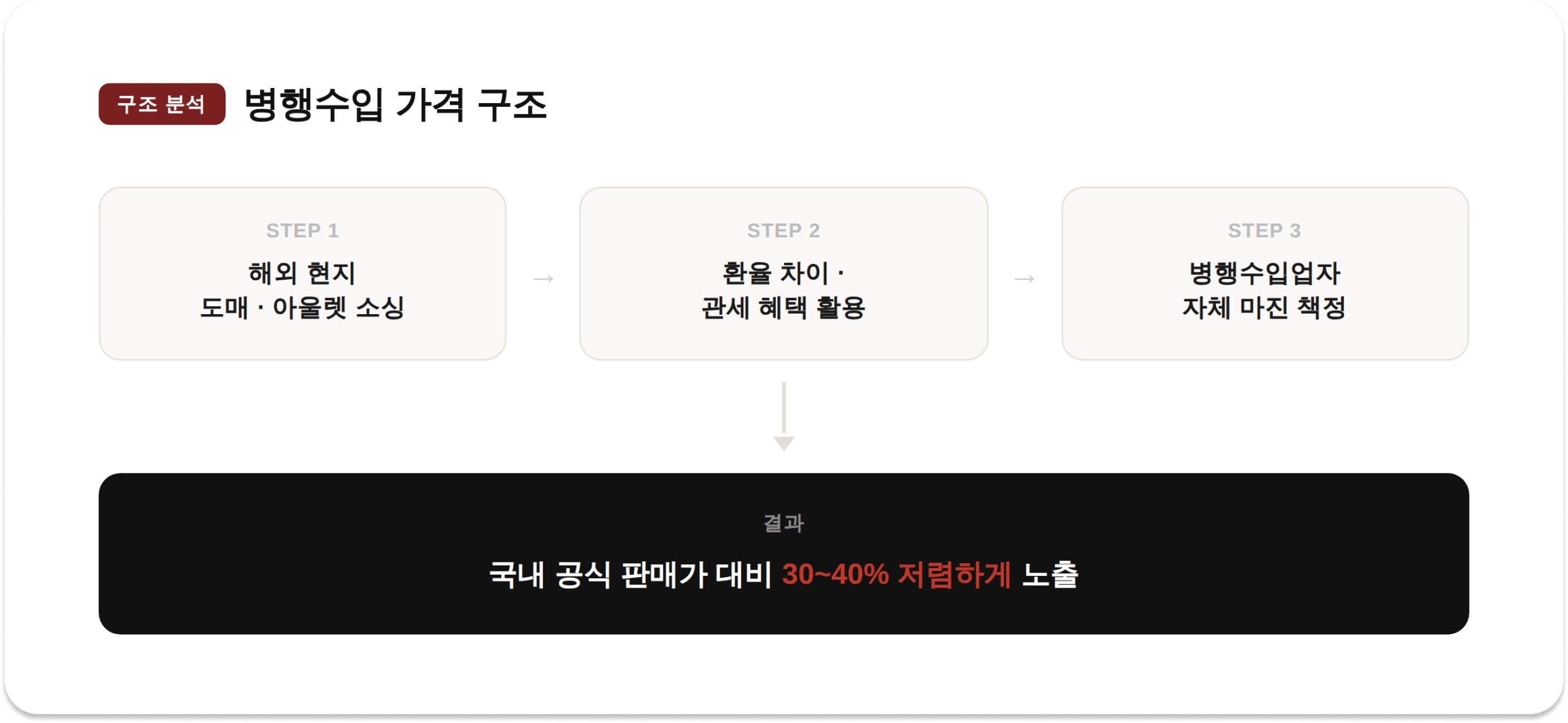
One of the points where confusion over pricing policy terms manifests as a most practical problem is parallel imports. Parallel import refers to a method where a third party, rather than an entity that has signed an official import contract with a global brand, purchases genuine products legally distributed through separate routes such as local outlets or wholesalers overseas, and brings them into the country to sell. It has been legalized in South Korea since 1995, allowed for the purpose of expanding consumer choice and stabilizing market prices (mitigating monopolies). Since it is not illegal, it is difficult for the headquarters owning the brand to fundamentally block their importing activities.
The problem is that the standard price of parallel imported products follows the price system of the country of origin. For example, when a product distributed under India's MRP enters the domestic market as a parallel import, a gap occurs between the product's origin country baseline price and the selling price of domestic official channels. Since India's MRP is a price reflecting local taxes and distribution structures, it is difficult to simply compare it with the price of Korean official channels, where exchange rates, tariffs, and domestic distribution margins are additionally added. The structures of the two prices are completely different, but in the eyes of consumers, it simply looks like the exact same product has different prices depending on the channel.
To explain in more detail, parallel importers do not spend any fixed costs such as large-scale domestic marketing expenses, CS establishment costs, and offline store maintenance costs that official importers or brand branches must bear. On top of that, if the local MRP itself is set low to match the income level of a specific country, the parallel importer enters the domestic open market carrying that price advantage entirely.
As a result, a phenomenon occurs where a product sold at 100,000 KRW in official domestic channels is openly exposed in the 60,000 KRW range in parallel import deals on Coupang or Naver Smart Store.
The same goes for products marked with UK/Europe standard RRP. Since RRP is a recommended price with no legal binding force and is a price reflecting local VAT and distribution structures, it is difficult to compare directly with official domestic channel prices. Nevertheless, when products entering as parallel imports are distributed at prices lower than official channels, brands have no direct means to control them.
When this price gap accumulates, two problems arise. First is official channel sales cannibalization. Even if the headquarters spends massive advertising costs to raise brand awareness on Naver or Instagram, the final purchase increasingly happens on the page of cheaper parallel import sellers. A structure repeats where official channels bear the marketing costs, while parallel import channels take the actual purchases. In other words, the place that sows the seeds and the place that reaps the fruits become different. It is a natural behavior for consumers to choose the route where they can buy the same product cheaper, and this directly leads to a decrease in the sales volume of official distribution channels.
Second is the issue of consumer trust. The wider the price gap between official channels and parallel import channels, the more consumers feel that official channel prices are excessively high, or conversely, they look at the low price of parallel imported products and start to doubt whether they are genuine. Even if it looks like the brand is directly controlling prices, a situation is created where parallel import channels are actually shaking the market's price standards.
Then, in this intricately tangled distribution structure, should practitioners just sit back and watch? If global price languages that differ by country are jumbled up and shaking the domestic market, practitioners must ultimately look into the status of price exposure by channel themselves and correct the standards.
You can catch price-violating sellers even without paid tools: 3 methods used by practitioners
Even without a grand system or separate paid tools, there are ways to check if the pricing policies established by the brand are being properly observed in the actual market. We have organized 3 realistic manual monitoring methods that you can start right away, so use them as the first step to correcting your brand's distribution order.
First, take periodic price snapshots.
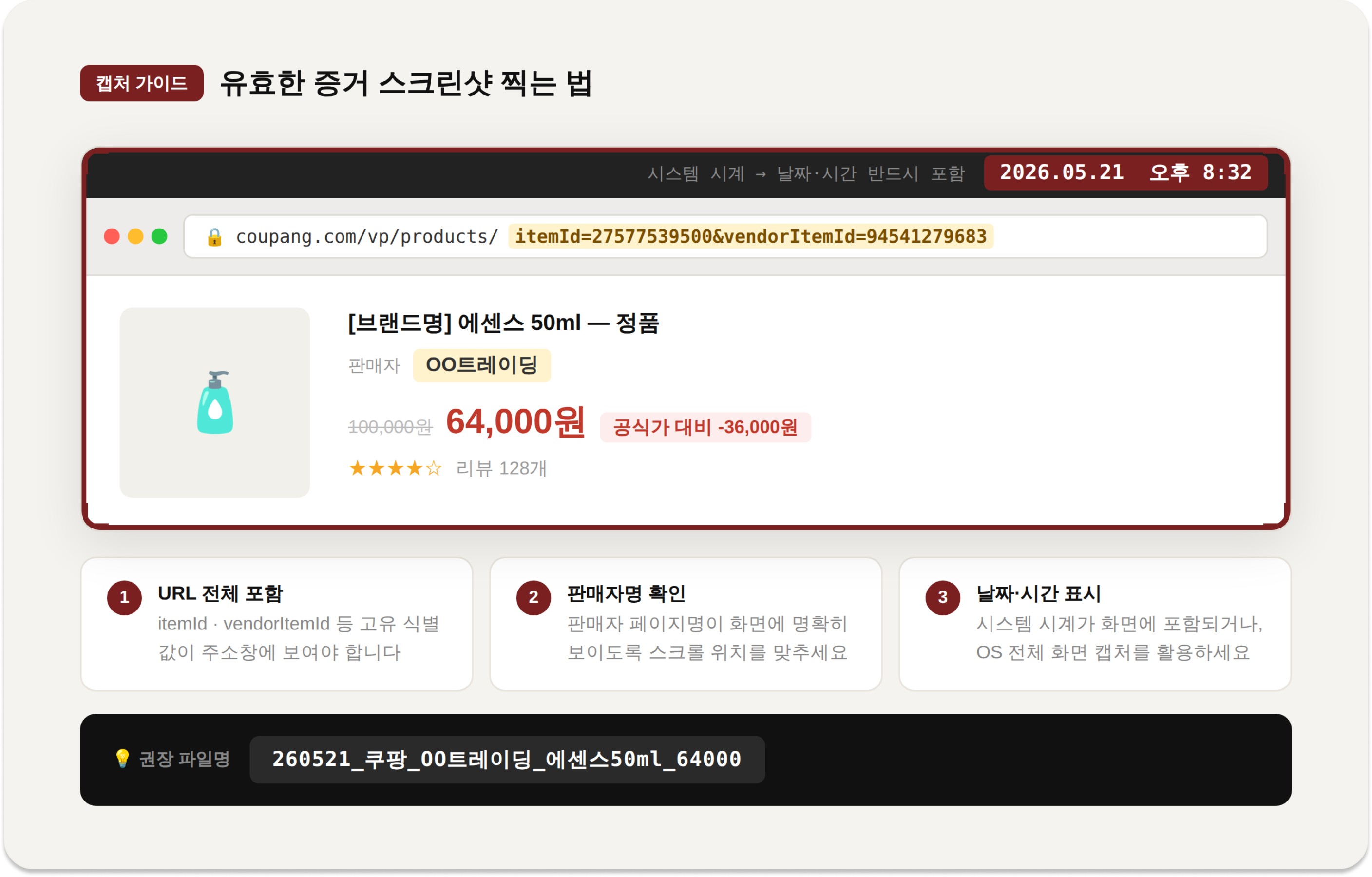
When you find a price violation, you need evidence of "when, on what channel, and at what price it was sold" to take effective action when notifying the seller or reporting to the platform. Rather than verbal complaints, a single captured image serves as a much stronger basis. Simply saying, "I saw it selling for 30,000 KRW yesterday," has no effect. This is because they use a 'hit-and-run' strategy of raising and lowering prices frequently.
💡 Practical Tip: If you find the detail page of a major violating seller, you should capture a screenshot so that the URL address, seller name, and system clock (date and time) are all visible on the entire screen. Unify the file name in the format of [260521_Coupang_SellerName_ProductName_SalePrice] and archive it in a folder. If you store them in folders divided by date, tracking history later becomes easier. Especially for sellers where violating prices repeatedly appear, the captured data accumulated over time can serve as valid evidence during the response process.
Second, try monitoring keywords using Google Alerts.
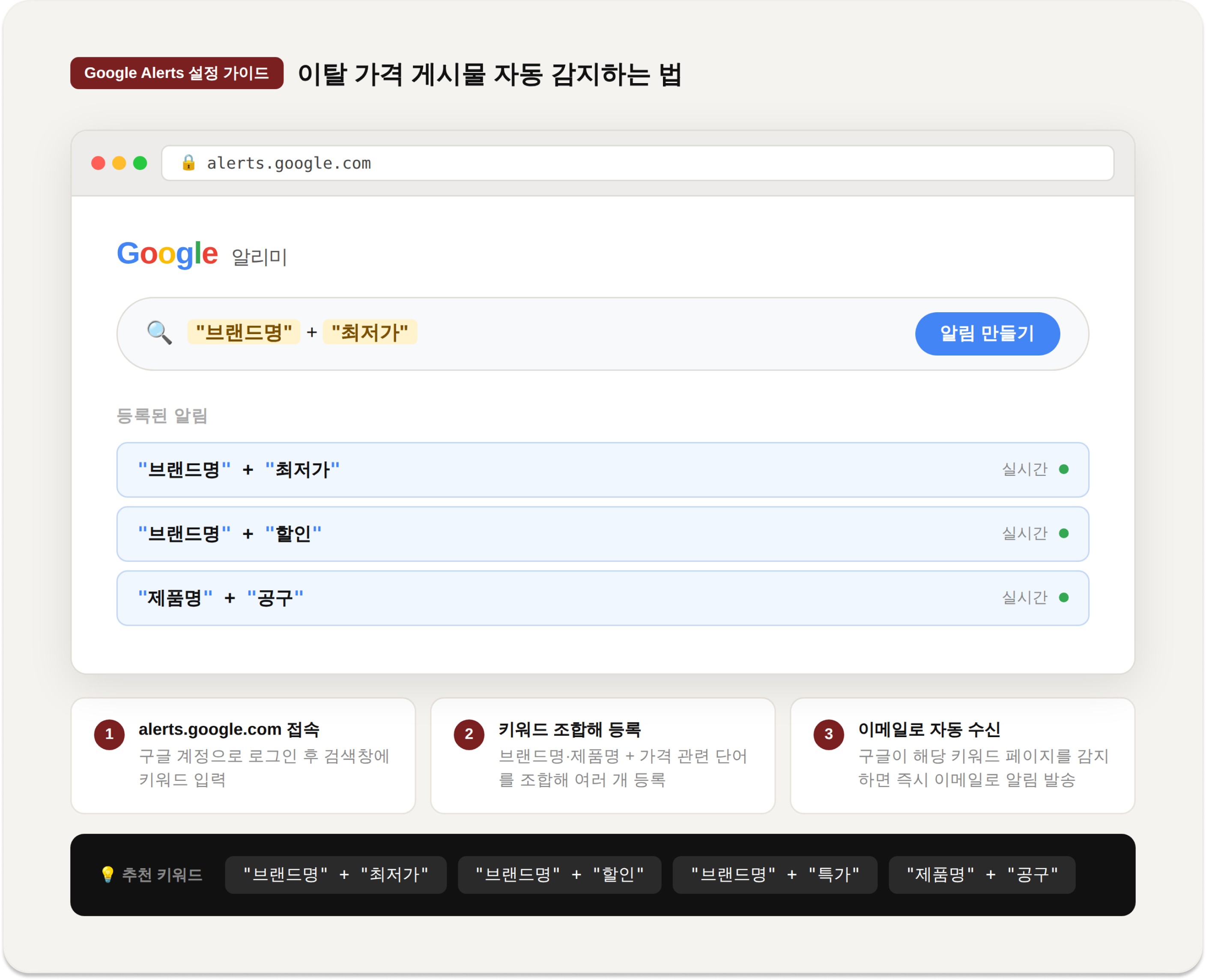
If you cannot search all portals all day long, you can use Google's free automatic alert feature as an indirect sensor.
💡 Practical Tip: Try setting up Google Alerts by combining your brand name with price-related keywords such as "lowest price", "discount", and "special price".
Example registration terms:
"Brand Name" + "lowest price","Brand Name" + "discount","Product Name" + "group buy"
If you set it up like this, when an unofficial seller posts guerrilla-style promotional articles with unconventional prices on blogs, cafes, or specific small commerce platforms, Google will collect the pages containing those keywords and you can receive notifications by email. Since it can only detect pages indexed by Google, making it difficult to cover all channels, it has limitations. However, it is free, simple to set up, and can identify violating prices exposed on major portals and price comparison sites to some extent. It is a method fully worth utilizing in practice, in that it can detect abnormal signs much faster than having no monitoring device at all.
Third, create a routine for regular checks on major platforms.
Create a routine to directly check platform search results 1-2 times a week with your brand name and major product names. When checking, it is recommended to check not only the price but also which seller is selling with what image and detail page. If you record the checked content in a spreadsheet with items such as date, platform, seller name, and selling price, it will help you grasp price change patterns over time.
This record must accumulate to start seeing which sellers repeatedly list violating prices. If you record manually for just 3 to 4 weeks like this, a few key dumping sellers who uniquely break prices repeatedly will start to stand out. Just by targeting them for intensive management and contacting them, you can put out the initial big fires.
💡 Practical Tip: Designate a specific day and time each week as 'price check time' and create and record in a Google Spreadsheet with a simple structure like below.
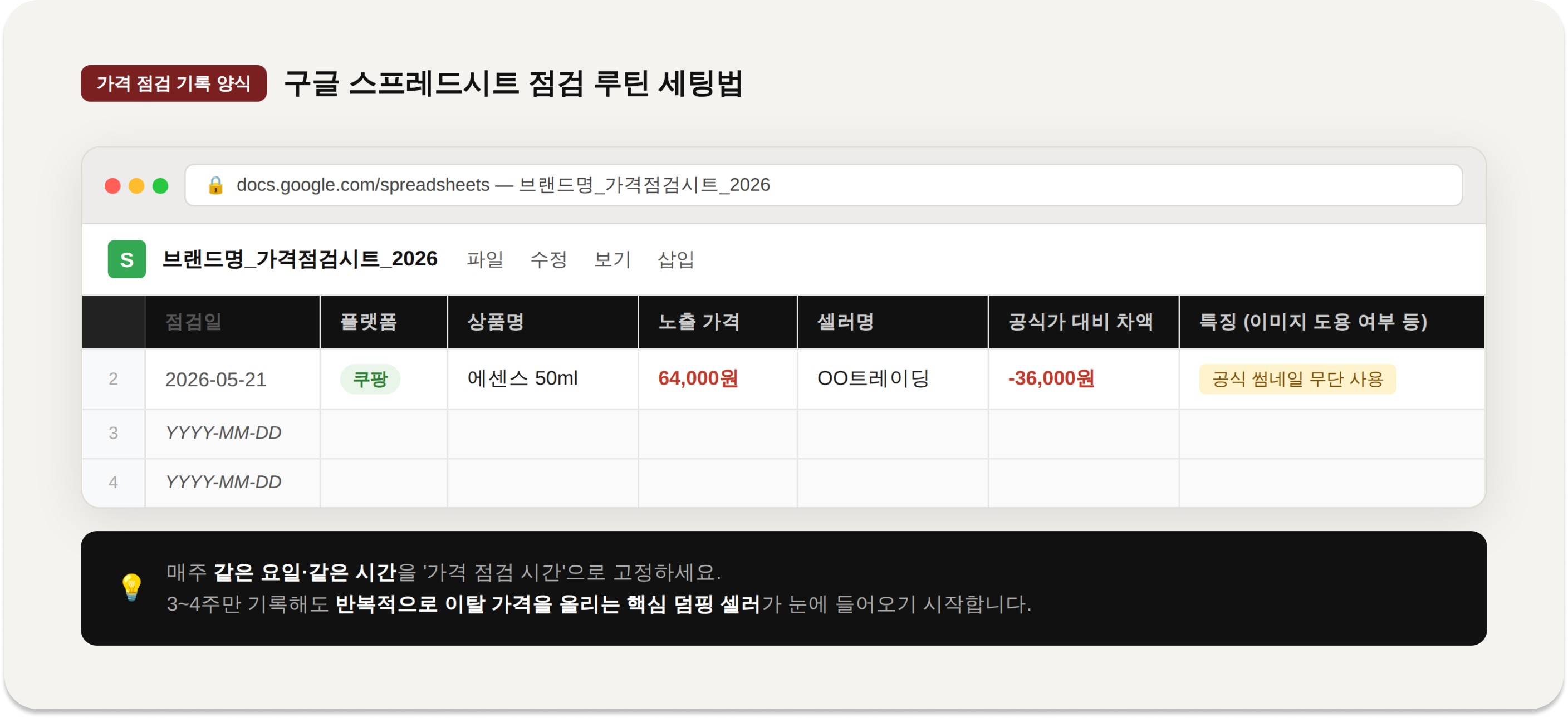
These methods work quite excellently in the early stages when the number of SKUs handled is not large. However, if the managed items increase or sellers start responding by lowering prices only during times when managers cannot easily check, such as nighttime or weekends, manual monitoring alone will eventually hit a limit. At that point, considering the introduction of an automated monitoring solution is also a good choice. Ultimately, the important thing, whether manual or automatic, lies in the action itself of looking into real-time market prices directly and clearly establishing the standards of the policies we set.
Price management starts not with a perfect system, but with 'turning on the search bar right now'
If you have organized the terms of global pricing policies, grasped the structure of parallel imports, and set the policy direction, the basic foundation for distribution control is ready. Now, all that's left is to actually move.
Right now, try searching your brand's core product names on Coupang or Naver Shopping. If an unfamiliar seller appears, check what price and image they are selling with. And capturing that screen—that is the start of monitoring. You do not have to start grandly. As single searches and captures accumulate, you will start to see patterns of which channels have repeated price violations and which sellers are the problem. The experience of directly tracking the scene of price violations, even manually, is the first step to seeing with your own eyes where your brand's distribution network is leaking.
Knowing the terms accurately is to design policies properly, and establishing policies is to manage the actual market. Price management does not start after equipping a perfect system, but starts from looking directly at where, for how much, and by whom my brand is being sold right now.