Counterfeit
Short-lived counterfeit sales on SNS: A 3-step response guide for brand managers

💡 In this article, you can check the following content.
Targeting only luxury bags? Now expanding to cosmetics, auto parts, and K-pop goods
Sell short, delete, and disappear: Why enforcement alone is not enough to stop it
Before they disappear, after they are gone: Three ways to capture their traces
Brands that wait for enforcement vs. Brands that look at distribution first
Last year's counterfeit product crackdown results have been released. According to the Intellectual Property Office, about 140,000 counterfeit items were seized during the year 2025, reaching 432.6 billion KRW based on the genuine product value. What stands out is the magnitude of the increase. Compared to the previous year's 13.4 billion KRW, it is more than 32 times larger in scale.
Looking only at the numbers, it reads as an achievement indicating that crackdowns have become that much stronger. Indeed, the Intellectual Property Office also explained it as a result of raising the intensity of crackdowns. However, the same figure can be viewed a bit differently. The fact that the volume of exposure jumped 32 times in just one year also means that the volume and value of counterfeit products released in the market have grown that much larger as well.
There is one more thing to consider. The volume caught through crackdowns is highly likely to be only a fraction of the actual distribution. Getting caught means belatedly removing some of what has already been released to the market, and volume sold quietly before disappearing doesn't get captured in the statistics to begin with. In other words, the figure of 432.6 billion KRW is only the 'revealed part,' and the unrevealed part could be much larger than that.
The problem is that this blind spot, which is not captured in statistics, constitutes a substantial crisis for brands. By the time counterfeit products are caught and captured in statistics, brands are often already suffering damage such as shaken price order and eroded consumer trust. Furthermore, recently, both the items targeted by counterfeiting and the methods of their distribution are changing rapidly, deepening the concerns of brands. Indeed, in this article, we will first point out how counterfeit product distribution and target items are evolving, and then look at counter-strategies that brands can execute directly in the field right now, before waiting for the post-crackdown results.
Do they only target luxury bags? Now it's cosmetics, car parts, and even K-pop merchandise
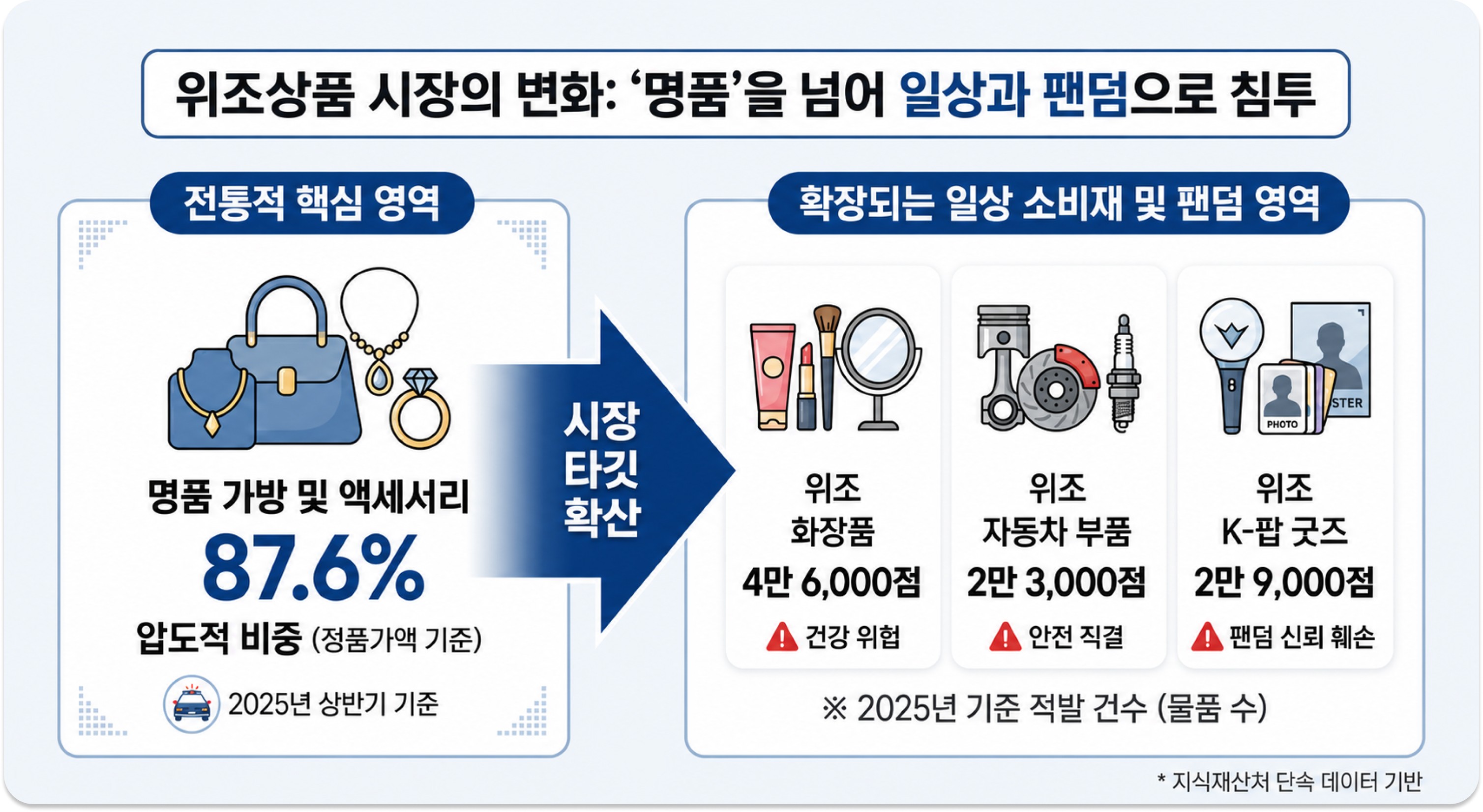
When people think of counterfeit products, they often think of luxury bags or clothing. In fact, looking at the scale of exposure last year, the proportion of luxury goods was still overwhelming. According to the Intellectual Property Office, in the first half of 2025, over 39,000 counterfeit luxury accessories (genuine product value of 340 billion KRW) were seized, marking the largest single-case scale since the launch of the trademark police. As accessory items account for 87.6% of the total based on genuine product value, the gravity of the counterfeit product market is still tilted toward luxury goods.
However, the change to watch out for is happening outside of that. This is because the targets of counterfeiting are expanding beyond luxury goods to daily consumer goods. Last year, about 46,000 counterfeit cosmetics (genuine product value of 2 billion KRW) and about 23,000 counterfeit auto parts (genuine product value of 250 million KRW) were seized. In terms of the number of items, cosmetics is also a category growing in share to 7.4%, following accessories.
The reason why this change, which goes beyond simple fashion counterfeits and penetrates into consumers' daily lives, is even more concerning is that it directly threatens the health and safety of consumers. Cosmetics directly touch the skin, and car parts are directly related to safety. While counterfeiting of bags or clothing was mainly a matter of price and brand value, counterfeiting of cosmetics and parts has crossed over into areas where consumers can actually suffer physical harm. Consequently, the weight of reputation damage borne by the brand also changes. If a consumer who thought they bought a genuine product experiences skin trouble, that blame is easily directed towards the brand, not the counterfeit seller.
The expansion of items has also extended into the fandom domain. Last August, the Intellectual Property Office seized about 29,000 counterfeit goods (genuine product value of 500 million KRW) that capitalized on K-pop popularity. This is a case where fans, who bought products believing they were official goods of their favorite artists, end up receiving counterfeits, which is also a point where the trust between the brand and the fans is directly shaken. Counterfeit goods, once considered an issue only for the single category of luxury items, have now spread to cosmetics, parts, and merchandise, making it difficult to say "our category is an exception." And these diversified items are trickling into the market through distribution methods that have become even more secretive and cunning to avoid the eyes of enforcement.
Sell quickly, delete, and disappear: Why is it hard to stop with enforcement alone?
Unlike in the past, counterfeit products no longer stay in a specific place for long. While past counterfeit transactions were centered around offline stores or fixed online shopping malls, recently, the stage has moved to SNS and live broadcasts. The Intellectual Property Office also stated that last year, in response to counterfeit transactions through SNS such as Naver Band, Instagram, and YouTube, they criminally booked 44 people and seized about 17,000 items (genuine product value of 12.7 billion KRW).
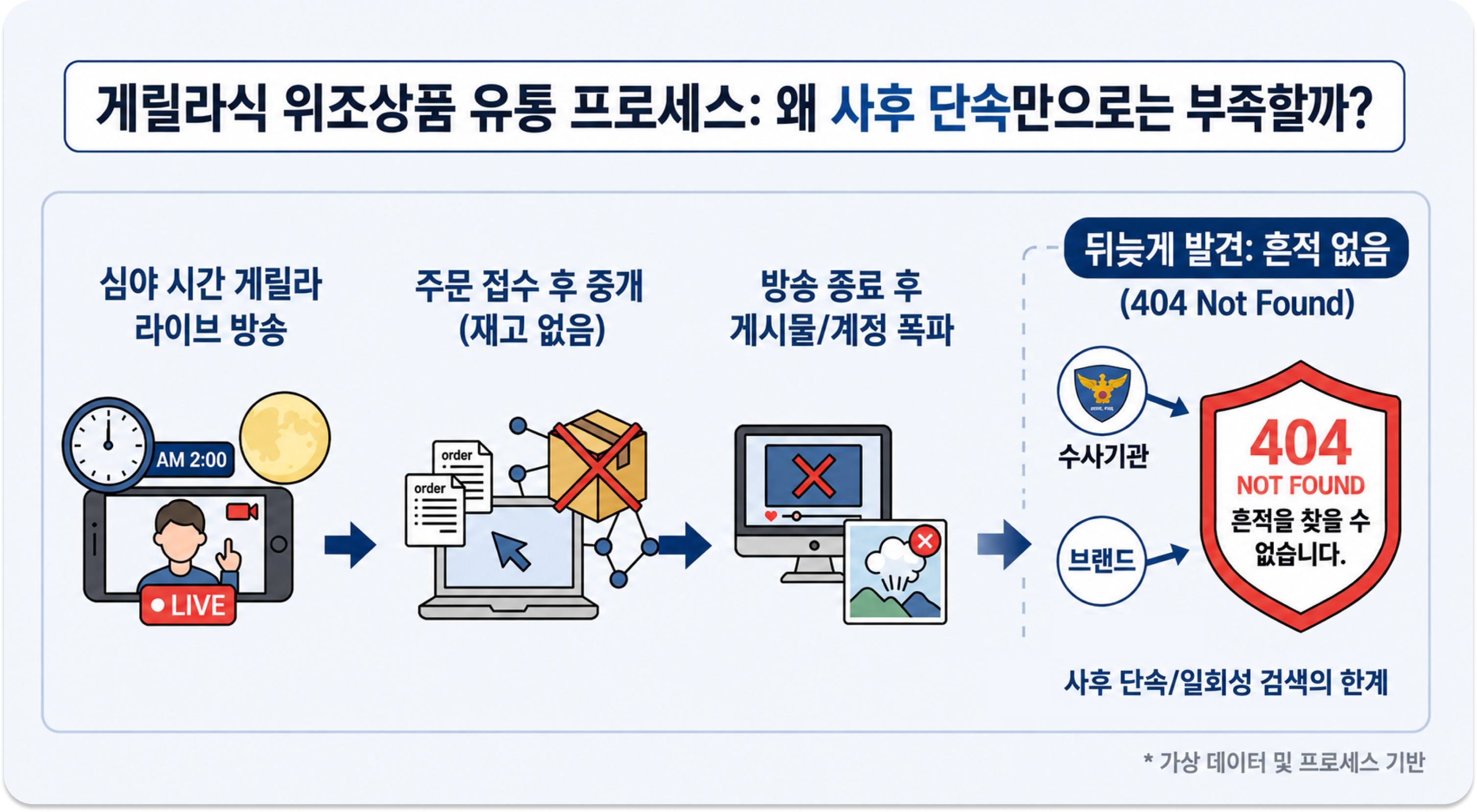
The problem is that this method makes detection extremely difficult. Among the cases detected by the Intellectual Property Office, there was a live broadcast method that used overseas platforms to sell in short periods during late-night hours and then deleted the posts. To crack down on just this one case, they had to go through months of monitoring and undercover investigation before raiding the scene, resulting in 22 people being criminally booked. The fact that investigative agencies had to spend several months to catch a single transaction that sells quickly and erases traces shows how tricky this distribution method is to capture.
Why it is so hard to catch can be understood by looking into the transaction structure. In a media report, a former counterfeit seller explained that modern sellers do not stock inventory themselves but operate by connecting orders in the middle and receiving only commissions. Since they do not hold the volume, there are no suitable goods to seize even if the live scene is raided. Transactions mainly occur late at night when there are few people, and sales posts disappear when the broadcast ends. It was also shared that even if a platform suspends an account, it is simple enough to just create a new account under someone else's name.
In this structure, crackdowns are bound to be a step behind. As mentioned earlier, detection is the act of checking transactions that have already occurred after the fact, but the transaction traces themselves are quickly erased. If it is something that even investigative agencies must dedicate months to, it is easy for a brand to take even longer to recognize it on their own. By the time a brand realizes that "counterfeits of our products are circulating," it is not uncommon for several transactions to have already concluded and the posts to have disappeared.
Then, must brands stand by helplessly in the face of this 'hit-and-run' guerrilla-style distribution structure? Fortunately, there is a clue to the solution. It is to preemptively collect clues left by them before and after they erase their traces.
Before they disappear, after they disappear: Three ways to capture traces
Just because a sales post disappears in an instant does not mean it leaves no clues. There are definitely clues in the short time the post is up and in the patterns of the same seller reappearing in a different guise. You can start gathering key clues right now to protect your brand, even without grandiose tools.
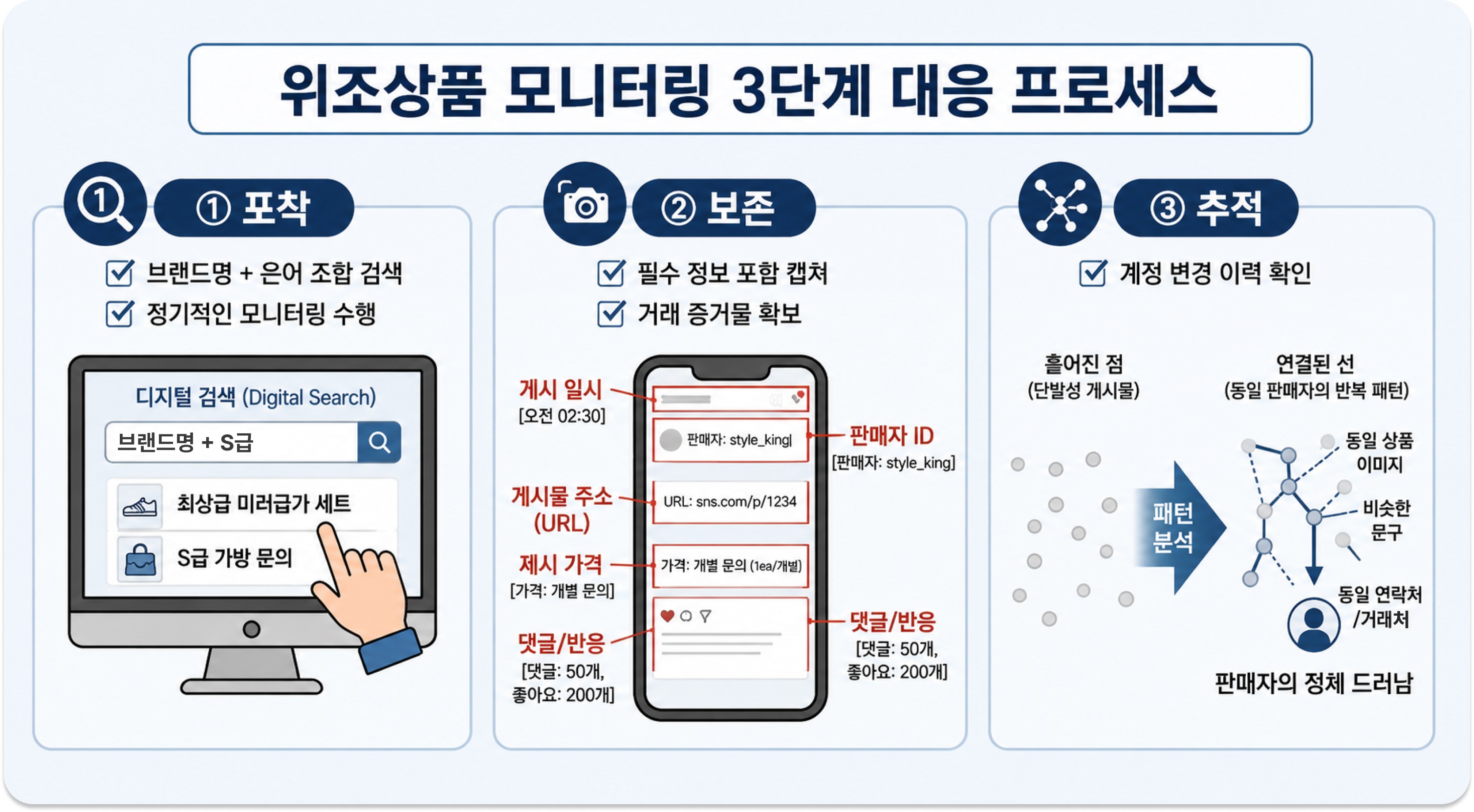
❶ Capture — Search using ‘slang they use’ instead of the brand name
Counterfeit sales posts often do not expose the official brand name as is. This is to avoid getting caught in searches or reports. Instead, sellers use their own expressions that imply the item is fake. Standard examples include grade expressions such as 'mirror grade', 'SA grade', '1:1 grade', 'replica', or attaching 'style' after the brand name, or directing to 'private inquiry' without listing the price. According to a survey of sales posts on Naver Band, Instagram, etc., by the Korea Consumer Agency, these counterfeit-implying expressions were confirmed in about half (51.8%) of the posts.
Therefore, if you search only for your brand name alone, it is easy to see only official information while the problematic posts are missed. If you search by combining such slang with the brand name, posts that were previously invisible are often revealed. Try creating a routine of constantly tracking 'product name + slang' for a few major products where fakes are frequently distributed. You can find blind spots much more closely than through passive searching.
❷ Preserve — Keep the screen before it disappears
The biggest characteristic of this distribution is that the posts do not remain for long. Therefore, if you find a suspicious post, it is more important than anything to leave a record right then and there. This is because if you try to find it again later, it has often already disappeared.
When recording, capture the screen, but it is recommended to capture it so that the posting date and time, the seller's account ID, the post address (URL), and the offered price are visible together in one screen. If you also leave reactions like comments or 'likes', it will serve as a basis for estimating the scale of transactions later or for comparison when you encounter the same seller again. After the post disappears, this record becomes virtually the only evidence that the transaction existed.
❸ Track — Gather scattered records to find re-emergence patterns
The weakness of disappearing sellers is that they eventually have to reappear to continue their business. The Korea Consumer Agency survey also confirmed cases where the same business operator used up to six different trade names, or sold the same product on multiple platforms simultaneously. Even if one account disappears, the same seller re-posts the same item under a different name.
This is where the records gathered earlier show their power. When looked at individually, they seem like one-off posts, but as screenshots accumulate, repeating characteristics catch your eye. This is because traces that the seller cannot change—such as the same product photo, similar phrasing, and identical contact information or price ranges—remain even when they switch accounts. When you start connecting these scattered dots into lines, the profile of "the same seller returning with only a changed account" becomes visible, and when reporting to platforms or responding, the accumulated circumstances showing that "the same violation was repeated across multiple points in time" serve as a much more concrete basis than a single screenshot.
Brands waiting for crackdowns vs. Brands observing distribution first
Let's go back to the first numbers again. The crackdown scale of 432.6 billion KRW is certainly a meaningful achievement, but at the same time, it is also a record that that much counterfeit product has been traded in the market. And crackdowns operate after those transactions have already taken place. While detection and punishment take place, the fracture in price order and damage to consumer trust suffered by the brand is often already underway before then.
Government crackdowns and brand monitoring have different roles. If crackdowns place weight on processing after detection, what the brand directly looks into is at an earlier stage, namely checking "where and how our products are being traded right now." The capturing, preserving, and tracking we looked at earlier are the starting points. Even if we cannot prevent all disappearing posts, just by collecting scattered clues to make invisible flows visible, the room for brands to respond definitely widens.
Taking it a step further from here, when you turn this check into a continuous flow instead of a one-time inspection, more things begin to show. As counterfeit distribution occurs late at night, briefly, and across multiple channels, rather than looking in once in a while, the more you constantly monitor distribution channels, the higher the chance of capturing signs of a same seller's re-emergence or new transactions at an earlier stage. Instead of waiting for crackdown results to be compiled into statistics, brands looking first at the scene where their products are traded—as counterfeit products quickly change their appearance now, a starting point for brand protection is created by changing the direction of that gaze.