Price Management
How far can the US MAP policy be controlled?
💡 In this article, you can find the following information.
Why MAP policies are allowed in the United States
Application and legal structure of the US MAP policy
Implementation and management of the US MAP policy
Background of the widespread use of MAP policies and their limitations
Conclusion
If you are a domestic brand practitioner considering entering the US market, you must have thought about the Minimum Advertised Price (MAP) policy at least once. In particular, the US is known as a representative country where the MAP policy can be legally utilized, but if you do not accurately understand its structure and scope, you will experience great confusion in practical application. In this content, we will systematically examine the legal basis for allowing MAP in the US, practical operation methods, drafting of contract clauses, and judicial precedents and differences in state regulations.
Reasons Why MAP Policy is Allowed in the US
The US is one of the countries where the Minimum Advertised Price (MAP) policy is most actively applied in the world. This is because US antitrust laws allow price control centered on **advertising conduct** rather than the selling price itself. Since MAP is a structure that limits only the "advertised price" presented to consumers, it is recognized as legal as long as it does not suppress competition.
The US Federal Trade Commission (FTC) and antitrust experts interpret that if a brand unilaterally announces a minimum advertised price MAP policy such as "do not advertise below this price" without separate consultation with the seller, it is generally not viewed as a violation of Section 1 of the Sherman Act (US Antitrust Act). In other words, if a brand independently sets the advertising price standard and stops transactions with sellers who violate it without agreement with the seller, it is not considered price fixing, meaning there is low potential for violating antitrust laws. However, according to legal experts, some say that the MAP policy is not explicitly approved by the FTC, but is merely considered not illegal. Jarod Bona, an antitrust lawyer, points out that "MAP policy applies only to advertising and has no binding force on the selling price, so it is legal in principle, but there is still potential for illegality depending on how it is designed and executed." For this reason, US MAP experts recommend that brands must collaborate with their legal team before introducing the MAP policy.

In fact, under the minimum advertised price MAP policy, sellers can freely adjust the selling price in various ways, such as prices shown after adding to the cart, personalized discounts provided only to logged-in customers, and individual quotes through telephone consultation. As such, brands can require only the 'price displayed in advertisements' to be maintained above a certain level, so the MAP policy does not suppress price competition and does not infringe on the actual freedom of transaction between consumers and sellers, while serving as a means to maintain the brand's distribution strategy.
The definition of advertised price is also important. It generally includes the following cases:
Prices displayed on the brand's homepage or official sales outlets
Promotional prices posted in emails, print media, or social media
Prices on product introduction pages of third-party reseller platforms (e.g., Amazon, Walmart)
On the other hand, the following items are not considered advertised prices:
Prices visible only after placing the product in the shopping cart
Private discounts exposed only to logged-in customers
Private customized prices such as telephone quotes
This shows that the minimum advertised price MAP policy does not practically control consumer prices, but is a device to manage the impact of price reduction competition on brand image. It is a very effective tool, especially for premium brands or brands that want to maintain distribution order. Thanks to this nature, the MAP policy is positively evaluated in various aspects, such as maintaining price order throughout distribution, preventing overheated competition among resellers, and protecting brand value.
※ However, restricting the selling price itself or enforcing price maintenance is considered "Resale Price Maintenance (RPM)" and carries legal risks, and may be considered illegal depending on the State.
Application and Legal Structure of US MAP Policy
Scope of Application and Major Cases of MAP Policy
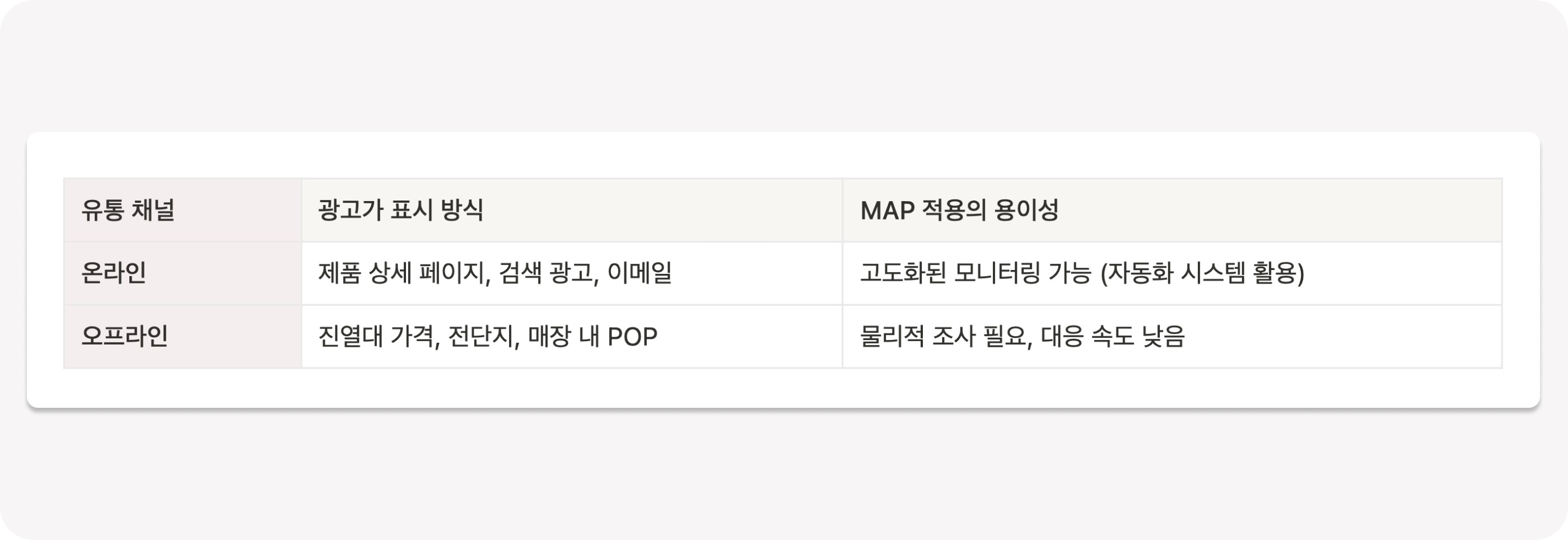
The minimum advertised price MAP policy can be applied to both online and offline distribution channels in the US, but the operation method varies depending on the characteristics of each channel. On online reseller platforms such as Amazon and Walmart, advertised prices are directly exposed on product detail pages, making it easy to detect MAP violations, and actions are sometimes taken through real-time monitoring systems. On the other hand, in the case of offline retail, advertisements, displayed price tags, and flyers serve as means of verification, and in this case, actual monitoring personnel and on-site investigations often must be conducted in parallel.
Differences in Application by Online/Offline Distribution Channel
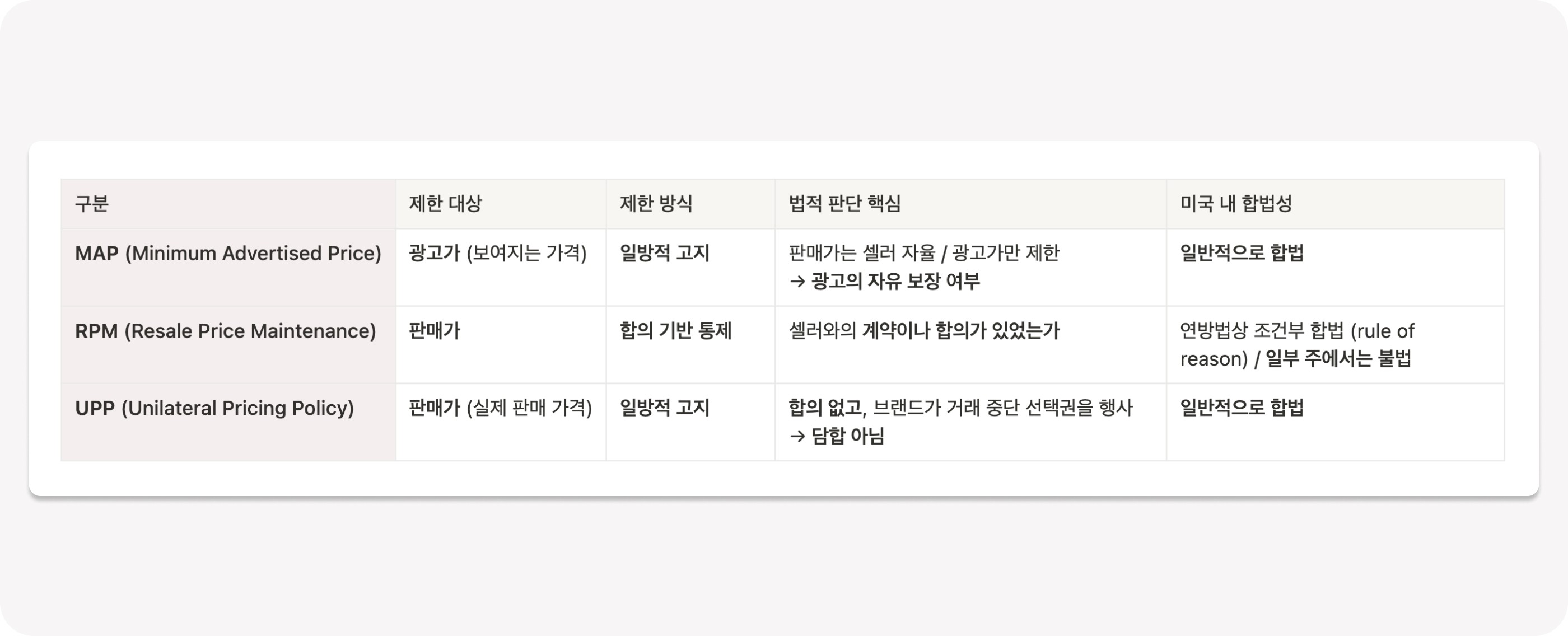
Three Major Structures of US Pricing Policy: MAP, RPM, UPP
In US practice, three policies are used interchangeably: MAP, RPM, and UPP.
MAP: Controls only the advertised price. (Generally considered not to be a violation)
RPM: Enforces the selling price. (Conditionally legal, but banned in some states)
UPP (Unilateral Pricing Policy): The brand unilaterally presents the price and can stop supply in case of violation. (Generally legal)
Since the Supreme Court's Leegin Creative Leather Products, Inc. v. PSKS, Inc. ruling in 2007, the rule of reason principle has been applied to RPM at the federal level. In other words, it is not unconditionally illegal, but whether it is illegal is determined by considering its impact on market competition.
However, some states, such as California, New York, Illinois, and Maryland, still prohibit or very strictly regulate RPM. For example, California in principle considers RPM illegal under the Cartwright Act, and there have been cases where courts determined it to be an antitrust violation. Therefore, even if a brand secures legality at the federal level, the risk must be reviewed again if the distribution area includes those states.
Because of this background, many brands utilize MAP, which controls only the advertised price, and UPP, which focuses on cutting off transactions, rather than RPM, which directly specifies selling price control. In particular, since UPP is a method in which a brand unilaterally announces its position, "We will not do business with sellers who advertise below this price," it can be operated without seller consent or entering into a contract, and carries less legal risk.
Comparison Table of MAP, RPM, and UPP
🤔 Why is UPP legal when it restricts the selling price?
The key is whether there is "agreement (collusion)."
UPP is a brand unilaterally announcing its position that "it will not do business with sellers who sell below this price."
Sellers do not have to keep this price, but in return, they may not receive supply from the brand.
There is no 'contract' or 'agreement' between them. For this reason, in the US, the general interpretation is that it does not violate Section 1 of the Sherman Act (prohibition of collusion).
📌 What is legally important is "whether the brand forced the price on the seller" and "whether they agreed in advance." UPP is not coercion, but a choice of transaction terms.
Execution and Management of US MAP Policy
MAP Contract Templates Used in US Practice
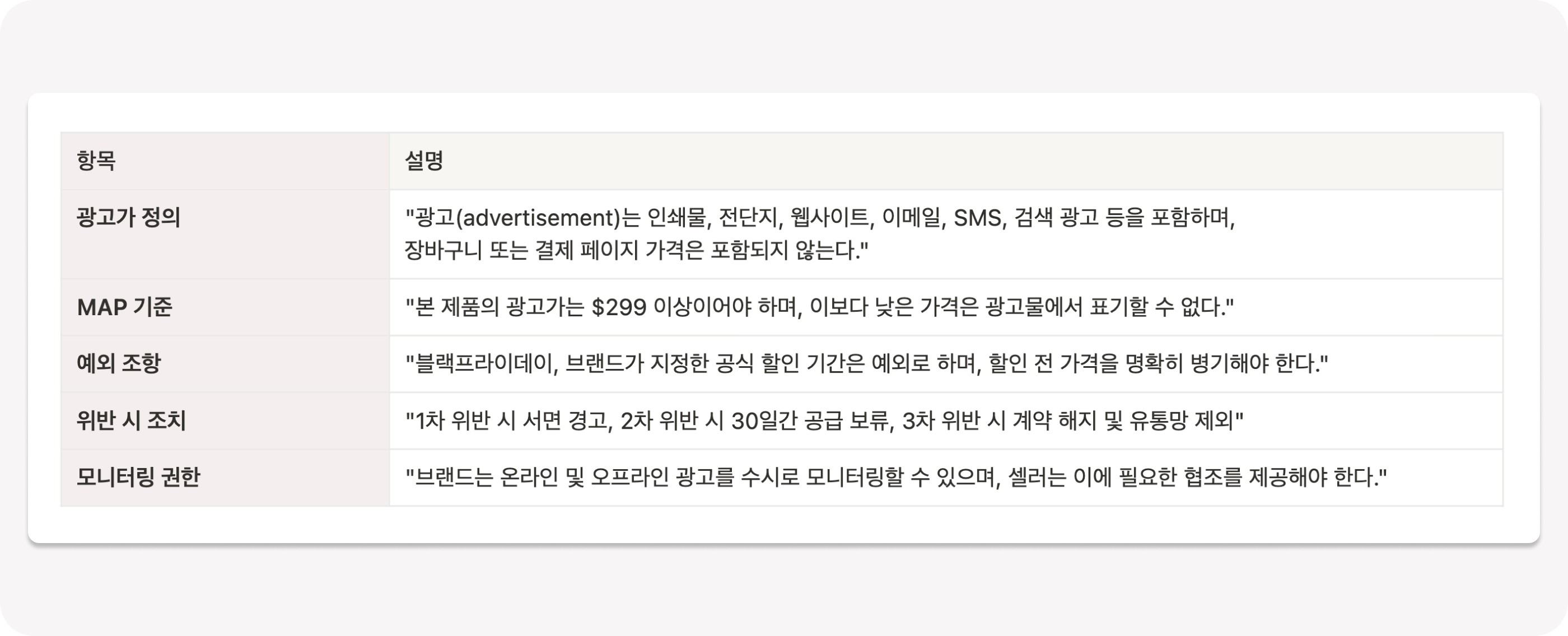
When reflecting the MAP policy in a contract, it is not enough to simply specify the reference price; it must include various exceptional situations and execution routines. Contracts used by actual brands include clauses such as the following.
Summary Example of Key Clauses in MAP Contracts (Based on Pillsbury Law, Lexology, and Actual Brand Materials)
For example, Karndean, a British luxury vinyl flooring manufacturer, details its legal structure and operating method through clauses such as the following in its official MAP policy applied to the US:
Non-contractual declaration: "This MAP Policy is a unilateral statement... and is not a contract or agreement with any reseller." → This clarifies that the structure implements the policy through unilateral notice without signature.
Specification of advertised price standard: "The Minimum Advertised Price for each product is listed in the Karndean Price List." → The standard advertised price for each product is specified in the official price list.
Selling price autonomy: "Prices shown only in the cart or at checkout are not considered advertised prices." → By not considering prices in the cart and checkout stages as advertised prices, the seller's actual selling price freedom is guaranteed.
Sanction method: "Violation of this Policy may result in immediate termination of supply." → Strong response measures, including termination of supply, are specified.
The MAP policy document of Minwax, a US wood finish manufacturer, follows a similar structure and includes the following clauses:
Specification of scope of application: "This Policy applies to all forms of public advertising... including but not limited to print, broadcast, online, and in-store signage." → It broadly defines the advertising scope to include offline as well as online.
Step-by-step sanction regulations: "Failure to comply may result in penalties including loss of cooperative marketing funds, quantity restrictions, or account termination." → It guides specific follow-up actions step-by-step, such as warnings, suspension of marketing support, and transaction restrictions.
As such, actual templates clearly distinguish and describe the legal nature of the policy, the distinction between advertising and sales, and the level of sanctions in case of violation at the sentence level.

This table can be used as a reference point when Korean brands design templates for the US market in the future or compare differences between the two systems. If a Korean brand wants to introduce the MAP policy to the US, it needs to comprehensively consider and compare the policy's notice method, advertising scope, securing selling price autonomy, and whether sanction measures are specified, beyond simply specifying price standards. This is because if only simple price standards are specified, there is room for sellers to ignore them and still avoid legal sanctions.
Background and Limitations of Wide Utilization of MAP Policy
The MAP policy has established itself as a key tool of distribution strategy in the US. In particular, in a competitive market led by large online platforms such as Amazon and Walmart, the US distribution structure consists of various 'official' and 'unofficial' sellers, making it difficult for brands to directly control the prices of all sellers. In this complex structure, MAP is utilized as an efficient device to execute brand strategies through indirect control measures called advertising. Brands are actively introducing MAP to maintain price order and prevent excessive discount competition among sellers.
As already examined, MAP is operated in the form of a brand's unilateral policy notice, not a contract, and because it limits only the advertised price, it is generally considered not illegal in the US. Based on this, brands can strategically adjust transaction terms with resellers through distribution sanctions such as suspension of supply. This structure can be a flexible means for maintaining price order even in a digital distribution environment.
In addition, as in the cases introduced in the text, the MAP policy exerts its effectiveness when clear criteria are set, systematic responses to repeated violations are established, and an automated monitoring environment is equipped.
Difficulties in Enforcement and Automated Responses
Even if a minimum advertised price MAP policy is set, to operate it effectively, violations must be regularly monitored, and follow-up measures leading to warnings and suspension of supply must be systematically executed. However, in reality, the following difficulties occur:
Difficulty in checking prices manually one by one on multiple reseller channels such as Amazon and eBay
Increased detection difficulty when the same seller attempts to detour sales using another account
The issue of sellers automatically discounting below the reference price through automated price linkage systems
Due to these operational difficulties, global brands are also increasingly utilizing lowest price monitoring solutions. For example, Reatrich's automated solution periodically collects price information from major open markets and reseller platforms, and diagnoses whether prices deviate from the reference price in real time, supporting brand managers to respond quickly.
Through this, it is possible to reduce repetitive manual work and increase the brand's execution power of the MAP policy. In particular, for companies holding a large number of SKUs (Stock Keeping Units), the introduction of such an automated system is emerging as a strategic necessity.
※ SKU refers to a product unit managed differently according to combinations such as color, size, and composition, and a systematic management system is required because price monitoring and violation detection become more complex as the number of SKUs increases.
In Conclusion
To properly utilize the minimum advertised price MAP policy in the US market, based on the structural understanding that "only the advertised price can be controlled," the difference between RPM and UPP, legal risks, and execution routines must all be considered. Simply setting a reference price cannot control seller behavior, and it becomes effective only when actual contract clauses and post-response systems are equipped. In particular, since positions on RPM differ by state, collaboration with the legal team is essential when establishing regional distribution strategies. In addition, brands that have a large number of sellers or utilize various distribution platforms are strongly recommended to introduce automated price monitoring systems.
The MAP policy is a minimum price strategy to protect brand image and profitability. Once standards are set, making them kept, and equipping a system to respond if they are not kept—this is the key to making MAP a tool of distribution strategy, not just a simple price standard.