Price Management
How does the European MAP policy differ from the US?

💡 In this article, you will find the following information.
Why MAP policies are generally not widely used in the EU
What are the exceptions introduced by the 2022 VBER revision?
MAP policies in the US and Europe differ right from their structure
Examples of MAP regulation by EU country: Germany and France cases
Practical checklist to review when implementing MAP in Europe
Conclusion: For Europe's MAP policy, 'avoidance design' is key, rather than 'implementation'
📚 Regional MAP Policy Series
🇺🇸 US Edition: US MAP Policy, How Far Can It Control?
🇪🇺 Europe Edition: European MAP Policy, How Does It Differ from the US?(Current Content)
🇰🇷 South Korea Edition – Coming Soon
One of the questions companies frequently face when designing their global distribution strategies is, "Can MAP policies be applied in Europe just as they are in the US?" In particular, in the US, brands widely utilize the method of presenting a Minimum Advertised Price (MAP) to sellers and suspending transactions if it is not observed, so many brand practitioners are considering similar policies for the European market.
However, the European Union (EU) has a very different legal structure regarding price-related regulations compared to the US. Approaching this with the simple thought of "Isn't it okay to just limit the advertising price?" can carry a huge risk of violating EU competition law. In this article, we will examine how MAP policies are regulated in Europe, how they differ from the US, and what precautions are required in practice.
Why MAP Policies Are Generally Not Widely Used in the EU
A MAP policy is a method where a brand restricts sellers from advertising below a certain price. This originated from the purpose of controlling advertisements exposed to consumers so that they do not fall below a baseline price. While such MAP policies are considered relatively legal strategies in the United States, the situation is different in the European Union.
In the European Union, any attempt by a brand to restrict advertising prices for its distribution partners—that is, to introduce a Minimum Advertised Price (MAP)—is itself a subject that must be carefully reviewed under competition law. This is not simply a matter of distribution policy, but because it can constitute 'vertical agreements that restrict competition' as defined by EU competition law (Article 101 TFEU). According to the core provision, Article 101 of the Treaty on the Functioning of the European Union (TFEU), agreements, decisions, or concerted practices between two or more undertakings that restrict or distort competition can be considered unlawful collusion.
An important point of contention within this provision is that the "advertised price" is also regarded as a price signal provided to consumers in the market. Rather than simply specifying the final selling price, restricting the price exposed in advertisements can also be interpreted as an attempt to indirectly control market prices. For example, if a brand presents a condition to a seller not to advertise below a specific price, and stops supply or limits compensation if this is not followed, this is highly likely to violate Article 101.
Moreover, if sellers cannot autonomously lower their advertised prices, internal discount competition is suppressed, and as a result, the final selling price itself can become rigid. Based on this point, EU competition authorities understand MAP in the following structure:
Restricted advertising price → Weakened incentive to lower prices → Rigid retail prices → Restrictive effect on competition
In this way, regardless of whether MAP is executed alone or whether there are visible sanctions, the structure itself can restrict price competition and act as a component of collusion.
What Are the Exceptions Arising from the 2022 VBER Revision?
So, is it completely impossible to use a Minimum Advertised Price (MAP) policy in Europe? Following the legislative revision in 2022, rather than such price-restricting practices being unconditionally deemed illegal, there is room for them to be exceptionally permitted, provided they are carefully designed not to restrict competition. It is the VBER (Vertical Block Exemption Regulation) that provides practical interpretation on this matter.
The core of this revision is that the provision of price-related information itself can be permitted. Specifically, if a brand provides information on price levels to distributors as a "non-binding recommendation," this can be restrictedly legal. For example, it is possible for a brand to suggest that "it is appropriate to advertise based on this price according to market conditions." However, if this recommendation practically becomes binding, it remains illegal.
According to the Clifford Chance report, even after the VBER revision, if prices are practically controlled through methods such as "indirect pressure, sanctions, or changes to transaction terms," it can be considered a violation of competition law. In practice, it is important to "clearly express in contracts and communications that it is non-binding, and to establish internal guidelines to comply with this." Indeed, according to European legal experts, interpretations are being raised that recommending a minimum advertised price may be possible in Europe in a manner that is 'not explicitly binding and does not hinder competition.'
US and European MAP Policies Differ Root and Branch
The legal premises under which MAP policies are interpreted in the US and Europe are fundamentally different. Even if the same terminology is used, what that policy means in competition law and to what level it is permitted are judged by entirely different standards.
🇺🇸 United States – “Restricting advertising prices is close to a 'legal marketing strategy'”
In the US, if a Minimum Advertised Price (MAP) policy restricts only the 'price displayed in advertisements' and not the selling price itself, it is generally considered a legal marketing strategy. The core standard is whether it constitutes 'price fixing' under Section 1 of the Sherman Act.
US courts have maintained the position that if the MAP policy is unilaterally announced by the brand without separate consultation with the seller, and the actual selling price is left to the seller's autonomy, it is not viewed as price fixing.
For example, even when a brand notices "do not advertise below this price" and takes transactional measures such as suspending supply against sellers who violate this, it is often accepted as a Unilateral Pricing Policy (UPP).
Particularly since the ruling in Leegin Creative Leather Products, Inc. v. PSKS, Inc. (2007), the principle has been established that vertical price restrictions should be reviewed under the rule of reason standard rather than being illegal per se.
Therefore, in the US, as long as it is clear that MAP is a 'restriction on advertising price' and not a 'restriction on selling price', and sellers can autonomously determine the selling price, the MAP policy is widely utilized as a means of brand protection and distribution strategy.
🇪🇺 Europe – “Restricting advertising prices is interpreted as a 'concern of structural collusion'”
On the other hand, in the European Union, even if a Minimum Advertised Price (MAP) policy restricts only advertising prices, it can be interpreted as a vertical restriction that can infringe on the freedom of pricing. Article 101 TFEU deems unlawful all vertical agreements and concerted practices related to prices, production volumes, market allocation, etc., if they result in anti-competitive effects.
In Europe, because even the advertising price is seen as an element providing a practical price signal to consumers, they judge that if a brand restricts either the selling price or the advertising price, anti-competitive effects can occur.
Particularly, if a brand goes beyond 'recommending' a price and imposes disadvantages if that price is not observed, or specifies it in a contract, this can be considered collusion (agreements, concerted practices).
However, following the 2022 VBER (Vertical Block Exemption Regulation) revision, it was specified that non-binding price guidelines at a 'recommendation' level may exceptionally be allowed under careful design. However, if the expression infringes on autonomy or works in a way that hinders competition, it can still be judged illegal. This is also subject to the condition that it must be non-coercive and free from subsequent sanctions.
In other words, in Europe, even if MAP is a simple advertisement restriction, the legal risk can vary depending on its execution method, the context of communication, and the presence of ex-post sanctions. Practitioners must judge focusing on the expressions and structural design during the execution process rather than the content of the policy itself, and carefully review the room for utilization at the level of 'non-coercive guidelines that do not restrict competition'.
🔍 Summary of Differences that Practitioners Must Distinguish
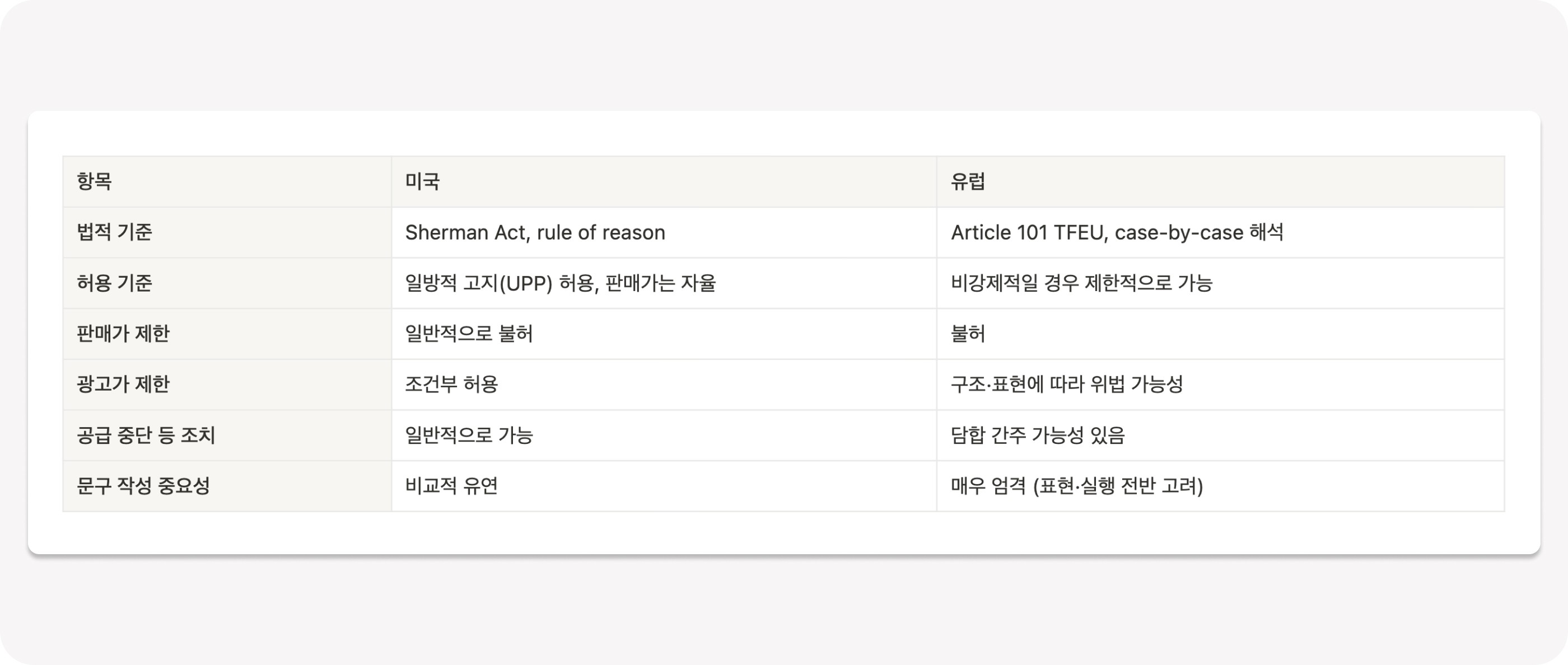
Even with the same name, MAP policies are a representative price policy where "it is generally legal in the US, but carries potential illegality if applied without careful design in Europe." Applying the same policy to all countries in the same format just because it shares the name can be dangerous, and practitioners must design it by accurately understanding the differences in each country's competition law system and distribution environment.
Examples of MAP Regulations by EU Country: Germany and France Case Studies
In addition to the EU-wide Article 101 TFEU regulations, the interpretation and enforcement intensity of MAP policies can differ by member state. In particular, Germany and France maintain the strictest stance on MAP, and the message they send to practitioners is clear.
🇩🇪 Germany – “MAP can bring about the same effect as RPM”
The Bundeskartellamt (German Federal Cartel Office) has stated that MAP policies can also be interpreted as de facto vertical price fixing, and that all forms of MAP, including informal advertising price restrictions, must be handled very cautiously.
On May 30, 2022, regarding a case where a company tried to implement a MAP policy in online sales, the Bundeskartellamt ruled that "enforcing a minimum advertised price carries potential illegality" and ordered immediate correction. This case clearly shows that restricting advertising prices through MAP can cause anti-competitive effects depending on the method of execution.
Beyond these cases, the German government and the Bundeskartellamt also strongly expressed their stance on MAP in an official submission to the European Commission in 2021. According to the document:
MAP policies effectively block discount advertising by retailers, and because advertising restrictions neutralize sales price reductions, they play the same role as RPM.
In an online environment, it is difficult to distinguish the advertised price from the actual selling price, so the anti-competitive effect of MAP is as serious as RPM.
Therefore, MAP should be considered an illegal hardcore restriction identical to RPM even without additional measures, and must not be subject to the application of exemption clauses.
Specifically, they point out that "MAP does not merely restrict advertising, but in reality, indirectly restricts the retail price itself and results in weakening price competition." Because the boundary between the advertised price and the actual price is blurred in the online distribution environment, the point was highlighted that MAP can operate as a more covert and powerful form of price control than RPM.
This stance is not just a simple policy recommendation, but is accepted as an official opinion that can have a practical impact on VBER interpretation and overall European competition policy in the future. Therefore, in Germany, the advertised price standard itself, including the name MAP, coercive expressions, and sanction conditions, must be reviewed very strictly, and practitioners must keep in mind that even phrases like "price recommendation" or "advertising standards" can generate legal risks depending on their expression and context. Cases of imposing fines for suspected vertical price fixing even in 2025, after the VBER revision, should also be noted.
🇫🇷 France – “MAP carries structural risks of restricting competition”
The Autorité de la concurrence (FCA) also regards MAP as an indirect restriction on price display, and states that it can cause anti-competitive effects depending on its structure and execution method.
In the Mobotix case, the FCA caught a practice where a wholesaler prevented resellers from advertising below the minimum advertised price, judged it as a violation of EU and French competition law, and imposed a total fine of 1.4 million Euros. In this case, the FCA stated, “resellers contractually bound not to display retail prices below the recommended resale price and not to sell online lose their commercial freedom and are subject to significant competitive restrictions,” making it clear that the MAP policy infringes on the commercial autonomy of resellers and is a measure that directly or indirectly restricts competition depending on its execution structure. Additionally, they warn that not only official contract clauses but also price restrictions carried out through informal communications such as emails, guide documents, and verbal instructions are subject to legal review.
Furthermore, in March 2025, the Paris Court of Appeal completely upheld the FCA's sanctions on the Mobotix case, reaffirming the illegality of the online sales restriction clauses in addition to MAP.
As such, Germany and France make clear the interpretation that “advertising price restrictions also carry a structural risk of leading to restricted competition.” Therefore, practitioners must manage very carefully not only official contracts but also the way of expression in all price-related communications. Because other European countries are highly likely to take similar stances, designing a strategy that considers the interpretation standards of individual national competition authorities, not just a single EU legislation, is essential.
Practical Checklist to Review When Introducing MAP in Europe
Within the European Union, caution is required because MAP policies can generally constitute price fixing. However, following the 2022 VBER revision, the possibility has emerged for brands to legally provide non-binding price guidelines to distribution partners under certain conditions.
The key here is the binding nature of the wording, the method of execution, and the presence of follow-up actions. Practical responses should be designed based on the following two items.
✅ Contract Wording Review Checklist
Direct wording such as “Do not advertise below this price” can trigger legal risks. Below are the check items that must be reviewed:

💡 Tip: Rather than the wording itself, how it is actually executed is the core of legal judgment. Even if in a recommendation format, if practical sanctions are accompanied, there is potential illegality.
✅ Exception Conditions and Wording Samples
To receive exception treatment under VBER, the following conditions must be met:
[✔] Exception Conditions
Must be non-binding guidelines – distribution partners must have no 'obligation' to follow them
There must be no practical disadvantages – there must be no practical sanctions such as supply suspension or margin cuts when prices are not observed
There must be no documented expression of coercive intent – no coercive intent in emails, contracts, phone calls, etc.
Partners must be able to follow based on autonomous judgment
[💬] Wording Samples

Should Be Designed as 'Price Guidelines' Instead of MAP
Based on the above, in Europe, rather than explicitly stating 'introducing a MAP policy,' it is more realistic and safer to approach it with the frame of "providing non-binding price guidance guidelines to protect brand image." Additionally, during the execution process, it is desirable to establish a joint review system with the legal team and manage communication history (documents, emails, training materials, etc.) assuming they could be subject to post-investigation.
Particularly after the VBER revision, if recommended guidelines are designed so that they do not have practical binding force, since there is a possibility they will not be considered a restriction of competition, the key is to inspect the context of execution and the substance of internal operations together, not just simple wording.
Conclusion: For Europe's MAP Policy, 'Avoidance Design' is Key, Not 'Introduction'
A MAP policy is a strategy considered by brands to manage distribution order and prevent excessive price competition among sellers. However, in Europe, MAP itself is highly likely to be considered an anti-competitive practice, and even if only advertising prices are restricted, it can be interpreted as a form of collusion. Caution is needed particularly in that if the execution method or expression of MAP infringes on autonomy and takes on a practical binding force, it can be considered in the domain of Unilateral Pricing Policy, increasing the likelihood of illegality.
In other words, the approach of "Isn't it okay to control only advertising prices and not selling prices?" can be a dangerous judgment under EU competition law, and practitioners must carefully design MAP policies so that they do not deviate from the level of legal recommendations.
Now, the direction practitioners should ponder is not 'Can we apply MAP?' but 'How to design a structure that can realize pricing strategies without MAP.'
✅ An execution structure that can maintain brand policy without directly controlling advertising prices
✅ Communication methods that can avoid legal risks in setting price standards with distribution partners
✅ Legal neutrality and document management systems throughout the execution process
Approaching with this frame, it is safe to avoid using the term MAP itself in contracts or external communications. In fact, many global brands use the expression 'non-binding price guidelines' instead of MAP in the European market, or design their distribution structure while explicitly excluding price-related policies altogether.
Ultimately, for MAP-related strategies in Europe, 'bypass' is the core, not 'application', and this is not a matter of simple expression, but a design matter spanning the contract structure, internal documents, and the overall execution method. We hope this content serves as a useful reference point for practitioners to find the balance between EU competition law and practical distribution strategies.