Price Management
I'm about to sign a MAP agreement with an overseas seller. Can I write it using the same standards as in Korea?

💡 In this article, you can find the following information.
MAP policy, why do design methods differ by country?
Comparison of MAP application environments in the US, Europe, and Korea
To implement MAP policy in Korean business practice: External design and internal preparation
Conclusion: 'How to design' rather than 'How far is it possible'
🤔 "I am trying to sign a MAP agreement with an overseas seller, can I write it with the same standards as in Korea?"
This is a question frequently heard recently by brand practitioners in charge of global distribution. The Minimum Advertised Price (MAP) policy is a representative strategy used by brands to maintain price order for their products and coordinate price competition across distribution channels.
However, when actually operating this policy, legal standards and market structures of each country must be considered. Particularly in Korea, restricting selling prices (resale price maintenance) is explicitly prohibited under the Monopoly Regulation and Fair Trade Act, making it difficult to apply a method where brands set or enforce selling prices as in the United States. However, since presenting standards for advertised prices is allowed within a certain scope, you can strategically design a MAP structure that can be operated within the scope of ad exposure without interfering with selling prices.
In this content, going beyond the simple perspective that 'MAP is globally applicable', we will focus on why the approach to MAP policies must differ by country, and in what ways MAP can be designed and executed in the practical environment of Korea.
MAP Policy, Why Does the Design Approach Differ by Country?
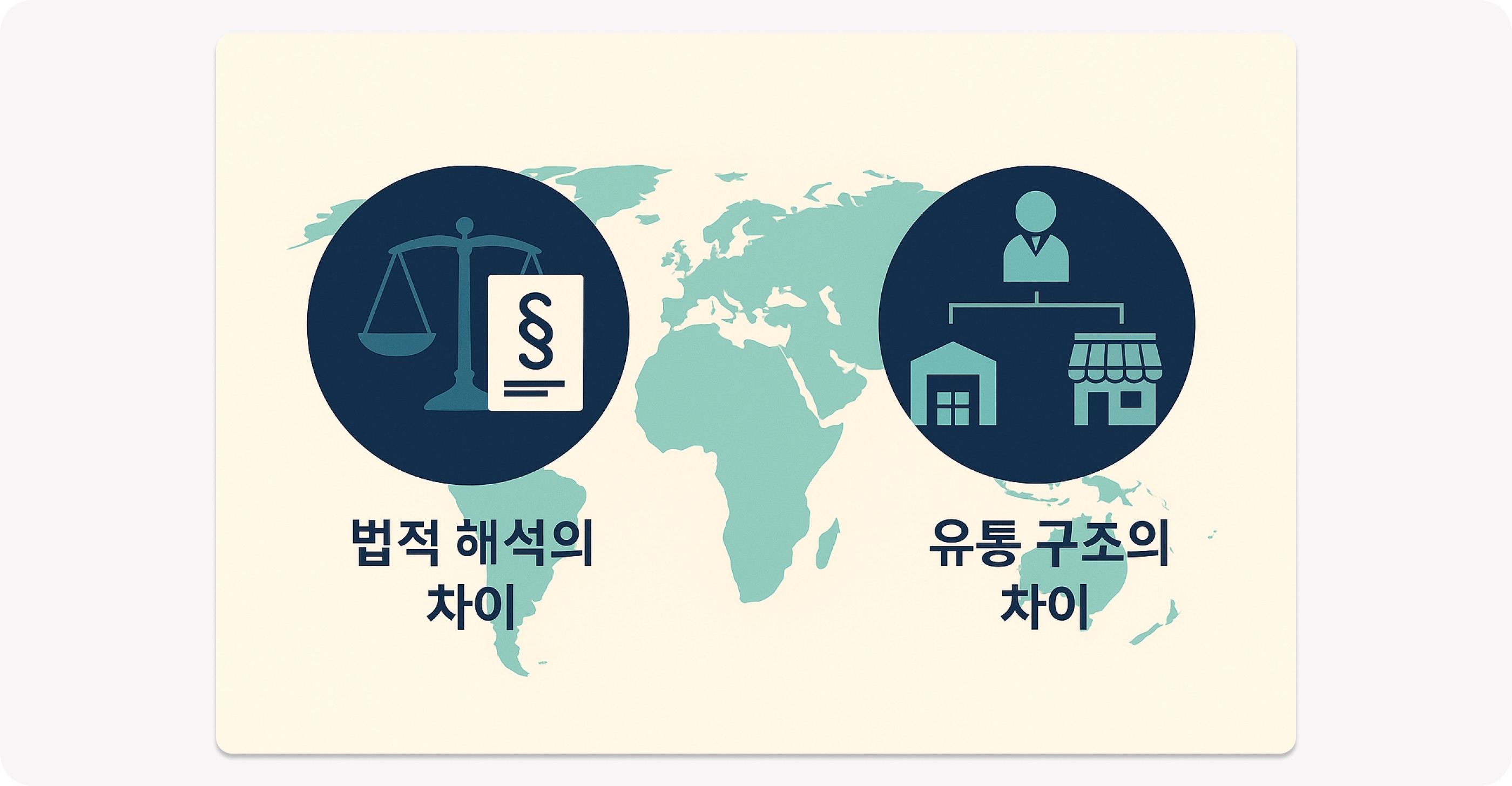
The Minimum Advertised Price (MAP) policy does not work the same way in all countries. Due to differences in legal interpretations and distribution structures, the design and execution of MAP policies inevitably vary from country to country.
Differences in Legal Systems and Regulatory Environments
Each country's fair trade or competition laws apply different standards to control advertised prices or restrict prices, which also affects the scope of policies a brand can present to sellers. In some countries, it is not a problem for a brand to unilaterally set advertising price standards, but in others, this is regarded as an act of violating the reseller's pricing freedom.
Differences in Distribution Structures
Furthermore, the distribution structure also significantly affects the design of the MAP policy. In markets with distinct distribution tiers from brand to wholesale to retail, such as in the US, the application and control of MAP policy standards are relatively clear. On the other hand, in structures where various online platforms and open market sellers coexist, such as in Korea or Europe, the scope that a brand can practically control is limited, and the method of presenting standards is inevitably indirect and flexible.

As such, even with a policy under the same name of Minimum Advertised Price (MAP) policy, in some countries it operates under strong standard controls, while in others it only holds meaning as a recommended level of guidelines. Therefore, when establishing MAP policies, global brands should approach it not with a 'blanket application' but with the premise of tailored design suited to the regulatory environment and distribution structure of each country.
Comparison of MAP Application Environments in the US, EU, and Korea
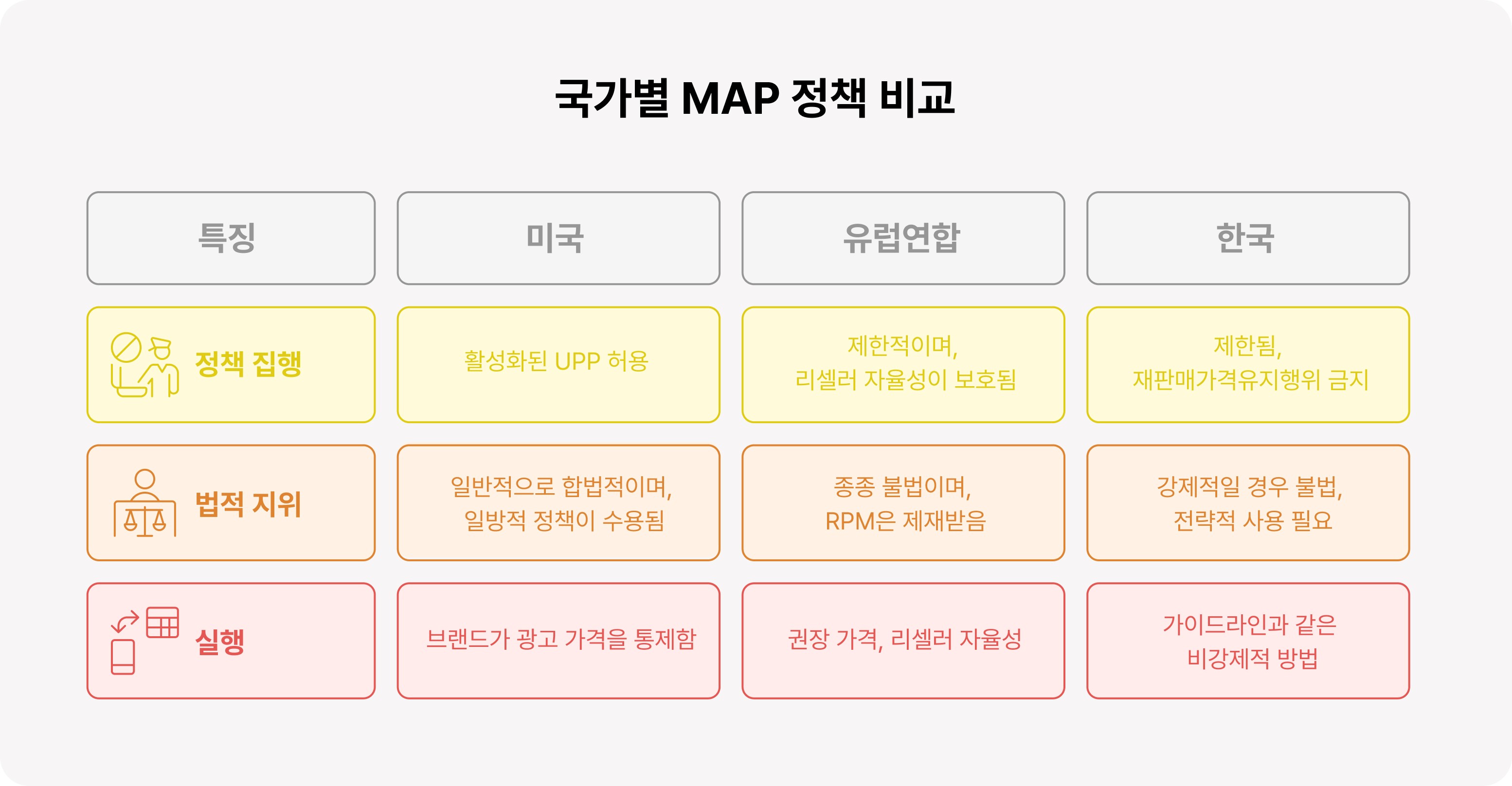
As mentioned earlier, the Minimum Advertised Price (MAP) policy has significant differences in its permitted scope and application methods by country. In particular, the distinction between advertised prices and selling prices, and whether the standards a brand can present to sellers are mandatory, depend on each country's fair trade laws and competition regulations. Understanding these differences is crucial when global brands design contracts with sellers in each country or establish distribution strategies. Below is a comparison of the MAP application environments in the three regions.
United States: This is one of the countries where MAP policies are most actively applied. Brands can set advertised price standards in the form of a "Unilateral Pricing Policy (UPP)" and operate by cutting off transactions with sellers who do not follow them. In this case, it is often recognized as a unilateral policy even without an agreement between the brand and the seller, and there are many judicial precedents showing this is not a legal problem. However, collusion among sellers or agreements with coercive force are still prohibited.
European Union: EU competition law strongly protects distributors' authority to set prices autonomously, and even controlling advertised prices can be interpreted as an indirect restriction on selling prices. Manufacturers forcing resellers to adhere to advertised price standards or penalizing them for violations can be considered Resale Price Maintenance (RPM) and subject to sanctions. Therefore, even when executing MAP policies in Europe, it is common for brands to present standards as 'recommendations' and guarantee the autonomy of sellers.
Korea: The Korean Monopoly Regulation and Fair Trade Act explicitly prohibits resale price maintenance, so it is potentially illegal for a brand to directly designate or interfere with selling prices. However, this does not prohibit setting standards for advertised prices. In other words, a MAP policy in which the selling price is left to autonomy but the price displayed in advertisements is restricted to a certain level can be operated within legal boundaries. Therefore, in Korea, it is important to clearly understand these legal limitations and strategically design and execute MAP policies centered on advertised prices.
※ Since interpretations for Europe and Korea may change according to changes in each country's laws and precedents, a prior legal review is absolutely necessary rather than applying them directly to specific brand situations.
To Execute MAP Policy in Korean Practice: External Design and Internal Preparation
To utilize the Minimum Advertised Price (MAP) policy in Korea, rather than exercising direct coercive power over advertised prices, a method that induces sellers to follow them voluntarily is required. In practice, a strategic approach from both external execution and internal operation serves as a more realistic alternative as follows.
External Design: Centered on Seller Response Strategy
Operating Seller Guides Based on Recommended Prices: We induce voluntary participation by providing incentives such as priority in joint promotions, advertising benefits, and official certifications to sellers who adhere to the standards.
Responding to Unofficial Sellers: We concurrently block price disruption factors through genuine authentication systems, image protection, and platform monitoring systems.
Real-time Monitoring and Feedback System: We must detect price deviations through lowest price monitoring systems such as Reaturns, and prepare a step-by-step response (Notification → Warning → Exclusion) for repeat-violating sellers. To this end, utilizing automated price monitoring tools is essential.
Internal Preparation: Refining the Execution System and Communication
Documenting Internal Standards and Departmental Collaboration: Clear definitions of standards and exceptional conditions should be shared among marketing, sales, and legal departments, and a consensus should be built internally by consolidating policy documents.
Refining the Seller Communication System: Rather than simply delivering directives, we maintain trust-based communication with sellers by providing official guidebooks or holding regular briefings.
Tracking and Reporting Routines for Execution Results: A system must be established to report internally on policy compliance rates, violation frequency by channel, and response history by seller, so that it can be used as supporting data for future policy modifications or seller evaluations.

In this way, the Minimum Advertised Price (MAP) policy must be designed based on autonomy and transparency, and brands must approach it in a direction that strengthens cooperative structures with sellers by setting effective standards within legal boundaries. If legal constraints are accurately understood and operated strategically within them, the MAP policy can become a core tool of brand distribution strategy even in the domestic environment.
Conclusion: 'How to Design' Rather Than 'How Far is it Possible'
The Minimum Advertised Price (MAP) policy is not simply a matter of whether it is permitted, but its effectiveness depends on how and with what standards the brand designs it within each country's legal system and distribution structure. Especially in markets with clear legal restrictions like Korea, a strategic approach based on collaboration rather than control, and autonomy rather than coercion, is necessary.
While there is no single standardized MAP policy that serves as the correct answer for all brands, the important thing is to have the following directions:
Instead of exceeding legal boundaries, presenting clear guidelines to collaborate with sellers within them.
Not stopping at setting price standards, but designing monitoring, feedback, and organizational internal execution systems as well.
Establishing sustainable MAP operating principles tailored to the brand's strategy and market structure.
The Minimum Advertised Price (MAP) policy is now a strategic tool that plays a practical role in protecting brand value, maintaining price order, and refining cooperative structures with sellers. Brands must design achievable MAP policies within their respective market environments and legal constraints, and link them with internal execution systems to create consistency in their distribution strategies.