Price Management
Unofficial Seller Management
Official Seller Management
Counterfeit
Which of our brand's products should we monitor first? 3 criteria for setting priorities

💡 In this article, you can find the following information.
Why shouldn't you monitor all products with the same priority?
What are the three criteria for setting monitoring priorities?
How do you create a monitoring priority table based on the three criteria?
How do the check frequency and channel scope change according to priority?
Monitoring Priority Frequently Asked Questions
Setting just three monitoring priorities for this week
Sometimes, while searching for your own products, you might discover an unfamiliar store. It is a seller that the brand has never supplied goods to, yet they are selling your products on various open markets, often at a price much lower than the official retail price. If products that are difficult to verify as genuine are mixed in, you have to worry not just about pricing issues, but also about brand image and consumer trust.
Managing only official retailers does not solve everything either. If some of the sellers you are doing business with continuously deviate from the set price guidelines, inquiries from other clients will start coming in, asking, "Why can that seller sell at that price?" and "Shouldn't we lower our prices too?" In the end, the brand manager has to look into where unknown sellers are selling our products and whether the prices of existing clients are being properly maintained.
The problem starts here. If you only manage a few SKUs, you can look them up one by one, but as the number of products increases to dozens or hundreds, the story changes. If you do not have a standard for which products to check first, which sellers and channels to look at, and what to monitor more frequently, you will end up looking at all products with similar intensity. Consequently, you will spend the same amount of time on products where issues actually recur and those where they do not, making it difficult to distinguish which products need to be checked first.
Then, what should a brand with many products look at first? If we choose which products to check first instead of looking at all of them, what criteria should we use to set the order?
In this article, we will examine how to prioritize products when starting actual monitoring, and how to divide the check frequency and channel scope based on those priorities.
Why shouldn't you monitor all products with the same priority?
When prioritizing monitoring when there are many products, the important thing is to set the order of which sales pages to check first and which ones to take action on first among the pouring pages. This is because it is practically difficult to check all sales issues with the same intensity at the same time.
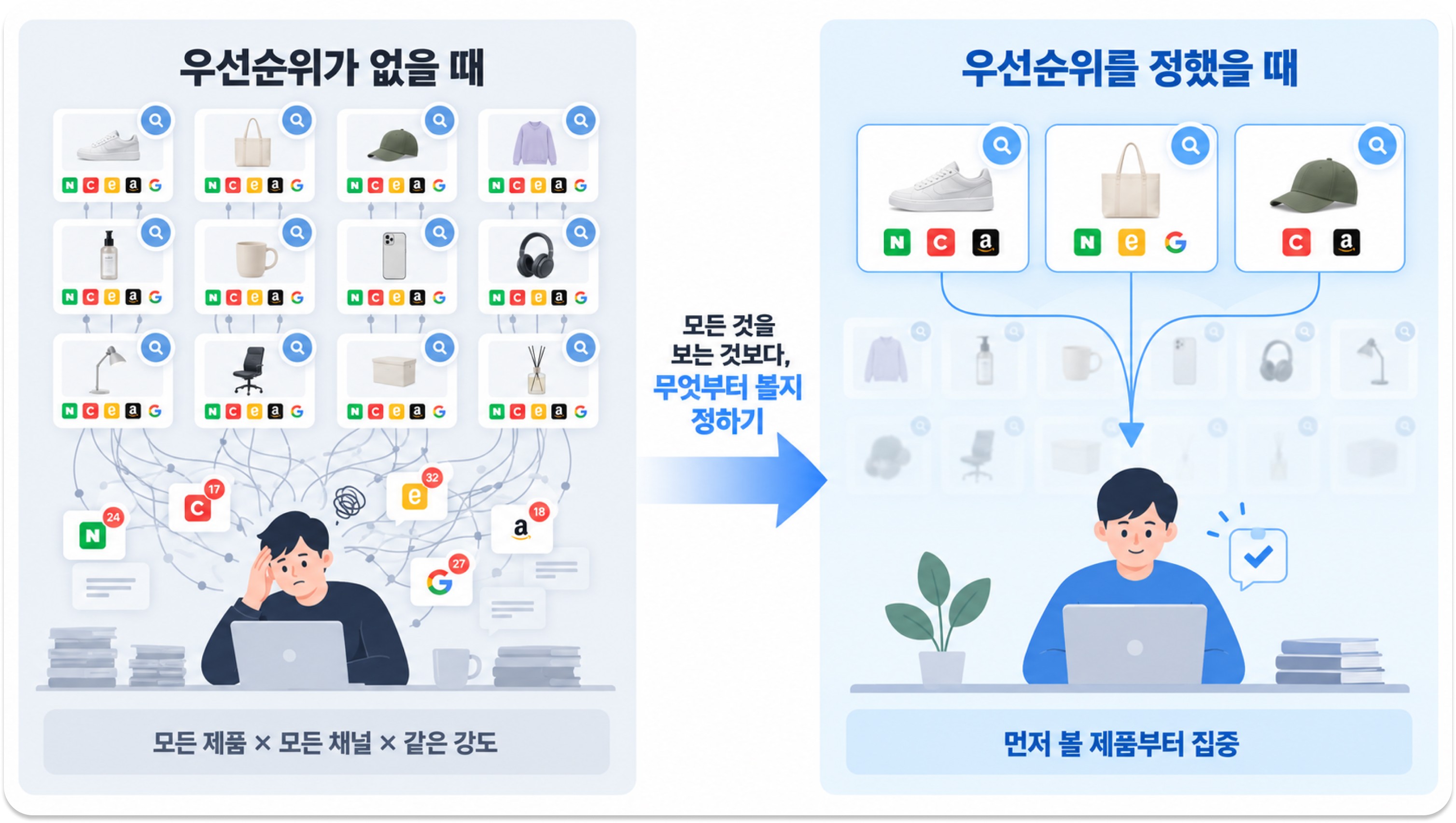
While handling inquiries from official retailers who violated the price, unfamiliar sellers may continue to appear on other open markets. Conversely, if you check every single sales page, your response to urgent pricing issues coming from regular clients might be delayed. However, problems do not appear equally across all products. Looking at the lists of brands and products of clients who contacted Retrix to start monitoring, issue signals were often concentrated on a few products first, rather than being evenly distributed across the entire product line.
To reflect these differences, we need to divide the monitoring scope into three axes: the number of managed products, check frequency, and target channels. This is about deciding how many products, how often, and on which sales channels to check.
These three axes are interconnected. If you increase the number of products while shortening the frequency and widening the channels, the volume to check will balloon all at once. If you start by saying you will look at all products frequently across all channels, it will take a lot of time just to review the accumulated results, making it difficult to carry out actions like contacting sellers or reporting them. This is because the time of the person looking at the results and making decisions is limited.
Therefore, it is more realistic to apply these three axes differently for each product. This is the same reason why we categorize and look at products in order. Even in the field of overseas price monitoring, methods of varying check intensity based on revenue contribution or price volatility are suggested. If there are many SKUs, starting by selecting only a portion of products to monitor is also a way. You do not need to look at products with almost no price changes or reported issues with the same intensity, while prioritizing products where issues recur.
It is convenient to lightly filter the candidate list before applying the three criteria. If you put products that are about to be discontinued or are not sold online on the table, it only increases the columns you need to evaluate.
💡 Implementation Tip
From the entire SKU list, leave only the products currently sold online, and mark next to each product whether a reference price has been set. For products with a blank reference price, it is difficult to judge deviations even if the price fluctuates, so it is recommended to set a reference price before starting full-scale monitoring. This filtered list will serve as candidates for prioritizing later.
What are the 3 criteria for determining monitoring priority?
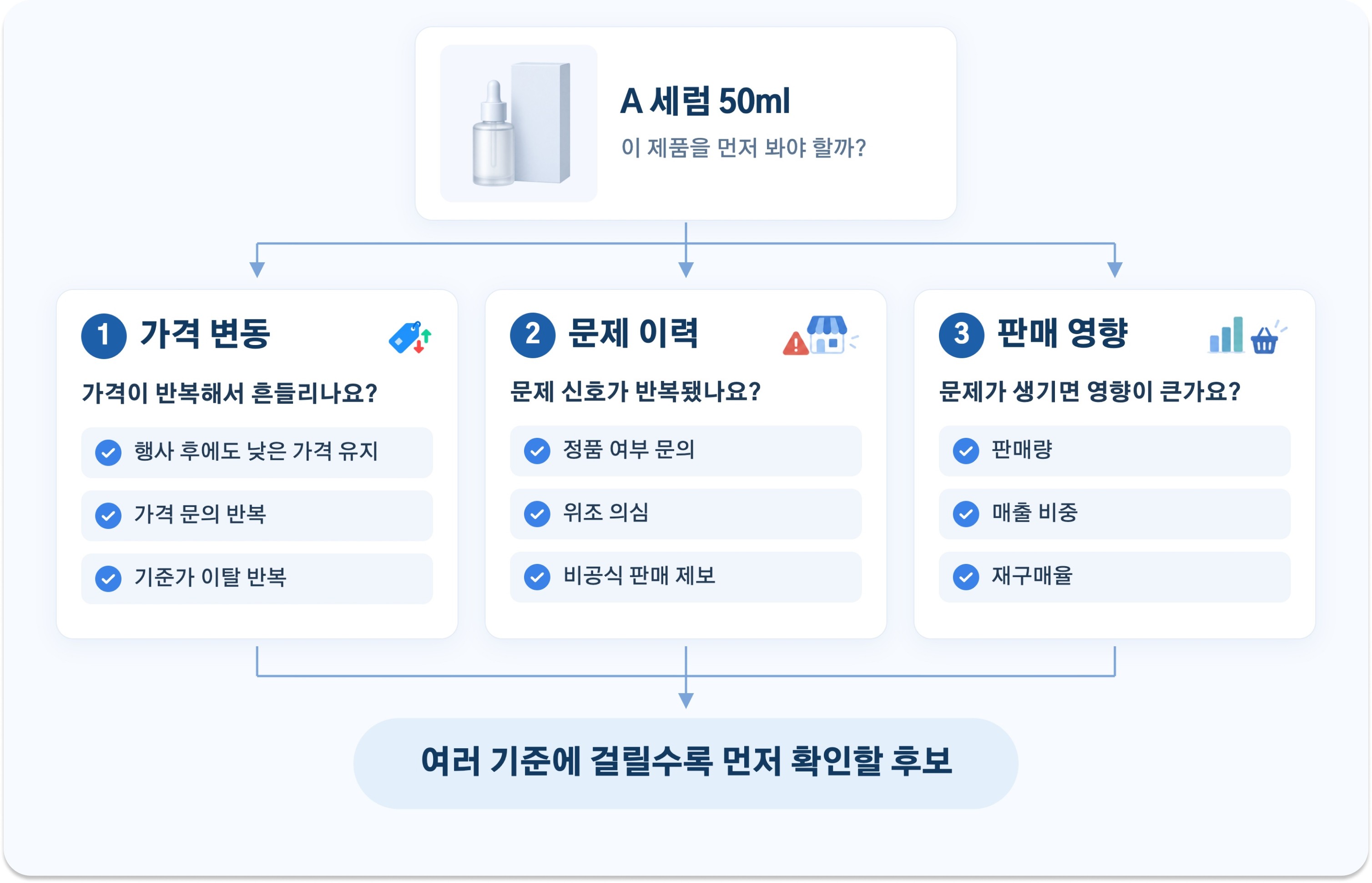
The criteria for determining monitoring priority are price fluctuation, issue history, and sales impact. The more criteria a product meets, the higher it is placed on the candidate list to look at first.
Criterion 1. Is it a product whose price fluctuates frequently?
A product with frequent price fluctuations is one where the selling price repeatedly deviates from the reference price on sales channels.
There are two signals you can identify by looking into price-related cases among CS and sales records.
One is when the promotion has ended, but the price of some stores remains low. If the price lowered during a special exhibition or seasonal discount continues even after the event, it can lead to consumer price inquiries or complaints from official retailers.
The other is when price inquiries for the same product repeatedly come from CS and sales teams. Consumers ask, "They are selling it much cheaper elsewhere, is it genuine?" while official retailers contact us saying, "It is hard to sell because of other sellers' prices." If the same product name repeatedly appears across multiple channels like this, there is a reason to recheck the actual sales page. Lowest price seller monitoring, which checks which sellers are offering low prices by channel, can also start with these products.
The important thing here is not simply finding the cheapest store. The judgment differs depending on whether the price was temporarily lowered due to an event, or if the same seller continues to maintain a low price even after the event ends. From the brand manager's perspective, it is more useful to look at whether deviations are repeated for the same product or store, rather than the price difference itself.
Another thing to decide is 'at what point deviation is considered a problem.' That standard varies by product and distribution structure. Therefore, the order is to first set the reference price and tolerance range for each product. Without this standard, judgments may differ, with the sales team calling it a problem and the marketing team calling it a promotional price for the same price.
At this time, it is more accurate to view the price compared with the reference price as the actual purchase price reflecting coupons or shipping costs rather than the displayed selling price. It is also good to record whether it is a discount during a promotion period or a price remaining after the promotion ends.
Here, the reference price is our team's internal standard to judge deviations. Since demanding stores to adhere to this price is a separate legal issue, it is recommended to review separately how to share the reference price with stores. If you are operating a Minimum Advertised Price (MAP) policy together, it is also necessary to distinguish between the two. As mentioned earlier, the reference price is a judgment standard for internal monitoring, while MAP is a separate policy operated as the lower limit of the price that stores expose on advertisements or product pages.
💡 Implementation Tip
Count the number of price-related cases by product from CS inquiries and sales reports over the past 3 months. Compare the timing of each inquiry with past promotion periods to check if price inquiries for the same product continued even after the promotion ended. You can mark products with inquiries from multiple channels as candidates for Criterion 1.
Criterion 2. Is it a product with repeated history of counterfeit or unofficial sales?
What is worth looking at as much as price is past issue history.
Check if there are products with repeated inquiries about authenticity, suspected counterfeit CS, or reports of unofficial stores recently. Although you cannot conclude it is a risky product based on just one inquiry, if the same SKU continues to appear at multiple times or through multiple channels, there is sufficient reason to prioritize it in the next monitoring target.
However, you do not need to immediately classify a store as a problematic seller just because it is an unfamiliar one. This is because products distributed officially might be resold. Therefore, rather than looking only at "Is this a seller we did not contract with?", it is better to look at whether there were repeated inquiries about authenticity, whether there were sales pages using the brand name or logo deceptively, and whether there were previous issues related to the same product or store.
It is also useful to organize reports on product names that slightly altered the brand name, detailed pages that used official logos without permission, and sales pages that claimed "genuine" or "official" without grounds as part of the same history.
When prioritizing our products, rather than estimating "Which product would be easy to counterfeit?", it is safer and easier to check which product's issue signals actually repeated in our records.
For example, if inquiries about authenticity for the same product came to the company mall, while reports on unofficial stores came to the sales team, there is a need to bind these separate records together. If there is a history of reporting or contacting sellers, look at that together too.
💡 Implementation Tip
Gather authenticity inquiries, suspected counterfeit CS, and unofficial store reports and action records over the past 6 months by product. If records of the same SKU came from two or more places, mark it as a candidate for Criterion 2. The starting point is to gather records already accumulated within our company in one place, rather than creating a new identification method.
📌 Note: It is also worth looking at the cost structure
While looking at records first is basic, even if there is no issue history in the records, you can look at whether there are products where consumers cannot easily notice quality differences when counterfeits are made due to the cost structure. Among the 18 counterfeit perfumes investigated by the Korea Consumer Agency last August, methanol was detected in 6 of them, and the Korea Consumer Agency analyzed the background of using cheap methanol instead of ethanol used in genuine products as cost reduction. However, this does not apply to all product categories, so it is better to use it as a reference for grading rather than a priority criterion.
Criterion 3. Is it a product with a high impact when a problem occurs?
Products with a high sales impact are those with a large sales volume or revenue share, or those that customers repeatedly encounter due to frequent repurchases.
This does not necessarily mean these products will become targets for unofficial sellers. It means that when the same price deviation or unofficial sales issues occur, the scope of orders, customers, and revenue affected can be relatively large.
Therefore, it is recommended to look at the revenue share and repurchase rate together, not just recent sales volume. Even if sales volume is not very high, there may be products with a high unit price that contribute heavily to revenue, and products with frequent repurchases expose the same customers to prices and stores repeatedly.
Representative products by which consumers judge the brand's overall price level also fall in here. If the price of a representative product fluctuates, the prices of other products can easily become objects of comparison. Products that can lead to consumer safety issues if counterfeits are mixed in, such as products applied to the skin or entering the body, should also be viewed as high-impact.
It is meaningful to view Criterion 3 together with the previous two criteria rather than alone. If price issues are repeating for a product with a large sales volume, the reason to prioritize checking becomes greater, and if suspected counterfeits or unofficial sales reports have repeated for a highly sold product, you can raise the priority in the same way.
💡 Implementation Tip
Mark products in the top sales volume, top revenue share, and high repurchase rate based on the past 6 months. You can mark products that fall under at least one of these as candidates for Criterion 3. If it is difficult to look at the repurchase rate separately, you can refer to the subscription proportion.
How do you create a monitoring priority list with the three criteria?
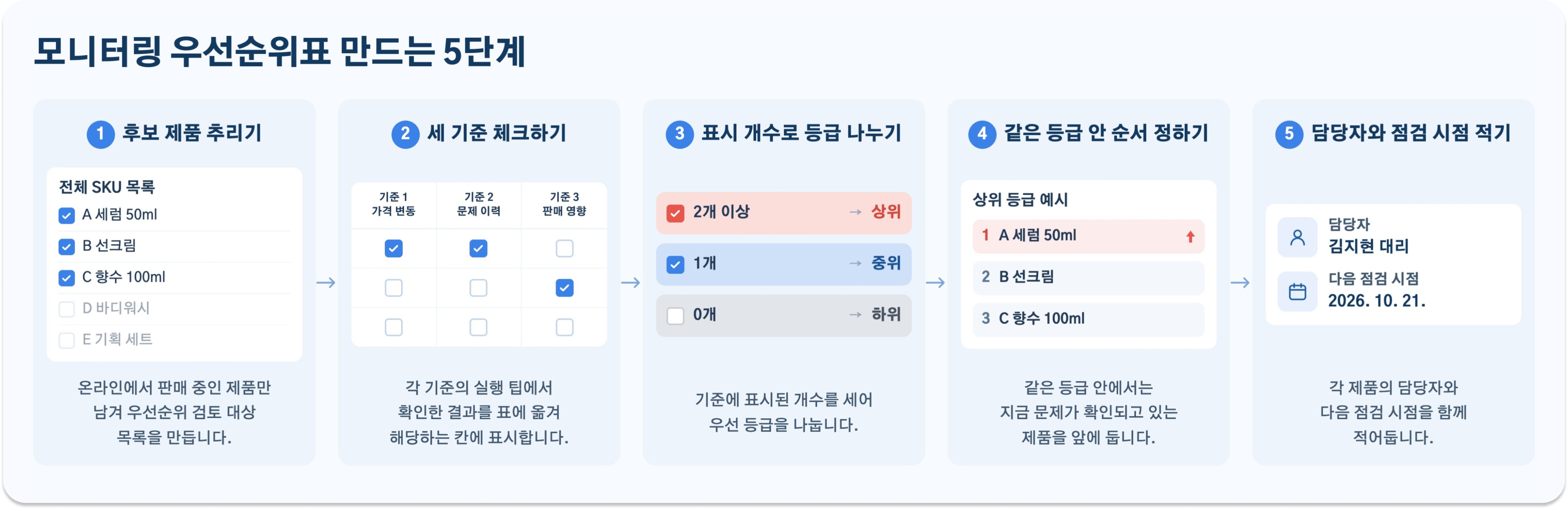
A monitoring priority list is a table made to see at a glance whether each product meets the three criteria.
You do not need to apply complex weights and scores for each criterion. When creating the table for the first time, you can start with a simple method of just looking at how many criteria are met, as shown below.
Place the candidate products marked earlier in rows and the three criteria in columns.
Transfer the results confirmed in the implementation tips for each criterion and mark them in the corresponding cells.
Divide the priority grades, such as high if there are two or more marks, medium if there is one, and low if there are none.
If you need to decide the order within the same grade again, place products with currently confirmed issues first.
Write down the person in charge and the next inspection timing next to the grade.
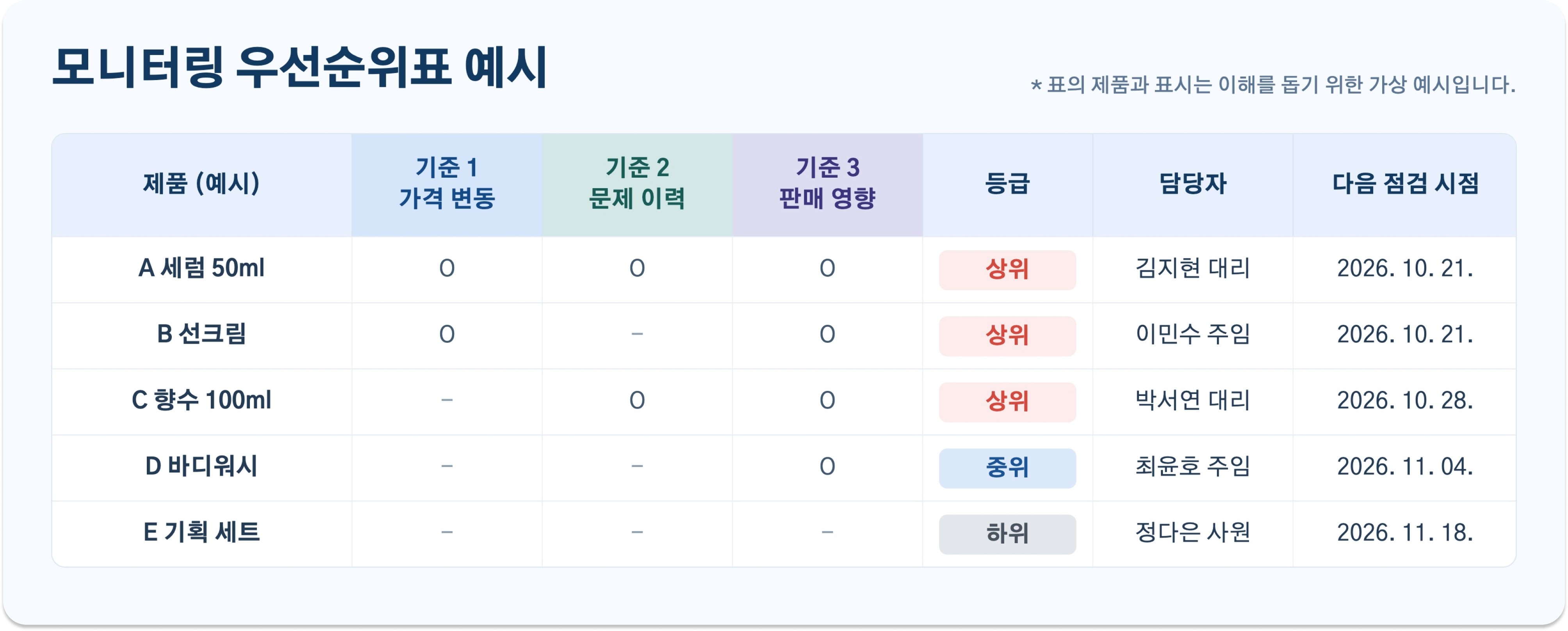
Here, high, medium, and low are not grades determining the risk of the product itself. It is closer to an operation order determining what our team will check first within a limited time.
Filling out the table reveals a combination to keep an eye on. Like product C in the example, it is a product where no price issue is currently confirmed, but has past issue history and a high sales impact. If you were only looking at prices, it might have been pushed back, but looking at the affected scope and past records when a problem occurs gives a reason to check it first. The reason for making a priority list is also to avoid selecting monitoring products by looking at only one metric.
For low-grade products, you can relatively lower the check intensity. If you need to reduce monitoring targets due to many SKUs, you can adjust the scope starting from low-priority products.
However, if sales conditions change, existing grades may also change. Therefore, this list is closer to a document that is continuously revised while looking at actual discovery records, rather than a document created once and finished.
If it is difficult to distinguish the order with method 4 alone due to a large number of products, you can move on to a method of assigning weights to each criterion and scoring them. For example, a brand with frequent price issues would weigh Criterion 1 heavier, while a brand with many counterfeit reports would weigh Criterion 2 heavier. Rather than setting weights from the beginning, it is more realistic to adjust weights by looking at actual discovery records after operating with simple counts a few times.
How do check frequency and channel scope differ by priority?
Once you have divided the grades, there is no need to check all products with the same frequency and within the same channel scope.
You can adjust operational intensity, such as looking at high-priority products relatively frequently and checking low-priority products focusing on key stores. However, just because a product is high-priority does not mean you must look at all channels equally widely. The channels to check first will also differ depending on the reason it became high-priority.
Grade | Check Frequency | Channel Scope | When Deviation is Discovered |
|---|---|---|---|
High | Relatively short | Expand check scope based on issue type | Record details, verify sales circumstances, and proceed to necessary actions |
Medium | According to set frequency | Focus on entered channels | Gather discovered cases and verify according to set workflow |
Low | Relatively long, exclude from target if necessary | Major channels with high revenue share | Monitor trends, and adjust priority if reports or issues repeat |
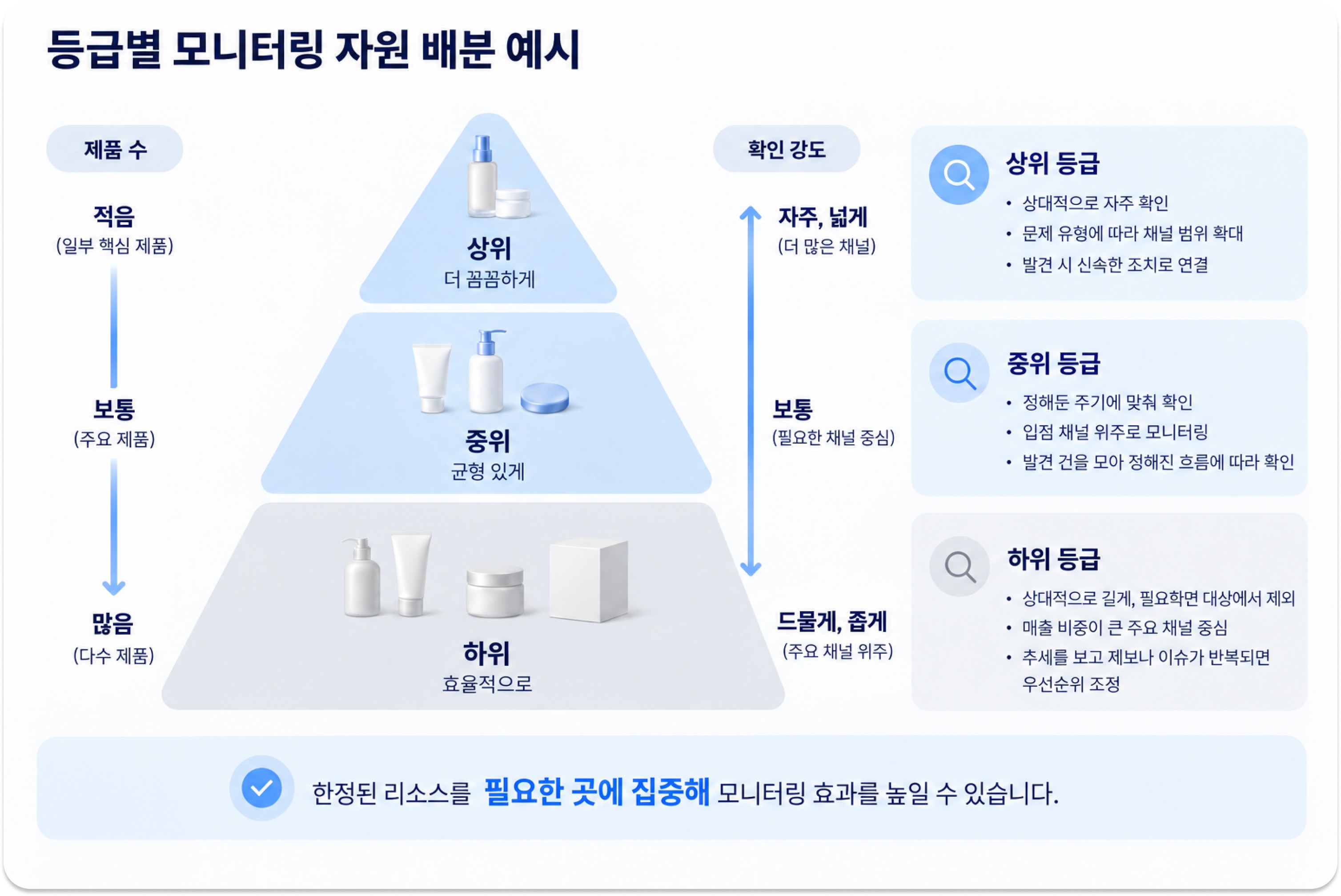
For example, if it is a product with repeated price deviations by official retailers, it is better to first closely look at currently active stores and major entered channels. Conversely, if it is a product with a history of repeated unofficial sales or suspected counterfeits, there is a reason to widen the scope to open markets or other sales channels where the brand has not entered. For the same high grade, one is focused on how prices move within our transaction network, while the other is focused on who is selling products outside our distribution network.
Regardless of the usual grade, it is also a way to temporarily raise the check intensity of the corresponding products during periods when prices are prone to move, such as during large discount promotions or before/after new product launches. What is as important as frequency is the workflow after discovery.
When a problematic sale is discovered in a high-grade product, it is recommended to set in advance who checks, what to record, and which manager to hand it over to. For example, if you set an operational goal of contacting sellers or reporting to platforms within 24 to 48 hours after discovery for high grades, and adjust deadlines based on team situations, it is easier to maintain response speed even if the person in charge changes. Leaving a screen showing the product page URL, check timing, selling price, and seller information makes it easy to reuse the same record when verifying sales circumstances or reporting to platforms later.
Even if you check frequently, if the subsequent workflow is not defined, only discovered cases will pile up and actual actions may be delayed.
If you are using monitoring tools or solutions, you must also verify the quality of the data itself before acting based on the results. For example, periodically check the following three, and if matching accuracy is low or data is outdated, temporarily suspend automatic notifications or rule applications.
Collection Success Rate: The percentage of target sales pages where price collection was successful
Matching Accuracy: The percentage of sales pages by channel correctly connected to the identical product
Data Freshness: Elapsed time from the last collection point to the present
If these three shake, even if discovered cases increase, a significant portion of them could be false positives.
You do not need to perfectly define the operation methods for all three grades from the beginning. You can adjust the product and channel scope sequentially while looking at the scope the team can actually handle.
💡 Implementation Tip
For example, select about three products from the high grade of the priority list and check them first for a certain period. Recording the number of discoveries, time taken to take action after discovery, and whether the price returned to the reference price after action by product will allow you to judge whether to add more products or reduce the current scope based on records rather than intuition next time.
Monitoring Priority FAQ
Q. If we don't monitor all products, won't we miss some products?
Yes, it can happen. Prioritizing means we do not check all products with the same intensity, and some may be excluded from the target. Therefore, instead of completely forgetting about products excluded from the target, you should look at signals coming from other channels, such as CS inquiries or official store reports. If reports for the same product repeat or sales conditions change significantly, you can include it back in the monitoring targets then.
Q. What is the monitoring scope based on?
The monitoring scope is determined by three things: the number of managed products, check frequency, and target channels. Especially if there are many SKUs, starting with high-priority products is easier to manage than widening the scope from the beginning. Even when reviewing the introduction of an online distribution channel monitoring solution, organizing these three first makes it easy to explain what scope is specifically needed.
Q. How often should we prioritize monitoring again?
There is no set answer. You can start by re-checking once every quarter in the beginning. However, if sales conditions have changed significantly, such as new product launches, large events, or entering new distribution channels, it is recommended to review priorities without waiting for the regular inspection timing. If you have accumulated discovery and action records in the meantime, you can use them as a basis for judgment when raising or lowering grades.
Q. Do we need to check channels we haven't entered?
If it is a high-priority product, it is worth checking. Especially if it is a product with a history of repeated unofficial sales or suspected counterfeits, there is a reason to widen the check scope. However, since the fact that it is sold on an unentered channel does not itself mean a problem, it is recommended to decide whether to respond after checking the aforementioned issue history and sales circumstances together.
Monitoring priority, trying to set just three this week
Searching for stores late whenever price complaints come in, and checking from the beginning whenever an unfamiliar seller is discovered becomes harder to respond to as SKUs increase.
Fortunately, we already have records we can look at. Products with repeated price inquiries, products with counterfeit or unofficial sales reports, and products with large sales volume, revenue share, or repurchase proportions are all in those records.
If you try to check all products with the same intensity all the time, it can be hard to manage from the start. Prioritizing is ultimately about deciding where our team should spend time first right now.
Starting small is fine.
Open the SKU list tomorrow and mark three things: whether price issues repeated, whether there was a history of counterfeit or unofficial sales, and whether the sales impact is high. Select just about three products that meet two or more of those. Those three are the products to check first this week, and they will become the first row of your priority list.
References
E-Today, "Harmful substances in 1 out of 3 counterfeit cosmetics, perfume methanol exceeds limit by up to 484 times", August 14, 2026. (Korea Consumer Agency investigation report), https://www.etoday.co.kr/news/view/2614623
FineData Engineering, "E-commerce Price Intelligence: Complete Strategy Guide", February 9, 2026. (Updated July 28, 2026), https://finedata.ai/blog/ecommerce-price-intelligence/
PromptCloud, "Ecommerce Price Monitoring Strategy: From Scraping to Pricing Intelligence", April 27, 2026, https://www.promptcloud.com/blog/ecommerce-pricing-intelligence-guide/