Official Seller Management
Price Management
Sellers who do not adhere to the standard price—is it okay to control their pricing?

💡 In this article, you can check the following content.
Can a brand force sellers to adhere to the standard price set by the brand?
Is it okay to block products from being passed on to sellers who sell below the standard price?
What was different in cases where restricting sales channels did not cause problems?
Before responding to sellers who sell below the standard price, what should be checked in contracts and notices?
If it is difficult to respond through price or distribution channels, what should you look at on the seller page?
Four common bottlenecks in seller price response
When the standard price collapses, what to check before taking action
🤷♀️ "We have a base price set by our brand, but there's a seller who keeps selling below that price. Can we stop them?"
This is a question frequently heard in meetings. Sometimes it's about an authorized distributor we have an agreement with, and other times it's about a seller we don't even know where they sourced the products from. These inquiries often come not right after the price fluctuates for a day or two, but after observing the situation for some time. The lowest price has been down for several days, and they start receiving calls from other distributors asking why only that channel is selling so cheap, so they come to us having decided that it is time to take action.
However, when we explain that controlling prices to maintain order is difficult, they usually ask these questions.
"Then can't we just stop supplying goods to that seller?"
In practice, this second question is more important. It seems more feasible than the first, and feels like something that can be resolved by inserting a single clause in the contract or cutting off supply. However, looking at cases sanctioned by the Fair Trade Commission, the act of directly setting resale prices and the act of blocking the distribution path of goods have been penalized separately under different clauses.
Therefore, when we receive this question, we do not immediately decide how to block that seller. We first check through which channel the product was transferred and how the distribution channels have been managed through contracts and notices so far. This is because the criteria for reviewing price compliance demands and distribution channel restrictions are different, and the possible responses diverge based on those facts.
Can a brand force sellers to comply with its set base price?
Resale price maintenance refers to an act by which a business operator sets a transaction price for a business operator who is its counterparty, or for business operators at each subsequent stage of transaction, and forces them to sell or provide at that price, or transactions under restrictive conditions to that effect. Article 46 of the Fair Trade Act prohibits this in principle.
What we need to look at first here is the target of application. This regulation does not apply only to distributors who have contracted directly with us. Since the provision includes 'business operators at each subsequent stage of transaction', even if we did not supply the goods directly, there is room for application if it is a seller who received products through our distribution network.
Next is from what point it is considered 'coercion'. Simply guiding the recommended retail price as a reference point is not considered resale price maintenance. The Fair Trade Commission's Guidelines for Review of Resale Price Maintenance state so. The line is drawn based on whether disadvantages follow when that price is not observed.
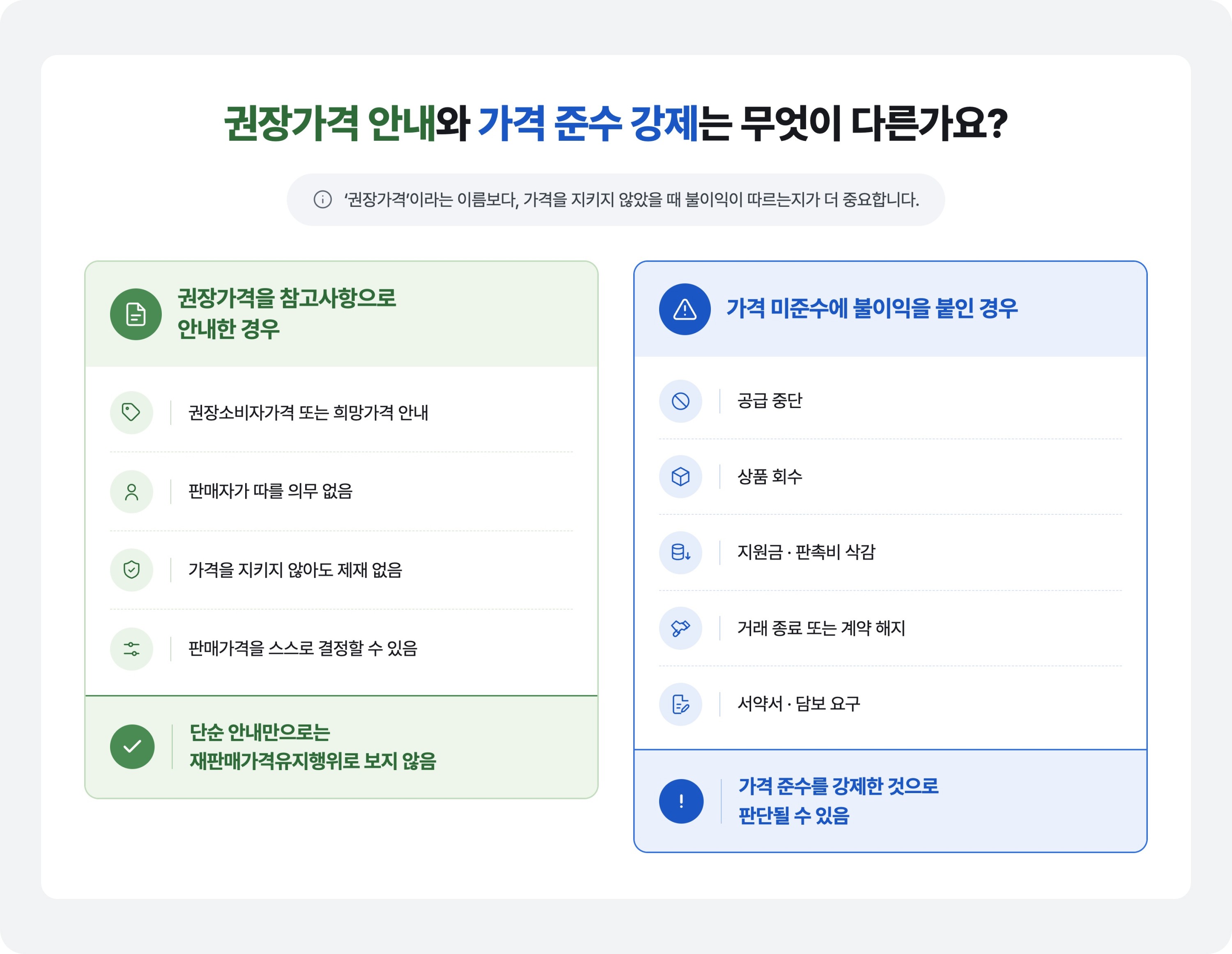
In March 2025, the Fair Trade Commission imposed a corrective order and a surcharge of 1.865 billion KRW on Dunlop Sports Korea. At that time, from January 2020 to April 2023, Dunlop set the lowest online and offline retail prices for XXIO and Srixon golf clubs and notified its dealerships. Along with this, they also announced that disadvantages such as suspension of supply, product recall, reduction of subsidies, and termination of transactions could be imposed if the price was not met.
This combination is not an unfamiliar method in practice. It's a way of sharing the base price and announcing that supply or support will be adjusted for distributors that do not follow the policy. The problem is when the two contents are bound together as cause and effect. If it is set to reduce supply or stop support on the grounds of not complying with the base price, it becomes difficult to view it as simple price guidance.
💡 To-do item for today
Open a notice or email recently sent to sellers. You just need to check if disadvantages such as suspension of supply or reduction of support are written to follow on the grounds of not complying with the base price.
Is it okay to block products from going to a seller who sells below the base price?
If you hear that it is difficult to directly demand compliance with the base price, the next method that comes to mind would be blocking the supply channel. It is thought that if we can just block the path through which products are transferred to that seller, we can resolve the situation without mentioning the price.
The Dunlop case also includes a judgment on this measure. Separate from the price fixing seen earlier, the Fair Trade Commission penalized Dunlop Sports Korea's act of preventing dealerships from reselling golf clubs to non-dealerships from January 2022 to April 2023. The applied clauses are also different. Article 46 of resale price maintenance was applied to price fixing, and Article 45, Paragraph 1, Item 7 of transactions under restrictive conditions was applied to the restriction of resale to non-dealerships.
Transactions under restrictive conditions refer to transactions under conditions that unreasonably restrict the business activities of the counterparty. The Enforcement Decree lists restricting the transaction area or the counterparty as one of its types. Conditions that restrict to whom a distributor can sell or transfer products are reviewed under this type.
Although the legal configuration was separate from price control, it was not completely detached from the facts. According to reports citing the Fair Trade Commission's announcement, non-dealerships did not trade directly with Dunlop, making it difficult to control retail prices, and by preventing products from being transferred to them, free price competition was also restricted.
Therefore, it is difficult to consider it safe to simply block the supply channel without directly demanding the price. Measures to restrict transaction counterparties or sales channels also require a separate review depending on why such restrictions were placed and what their scope is.
However, measures that restrict transaction counterparties or sales channels are not always unlawful. The provision includes the requirement of 'unreasonably', and Article 45, Paragraph 1 also targets only acts that are likely to impede fair trade. This means that the conclusion is not reached solely by the fact that there is a restriction, but that its purpose, scope, and actual impact on competition are viewed together.
💡 To-do item for today
Open the contract signed with the distributor and look for clauses that restrict to whom they can transfer goods or in which channels they can sell them. Expressions such as 'prohibition of resale to non-dealerships', 'prior approval of new accounts', and 'prohibition of sales outside designated channels' correspond to this.
What was different in cases where restricting sales channels did not become a problem?
There is a case where restricting transaction counterparties was an issue like the Dunlop case seen earlier, but the conclusion was different. It is a case where a company supplying Gore-Tex fabrics demanded that its customer companies not sell finished products made with that fabric at hypermarkets. The Fair Trade Commission viewed this as a transaction under restrictive conditions that restricted transaction counterparties and sanctioned it, but the Supreme Court judged that it was difficult to see it as an act likely to impede fair trade (Supreme Court Decision 2020Du35219 decided August 25, 2022).
In this case, the Supreme Court comprehensively judged the intention and purpose of the act, its effect and impact, the form of transaction, the characteristics of the product, the market situation, and the content and degree of restriction. Among them, points worth referencing in practice are the purpose and scope of the restriction, and its actual effect on competition.
First is the purpose of the restriction. The Supreme Court viewed that this measure was to protect luxury brand value rather than to maintain high prices. What is important is what supported that purpose.
This company supplied fabrics only to customers who had signed trademark license agreements, and had finished products made through certified manufacturers designated by itself. Before mass production, the performance of prototypes was tested and inspected, and the Gore-Tex trademark was displayed together only on finished products that went through this process. If a problem occurred with a product, they directly guaranteed the quality to the final consumer regardless of who the manufacturer was, and sales staff training for customer companies was also conducted at their own expense. They didn't just claim the purpose of maintaining brand value in words; their actual operation method supported that purpose.
Next is the scope of restriction. What was prohibited was sales at hypermarkets, and other sales channels such as directly-managed stores, department stores, dealerships, outlets, and online were left open. The proportion of sales through hypermarkets was also less than 5% of all distribution channels. Considering these circumstances together, the Supreme Court judged that the restriction on hypermarket sales did not exceed a reasonable scope.
They also checked how much competition was actually restricted. Pointing out that the share of hypermarket sales did not increase significantly even after the measure was discontinued, they viewed that the effect of restricting competition among distribution channels within the brand was not significant. They looked not only at the reason and scope of the restriction, but also at what results that restriction actually produced in the market.
However, we must look carefully at whether this judgment can be applied directly to restrictions on online sales channels. This is because this case is an example of restricting a specific offline distribution format called hypermarkets, and is not a case directly judging online sales restrictions. Nevertheless, we can refer to the fact that they did not conclude based on the single fact that there was a restriction, but looked at what the restriction was for, to what extent it was restricted, and what impact it actually had on competition.
💡 To-do item for today
If there is a clause prohibiting sales outside designated channels, do not look only at the prohibited channels, but also write down the allowed sales paths together. If virtually no other sales paths remain, you need to look at the scope of the restriction again from the beginning.
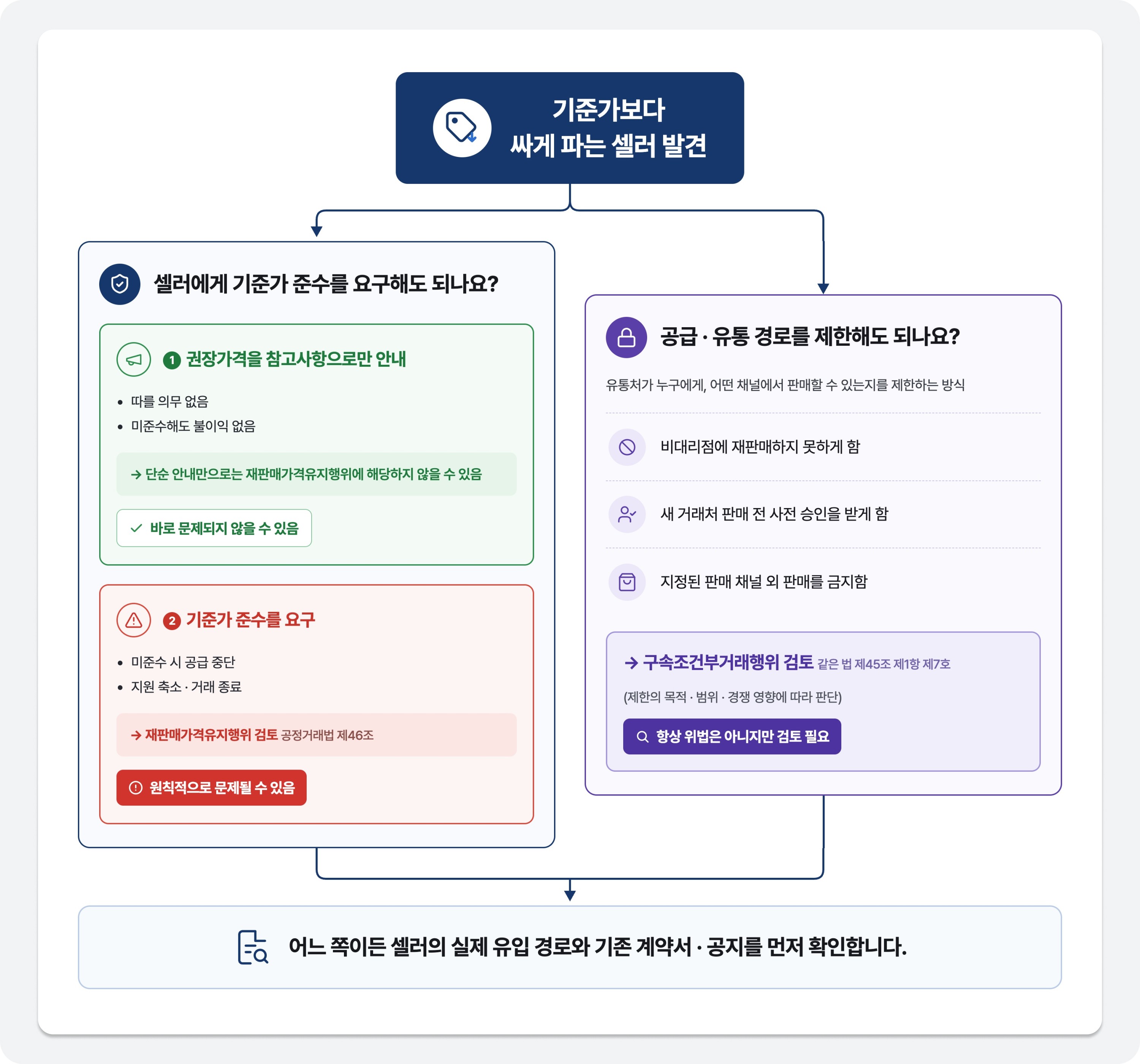
Before responding to sellers who sell cheaper than the base price, what should be checked in contracts and notices?
Although the clauses applied to the price compliance demands and restrictions on accounts/sales channels seen above are different, the materials to be checked in practice overlap to a large extent. You can open contracts signed with distributors, and notices and emails sent to sellers, and divide them into the following two categories.
First, is it set so that disadvantages follow when the base price is not observed?
The Fair Trade Commission's Guidelines for Review of Resale Price Maintenance determine coerciveness focusing on whether the counterparty had the freedom not to follow the designated price, and whether disadvantages followed non-compliance with the price.
Examples of acts listed in the guidelines are as follows:
In cases where a price list is notified, and measures such as suspension of shipment or cancellation of agreement are taken against a dealership that sold at a discount
In cases where a pledge regarding compensation is forced on a place that did not observe the designated price
In cases where performance bonds or collateral are required to guarantee price compliance
In cases where customary support such as promotional activity expenses or interior installation costs is stopped if the price is not met
In cases where a sanction policy is set in business plans or sales strategies, and the sanction is actually executed
Among these, what is easy to miss is the 'method of reducing support'. While stopping supply or terminating a contract is easy to recognize as a sanction, reducing promotional activity expenses or interior cost support can feel like a routine operational adjustment. The review guidelines list this kind of suspension of support as an example of coercive action.
Even if you have never actually imposed a disadvantage, you cannot rest assured. The review guidelines consider that coerciveness exists even when it is set so that the contract can be terminated or sanctioned if the desired price is not followed. This is why you must check clauses that have never been invoked.
Second, can restrictions on accounts and sales channels be explained by reasons other than price?
Next, look at clauses such as prohibition of resale, prior approval of accounts, and prohibition of sales outside designated channels. A conclusion is not reached solely by the fact that the clause exists, and we must check why such restrictions were placed and whether the actual operation matches that reason.
If brand value or quality control is cited as the reason, you can examine whether there was actual operation suitable for it. These include whether sales environment standards were set and guided, whether sales personnel training was conducted, and whether consumer inquiries related to product quality were directly handled. In the Gore-Tex case seen earlier, these operational facts served as the basis for judgment.
If related materials are scattered across multiple departments or documents, you can start by gathering them in one place.
List of documents to check
Clauses on price compliance, suspension of supply, reduction of support, and restriction of accounts in distributor contracts
Price policy notices, emails, and messenger conversations sent to sellers
Store entry/sales guides and training materials for sales personnel
Internal documents or meeting minutes explaining the purpose and background of the channel policy
Operational materials to verify quality assurance or consumer handling methods

💡 To-do item for today
Put the phrases mentioning the base price and the phrases restricting accounts/sales channels side by side. Rather than whether the two phrases are in the same document, it is important to check whether the fact that the price was not met is set as the reason or condition for suspension of supply, reduction of support, or restriction of accounts.
If it is difficult to respond with price or distribution channels, what should be looked at on the seller page?
After checking contracts and notices, look separately at the phrases written on the sales page. Even if it is difficult to take immediate action based solely on base price compliance or distribution channels, how the seller displays themselves can be a separate issue.
For example, this is the case when a seller we have never contracted with displays 'Official Domestic Retailer' at the top of the detail page. Selling a product and making oneself look like the brand's official distribution network are not treated as the same issue. Even if it is difficult to block the sale itself, whether that expression gives a certain impression to consumers can be reviewed separately.
However, how far it can be questioned is more divided than expected. More details on what expressions can actually be disputed, what can be used as a basis, and what to prepare for reporting are organized separately in the article on responding to parallel import sellers' official retailer displays.
Therefore, if you find a seller selling below the base price, do not record only the price, but also look at how the seller introduces themselves, such as the seller's name, store introduction, or the top of the detail page.
Four frequently encountered obstacles in responding to seller prices
Q. Can we demand price compliance even from a seller who secured products without going through our distribution network?
Just because they did not contract directly with us, they are not immediately excluded from the target. If they are a seller who received products from our distributor, there is a possibility that they correspond to 'business operators at each subsequent stage of transaction' mentioned in the clause.
On the other hand, if they seem to have secured products from outside our distribution network, such as through parallel imports, you must first check if the actual inflow path connects to our distribution network. If not connected, it is better to review other issues such as trademark use or 'official retailer' displays, rather than demanding price compliance.
Q. Is guiding the recommended retail price also a problem?
Guiding the recommended retail price in itself does not constitute resale price maintenance. What is important is whether the distributor actually had the freedom not to follow that price. If the notice states measures such as suspension of supply or reduction of support upon price non-compliance, or if the contract includes price compliance obligations and sanction clauses together, it becomes difficult to view it as simple guidance under the name of 'recommended price'.
Q. If we clean up our policy now, will past notices no longer be a problem?
Stopping a policy does not mean that past notices and operations disappear from the scope of review. Whether there is a violation is judged based on what content was delivered at the time, what measures were actually taken, and how long that state continued. In the Dunlop case, what was penalized was the acts committed from 2020 to 2023.
Cleaning up policies now is meaningful in that it changes the future state. However, since past actions are not retroactively eliminated, whether and to what extent previous notices and measures can be problematic must be reviewed separately according to the facts.
Q. What if a distributor first requests to match the price?
Just because a distributor requested it first does not mean that coerciveness disappears. Even if the price was set through requests or agreements, if it is structured so that disadvantages follow when that price is not observed, resale price maintenance issues can arise. What to check in practice is not who brought up the price discussion first, but whether the distributor actually had the freedom not to follow the agreed price.
When the base price breaks down, what to check before taking action
Let's return to the two questions that came up in the first meeting. Whether we can make them comply with the base price, and if not, whether we can block products from going to that seller. Neither is a simple option that can be executed immediately.
The reason why the conclusions of the Dunlop and Gore-Tex cases were different did not lie in the fact itself that there was a restriction. They looked at why it was restricted, what the scope was, and what impact it actually had on competition. In the Gore-Tex case, the explanation of maintaining brand value was supported by operations such as actual quality control, training, and quality assurance.
Therefore, if you find a seller selling below the base price, rather than deciding how to raise the price or cut off supply, first check the channel through which the product entered, as well as existing contracts and notices. What measures can be reviewed often depends on those documents and the operation methods so far.
In the end, when the base price breaks down, what we need to look into first is our distribution structure and documents rather than a single seller. Those criteria must be organized so that the scope of subsequent responses also becomes clear.
▶︎ Reference Laws and Precedents
This content was written based on the following laws and precedents. The laws are current as of August 2026 and may be amended, so please check the latest content before actual response.
▶︎ Regulation on Prices
Article 2, Item 20 of the Monopoly Regulation and Fair Trade Act - This clause defines resale price maintenance and includes business operators who are transaction counterparties and business operators at each subsequent stage of transaction in its scope. (National Law Information Center)
Article 46 of the same Act - This clause prohibits resale price maintenance in principle, but provides exceptions such as when there are justifiable reasons. (National Law Information Center)
Guidelines for Review of Resale Price Maintenance (Established Rule of the Fair Trade Commission No. 482, enforced Dec. 30, 2024) - These are administrative rules that set the standards for determining coerciveness and specific examples corresponding to coercive acts. (National Law Information Center)
▶︎ Regulation on Distribution Channel Restrictions
Article 45, Paragraph 1, Item 7 of the same Act - This clause defines trading under conditions that unreasonably restrict the business activities of the transaction counterparty as an unfair trade practice. (National Law Information Center)
Article 52, Attached Table 2, Item 7, Sub-item (b) of the Enforcement Decree of the same Act - Among the detailed types of transactions under restrictive conditions, this clause regulates restrictions on transaction areas or transaction counterparties. (National Law Information Center)
▶︎ Cases and Precedents
Fair Trade Commission Press Release distributed on February 28, 2025 - A case where a corrective order and a surcharge of 1.865 billion KRW were imposed on Dunlop Sports Korea's resale price maintenance and transactions under restrictive conditions. (Fair Trade Commission)
Supreme Court Decision 2020Du35219 decided August 25, 2022 - A precedent which judged that it is difficult to see that the act of restricting hypermarket sales of finished products is likely to impede fair trade by comprehensively examining the purpose, scope, and effect on competition. This case was judged by applying Article 23, Paragraph 1, Item 5 of the former Monopoly Regulation and Fair Trade Act and Article 7, Sub-item (b) of Attached Table 1-2 of the former Enforcement Decree, and the relevant clauses lead to the current Article 45, Paragraph 1, Item 7 and Article 52, Attached Table 2, Item 7, Sub-item (b) of the Enforcement Decree. (National Law Information Center)
▶︎ This content is intended to provide general information based on practical experience supporting brand distribution responses, and the conclusion may vary depending on specific facts. For detailed matters related to the Fair Trade Act, we recommend consulting with relevant experts such as lawyers.