Counterfeit
Government certification for K-brand protection against counterfeit goods abroad: What are the conditions for up to 200 million won in support?

💡 In this article, you can check the following content.
What was confirmed in the 1st recruitment of the K-Brand government certification system?
Is our company eligible to apply for the K-Brand government certification?
What should we prepare together before and after applying for the K-Brand government certification?
Frequently asked questions about applying for the K-Brand government certification system
Things to organize before the application deadline: trademark status by country
Last spring, we shared the news about the introduction of the K-Brand Government Certification System, through which the government directly responds to counterfeit goods overseas. At that time, the general direction of the system was disclosed, and this time, as the recruitment of the first batch of participating companies has begun, the application requirements and support conditions have been concretely determined.
The K-Brand Government Certification System is a program where the government develops a state-certified trademark of which the government holds the rights, promotes its filing and registration in major overseas countries, and permits selected companies to use the trademark after an evaluation process. Through the genuine product authentication technology applied to the state-certified trademark, overseas consumers can check whether a product is genuine using their mobile phone cameras. If an infringement of the state-certified trademark is confirmed, relevant government ministries will request investigation, crackdowns, and customs clearance suspensions from local authorities. This changes the existing approach where individual companies had to respond on their own, establishing a structure where the government also participates in the response as a right holder of the state-certified trademark.
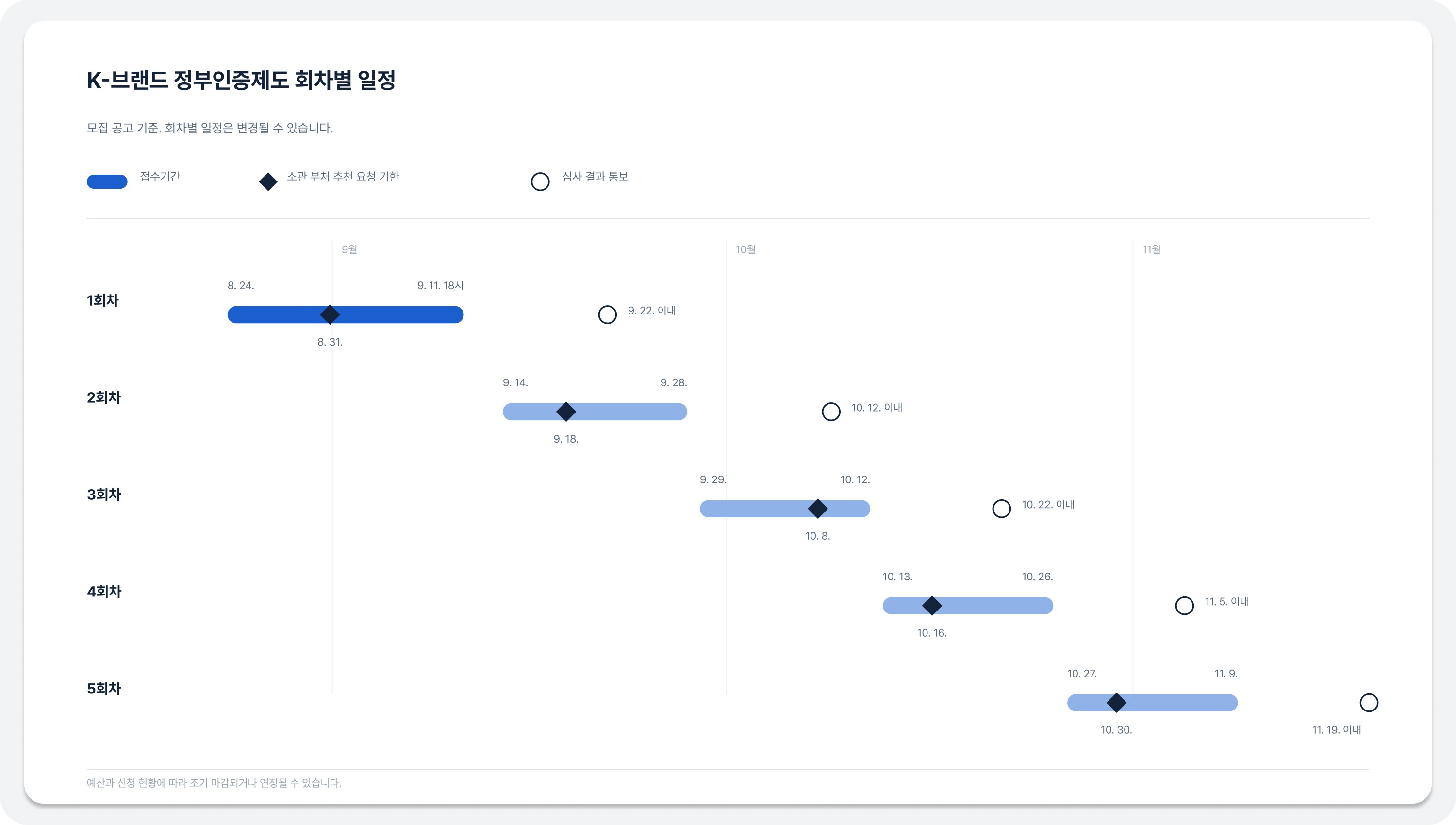
The Intellectual Property Office has been recruiting the first batch of participating companies since August 24, and the deadline for applications is September 11 at 18:00.
If you are considering applying this time, there is one thing you must check first before the deadline. It is whether our trademark is filed or registered in the countries where we intend to use the state-certified trademark. Based on this requirement, the countries for which you can apply in this round will be determined first. We will organize and walk you through what has been decided in this announcement, and what requirements and documents our company needs to prepare, in order.
The 1st Round of K-Brand Government Certification Recruitment, What Has Been Confirmed?
This announcement details the application schedule, target countries, methods for permitting the use of the state-certified trademark, and support conditions for genuine product authentication technology implementation costs. The very first thing to distinguish is that the permission to use the state-certified trademark and the support for implementation costs are determined separately.
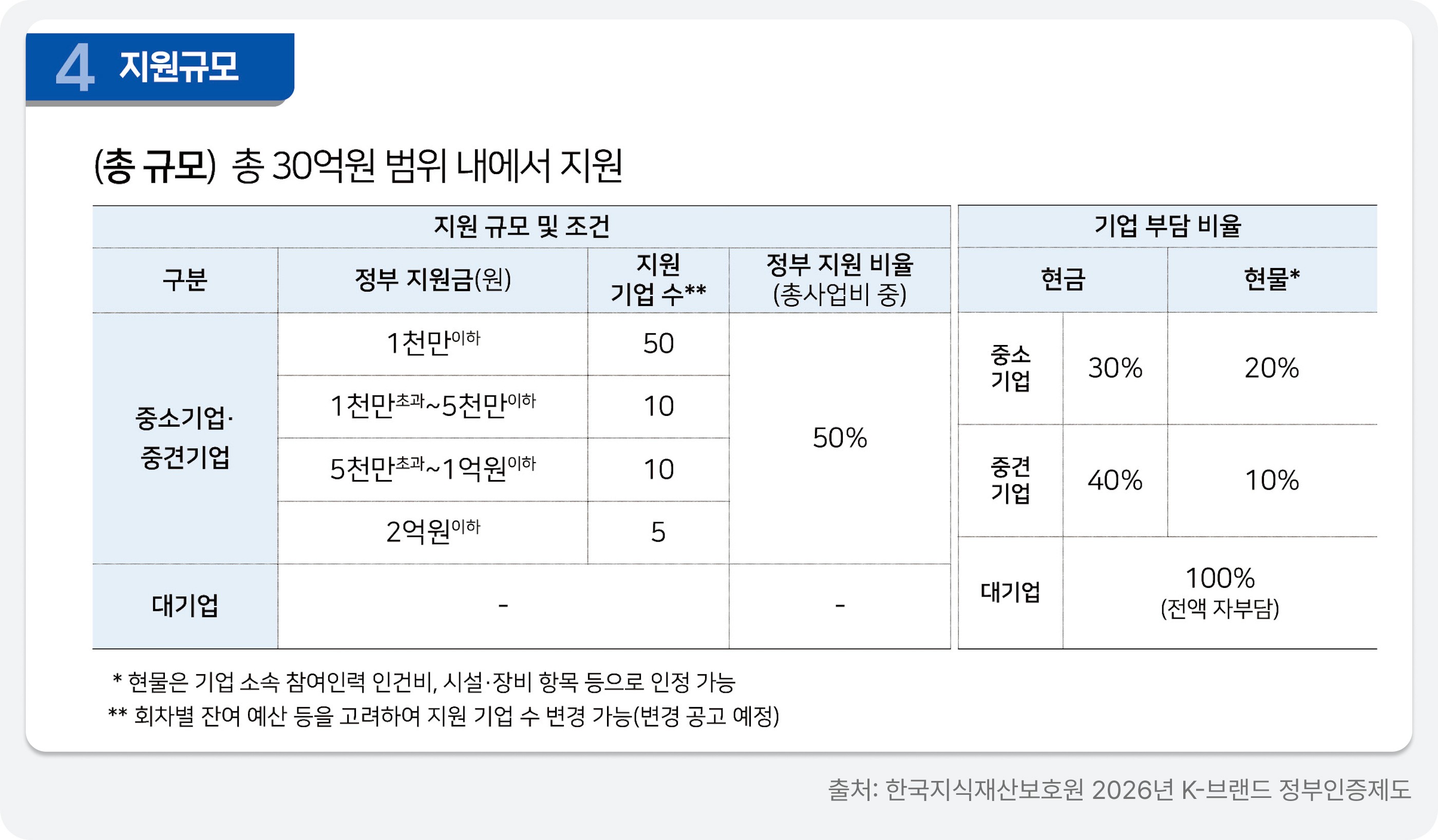
For products that receive permission, you can attach the state-certified trademark that the government is pushing to file and register overseas. However, receiving permission for use does not guarantee that the implementation cost support is also finalized. The recipients of support are determined within the budget limits from among the products that have received permission, in order of their evaluation scores. The support limit for small and medium-sized enterprises (SMEs) and middle-standing enterprises is up to 200 million KRW per company.
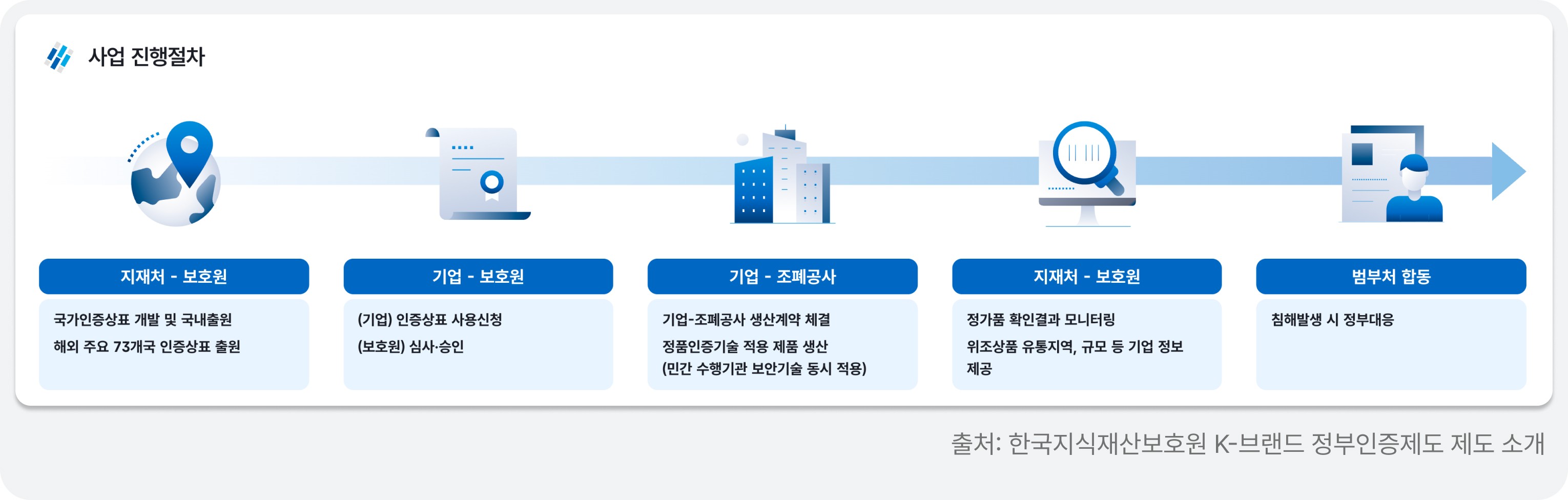
The following six conditions should be reviewed when considering this first round of recruitment.
Recruitment Round and Period: The application period for the first round is from August 24, 2026, to September 11, 2026, at 18:00. The announcement schedules up to 5 rounds, and evaluations are conducted collectively for each round, regardless of the order of receipt. The recruitment poster states that applications may close early or be extended depending on budget and application status.
Application Method: Apply online through the Korea Intellectual Property Protection Agency's K-Brand State-Certified Trademark Application System.
Target Countries: The targets are the top 73 export destination countries. These are countries that account for 98% of South Korea's total exports, and include not only places where the distribution of counterfeit goods is currently severe, but also countries with potential to become new distribution hubs in the future. The filing and registration of the state-certified trademark are pursued on a country-by-country basis, and companies designate and apply for their export destinations among these.
Support Content: This includes permission to use the state-certified trademark, support for genuine product authentication technology implementation costs, and provision of monitoring results. Companies can use the monitoring results regarding counterfeit distribution areas and scale as reference materials for confirming damage and responding to disputes. In cases where large-scale infringement is confirmed, support for local fact-finding investigations can also be provided.
Business Cost Sharing: SMEs and middle-standing enterprises receive 50% of the total business cost from the government and bear the remaining 50%. Based on the total business cost, SMEs bear 30% in cash and 20% in-kind, while middle-standing enterprises bear 40% in cash and 10% in-kind.
Large Corporations: Large corporations can also apply to use the state-certified trademark, but they must bear the full cost of implementing genuine product authentication technology on their own.
The background behind the government participating as a right holder of the state-certified trademark can be found in the two cases disclosed together by the Intellectual Property Office when announcing the system.
Cosmetics export company A confirmed that counterfeits of its products were being distributed in the local market and requested an investigation and crackdown from the local authorities. However, due to the non-cooperation of the authorities, no crackdown took place, and the investigation did not progress for two years. Food company B filed a lawsuit for damages resulting from counterfeit infringement and won, but the awarded compensation of 47 million KRW did not even cover the local attorney fees of 60 million KRW.
These two cases show that even if an infringement is confirmed or a lawsuit is won, it can be difficult for an individual company alone to elicit action from local authorities or to recover the response costs incurred. When the government participates as a right holder of the state-certified trademark, the entity requesting response from the local authorities and the inter-agency cooperative tools available become different.
Whether our company can utilize this system depends on whether we meet the trademark and product requirements.
Is Our Company Eligible to Apply for K-Brand Government Certification?
The basic target for application is domestic corporations currently exporting products overseas. Once you have verified the company size, you must next check the trademark and product requirements.
The first hurdle is the trademark. Your company's trademark must be filed or registered in the overseas countries where you wish to use the state-certified trademark. It does not need to be fully registered; a filed status also satisfies the requirement. However, the designated goods of your trademark must fall within the scope of the designated goods of the state-certified trademark. Since the list of designated goods is posted separately on the application website, it is recommended to first compare and see if the product you wish to apply for is included in the scope.
Checking the trademark status in export countries alone is not enough. In the actual evaluation, they also look at whether the trademark for the corresponding product is filed or registered in the manufacturing country. If you have products manufactured overseas, you should also organize the trademark status in the manufacturing countries.
The second hurdle is the product. The product applying must meet domestic certification standards, and the list of standards can be checked in the announcement attachment. Certifications applied by item, such as KC or HACCP, fall under this category.
▶︎ Point to Note: If you are in an industry with no certification standards
If there are no domestic certification standards for the relevant industry, this requirement can be substituted with a recommendation letter from the competent ministry. Conversely, if certification standards exist but have not been met, this does not apply. To receive a recommendation letter, you must also adhere to the recommendation request deadline for each round. The deadline for the first recommendation request passed on August 31, and the deadline for the second is until September 18.
Where the product was produced and under what management is also looked at during the evaluation. While products manufactured domestically are the primary target, products manufactured overseas can also be applied for if they meet the requirements. When applying for products manufactured overseas, you must show through documentation that the domestic corporation manages and controls the overseas production and quality.
Evaluations are conducted collectively for each round. Usage permission is granted to products with an average evaluator score of 70 points or higher. However, even if the overall average is 70 points or higher, if the average evaluator score for the 'Me-too Product Verification and IP Infringement Risk' evaluation item is 10 points or lower, permission to use cannot be granted regardless of the total score.