Price Management
Unilateral Pricing Policy (UPP): Partially allowed in the US vs. Illegal in South Korea

💡 In this article, you can check the following content.
What is UPP?
What is the difference between MAP and UPP?
Why is UPP not possible in Korea?
Is MAP applicable in Korea?
In practice, MAP + automation system is the most realistic
Conclusion: A feasible pricing strategy tailored to the brand is needed
What is UPP?
UPP (Unilateral Pricing Policy) is a policy designed where a manufacturer or brand unilaterally sets the minimum resale price (Minimum Resale Price) for its products and can cease business relations with the respective distributor or seller if they fail to comply. This policy is termed 'Unilateral' because the brand establishes and announces the policy unilaterally without any 'agreement' with the seller.
From a brand perspective, such policies are utilized as a means to maintain price order within distribution channels and prevent damage to brand value. Especially for high-end or premium product lines, indiscriminate price discounting can adversely affect brand credibility and negatively impact the profitability of existing authorized sellers.
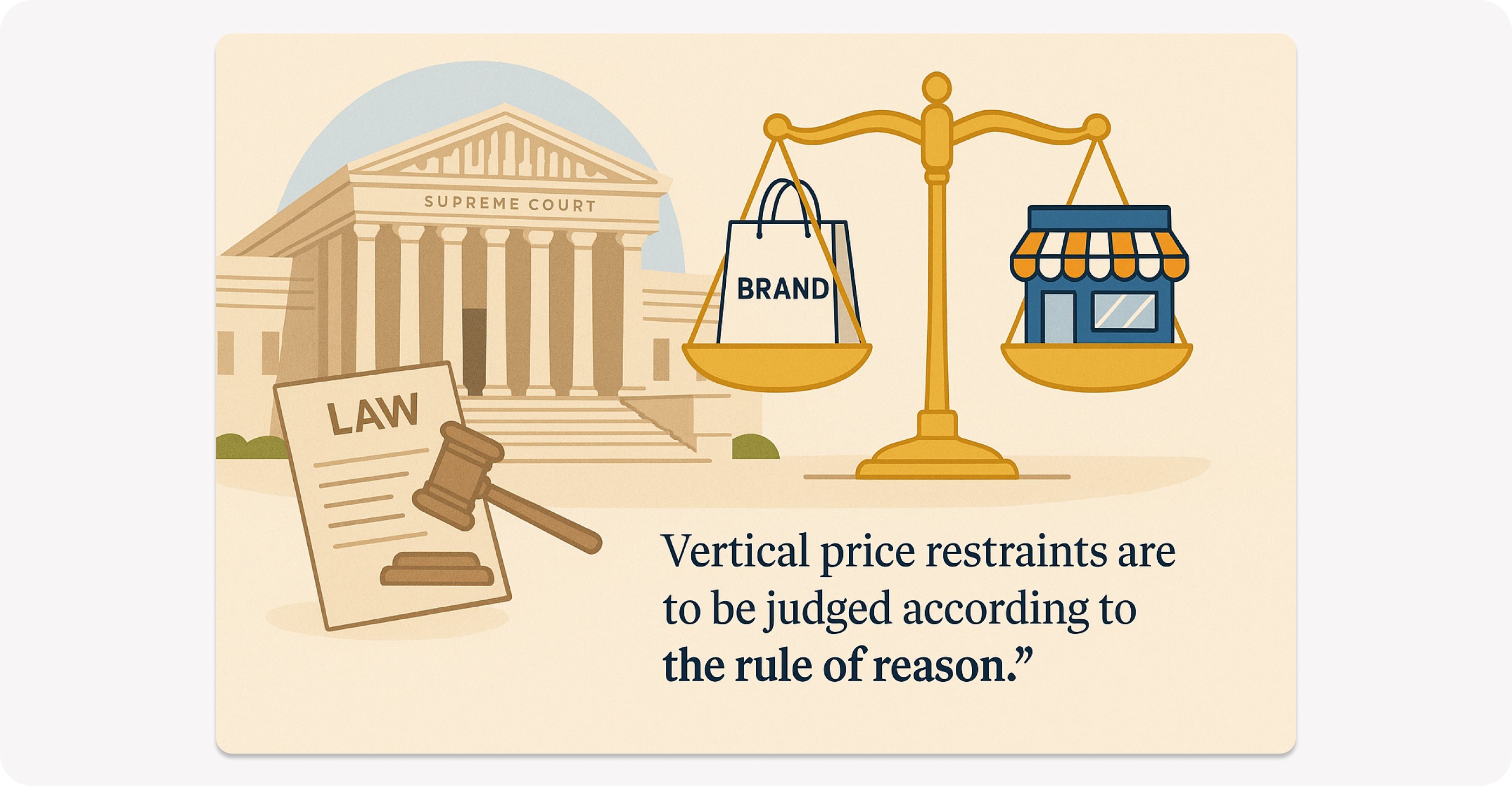
In the United States, following the Leegin Creative Leather Products case in 2007, the Supreme Court overturned the previous Dr. Miles decision, ruling that vertical price restraints should be judged under the rule of reason rather than being deemed per se illegal, which led to the widespread adoption of UPP. The ruling states as follows:
"Vertical price restraints are to be judged according to the rule of reason."
This means that even if a manufacturer sets a minimum resale price, the action can be legal as long as it does not hinder market competition. In other words, restricting the sale price does not automatically become illegal, but rather its impact and context must be comprehensively considered.
However, this is a story limited to the US legal system, and the legality of UPP can vary significantly depending on the fair trade laws and precedents of each country.
What is the difference between MAP and UPP?
Although many practitioners use UPP and MAP (Minimum Advertised Price) interchangeably, the two policies are distinctly differentiated in their targets of application, legal interpretation, means of control, and practical operations. Failing to understand this distinction accurately and considering adoption solely based on the perception that "UPP is a stronger policy" can lead to legal risks.
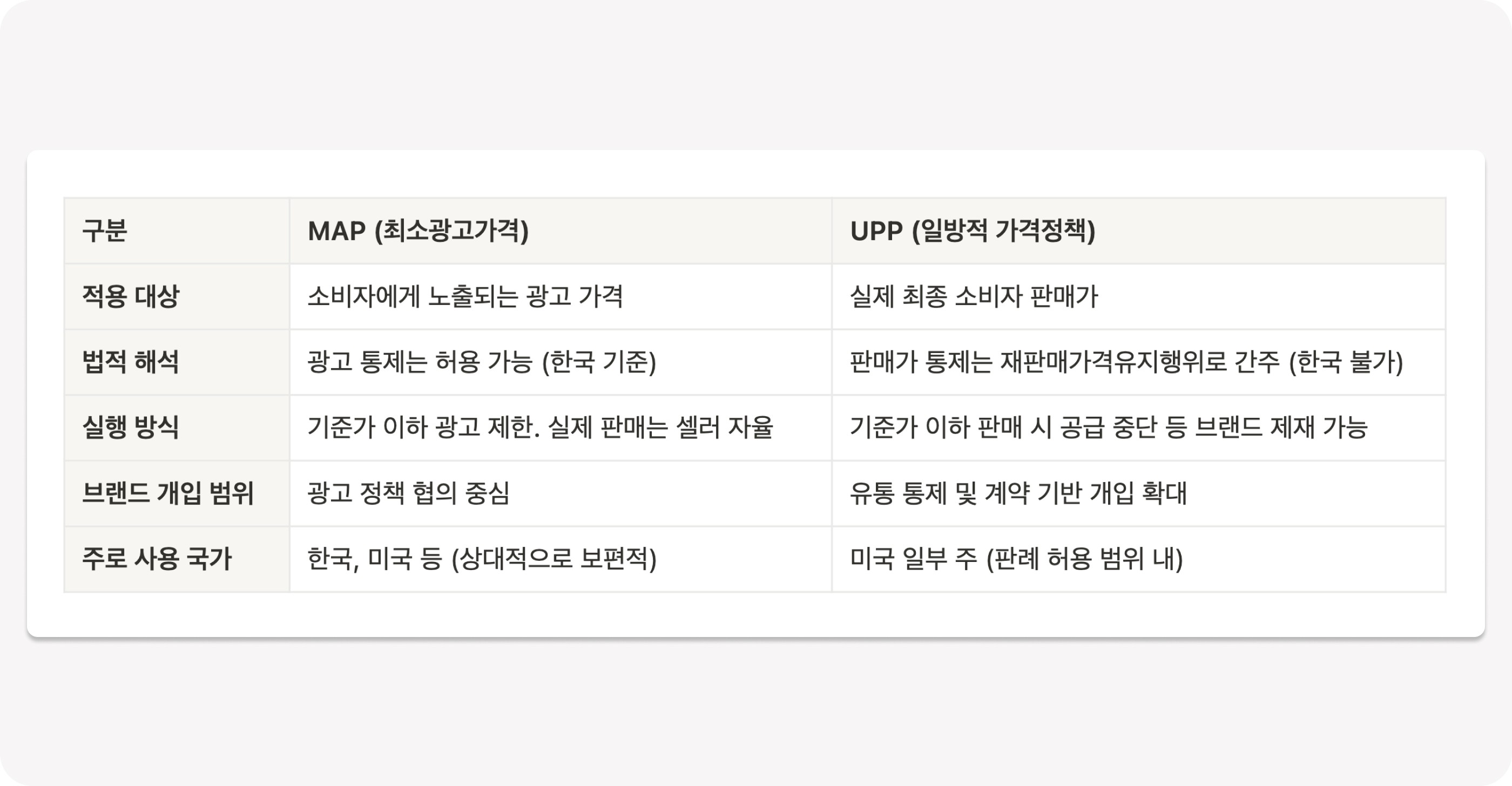
The Minimum Advertised Price (MAP) is a policy that restricts products from being 'advertised' online or offline at a price lower than the advertised baseline price set by the brand. However, the actual selling price can be adjusted at the seller's discretion. In other words, the brand can control the 'price perception' projected to consumers, but does not control the actual purchase price.
On the other hand, UPP is a policy where the brand specifies the actual selling price itself and can take direct actions, such as suspending supply or terminating transactions, if it is not adhered to. As mentioned earlier, in the United States, it became partially legalized after the Supreme Court applied the "rule of reason" principle in the 2007 Leegin decision, but this is due to the unique legal structure of the US.
UPP significantly expands the brand's room for intervention throughout the sales process. While it holds strong execution power for companies with robust distribution structures, it has the disadvantage of high management costs in markets with a large number of sellers and decentralized transaction structures. Particularly in countries like South Korea, where price control is strictly restricted under fair trade laws, it cannot be practically utilized.
Since MAP allows a brand to realize its pricing strategy within a relatively flexible framework of advertising control, it is utilized in domestic practice as a realistic alternative that minimizes legal risks.
Why is UPP impossible in South Korea?
While UPP policies are operated legally under certain conditions in some countries, including the United States, they face structural limitations that clearly prohibit them in South Korea. The core reason is that the South Korean Monopoly Regulation and Fair Trade Act prohibits 'resale price maintenance' in principle.
'Resale price maintenance' refers to any act by a manufacturer or brand that forces or induces a distributor or seller to maintain a certain resale price. This is prohibited by the Fair Trade Act on the grounds that it is likely to undermine free competition in the market, and violations can result in sanctions such as corrective orders or surcharges.
According to a case announced by the Fair Trade Commission (FTC) in March 2024, the digital piano brand 'Young Chang' (HDC Young Chang Co., Ltd.) established the minimum online retail price for its products (digital pianos, synthesizers, speakers, headphones, etc.) from 2019 to 2022, notified its distributors of this on at least five occasions, and forced compliance. Distributors that violated the pricing baseline faced product supply suspensions of 15 days to 3 months, and the FTC investigation confirmed that shipping suspensions were actually executed 289 times.
Furthermore, from 2021, the severity of penalties was increased to allow contract termination depending on the number of violations, and Young Chang documented this in the form of 'Online Management Regulations' and delivered it to distributors via email or sales representatives. Price monitoring was continuously conducted using dedicated software and personnel, and it was confirmed that price competition among sellers within online distribution channels was practically blocked.
The FTC judged this as resale price maintenance and imposed a corrective order along with a surcharge of 166 million KRW. Notably, since Young Chang is the number one operator with a 47.2% share in the domestic digital piano market, it was also specified that the sanction holds symbolic significance due to its major impact on the overall market.
As such, because UPP is structured to control the actual prices at which sellers transact, either directly or indirectly, it cannot be legally permitted in South Korea. Particularly, if accompanied by the following actions, its illegality becomes even clearer:
Unilaterally notifying price guidelines without specifying them in the contract
The brand taking disadvantageous measures retrospectively, such as suspending supply or reducing margins
Discriminatory application among sellers, even if it is an internal operating policy

From a practitioner's perspective, applying cases from other countries like the US directly to the domestic market can be risky in itself, and even policies expressed internally as 'supply policies' or 'seller consultation standards' can actually constitute violations of the law.
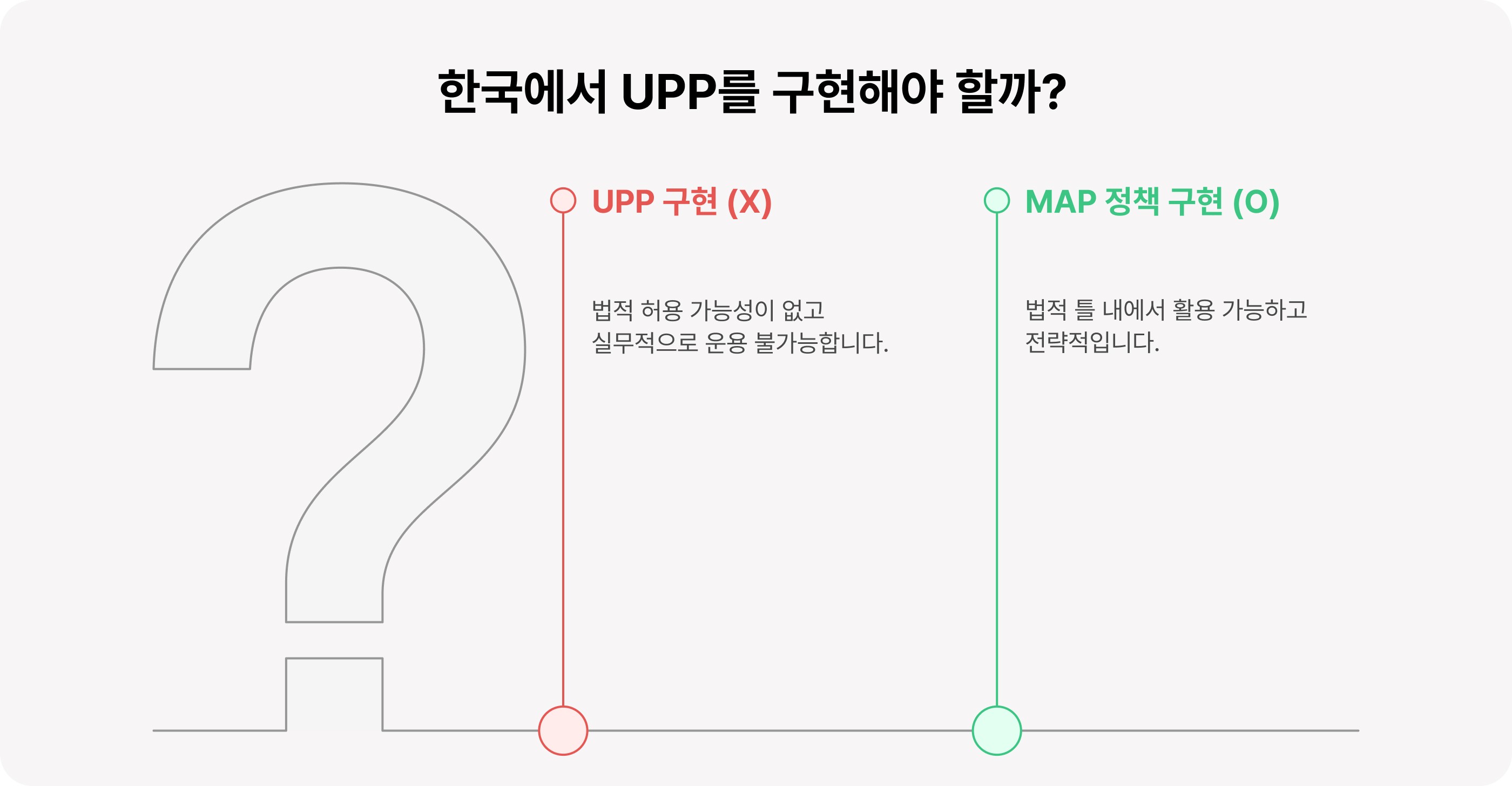
In conclusion, in South Korea, UPP has no legal permissibility at all and is a strategy that cannot be practically operated. Rather than agonizing over whether to adopt UPP, it is a far more strategic choice for brand managers to flesh out execution methods for policies that can be utilized within Korean law (such as Minimum Advertised Price MAP).
Is MAP usable in South Korea?
Because the Minimum Advertised Price (MAP) policy takes the form of controlling only the advertised price exposed to consumers, in principle, it is interpreted as not falling under resale price maintenance under the South Korean Monopoly Regulation and Fair Trade Act. In other words, a method in which a brand does not force the actual selling price on the seller but requests that the exposed price be maintained above a certain baseline can be operated with relative flexibility.
However, for a MAP policy not to be misunderstood as price interference in practice, the following conditions must be met:
The setting of the advertised baseline price must be clearly notified in advance,
It must be applied equally to all sellers, and
In case of baseline violations, there must be no direct sanctions such as supply suspension or contract termination, and actions must be limited to indirect measures such as suspension of advertising subsidies or marketing cooperation restrictions.
For example, when registering a product on a specific open market, Naver Shopping, or a price comparison site, it may not pose a legal issue if the brand provides prior guidance so that the price exposed to consumers remains at or above the MAP baseline, maintaining it in the form of agreed guidelines with the seller. However, if actual supply is cut off or contractual disadvantages are imposed solely because this baseline was breached, it can be viewed as a form similar to UPP and judged as resale price maintenance.
In relation to this, although there are no official sanction cases by the FTC regarding Minimum Advertised Price (MAP) policies to date, the FTC has stated that if violation leads to sanctions or is linked to supply conditions, it can become subject to investigation or sanctions. The standard that the FTC has consistently emphasized is that "it is permissible only to the extent that it does not practically infringe upon the autonomy of the seller." Therefore, if measures like supply restriction, contract termination, or advertising restrictions are combined during MAP operation, it may be judged as resale price maintenance.
Furthermore, even if the Minimum Advertised Price (MAP) policy is used as part of internal brand regulations or marketing policies, if the equity among sellers and the notification procedures are unclear, it may face retrospective investigation by the FTC. In particular, since the boundary between advertising and selling price is blurring in the recent digital distribution environment, a higher level of caution is required in practice.
In conclusion, although MAP is a far more usable policy in South Korea compared to UPP, the legal risk can vary depending on the actual execution method and the level of subsequent measures. Practitioners must operate MAP not as a simple 'price baseline' but as a transparent and consistent communication system, and a conservative approach accompanied by legal reviews when necessary is required.
In practice, MAP + Automated System is the most realistic
For brands in South Korea to stably maintain price order while minimizing legal risks, combining an automated management system based on a Minimum Advertised Price (MAP) policy is the most realistic alternative. Simply setting an advertised baseline price and guiding sellers does not make price control work properly, and repeated violations will inevitably increase the burden on practitioner resources.
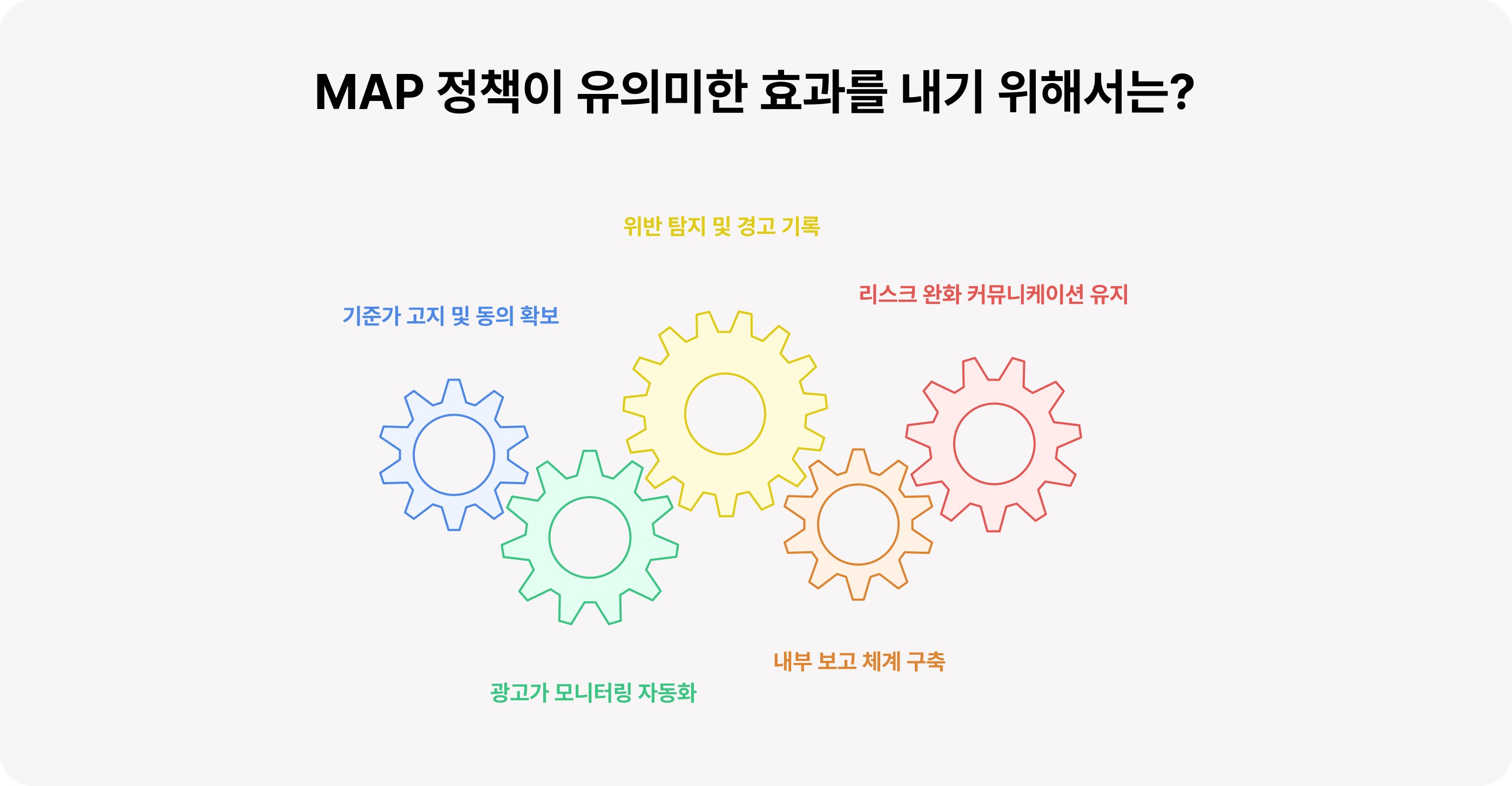
For a MAP policy to exert meaningful effects in actual operation, the following systems must be premised:
Notifying baseline prices and securing consent: Officially notify sellers of the advertised baseline price via document or email in advance, and establish a process to obtain consent for the brand policy.
Automated monitoring of advertised prices: Automatically collect and compare advertised product prices on major channels such as open markets, price comparison sites, and brand stores to check if they deviate from the baseline.
Violation detection and warning records: Automatically send warning templates to sellers who deviate from the baseline, and log the history to cumulatively track repeated violations.
Establishing an internal reporting system: Quantify the violation status by seller, action results, accumulated warning counts, etc., and utilize them periodically for internal sharing and strategic meeting materials.
Maintaining risk-mitigation communication: Pre-establish the tone of response messages and action criteria so that the consistency of the brand's pricing policy can be maintained without damaging relations with sellers.
Handling these operations manually consumes excessive practical resources and may also result in low accuracy. Therefore, adopting an automated solution like Reatrichs offers the following advantages:
Automated monitoring of price deviations based on the advertised baseline price
Automated extraction of deviating seller lists and history management
Automated sending of warning templates and logging of responses
Providing visualization reports such as deviation rates by seller and occurrence frequencies by platform
In particular, for repeat-violating sellers, response priorities can be established based on 'number of warnings within the last 30 days', 'degree of deviation (%)', 'last warning date', etc. It also includes an automated PDF generation function for internal reporting, enhancing both the strategic nature and efficiency of practical responses.
As a result, for a Minimum Advertised Price (MAP) policy, the operating method is more important than the policy itself. If you only set a baseline price without an execution system, its effectiveness drops, and it can be difficult to secure defensive logic legally. Therefore, brands should not operate the Minimum Advertised Price (MAP) merely declaratively, but must build a data-driven execution system that continuously operates on the ground. This is precisely what determines the execution power of a brand's pricing strategy.
Conclusion: A feasible pricing strategy tailored to the brand is needed
As we have explored so far, UPP is not legally permitted in South Korea, and price controls that actually involve supply suspensions or contract terminations are subject to sanctions by the FTC. On the other hand, the Minimum Advertised Price (MAP) is a method of setting standards limited to advertised prices, which, if certain conditions are met, serves as a realistic tool that can be applied in practice while reducing legal risks.
However, MAP can also be regarded as resale price maintenance if operated only declaratively or if accompanied by excessive sanctions upon violation. A consistent operating system encompassing the setting of advertised baseline prices, monitoring, warnings, and communication with sellers is required, and combining it with an automated system is effective in reducing the burden of repetitive manual work.
Ultimately, the core that brands must protect is "how to effectively maintain distribution order within the boundaries of the law." Pricing policies must focus on realistic feasibility rather than strong control, and the strategy must start with designing a sustainable execution system rather than simply establishing standards.