Image Theft
Reporting Image Theft on Open Markets: Why is it Not Being Deleted? The 2 Proofs Platforms Require

💡 In this article, you can find the following information.
Why isn't the seller who uploaded and sold our images as they are being taken down, even after being reported?
Why doesn't the platform delete it immediately despite it being an obvious theft?
What makes a successful report different: Two types of proof required by platforms
Is it already too late when you discover the theft? 3 evidence routines to maintain on a regular basis
Protecting brand assets with 'perfect proof' instead of emotional protests
Why Isn't a Seller Who Copies and Uses Our Image for Selling Taken Down Even After Being Reported?
While managing your brand, have you ever seen a screen like this on an open market?

It is a situation where the detail page we carefully created last season is uploaded in the exact same way on the sales page of an unknown third-party seller. The lighting angles of the model cuts, the layout of the ingredient table, and the product lighting are all exactly the same as the original we shot. The only difference is that the seller is 'not us.' If you look closely, our brand watermark is subtly erased, or the logo position is slightly shifted. Many brand managers I met during practical consultations also expressed feeling hollow as they sat looking alternately at the original image files and the unauthorized plagiarized pages side by side on their monitor screens.
These sellers usually hang our brand logo prominently on the front of the thumbnail and use the pictorial cuts we spent money to take exactly as they are in the middle of the detail page. They either copy it entirely as a whole, or cunningly modify the image, such as cropping it slightly or tweaking the colors a bit to avoid similarity checks. In either case, the selling price is often cheaper than the official retail price. From the consumer's perspective, since our image is used exactly as it is, it becomes difficult to distinguish whether this place is an official distribution channel or not.
When first encountering such a page, it is easy to think casually, "Since it's obviously our product image, it will be taken down quickly if I report it." So, you click the platform's report button and send an email to the customer center. However, the reply that comes back is only a principled copy of "We will take action after confirmation," and even after several days, the product page is often still up and running perfectly. There are really many managers who complain of difficulties, saying they missed the golden time for response while waiting, trusting only such guidance. In the meantime, the unauthorized seller acts as if they are the official seller to sell goods, and the brand's price order is disrupted in an instant.
Moreover, this kind of thing does not end as a one-off event. It is certain that you reported it yesterday and even completed internal sharing, but the next day, it appears again under a different name. It is a page made of our logo and photos, but we, who suffered the damage, have to go around proving "why this is ours" one by one, which is bound to be frustrating. If you handle numerous cases of plagiarizing and blocking in the field, you can find a clear reason. The reason why reports are not processed properly is not because the content of the complaint is wrong, but because the evidence in the format required for the platform to proceed with the deletion measure was not submitted.
Then, what exactly does that "format" that the platform talks about mean? In order to approach reporting not as an emotional protest but as a practical procedure, it is necessary to accurately understand the judgment criteria and internal processing structure by which the platform operates first.
It's an Obvious Plagiarism, so Why Doesn't the Platform Delete It Immediately?
First, we need to look into how the platform operates. Knowing this mechanism, you will naturally understand why the evidence materials to be discussed later are necessary.
An open market operator is merely an intermediary platform that connects sellers and buyers, and does not directly get involved in individual transactions or registered products. Therefore, even if a specific seller plagiarizes someone else's trademark or image to upload a product, the platform does not assume immediate legal responsibility solely for that fact. The Supreme Court ruled that in order for an open market operator to be held liable for aiding and abetting trademark infringement, several strict requirements must be met (Supreme Court Decision 2010Ma817 decided on Dec. 4, 2012), and since then, lower courts have also referred to similar judgment criteria for other types of infringement, such as copyright and unfair competition. This means that liability can be pursued only when it is recognized that the illegality of the infringement is clear, the operator received a specific request for deletion from the victim or could clearly recognize the existence of the post, and was in a state where they could technically control the post.
The key keywords in practice here are "specific request for deletion" and "clarity of illegality." This is easy to understand if you think about it from the platform's perspective. If the platform immediately deletes a specific seller's product or takes down a page simply because a report has been filed, the platform itself could also bear a risk. This is because false reports are frequently made to disrupt competing sellers. Therefore, the platform requires evidence that can prove they took action to delete it "after sufficiently checking objective evidence."
Consequently, a gap arises between the 'obvious infringement' judged by the brand and the 'level of proof' required by the platform to take action. This is the very reason why processing is delayed with only repeated answers of "we will check." As mentioned earlier, in many cases, reports are rejected or processing is delayed not because the claim is wrong, but because objective supporting evidence that allows the platform to make a decision has not yet been delivered. Ultimately, to end the frustrating waiting state, there is no choice but to clearly deliver 'the documents they require' so that the platform can act with confidence.
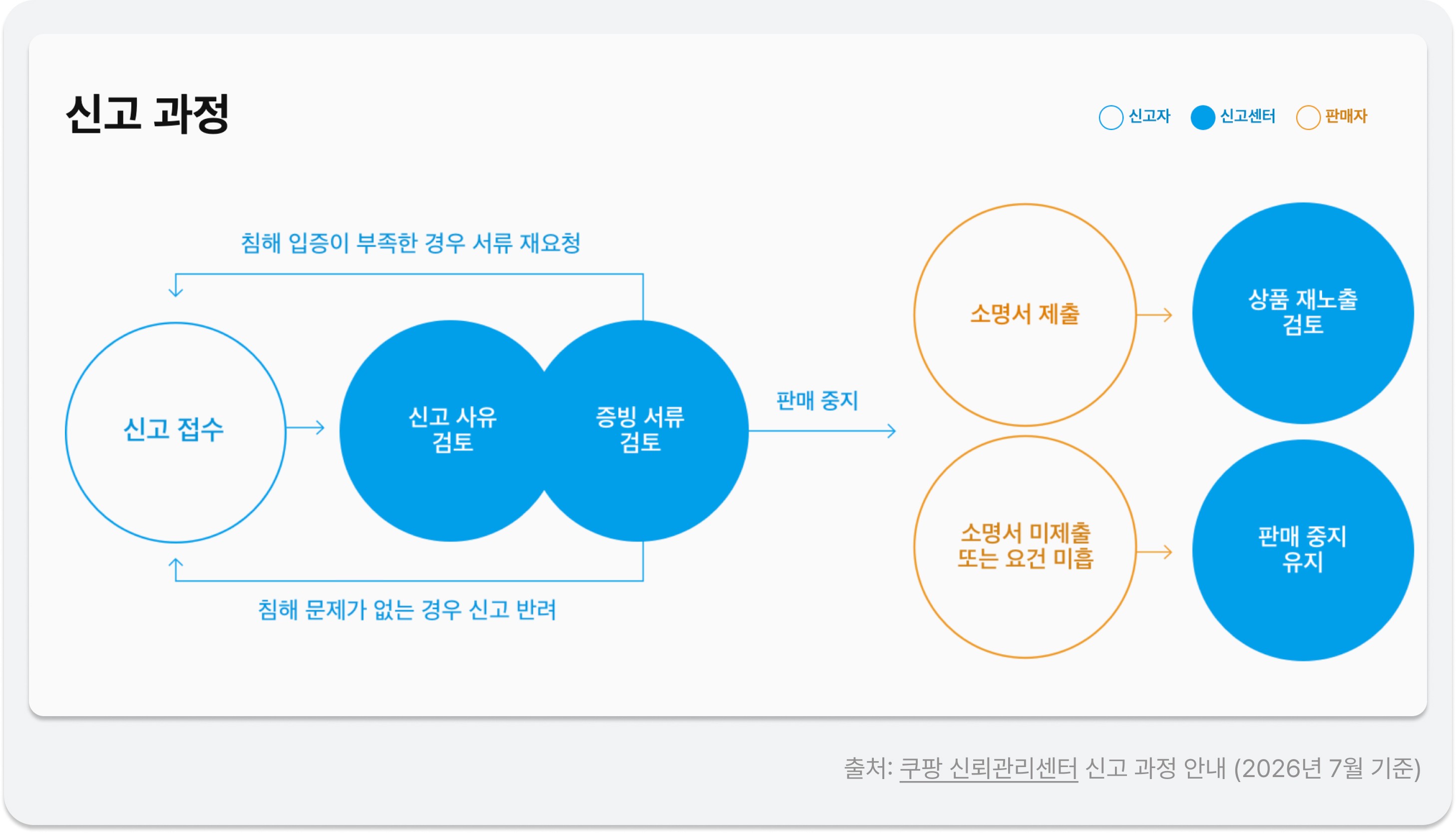
What's Different About Successful Reports?: Two Evidences Required by the Platform
Then, what kind of materials should be prepared in practice? Looking at the official guides of major domestic open markets (as of July 2026), the materials for an infringement report to be accepted are largely divided into two axes. One is evidence proving that "I am the legitimate right holder," and the other is evidence specifying "how that seller infringed on my rights." Since these two are different in nature, they cannot be processed with only one. Normal review begins only when both are present.
"Why Is This Ours?”: Document Proving That I am the Right Holder (Proof of Right)
The platform first verifies whether the reporter holds legitimate rights to the content or brand. At this time, since the required documents differ depending on the type of infringement, caution is needed in practice. This is because the brand's claim of "ours" is also legally divided into three types.
First, if a trademark or logo is used without authorization, it falls under trademark infringement. In this case, a trademark registration certificate or trademark register registered with the Korean Intellectual Property Office, or a trademark license agreement is required. There must be a legal basis on paper, not a suspicion of "anyone can see it's our logo." Since trademark rights generate exclusive rights only when setup registration is completed with the Korean Intellectual Property Office, unregistered trademarks are highly likely to be rejected at the platform reporting stage.
Second, if a directly photographed photo or detailed page is copied without authorization, it should be approached as a copyright issue. A copyright registration certificate is the most secure, but even if it is not registered, the original file (including Exif metadata) recording the date and time of creation or shooting, or the post on our own mall/SNS where the image was first posted can be used as supporting evidence. Since copyright is generated simultaneously with creation, registration is not an essential condition, but we must prove through original files and the first public record that "we created it first."
Third, if the entire detail page is copied, the perspective of 'editorial work' can be utilized. While a single simple product photo is often ambiguous in having its creativity recognized, the entire detail page, which combines photo arrangement, text composition, and design layout, is easy to be protected as an editorial work that recognizes creativity in selection and arrangement. When it is difficult to prove creativity with a single individual image, targeting whether the entire page is copied, where creativity is recognized in the selection, arrangement, and composition of materials, can be an effective alternative.
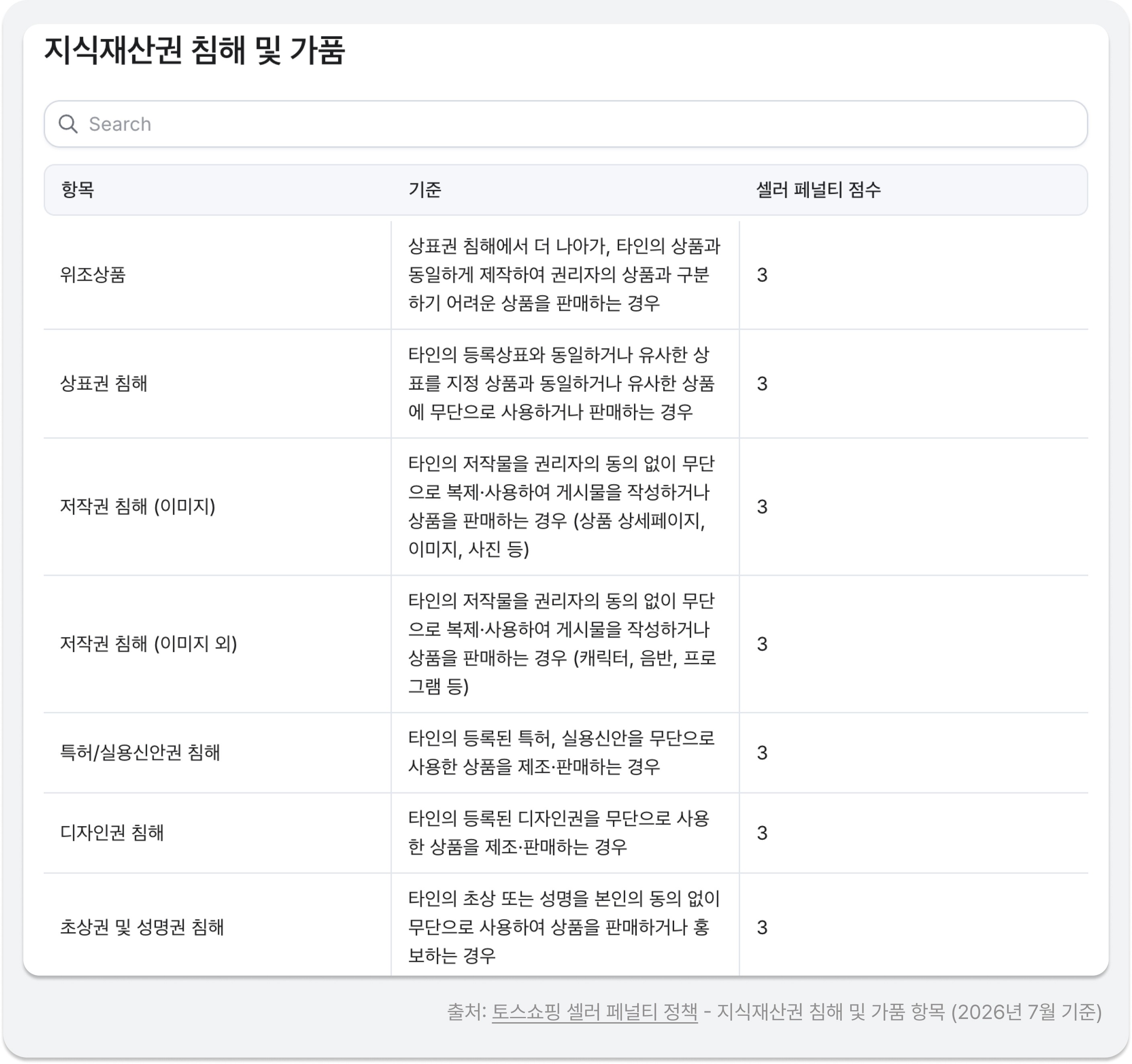
Additionally, if a cut of a person is included, right of publicity issues are intertwined together. Coupang classifies infringement of the right of publicity and right of portrait, and Toss Shopping also classifies infringement of portrait rights and name rights as a separate penalty item from infringement of trademark, copyright, and design rights, so documents indicating legitimate authority to use the image, such as a model license agreement, must be prepared together.
Therefore, when refining reporting requirements in practice, you must clearly determine which rights to base your claim on. A simple cut of a product placed squarely on a white background is difficult to have its creativity recognized because anyone can produce it similarly. On the other hand, a pictorial cut where lighting, props, and model poses are staged, or the entire layout of a uniquely planned detail page is a much stronger ground for proof. Even for the identical plagiarism case, the feasibility of restriction varies greatly depending on which right is placed at the center of the approach.
There is one more situation to look at carefully here. That is 'when the product being sold by an unauthorized seller is actually authentic.' It is a situation where they sell a real brand product obtained through parallel import or other distribution channels. In this case, it is practically not easy to restrict the "sale of the product itself." This is because the legal principle (exhaustion of trademark rights) that a trademark owner cannot prohibit resale of authentic goods normally distributed applies.
However, changing the point of proof slightly can open up a solution. Even if the sale of authentic goods itself cannot be blocked, the act of using our pictorials or detail pages without authorization or leading to misconception as if they are an official store can be treated as a separate infringement. Using a pictorial taken without permission constitutes copyright infringement, and creating a misconception as if they are an official distribution channel has plenty of room to be disputed as an act of unfair competition under the Unfair Competition Prevention Act. Therefore, when dealing with sellers who distribute authentic goods without authorization, setting the direction of proof to 'prohibition of unauthorized use of company intellectual property and indicia' rather than 'prohibition of sale' is often more effective in practice. In real practice, when utilizing this distinction clearly, there were relatively many cases that led to restrictions.
"Where and How Did They Copy It": Material Specifying the Infringement Fact (Proof of Infringement)
If you proved the fact of holding rights, next, you must clearly point out "exactly which part did the seller infringe upon." The processing speed of the report is determined at this stage. It is also the stage that helps the platform manager's judgment.
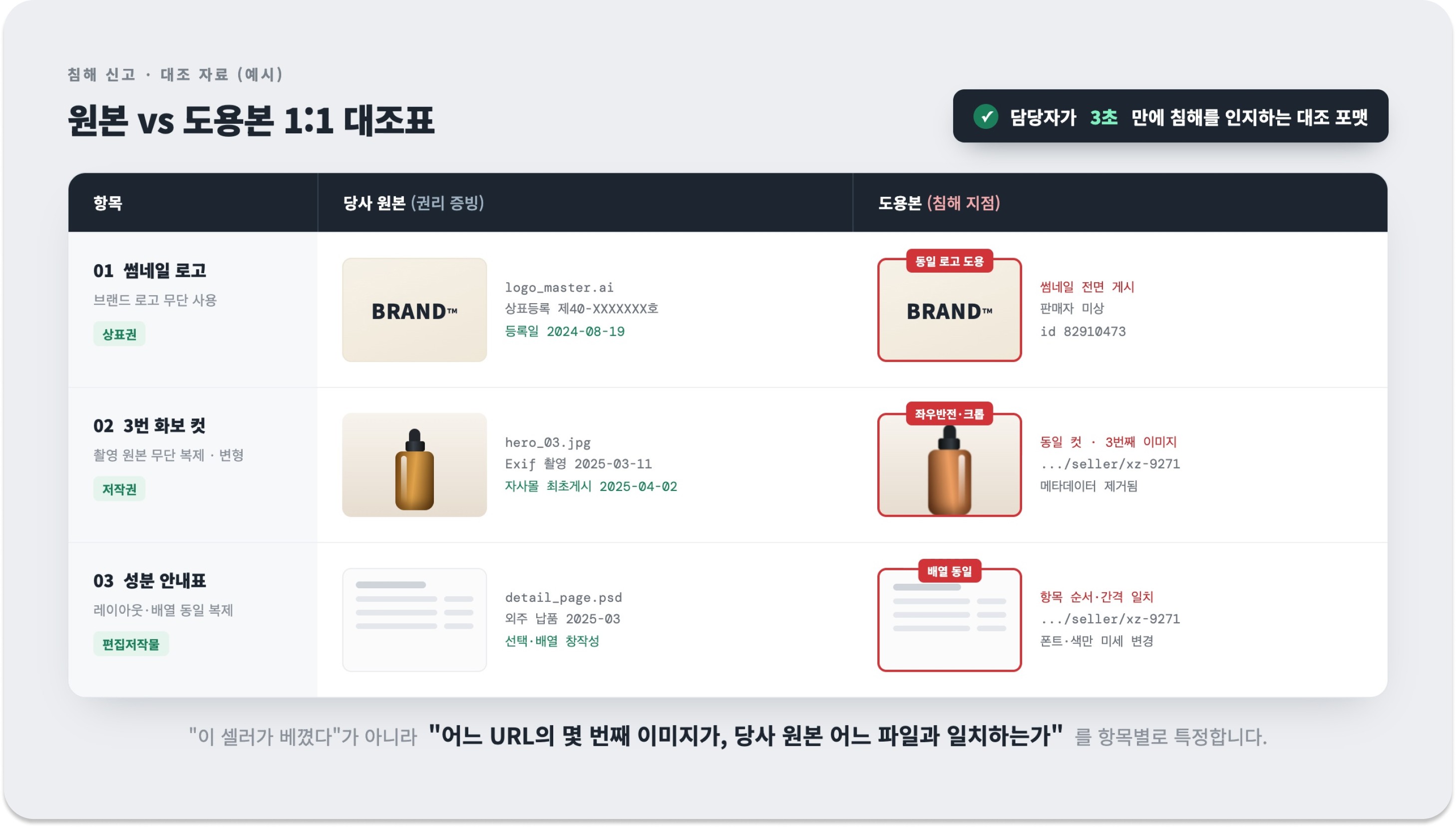
Rather than a vague writing like "This seller copied our page," a specifically targetted report like "The third image of the detail page of the corresponding URL is exactly identical to our original file and first post" is processed much faster. The core points required by the platform are the URL of the infringing product, seller information, product ID, and visual comparison materials contrasting the original and the copied version 1:1.
When configuring such contrast data, it is efficient to categorize and organize the infringing items. For example, if you organize contrast points by item, such as "1. Unauthorized use of thumbnail logo / 2. Original contrast of pictorial image 3 on detail page / 3. Identical design layout of ingredient guide table," you can use them exactly as they are as a list of proof when writing a report. A manager can make a decision much more quickly when materials with detailed correspondence are submitted rather than vague claims.
In fact, looking at the Coupang Intellectual Property Protection Policy, intellectual property owners can report infringement through an online report form, and when a report is received, the operator reviews the contents and requests documents from the seller to prove the source of the product. If the seller fails to explain legitimate authority or the infringement is confirmed, measures such as suspension of product sale/exposure, suspension of seller account, and suspension of settlement payment follow. To pass this review process at once, rights documents and infringement contrast data must be prepared without omission. Also, Coupang Trust Management Center refines report types into trademark, copyright, design, and patent rights, as well as unfair competition, portrait rights, and right of publicity, and Toss Shopping also manages them by dividing types into counterfeit goods, trademark rights, copyright, design rights, patent rights, portrait rights, and name rights infringement. (As of July 2026, and details may change according to platform policy revisions.)
In summary, only when the two axes of proof of rights (proving the right holder saying "It is our product") and proof of infringement (specifying the infringement saying "That seller plagiarized") are prepared with appropriate forms and documents, a "normal report" that the platform can process is established.
When Plagiarism is Discovered, is It Already Too Late? 3 Evidence Routines to Keep Regularly
However, the proof materials required by the platform have practical difficulties to gather in a hurry immediately after discovering plagiarism.
The open market's reporting system is a useful tool to quickly block infringing posts, but there is a limit to dealing with it only as a post-response. In order to smoothly pass platform reviews and furthermore prepare for legal disputes, records on brand assets must be managed continuously on a regular basis.
In particular, an objective record that can prove the 'time of creation and publication' is most crucial. The URL of the plagiarized post, the screen capture at the time of discovery, the record of the captured date and time, etc., become clear grounds to gain an upper hand when the opponent claims initial dissemination in an unprovoked way in the future. Shooting metadata of our original file, the date of the first public post, and emails exchanged regarding production correspond to this.
Here are three management criteria that practical managers can apply right now.
First, inspect the preservation status of the original files of your company's representative images and detail pages. In many cases, the original is destroyed leaving only the final outsourced delivery copy or JPG file containing combined text, but original files containing metadata are the clearest proof showing "we are the original creators."
Second, it is good to organize records on the initial release timing and channels of content. If you preserve the first public trace that can be verified externally, such as the registration date of the product on your own mall and official SNS upload date, it is highly likely to be advantageous in the future proof process.
Third, capture the screen immediately as soon as you find a suspected plagiarized post so that the acquisition time (date and time) and URL are clearly revealed. If you put it off thinking "I should gather and report them all at once later," situations often occur where you cannot secure evidence in a necessary moment because the seller modifies the page or takes down the post voluntarily.
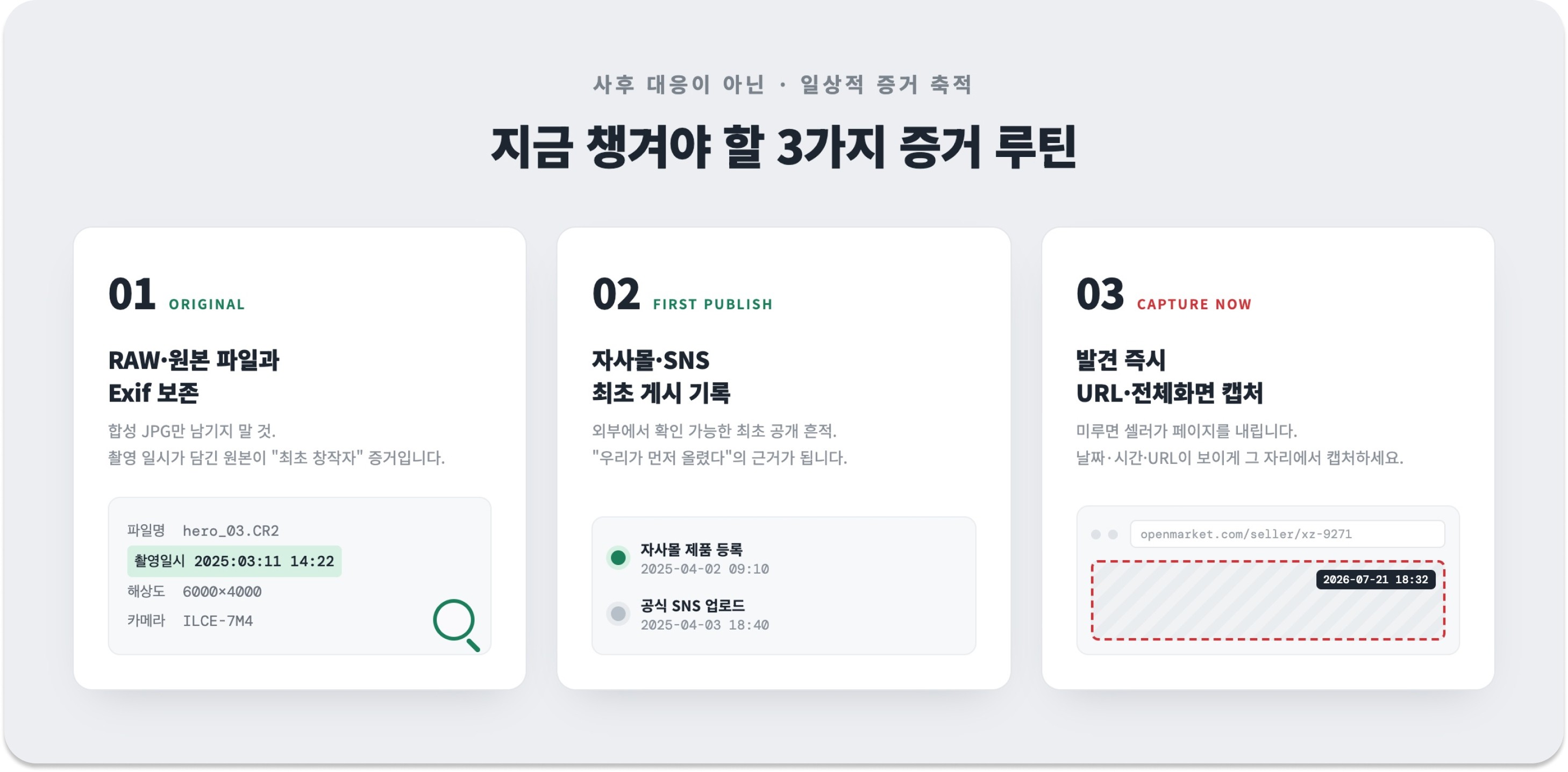
These three routines are areas that can be started immediately without a separate budget or grand system. However, depending on whether these management habits are established, it is decided whether the product can be taken down in a single day or dragged around for several weeks when plagiarism occurs. In the end, the key lies not in 'post-response' but in 'daily accumulation of evidence.'
Protecting Brand Assets with 'Perfect Proof' Instead of Emotional Complaints
Let's go back to the situation we talked about at the beginning. Finding an unauthorized seller who copies and sells our image, clicking the report button saying "anyone can see it's ours," but only receiving the frustrating reply "checking," right?
The way to resolve this situation is not to complain more strongly to the customer center, but to prepare and deliver the proof in a format that the platform can take action on immediately. And the core materials that complete that format—rights documents, original files, first public records, and captures with timestamps—are all things that should have been prepared before the incident broke out.
Reporting itself is a momentary action, but the power to make the report pass comes from records accumulated regularly. Staging a plagiarized page takes only five minutes, but correcting it naturally takes far more time and effort. The surest way to minimize damage is not to cope after a problem occurs, but to create a routine to systematically manage asset images and evidence materials in daily life.
Checking where the original files of our brand's representative images are stored right now and whether the shooting metadata is well maintained. Brand asset protection starts from that small inspection.
▶︎ Reference Laws & Precedents
Supreme Court Decision 2010Ma817 Decided on Dec. 4, 2012 — Precedent presenting requirements for an open market operator to be held liable for aiding and abetting trademark infringement. (National Law Information Center)
Article 103 of the Copyright Act (Suspension of Reproduction and Transmission) — Article stipulating that a right holder can explain infringement and request suspension of reproduction/transmission from an online service provider. (National Law Information Center)
Article 102 of the Copyright Act (Limitation on Liability of Online Service Providers) — Article acting as a basis for limiting liability when online service providers take measures satisfying certain requirements. (National Law Information Center)
Unfair Competition Prevention and Trade Secret Protection Act — Law regulating, as an act of unfair competition, conduct that causes confusion of source by using widely known marks without authorization. (National Law Information Center)
▶︎ This content is aimed at providing general information based on the experience of operating brand protection solutions that have supported open market plagiarism responses of various brand companies, and it is recommended to receive advice from professionals such as lawyers or patent attorneys for detailed individual matters.