Price Management
MSRP vs MAP: Which is more effective for brand protection?

💡 In this article, you can find the following information.
MSRP and MAP, what are they and how do they differ?
Which policy is more effective for brand protection?
Which policy, MSRP or MAP, is right for our brand?
Can both policies be used together?
How can we operate and manage a MAP policy?
A feasible strategy is more important than the policy itself
“I've heard that MSRP is the price shown to consumers, and MAP is the lowest price at which resellers can advertise... But I don't know which policy is actually more suitable for our brand.”
This is a dilemma that almost every brand manager has faced at least once. Pricing policy is not an easy decision to make because it affects not only the brand's revenue structure but also its overall image, customer trust, and distribution strategy.
Particularly, as the number of resellers on domestic and international platforms has surged, and unauthorized discounts and price distortions have worsened due to 'unauthorized sellers (black sellers),' the need for brand protection has grown even greater. The emergence of black sellers who undermine the brand's benchmark price can shake the trust and premium image that the brand has painstakingly built up over a short period. In this reality, brand managers face the fundamental question of 'What policy allows for practical price control while maintaining brand value?'
In this content, we will structurally compare the differences, pros and cons of the MSRP (Manufacturer’s Suggested Retail Price) policy and the MAP (Minimum Advertised Price) policy, and their applicability in practice. We will also present a checklist and practical tips on what criteria can actually be used to select and operate policies in the field.
MSRP and MAP, How Are They Different?
MSRP and MAP are two terms that are often confused when brands establish pricing strategies. However, the two policies show distinct differences in purpose, execution method, and level of brand protection.
MSRP(Manufacturer’s Suggested Retail Price) is the standard price proposed by the brand to consumers. Official distributors or resellers refer to this price to set selling prices autonomously, but it is not legally binding. In reality, even if they sell or discount at a price lower than MSRP, it cannot be sanctioned. From the brand's perspective, it serves as a reference point for providing price credibility to consumers, but it has limitations in that it cannot control actual market prices. In reality, due to intensifying price competition among platforms, the MSRP is often ignored among resellers.
MAP(Minimum Advertised Price) is a policy that specifies the lowest price at which a brand can advertise or publicly expose to authorized resellers with whom it has a supply contract. This is a means to adjust the price perception seen by consumers without directly controlling the selling price. If a reseller advertises at a lower price than this, contractual sanctions such as supply suspension or warnings are possible, and the brand can maintain market order based on the exposed price.
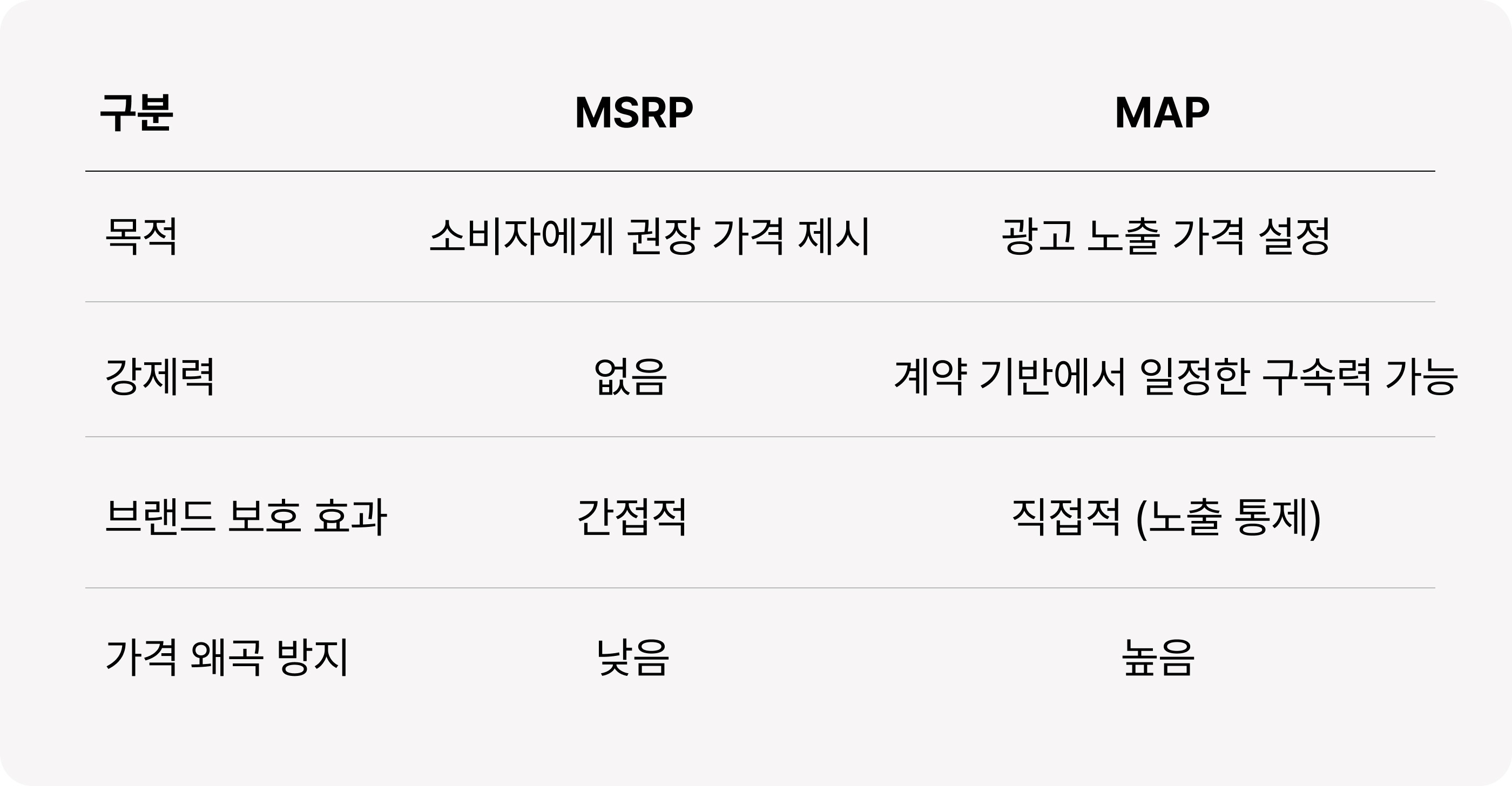
※ Caution: In South Korea, the MAP policy may be considered a 'resale price maintenance behavior' under the Fair Trade Act, so mandatory enforcement can be legally problematic. Therefore, domestic brands request compliance with MAP at the level of 'advertising guidelines' based on official distribution contracts, or strengthen internal discipline through an authorized reseller registration system. Exercising this forcibly without legal advice can lead to sanctions from the Fair Trade Commission, so caution must be exercised.
Which Policy is More Effective for Brand Protection?
While MSRP is useful as a price benchmark, it has limitations in directly preventing price distortion. For example, even if a reseller sells a product with a regular price of 99,000 KRW for 65,000 KRW, the MSRP itself cannot sanction this. Consequently, the brand's premium image may be damaged due to price distortion, trust with existing customers may be lost, and even reputable sales channels can be affected.
On the other hand, MAP can act as a more advantageous tool for protecting brand value and premium image by controlling the price advertised and exposed. In particular, it is effective in preventing brand value depreciation caused by excessively low prices exposed on search advertisements, price comparison sites, and meta platforms.
Ultimately, the key point for practitioners to consider is that brand protection is difficult through simply setting price standards alone. In an era where the visible price determines the brand image, how you manage the advertised price is directly linked to the brand's position in the market and the trust of distribution partners. Finding a balance between simple standard-setting (MSRP) and actual execution power (MAP) is the core of a brand protection strategy.
Which Policy is Right for Our Brand, MSRP or MAP?
Since each brand has a different distribution structure and strategy, a uniform standard is difficult to apply. However, you can find a direction through the following criteria:
Product Price Range: The higher the unit price of the product, the greater the effect of MAP, whereas for low-priced products, price stability may be achieved through MSRP alone.
Number of Resellers: If there are multiple distribution channels such as open markets and global platforms, advertising control through MAP is advantageous.
Brand Position: For brands where maintaining image is more important than price competition, prior operation of MAP is effective.
Internal Human Resources: Operating MAP requires not only policy design but also monitoring, response personnel, or automation tools. If human resources are lacking, starting with MSRP and expanding to MAP is also an option worth considering.
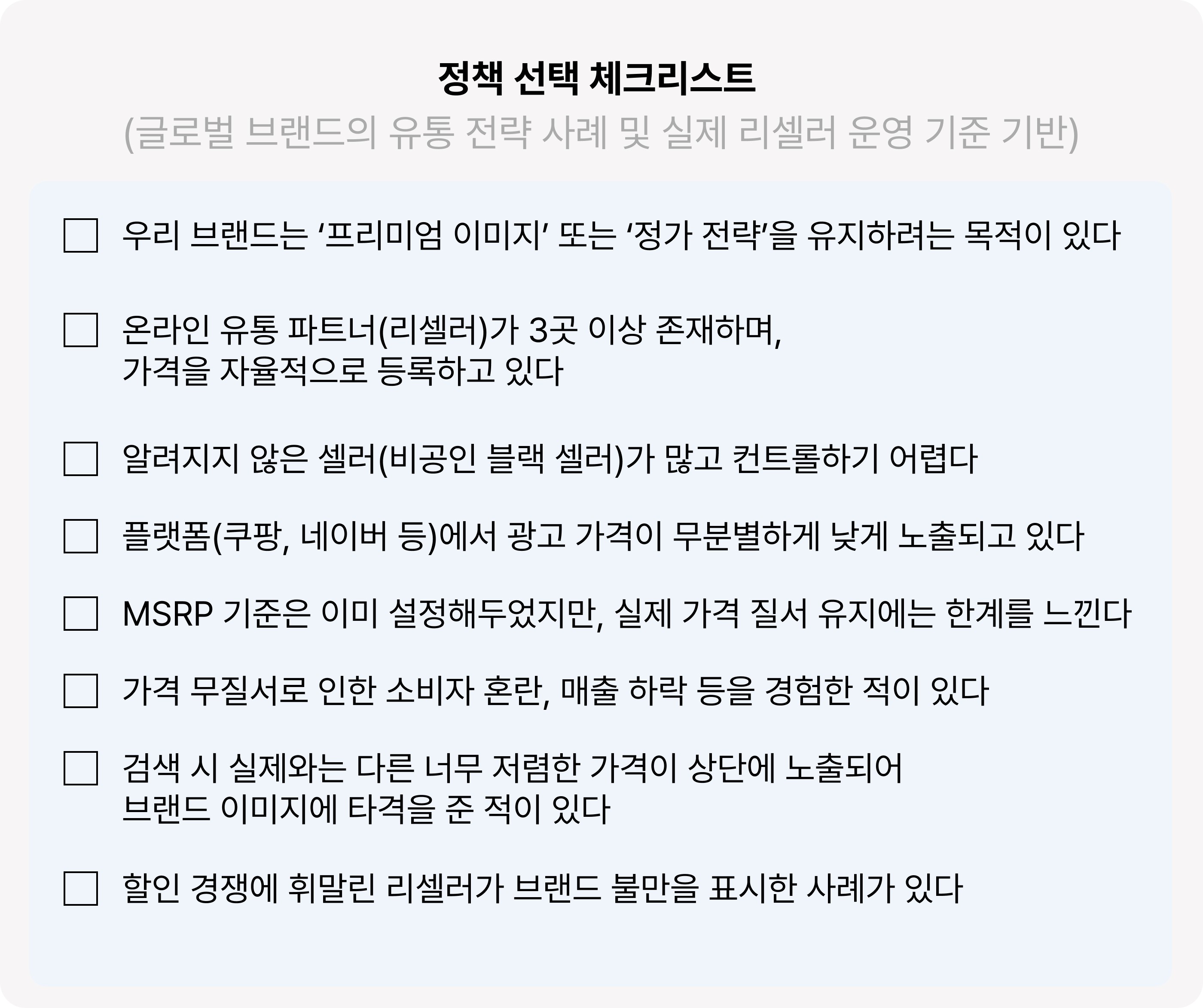
✅ If 3 or more items apply: → It is necessary to set a MAP and control price exposure based on the advertised price. During execution, also review systematic response measures such as automatic detection and warning systems.
✅ If few items are checked: → This may be a situation where distribution prices are well-managed with MSRP alone. However, since the execution power may be low, it is good to plan a transition to MAP considering future expansion.
Can Both Policies Be Used in Parallel?
Many brands actually run both MSRP and MAP in parallel. Operating both policies together allows for securing consumer trust and reseller control simultaneously.
Precautions during operation:
Provide guidelines to resellers in writing (including definitions, standards, measures for violations, etc.)
Clarify violation criteria, including advertising copy and search keywords
Share policies with internal CS and sales teams and prepare issue response scenarios
Distinguish and specify MSRP and MAP standards in B2B contracts to prevent confusion
For example, you can guide resellers by clearly distinguishing them in the reseller guideline document as follows:
MSRP: This is the standard price presented to consumers, used as the basis for discounts and the pre-promotional base price.
MAP: This is the lowest price that authorized resellers can expose on advertisements or external channels, and exposing prices below this standard is considered a breach of contract.
This explicit distinction is effective in reducing confusion for both resellers and internal operation teams.
Corporate Cases Combining MSRP and MAP
Parallel operation is not simply about introducing two policies at the same time, but rather about separating roles and establishing clear management systems in line with the characteristics of distribution channels and brand strategies. Below are three global brand cases that maintain price order by operating MSRP and MAP in different ways.
Chef Works: An American chef uniform brand that presents consumer benchmark prices with MSRP while clearly notifying resellers of the MAP policy. They have a contractual basis to take measures such as supply suspension or disqualification if the advertised price is exposed below MAP, thereby stably maintaining brand image and price order.
OtterBox: When price confusion across platforms intensified during the period of operating under MSRP alone, they introduced an additional MAP policy to resolve this. For products with an MSRP of $49.99, they set the MAP at $39.99 and control price perception by applying sanctions when lower advertised prices are exposed. This is a representative case of securing both brand credibility and distribution order simultaneously.
Le Creuset: A French premium kitchenware brand that had historically operated separate price exposure strategies by channel, applying MSRP standards to offline distribution networks and MAP policies to online channels. However, it was revealed that they forced suggested retail prices on distributors in the European market and exerted pressure, such as order restrictions, if they violated them, resulting in a fine of 490,112 euros from the Belgian competition authority in December 2023. This case demonstrates the effectiveness of running MSRP and MAP in parallel, while highlighting that fair trade regulations of each country must always be considered.
How Can the MAP Policy Be Operated and Managed?
The MAP policy does not become effective simply because it exists on paper. Its actual effectiveness depends on how it is executed and managed. Many brands struggle with the dilemma of 'having a MAP policy but it not being followed,' which is mostly due to the lack of an execution system. The most common problem is the inefficient process of manually checking price violations and collecting screenshots to deliver to resellers individually. In this process, thorough monitoring is difficult, and tracking whether violations are repeated systematically is also hard.
To solve this, an increasing number of brands are recently adopting automated price monitoring systems. Particularly for brands with many resellers or those entered on multiple online platforms like Coupang and Naver, technology-based responses are essential for operating MAP policies effectively.
Example of Automated Price Monitoring System: Retrix
Price Crawling: Automatically collects price information from major marketplaces and search ad areas.
Violation Detection: Detects advertised prices that are lower than the MAP set by the brand.
Automatic Alert Sending: Automatically sends warning emails to violating sellers based on set conditions.
History Management: Manages the cumulative number of violations, warning status, etc., in report format.
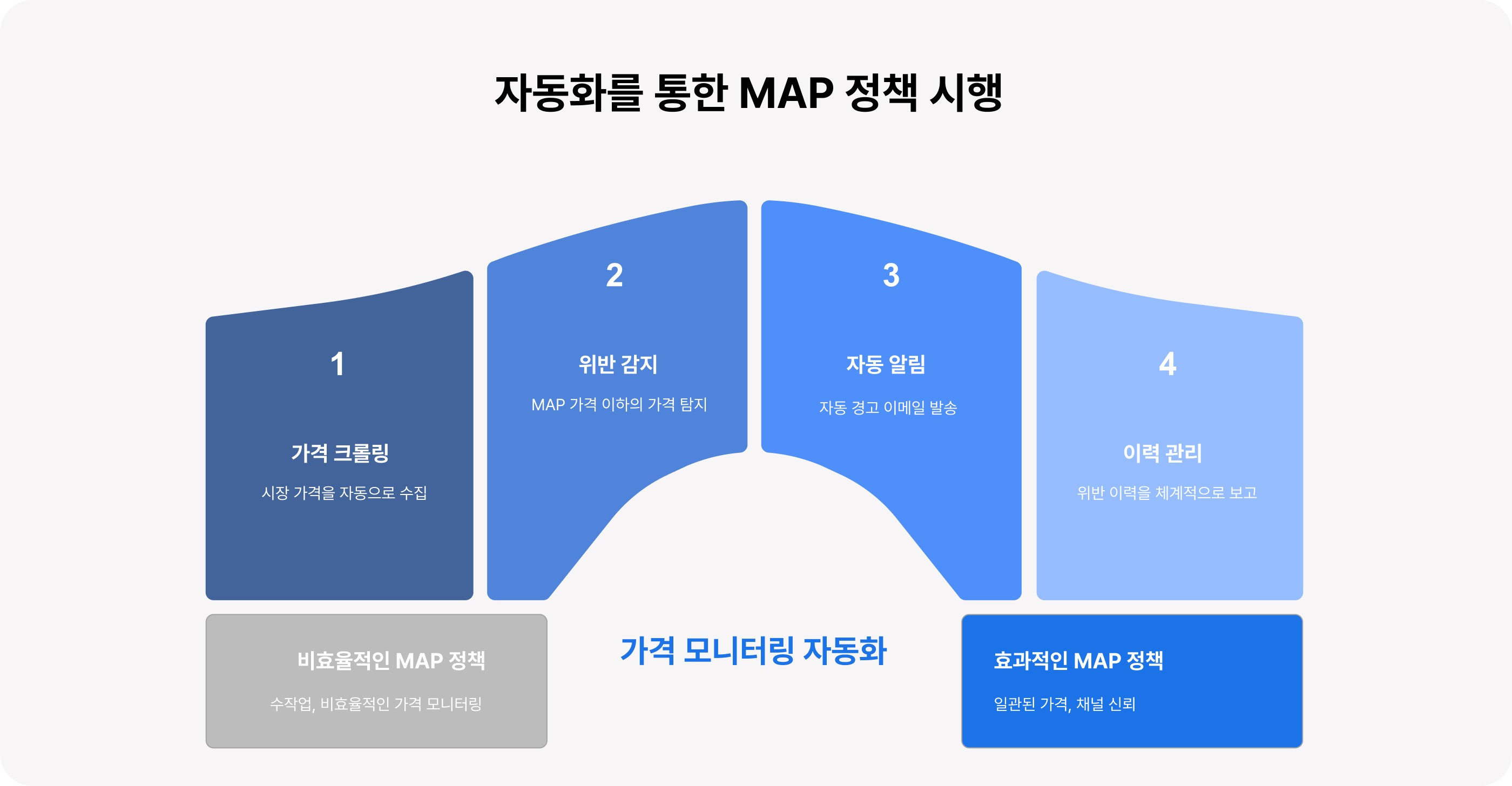
A systematically designed MAP execution structure like this serves as a practical means to reduce repetitive tasks for operators while delivering consistent messages to authorized resellers and increasing control. In addition, these systems go beyond simple technology-based control and play an important role in maintaining the brand's 'price consistency' and 'channel credibility.' When customers have a similar price experience across any distribution channel, trust in the brand increases, which can lead to improved customer loyalty and repurchase rates in the long run. Ultimately, the technical execution capability of the MAP policy goes beyond short-term price stability and aligns with the brand's mid-to-long-term growth strategy.
If brand resources are insufficient, it is also good to start by trying manual monitoring targeting only a few major channels and building up a violation history database. The important thing is to continuously signal to resellers that 'the policy is actually working,' and the introduction of an automation system can be expanded gradually afterwards.
A Feasible Strategy is More Important Than the Policy Itself
MSRP is useful for increasing brand trust by presenting benchmark prices to consumers, and MAP is effective in maintaining brand image and distribution order by controlling the advertised prices of authorized resellers. Rather than one policy being absolutely superior, flexible parallel operation according to the brand's market situation and strategy can be the most realistic choice.
However, whichever policy you choose, an operating system with execution power must back it up in order to function in the actual market. It is difficult to expect effects from a price policy through declaration alone. Only when price monitoring systems, reseller guidelines, and internal response processes are designed together can a brand lead distribution order and maintain relationships with sellers based on trust.
Brand protection should lead to mid-to-long-term trust and value maintenance, not just short-term price stability. The strategic combination of MSRP and MAP, along with establishing the execution-based infrastructure to enable it, is the most crucial task required of practitioners today.
Practical Checkpoints at a Glance:
High unit price products, brands with many resellers → Prioritize MAP consideration
No effect if you only have a policy without an execution system → Monitoring system is essential
If resources are lacking, start with manual monitoring but prioritize message delivery
MSRP and MAP can be operated in parallel; clear standards are key