Counterfeit
Coupang is genuine, Kream is fake? Why is the inspection result different for the same product?

💡 In this article, you can find the following information.
Coupang sells genuine products, but Kream sells counterfeits?
The realistic reasons why platform inspection teams cannot catch all counterfeits
'Distribution channel' vs. 'Physical inspection': The fundamental cause of conflicting judgment standards
Strategy to regain distribution leadership: Don't leave it to the platforms, present the 'standards'
The brand's fate left to the platform: Now is the time to prove it yourself with 'data sovereignty'
Coupang says Genuine, Kream says Fake?
Recently, the controversy over the authenticity of 'On Running Sneakers' that arose between Coupang, South Korea's largest e-commerce platform, and Kream (Naver) and Soldout (Musinsa), which are limited-edition transaction platforms, is causing a huge wave in the retail industry. The incident began when a consumer registered a product purchased through Rocket Direct Purchase from Coupang's luxury service 'R.LUX' on a resale platform. Coupang was confident that the product was genuine after checking its internal distribution channel, but Kream and Soldout judged it to be counterfeit based on the fact that the box label shape, insole printing, and tongue logo details differed from those of the genuine product. In this process, the consumer suffered practical financial damage, such as paying penalty costs for attempting to sell counterfeit goods. The occurrence of such conflicting results for the same product among highly trusted large platforms means that a structural crack has developed in the authenticity certification systems currently built by the platforms.

Legal experts point out that if the product is ultimately found to be counterfeit, it is highly likely to go beyond a simple distribution error and constitute a 'deceptive act towards consumers' prohibited by Article 21 of the Electronic Commerce Act. However, the platforms tend to treat the results of external inspections as mere reference opinions and are rushing to resolve the issue with free returns and refunds.
The risks for brands watching this situation are also significant. Despite the fact that the brand value is being damaged as the authenticity of the product varies depending on the platform, the official data of the brand, which should be the absolute standard for judgment, is thoroughly excluded from the verification process. The irresponsible response of platforms trying to settle the situation with only refunds without clear evidence not only undermines the public credibility of the brand but also leads to non-transparent inspection guidelines threatening brand assets.
Ultimately, this incident clearly demonstrates how dangerous it is for brands to rely entirely on platforms to judge product alignment. While platforms complain of operational fatigue by making judgments based on fragmented verification logic, the most important 'flawless source data' is missing from the center of the discussion. For brand managers, this incident is more than just a passing episode; it poses an important task of securing 'data sovereignty' from platforms to protect their brand value on their own.
Practical Reasons Why Platform Inspection Teams Cannot Catch All Counterfeits
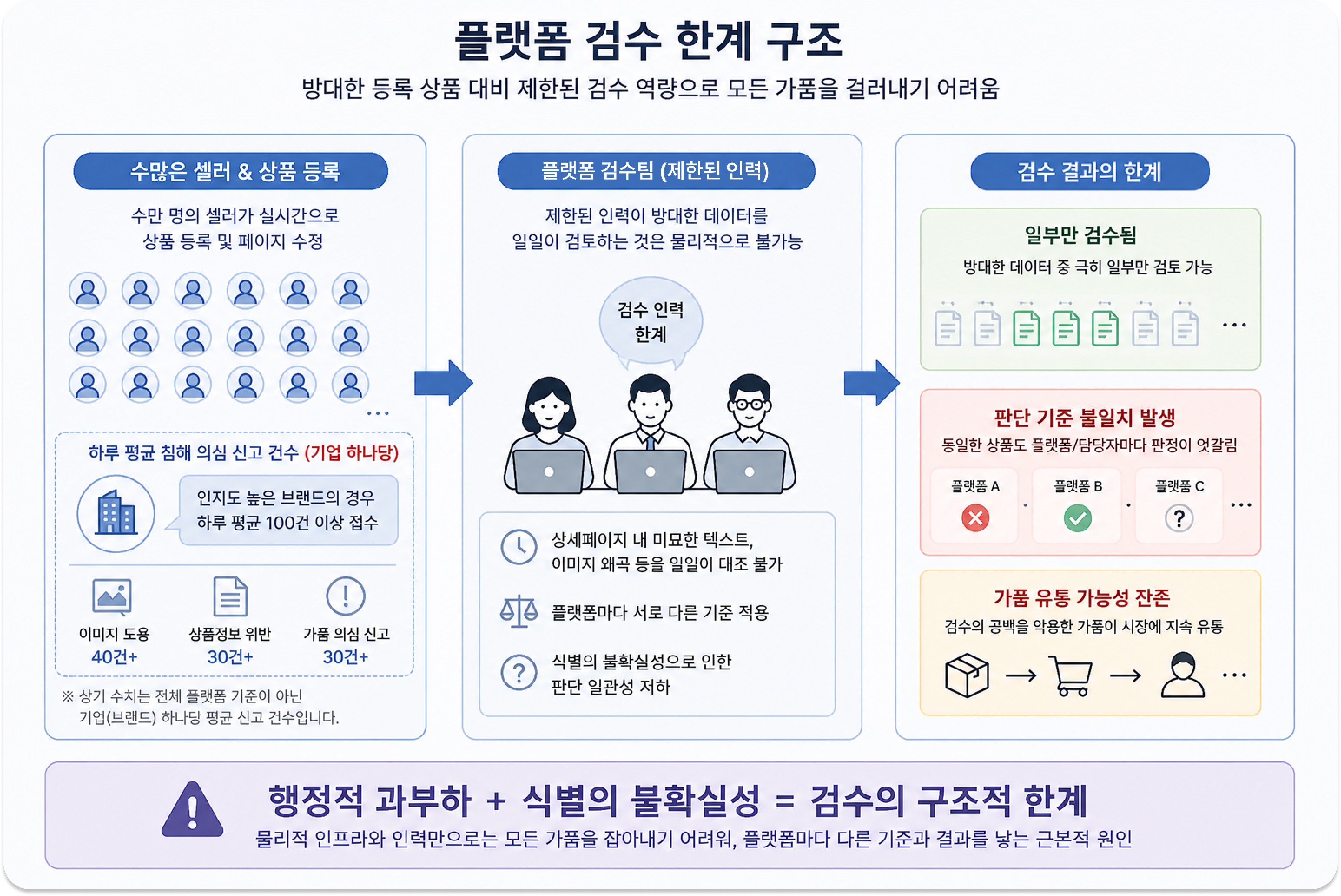
Coupang's stance in this sneaker incident, stating that "our internal distribution channel verification shows it is genuine," clearly reveals the practical limitations of the verification system possessed by large platforms. The fundamental background behind large platforms taking such a defensive stance when faced with counterfeit controversies lies in the 'administrative overload' and 'identification uncertainty' of not being able to physically filter out all the vast cases of suspected infringement pouring in every day. In fact, for highly recognized brands, an average of over 100 cases of image theft, violations of product information notification, and reports of suspected counterfeits are received per day on a single platform.
The problem is that platforms do not have the physical infrastructure to conduct a complete survey of this vast amount of data. In an e-commerce environment where tens of thousands of sellers register products and edit pages in real time, it is virtually impossible for platform operations staff to compare subtle awkwardness in text within detailed pages or micro-distortions of logos in images to judge authenticity. This gap in physical verification ultimately leads to each platform applying different judgment criteria, which becomes the decisive reason for conflicting judgment results even for the exact same product.
From the platforms' perspective as well, this battle over authenticity is merely a war of attrition that undermines trust with brands and increases legal risks. If it is difficult for platforms to fill this huge verification gap with their own monitoring alone, brands must now present guidelines for judgment by directly providing reliable data. It is a critical time for partnerships that provide technical support so that platforms can immediately confirm counterfeits rather than relying on vague reports.
'Distribution Channel' vs. 'Physical Inspection', The Fundamental Reason for Conflicting Judgment Standards
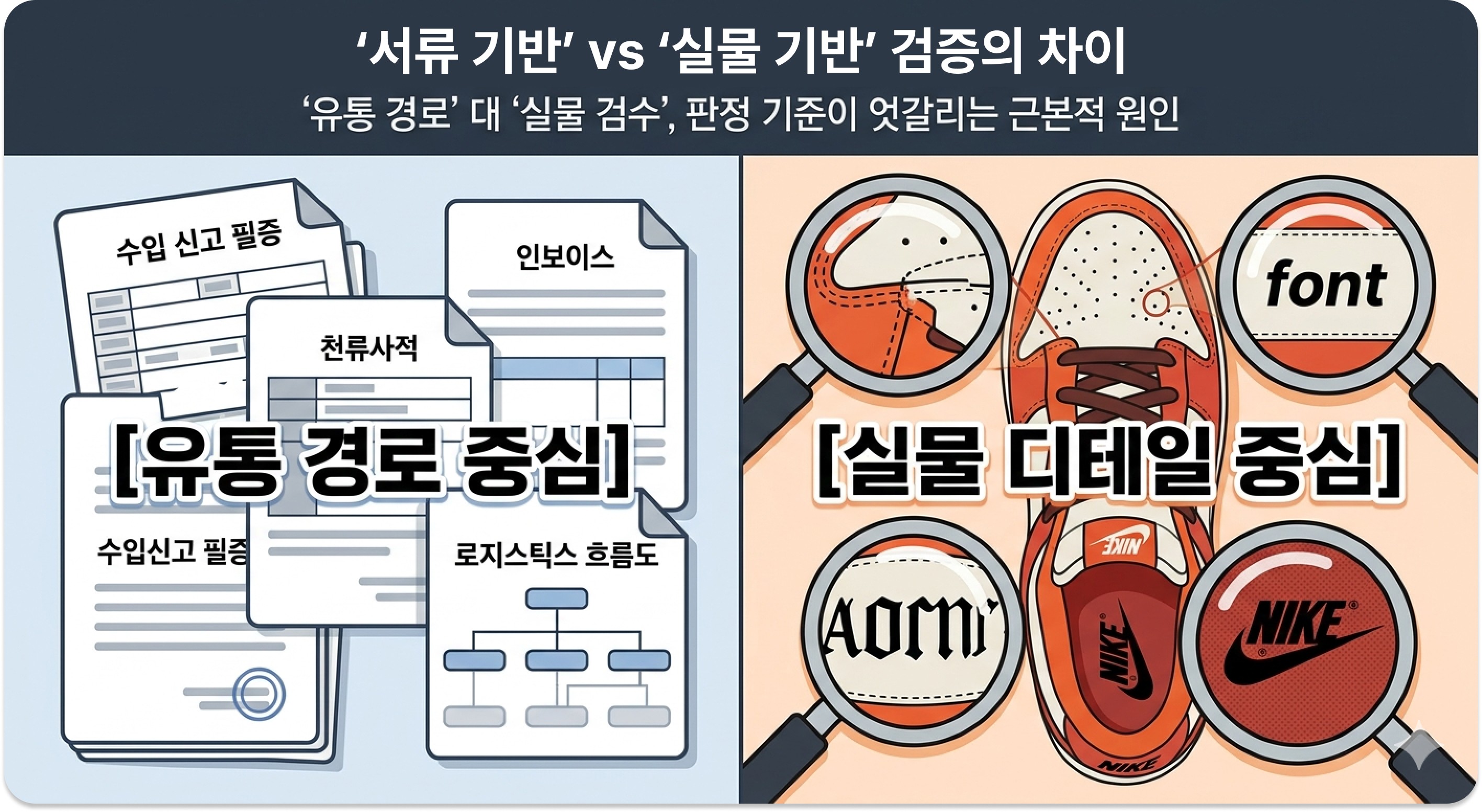
The decisive reason for the conflicting judgments between Coupang and Kream lies in the difference in the 'nature of data' that defines authenticity and its 'verification method' for each platform. Coupang, which operates a large-scale direct purchase system, has a strong tendency to use document-based data proving 'transparency of the distribution channel', such as import declaration certificates or invoices, as key indicators for judging authenticity. In fact, Coupang maintained its stance that "internal distribution channel verification shows it is genuine" regarding this incident, but this ultimately revealed a fatal limitation of failing to catch variations in the physical product.
On the other hand, Kream and Soldout, which are specialized inspection platforms, are analyzed to place a relatively higher weight on physical inspections based on so-called 'microdata' that analyzes subtle design elements or manufacturing process characteristics of brands. As mentioned earlier, they made counterfeit judgments based on specific physical differences, such as the shape of the box label, the insole printing, and the details of the tongue logo. This incident showed a fatal blind spot in document-based verification, where even if distribution documents are lawful, the actual product delivered to the consumer can differ from the genuine specification.
This systematic gap acts as a bigger risk when brands make subtle changes to specifications for process improvement. If brand master data is not synchronized in real time, a verification gap is exposed where one platform misjudges the latest process as counterfeit, while another platform is fooled by sophisticatedly forged documents and mistakes an actual counterfeit for genuine. Ultimately, this judgment confusion goes beyond the difference in inspection guidelines of each platform and is a result of the brand's official data, which should ultimately prove the alignment of the physical product, being excluded from the verification process.
Therefore, brands must no longer leave the credibility of their products solely to the incomplete inspection systems of platforms. By utilizing specialized technology to supply flawless master data to the distribution field in real time, brands must transform into active agents that fundamentally block the risk of platforms misjudging counterfeits as genuine by relying solely on documents.
Distribution Initiative Recovery Strategy: Present 'Standards' Instead of Leaving it to Platforms
Counterfeit Detection Finished in Just Seconds with Retrix AI, Compared to Days by Humans
As seen in the previous Coupang case, the judgment confusion caused by the lack of synchronization between distribution channels and brand data directly leads to a decline in platform trust and enormous operational risks. Even if a product is genuine on paper, it is virtually impossible for a human to compare physical products that undergo sophisticated variations with detailed pages one by one to catch them. Retrix provides technical support at this very point so that brands can present immediate and objective evidence to platforms.
Retrix's Natural Language Processing (NLP) technology captures suspicious phrases unique to counterfeiters among thousands of detailed pages, and its Optical Character Recognition (OCR) technology precisely analyzes micro-distorted logos, incorrect box label information, and differences in insole printing that Kream or Soldout pointed out. Instead of making subjective claims like "It looks different from our product," try sending a data report generated by Retrix to the platform, stating "The logo position and font are 99% inconsistent with the brand master data." Faced with clear physical evidence that even platforms prioritizing paper legitimacy cannot deny, counterfeit enforcement and processing speeds are bound to accelerate dramatically.
Resolving Information Asymmetry and Reclaiming Brand Sovereignty Through Data Synchronization
To solve the phenomenon where genuine products become counterfeits and counterfeits masquerade as genuine due to conflicting judgment standards across platforms, the disconnect between the distribution field and brand master data must be bridged. The Retrix solution acts as a 'data hub' where brands can immediately reflect and collectively manage information on minor product specification changes or label design updates. As soon as a brand enters the latest data into Retrix, the AI conducts a complete survey of the e-commerce market based on this standard.
This real-time data synchronization fundamentally blocks the 'inspection gap' where platforms misjudge the latest products by relying on past data or, like Coupang's case, miss physical defects by being fooled by sophisticatedly forged documents. Brands no longer need to rely solely on the non-transparent guidelines or incomplete verification systems of platforms. By directly establishing clear reference points in the distribution market through Retrix, brands can secure true 'data sovereignty' to protect their brand value on their own. Ultimately, reclaiming this sovereignty will reduce unnecessary friction with platforms and become the foundation of trust that remains unshaken in any environment.
A Brand's Fate Left to Platforms: Time to Prove it Ourselves with 'Data Sovereignty'
As we have seen so far, e-commerce platforms are efficient arenas of distribution connecting brands and consumers, but there are structural limitations in ultimately guaranteeing the essential value and alignment of brands. The controversy between Coupang, which trusted only paper legitimacy, and Kream, which caught physical defects, proved that verification logic is fragmented across platforms and judgments excluding brands can escalate into legal and social risks at any time. Brands must now break away from the passive attitude of relying solely on the incomplete protective nets of platforms. The only way to escape the swamp of counterfeit battles is for the brand itself to secure sovereignty over the most reliable data.
Ultimately, a brand's public credibility comes from sophisticated master data built by the brand itself, not from the platform's judgment results. Establishing and managing market standards directly using AI technology like Retrix goes beyond simple enforcement; it prepares an essential management infrastructure to prevent inspection blind spots like the Coupang case and protect the long-term value of the brand.
When brands stop wasteful truth battles with platforms and reclaim data sovereignty, they can finally lay the foundation of trust that remains unshaken in any distribution environment. Just as sophisticatedly forged documents cannot overshadow the physical product, we must remember that the value of our brand is not defined by the platform but begins with flawless data that we prove ourselves.