Price Management
Is the MAP policy really possible in Korea?

💡 In this article, you can check the following content.
Selling price is not allowed, but advertising price is?
How is MAP being utilized in domestic practice?
Example of Korean-style MAP through the case of Allegion Canada
How far can expressions go in a contract?
Is it really okay to 'limit only the advertising price'? – Focusing on sanction cases
3 conditions that must be checked when operating MAP
Why is MAP policy so complex? – Comparison of US, Europe, and Korea
Conclusion: MAP is not a globally common strategy
Selling price is not allowed, but advertising price is?
🤔 “Since sellers are selling much cheaper than the standard price, I'm worried that the brand image is being ruined. Since I can't touch the selling price, is there any way to limit even the advertising price?”
If you are a brand practitioner, this is a concern you have probably had at least once. In fact, Korea's Monopoly Regulation and Fair Trade Act explicitly prohibits 'resale price maintenance.' This means an act where a supplier forces a distributor to maintain a certain selling price, or limits the selling price within a certain range.
Then, what about limiting the advertising price?
The so-called Minimum Advertised Price (MAP) policy is a method that controls only the price information exposed on online advertisements, banners, and detail pages, rather than the 'selling price'. While leaving the product sale itself to the seller's discretion, it controls only the exposure of the lowest price revealed to the outside. In the US and elsewhere, this method is common and widely used as a means of brand protection.
However, to date, the term 'MAP' does not appear in Korean laws and regulations. Nevertheless, limiting advertising prices is allowed to some extent in practice. Of course, there is no clear legal definition in Korea, and caution is required in practical design, but if certain conditions are met, advertising price standards can be fully utilized. In practice, cases of effectively managing brand image and price trust through this are gradually increasing.
How is MAP being utilized in domestic practice?
Although there is no explicit regulation on 'advertising price limitation' in the laws and regulations in Korea, some brands are applying it practically in the following ways.
Presenting advertising price standards linked to joint marketing or advertising cost support
→ While the brand supports the seller with advertising or promotional expenses, it requests that the price exposed in the corresponding marketing activity be set above the 'advertising price standard.' At this time, "presenting a price guide as a condition for advertising support" is not direct control of the selling price, so it is considered a method with relatively low legal risk.
Specifying 'advertising price guidelines' in contracts or operation guides
→ It presents advertising price standards in the form of "recommendations" or "requests for compliance with brand guidelines," rather than direct mandatory clauses. For example, inserting a phrase in the contract such as, "For a unified brand image, our company presents advertising price standards, and partner sellers are requested to comply with them as much as possible."
Introducing prior approval procedures for promotional materials
→ In order to induce sellers to keep advertising price standards, some brands require that promotional materials, such as detail pages and banners produced by sellers, be reviewed and approved in advance by the brand headquarters. This method is not direct price control, but consequently becomes a means of managing advertising price standards.
Linking with eligibility for promotion participation
→ Only sellers who have observed the advertising price standards are granted eligibility to participate in major benefits such as large-scale discount events, joint marketing, and brand main exposure. This is also not a direct means of sanction, but can work as a practical incentive.
As such, in Korea, while presenting advertising price standards in the form of 'recommendations' to avoid legal risks, there is a strong tendency to secure practical effects through various incentives and internal processes.

Korean MAP examples looking through the case of Allegion Canada
In fact, it would be easier to understand if you check the MAP templates available domestically. Let's look at overseas cases that have a similar scope to Korea's MAP policy.
Canada, like Korea, clearly prohibits resale price maintenance (RPM) under its competition law, and there is no separate legal definition for advertising price (MAP). However, in practice, brands adopt a structure where they guide sellers on advertising price standards and, if they follow them, operate flexibly in connection with joint marketing and advertising cost support. This is very similar to the way Korea is operating in practice, and is a reasonable structure that domestic practitioners can refer to, as it is designed to allow brands to maintain price order without direct supply restrictions or contract termination.
Allegion is a global security hardware company that actively operates MAP policies to maintain price order among resellers and protect brand value.
📄 Example phrases of Allegion's MAP policy
“This MAP Policy applies strictly to advertised prices. Resellers remain free to determine their actual selling prices.” → This policy applies strictly to prices exposed in advertisements, and resellers are free to determine their actual selling prices.
“For purposes of this MAP Policy, the terms ‘advertise’ and ‘advertisement’ include all promotional or pricing information displayed via any type of media.” → In this policy, 'advertisement' includes all promotional or pricing information displayed through any type of media.
✅ Feature Summary – MAP Policy of Allegion Canada
Clarifying the scope targeting "advertisements"
Controlling only advertisement exposure prices by separating them from "in-store undisclosed prices"
Setting advisory standards, but mentioning the possibility of supply restrictions in case of violation
Operated in a form separated from retail price maintenance (RPM)
🧭 Implications of Canada's MAP policy structure for Korean practice
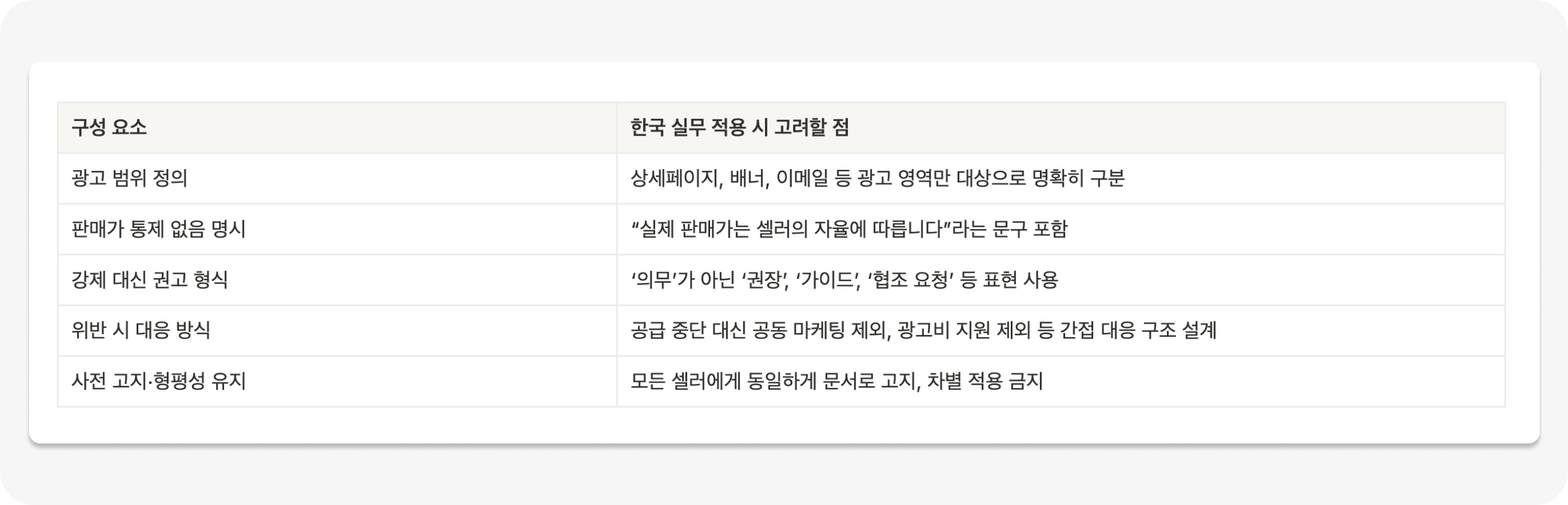
To what extent can expressions be included in a contract?
If a brand decides to reflect advertising price standards in practice, the process of documenting this must also be approached carefully.
🧐 “Is it okay to write in the contract that 'the advertising price must be maintained above the standard price'?”
To start with the conclusion, the risk varies depending on the way of expression and context, and the key is to design it so that it does not look like a mandatory clause. The Fair Trade Commission judges that contract terms specifying compulsory nature or disadvantages can practically be regarded as resale price maintenance.
For example, expressions like the following can be risky:
🚫 “The advertising price must observe the standard price, and violating this will restrict product supply.”
🚫 “In case of non-compliance with the advertising price standard, it will be excluded from joint marketing, and future collaboration will be reviewed.”
On the other hand, phrases like the following are evaluated as relatively safe:
✅ “In order to maintain a unified image of our brand, our company sets advertising price standards and requests the seller's cooperation.”
✅ “When producing promotional materials, please refer to our guidelines. If necessary, we may request a prior review.”

📌 Suggested Practical Example Phrases
“In order to maintain consistent market perception and consumer trust of the brand, our company operates the following advertising price standards (MAP). The corresponding standard applies only to the advertisement exposure area, and the actual selling price can be set according to the seller's autonomy.
▪ Product A: 29,800 KRW
▪ Product B: 49,000 KRW
This standard is a recommended guide, not a mandatory requirement, and in case of repeated deviations, collaboration opportunities such as joint marketing participation restrictions may be limited.”
In addition, you can expand the scope of practical application in the following ways:
Utilizing separate guide documents: Explain the advertising price standards by attaching a separate document such as a 'Brand Operation Guide', without specifying price-related content in the body of the contract. This document includes expressions such as "Our company provides recommended price standards and requests the seller's cooperation."
Adding prior review clauses: When a seller produces promotional materials or promotion detail pages, specify a procedure through which they can receive prior review or comments from the brand side. However, care must also be taken so that this is not interpreted as an "obligation", and expressions such as "review request possible if necessary" are safe.
Reviewing standard contracts: By referring to distribution-related standard contracts or guidelines suggested by the Fair Trade Commission or industry associations to compose phrases, a certain level of legal stability can be secured.
Lawyer review required: Determining whether phrases in a contract practically infringe upon the trading partner's autonomy in price determination ultimately requires the judgment of a legal expert. In particular, when supply conditions, sales channel restrictions, or incentive conditions are linked with advertising price standards, the risk becomes even higher.
In summary, rather than including the advertising price standard in the contract itself, the key issue is whether it looks like a structure that forces or restricts certain actions of the seller. Brand practitioners must minimize risks by comprehensively considering the phrasing of expressions, the utilization of attached documents, the scope of application, and the presence of sanctioning means.
Is it really okay to 'limit only the advertising price'? – Examining through sanction cases
Then, is it really okay if we limit only the advertising price? On the surface, since it does not force the selling price, there seems to be no room for illegality. However, as mentioned several times earlier, if the operating method related to the advertising price standard practically restricts the selling price or acts disadvantageously to a specific seller, it can be regarded as a violation of the Monopoly Regulation and Fair Trade Act.
A representative case is the Hankook Tire case. Hankook Tire presented price standards to some dealerships, and setting a policy to stop product supply if they did not follow these standards became a problem. The Fair Trade Commission judged that such a structure corresponds to resale price maintenance, and imposed sanctions, viewing that the corresponding act infringed upon the dealerships' autonomous price-setting rights.

This case gives the following implications:
Even if it is an advertising price standard, it is important whether it was actually designed as a structure to induce or force the selling price, and
Specifying disadvantages such as supply suspension or contract termination in case of violation immediately creates room for illegality.
In addition, the Fair Trade Commission has warned that even if price standards are notified in advance, methods lacking fairness and transparency, especially when applied disadvantageously only to specific sellers, can be judged as unfair trade practices.
Ultimately, the key is to design the overall operating method so that it does not infringe upon the autonomy of consumer price determination and fair distribution order. If a brand introduces advertising price standards while satisfying the conditions of the Fair Trade Commission, this can be a practical means of protecting distribution order.
3 conditions to check when operating MAP
When trying to apply advertising price standards in practice, simply guiding prices or softening phrases is not enough. The Fair Trade Commission has presented administrative interpretations in practice that setting advertising price standards may not be illegal if the following three conditions are met.
Principle of prior notification
: Notify the advertising price standards to all sellers in advance with the same content. Notifying afterward or guiding only some sellers violates fairness and may cause problems. In addition, the notification method must be in an objectively provable form, such as a document or e-mail, rather than verbal, to be safe.
Principle of fair application
: Apply the advertising price standards equally to all sellers. If it acts disadvantageously only to some sellers or targets only specific distribution channels, it can be interpreted as an unfair practice under the Monopoly Regulation and Fair Trade Act. Even if the same standard is applied, cases of monitoring or sanctioning only specific sellers in actual operation must be particularly cautioned against.
Principle of indirect operation
: Apply indirect methods that induce cooperation, such as 'restricting participation in joint promotions' and 'excluding advertising cost support'. However, even when documenting this, phrases without compulsory nature must be used, and phrases giving the impression of "giving disadvantages" should be avoided as much as possible. Direct sanctions such as supply suspension or contract termination in case of non-compliance with advertising price standards can become problematic according to the Fair Trade Commission's criteria for judgment.

📌 Practical Tips
In the advertising price standard guidance document, use expressions such as "We have prepared the following advertising price standards to maintain brand image. We ask for the seller's autonomous cooperation."
Even if you manage a list of sellers who do not comply with advertising prices internally, you must not utilize it as a sanction standard externally or link it with supply policies.
When notifying price standards, adding an explanation on the "standard price calculation method" together also helps secure transparency.
Why is MAP policy so complex? – Comparison of US, Europe, and Korea
The reason why MAP policies are operated differently in each country is not just a policy difference, but because the structure of fair trade laws, distribution environments, and philosophies of competition policies in each country are vastly different. Since legal interpretations and scopes of application differ even for the same policy concept, even global brands need to design price policies separately for each country.
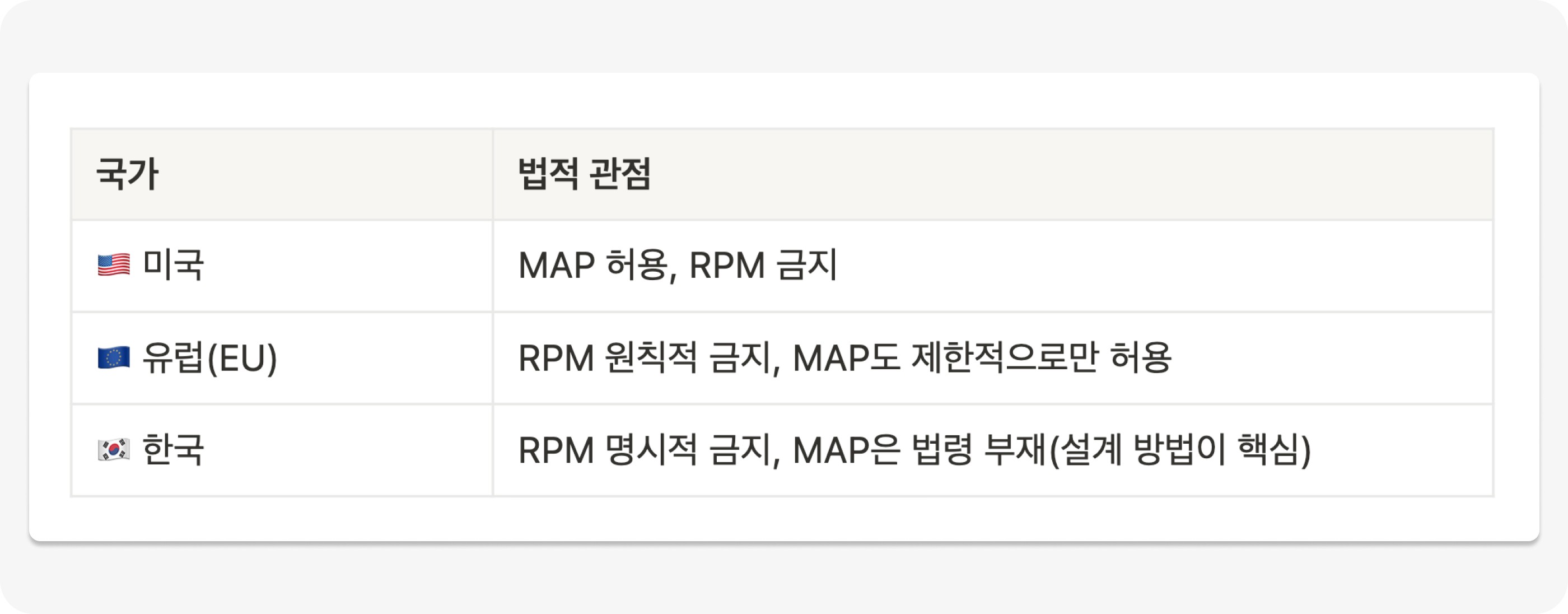
As shown in the table above, the US shows a practice-centered policy environment, Europe shows a law-and-regulation-centered environment, and Korea shows an interpretation-centered environment. In particular, in Korea, even the name 'MAP policy' is not systematically defined, and applying overseas cases as they are may expose you to legal risks.
Therefore, even for global brands, applying MAP standards operated in the US directly to Korea is very dangerous, and redesign is absolutely necessary based on local laws, systems, and administrative interpretations of the Fair Trade Commission. As the distribution environment is rapidly digitalizing, designing advertising price limitations based on how prices are exposed in online advertisements, search results, and price comparison platforms can be a key strategy.
Conclusion: MAP is not a global common strategy
A single global standard does not exist for MAP policy, and Korea in particular is under completely different legal and operational conditions compared to the US or Europe. However, if the judgment criteria of the Fair Trade Commission are satisfied, advertising price standards can be fully utilized as a practical means for maintaining the brand's price order.
Therefore, brand practitioners must strategically redesign MAP policies to fit their distribution structures and risk tolerance, rather than simply 'copying' them. In particular, from contract terms, advertising price standard notification methods, to internal operation processes, establishing practical operating standards suitable for domestic circumstances reduces risks and enables sustainable brand management.
What is more important than the concept of 'MAP' is a practical execution strategy on how to restore collapsed price trust and maintain brand standards.
Notify advertising price standards in advance and guide all sellers equally
Present advertising price standards as recommendations, and avoid compulsory phrases or sanctioning means
When designing contract terms, go through legal review and check similar cases
The MAP policy is not a tool to crack down on a brand's distribution strategy, but a means to design market order and coordinate trust with partners. By remembering the above 3 matters well, the core capability is the operational ability to present consistent standards within a feasible range and communicate those standards persuasively.