Counterfeit
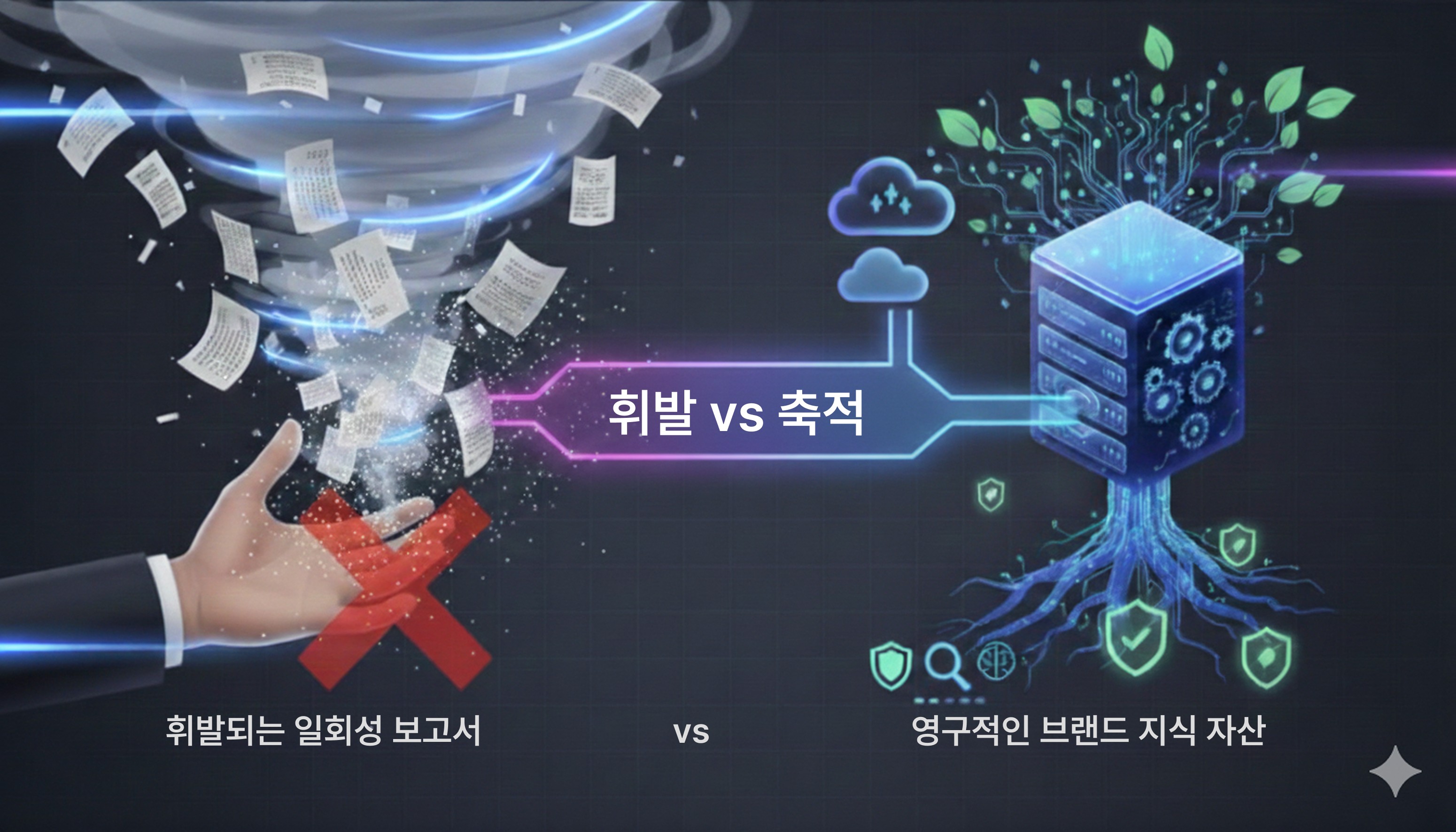
Volatile 'one-time counterfeit detection reports' vs. 'source data' that accumulates brand know-how
💡 In this article, you can find the following information.
What is left after the contract ends? Counterfeit detection reports that evaporate
Limitations of simple reports: A 'summary' missing key information and context
The power of data sovereignty through DB: A 'business diary' that creates our brand's tomorrow
How to move beyond passive result checking to achieve 'proactive response capabilities'?
Conclusion: Brands that prevent information evaporation take the lead in e-commerce
What is Left After the Contract Ends? The Evaporating Counterfeit Detection Report
"Thank you for your hard work in responding to counterfeits this year." Upon receiving the final email from a partner company, this question suddenly arises: 'So, what is left in our hands now?' Opening the [2025_Counterfeit_Response_Report] folder on the desktop, it is densely packed with the records of the past year. It clearly states that thousands of counterfeits were removed and price collapses were prevented. However, strangely enough, "our own data" that can be brought out when planning next year's marketing strategy or sitting at the negotiation table with a platform MD is nowhere to be found.
Most monitoring services focus on delivering 'deliverables'. To compare the endless spread of counterfeits to a process of a fire spreading, they generally focus only on 'on-site suppression', which is detecting and removing counterfeits. Of course, deleting counterfeits quickly is important, but a brand's future cannot be designed simply based on result-oriented statistics showing how many cases were resolved. To prevent a fire from breaking out next time, a detailed 'log' recording where the smoke started and through which path the fire spread is required. A report is merely a 'record of the past' that ends after reading, whereas internalized source data is a 'future asset' that our brand can directly interpret and utilize.
The longer data is left only in the hands of others, the further the brand drifts from the opportunity to develop its own capacity to screen out counterfeit sellers. Indeed, in the e-commerce field, the appearance of brands is clearly divided depending on these differences in response methods.
Limitations of Simple Reports: An 'Executive Summary' Missing Core Information and Context
There are two types of brands in the world: those that read and feel relieved by reports written by others, and those that accumulate daily records themselves and study the tactics of counterfeit sellers. The former may be comfortable while the contract with the partner company is maintained, but the moment the cooperation ends, the accumulated know-how disappears as well. On the other hand, brands that directly own and manage data like the latter steadily build up the practical response capability to read the subtle patterns of counterfeit sellers within their organization. We call this 'data sovereignty' and 'internalization of capabilities'.
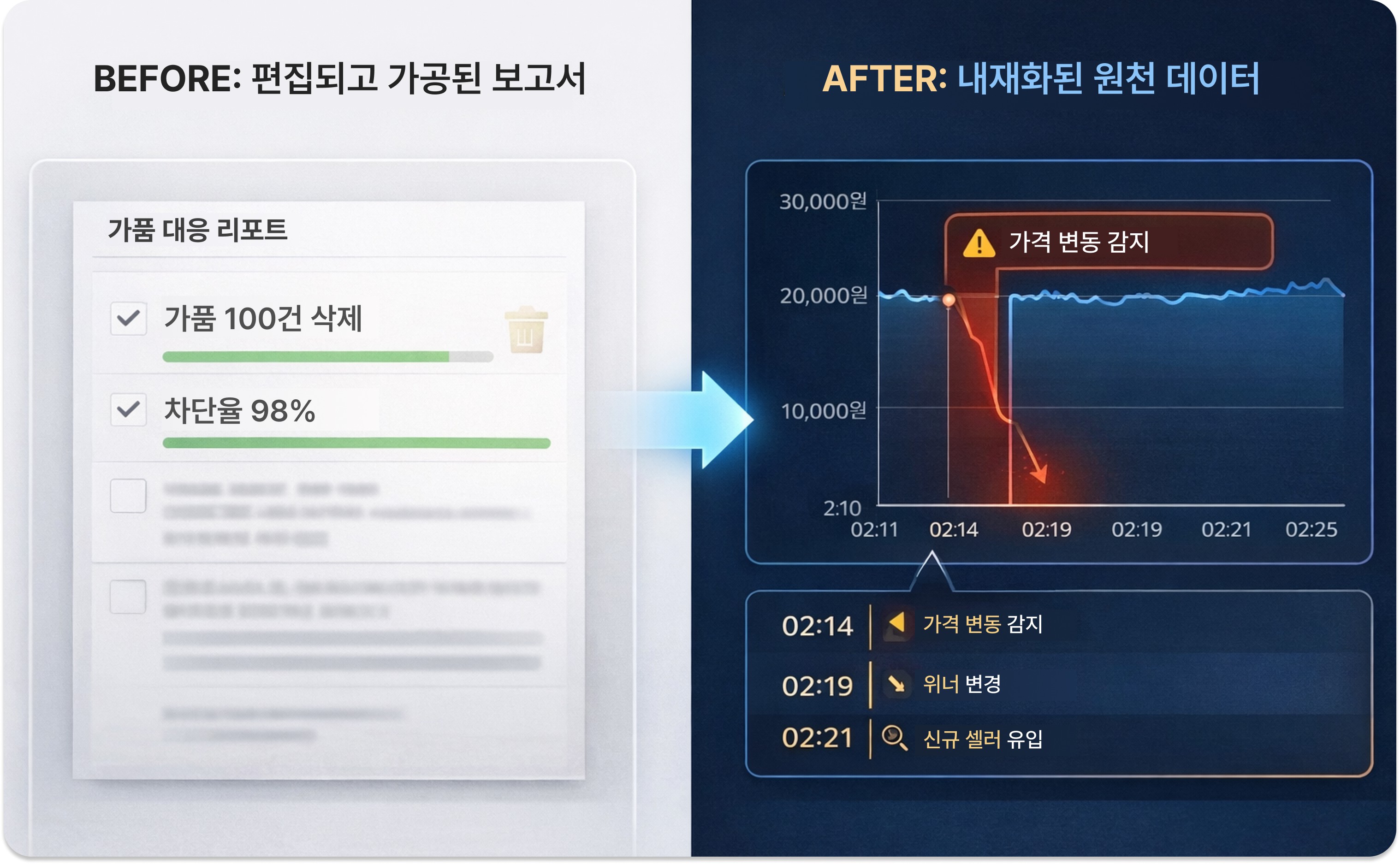
The reason many brands take the former path is, paradoxically, because of the 'flashy reports' provided by partners. From a practitioner's perspective, a report sometimes becomes 'the flashiest but most useless pile of paper'. Although the monthly report received from the partner states "98% of counterfeits blocked," when sharp questions are thrown in the field, such as "What kind of tactics do the sellers use, who reappear under different names the very next day after we delete their counterfeits?" or "What is the root cause of the sudden surge in counterfeit inquiries particularly this weekend?", the report fails to provide any answers. This is because the essence of a report lies in 'summarization', and summarization is inevitably an 'edited version' accompanied by data filtering.
Reports provided by most monitoring services focus only on refined results such as the 'number of detections' and 'deletion rate', deleting numerous variables and causal relationships involved in the process. For example, behind a single line stating "30 counterfeit sellers detected during a specific period" lies a vast context, such as which platform logic they used to enter, how many minutes it took them to react to the brand's official store price changes, or whether specific sellers shared the same IP or similar delivery address information despite having different accounts. If raw log data is a detailed record second by second, a report is merely a snapshot excerpting an extremely small part of it. Even though the clever tactics and real identities of counterfeit sellers are hidden within the raw data logs, we are only looking at the values prettily packaged by someone else.
When a report simply says "deleted 100 counterfeits," the raw log shows a detailed pattern: "Starting from 2:14 AM, 10 ghost accounts were created sequentially at 5-minute intervals, and they all rotated the winner spot while maintaining a price exactly 50 KRW lower than the genuine price." With a report that omits such detailed context, it is impossible to catch up with the intelligent tactics of counterfeit sellers.
Edited data fundamentally blocks opportunities for brands to analyze the market from various angles. The marketing team might want to analyze the correlation between the timing of ad execution and counterfeit influx, and the sales team might want to grasp the impact of a specific platform's UI reorganization on the exposure of black sellers. However, with a report that has hardened into fragmented figures to fit the conclusion of 'successful counterfeit response', it is difficult to extract these multi-dimensional insights required in the practical field. Once the data is refined and a conclusion is drawn according to the author's purpose, all the strategic connections behind it are cut away.
Like this, if data does not accumulate internally but only stays and disappears within the dashboard of an external agency, the brand's counterfeit response know-how is bound to stall the moment the contract ends. Now, we must break away from the result-oriented thinking of "how many cases were caught this month" and grasp the raw data that allows us to track "which keyword in our product detail page did this seller use as a fishhook."
A structure that relies solely on reports without securing raw data is equivalent to a brand giving up its opportunity to learn patterns on its own and build response strategies—that is, giving up 'data sovereignty'. This is because unrefined raw data is the most powerful 'real asset' that a brand can utilize in the practical field.
The Power of Data Sovereignty Through DB: A 'Business Diary' That Creates Our Brand's Tomorrow
Then, beyond simply accumulating data, what does it mean to have true 'data sovereignty'?
Data sovereignty goes beyond physical possession of owning files; it means the right to process and interpret data to convert it into an 'internalized asset of the organization'. A report written by someone else is like an answer sheet with only the correct answers written down. When you look at the correct answers, you feel like you know it all, but when the problem changes slightly in practice, you cannot even start. On the other hand, directly managing unrefined raw data as if writing a diary is like reviewing the problem-solving process by yourself. If a report provided by an external monitoring solution is a 'commentary' described from another's perspective, raw data directly owned by a brand is like a 'business diary' that records daily events without addition or subtraction. Commentary helps in understanding phenomena, but to fundamentally change the constitution of the organization and internalize response capabilities, the power of directly recorded data is required.
The specific tactic, "This seller initially came in with the same price as the genuine product, but then lowered the price by exactly 10 KRW starting from Friday at 7:00 PM when our manager left work," is a know-how that can only be discovered by a practitioner who directly writes the diary called raw data. Only when these detailed experiences accumulate can a 'brand's unique screening capability' to find counterfeit sellers be created.
The vulnerability that counterfeit sellers exploit is different for each brand. For some brands, the influx of counterfeits is concentrated at the viral marketing stage immediately after a new product launch, while for others, the price collapse begins during a specific platform's promotion period. Such unique patterns can never be perfectly captured with simple, uniform monitoring logic alone. When a brand directly possesses raw data and accumulates it in its internal DB, it can analyze the correlations between marketing strategies, price changes, and counterfeit influxes from multiple perspectives. As this process is repeated, a concrete and sophisticated 'counterfeit screening formula', such as "when the price of our brand's product falls to range A, a counterfeit seller appears on platform B," remains as an internal asset.
How Data Internalization Changes Practical Judgment
Directly accumulated raw data becomes the most objective basis for supporting decision-making in the practical field.
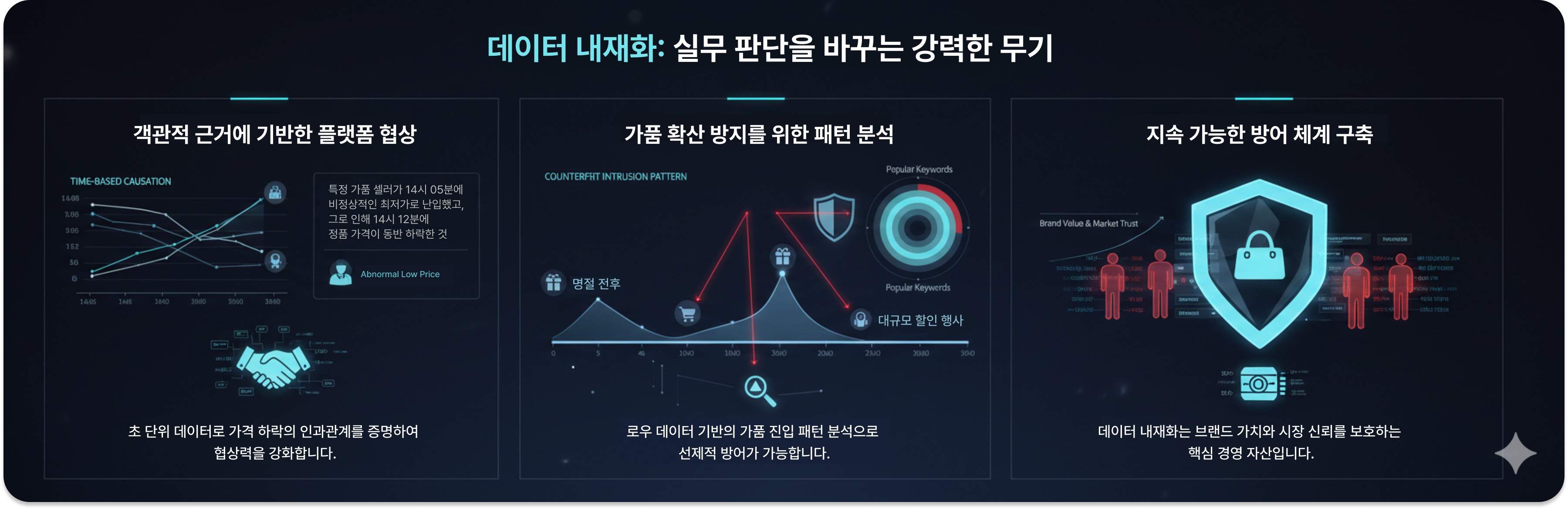
Platform Negotiation Based on Objective Evidence: In price negotiations between brand companies and platform MDs, raw data becomes a decisive weapon. When the platform pressures a price reduction, you can prove the causal relationship with a second-by-second timeline, showing that "a specific counterfeit seller entered with an abnormally low price at 14:05, and as a result, the algorithm reacted at 14:12, causing the genuine product price to drop along with it." This serves as a strong logical foundation for adhering to the brand's pricing policy.
Pattern Analysis to Prevent the Spread of Counterfeits: Although the influx of counterfeit sellers seems random, analyzing years of raw data reveals recurring 'entry patterns' during specific seasons, such as before and after holidays or just before large-scale discount events. A brand that has consistently written a diary in the form of raw data does not miss this. What if the brand already understands the timing when counterfeit sellers intensively inject ads to preoccupy popular keywords in a specific category, or the intervals at which they finely adjust prices to steal the winner spot? In this case, offensive defense becomes possible, such as catching danger signals to strengthen monitoring or requesting proactive blocking from platforms.
Building a Sustainable Defense System: Consequently, data internalization functions as a practical business asset that can quantitatively protect a brand's price value and market trust, going beyond the short-term performance of detection counts. Instead of hurriedly deleting counterfeits after they enter, it means using data to guard the path where counterfeits are likely to enter in advance.
Ultimately, the real utility of data lies in its 'utilization'. It does not stop at "having data"; the key is "what we can do through this data".
The internalization of these capabilities maximizes the utilization value of data. Even if the contract with an external partner ends, the raw data accumulated in the meantime permanently remains on the brand's server, serving as a basis for future strategic decisions. Our own well-accumulated database becomes more sophisticated over time, and consequently, it allows the brand to build its own independent defense system to discover and block signs of counterfeit sellers early on without external help.
To Go Beyond Passive Result Checking and Gain 'Proactive Response Capabilities'?
As seen above, what a brand truly needs is not a refined result report, but raw data containing the truth of the field. However, the majority of brands lose data sovereignty and are trapped in the narrow view of reports.
Retrix begins precisely at this point, which is solving the structural limitation where data is not accumulated as a brand's internal asset and evaporates instead. Where Retrix's monitoring system differentiates itself from existing services lies in the 'method' of delivering data and its 'purpose'. While the method of providing only refined reports as results may be effective for immediate detection, it has clear limitations in terms of developing a brand's self-reliance in the long run. As mentioned several times, in a structure where data figures are only checked within a closed dashboard, a volatility problem occurs where all the information accumulated by the brand disappears along with the end of the contract. This structural limitation can be overcome through 'accumulated data' rather than 'borrowed data'.
Not a Simple Summary Report, but a Data Pipeline Connecting Directly to the Brand's Server
Going beyond the result of summarized reports, Retrix aims for a 'data pipeline' structure that transmits the entire raw log to the customer's server (DB) so that the brand can internalize the capability to screen counterfeit sellers directly. This is a method of securing a constant data path between the brand's server and the monitoring engine, going beyond simple measures of detecting and deleting counterfeits. The raw data flowing through this path is not dependent on the interface of a specific solution. Therefore, the brand can freely process and interpret data as needed to reflect it in actual sales and marketing strategies, meaning it exists as a 100% independent asset of the brand.
Self-Reliance in Counterfeit Screening Accumulated in the Brand Beyond One-off Responses
This method of data transmission leads to practical changes of 'internalization of capabilities' beyond simple information sharing. With general monitoring solutions, once the service is discontinued, access to past detection history or price change data becomes impossible, but the raw data accumulated in the brand's own server through Retrix remains as a permanent knowledge asset. Based on this, the brand acquires practical skills to immediately screen entry signs of violating sellers without relying on an external agency environment, read recurring patterns, and directly operate a preemptive defense system.
Ultimately, recovering data sovereignty is a process in which a brand breaks away from being a passive subject reading reports and secures proactive practical capabilities to directly handle data and respond to the tactics of counterfeit sellers. Retrix provides raw data so that brands can design and operate fire protection systems themselves, helping to build a protection system that does not shake under any market environment. The data sophisticatedly accumulated in the brand's server and the seller screening know-how cultivated by utilizing it will become core assets that the brand can permanently possess and utilize, regardless of changes in the external environment.
Conclusion: The Brand That Prevents the Evaporation of Information Grips the Initiative in E-Commerce
In the e-commerce ecosystem, what determines a brand's fate is ultimately the 'attitude toward handling information'. Even if numerous counterfeits are detected and flashy reports are piled up, if those records are not absorbed into the brand's internal system, it is merely temporary consumption, not growth.
The only way for a brand to possess unrivaled defensibility in the market is to directly control data and internalize the 'decision-making system' itself to screen out violating sellers within it. Without settling for results summarized from the outside, the brand must possess the ability to directly read the market flow through detailed raw data on a minute-by-minute basis. Accumulated raw data is not a simple arrangement of numbers. It becomes a logical shield that protects the brand's pricing policy in the face of platform MD pressure, and a sharp antenna that senses threats faster than anyone else in the face of the encroaching paths of clever counterfeit sellers.
Only brands whose records do not evaporate but solidify into the brand's experience, and brands that read the tactics of counterfeit sellers in advance through data and internalize response capabilities, will hold the unshakable initiative in the fierce e-commerce ecosystem.