Price Management
In-house development is a 'maintenance hell', while extensions are a 'labor cost trap'... What is the smartest way to collect data?

💡 In this article, you will find the following content.
“The price scraper that they said would be done in no time if left to the dev team, is it running well now?”
"I thought making it was the end of it" The reality of 'maintenance' which is scarier than development
Strategies built on incorrect data are bound to collapse
The hidden opportunity cost behind a simple subscription fee, the invisible expenses incurred when managing infrastructure yourself
Infrastructure is a 'constant', strategy is a 'variable': How to seize business sovereignty beyond data collection
“Is the price collector, which was supposed to be done in no time if left to the development team, running well now?”
“With our development team's capabilities, we could easily build a lowest price collection program. Do we really need to use a paid solution?”
When building business infrastructure, 'in-house development (Build)' comes across as a highly attractive option in that it saves initial implementation costs and allows you to have a system perfectly tailored to your organization. In particular, many cases start in-house collector development to solve the hassle of Excel price collection tasks performed manually every morning. However, just three months after a project started with high hopes is completed, the vast majority of companies face the reality of unexpected 'operational debt.'
Data that looked perfect right after construction starts to go slightly awry as time goes on. This is not because of a lack of skill on the developer's part. It is due to the platforms' anti-crawling technology, which hinders collection 24 hours a day, and the constantly changing site UI structures.
Phenomena where data that was coming in fine until yesterday suddenly becomes '0 cases' or filled with unrecognizable gibberish often repeat. Ultimately, the self-developed data scraper started to save costs turns into a 'maintenance swamp' that makes senior developers hang onto repairs all day long, even putting aside their main job. The data collection infrastructure, which should be a core asset of the business, slowly collapses on top of an unsustainable operational structure.
"We thought making it was the end" The reality of 'maintenance', scarier than development
The reason in-house crawlers reach the end of their lifespan uniquely fast is not because of a lack of technical skills. The real problem is that the platforms we are trying to get data from are by no means easy. As mentioned earlier, the 'data shields' set up by platforms are much more robust and persistent than you think. Let's look closer into three realistic challenges that in-house teams aiming for a professional e-commerce price monitoring environment will face.
From IP blocking to UI reorganization, operational technical limitations faced by in-house teams
First, conflict with advanced anti-crawling systems. From the platform's perspective, they cannot be happy about collectors that eat up their server resources. To protect their data, major platforms go beyond simple IP blocking and run bot detection algorithms at all times, immediately restricting access or displaying CAPTCHAs to hinder collection if requests with the same pattern repeat.
The problem is that these platform defense mechanisms even paralyze the work environment of the organization running the in-house collector. If collection is repeated using the office internet network (IP) without a separate bypass infrastructure and is detected by the platform, absurd situations occur where the IP is blocked entirely, preventing even access to the shopping mall from any computer in the office. Furthermore, 'empty data' intentionally thrown by platforms to confuse bots even contaminates the analysis results themselves. Ultimately, to bypass this, they cling to tasks of changing setting values, such as managing proxy servers and frequently changing request headers, ending up spending more energy on 'unblocking' and 'bypass technology' than on actual important brand service development.
Second, structural vulnerability due to unexpected UI/UX reorganizations. Platforms frequently change site structures for user convenience. In our eyes, it looks like a minor change, such as a slightly shifted button position or a changed name of an internal code (such as a Class name), but from the perspective of a collector designed to find data along a specific path, it is no different than the map being changed entirely. If you come to work and open a report but the data is '0 cases', in nine cases out of ten, it is because the platform structure changed overnight. Since in-house collectors lack the infrastructure to detect these changes in real-time, they can only repeat a lock-the-stable-door-after-the-horse-is-stolen style of response, modifying the code belatedly only after data has already been missed. For developers, this leads to a tiring daily routine of tearing apart and fixing code every morning.
Third, the high difficulty of unstructured data refining. Simply scraping numbers visible on the screen does not immediately turn into meaningful data. This is because the system of indicating prices is completely different for each platform. In a structure where basic prices, immediate discount prices, coupon-applied prices, and specific card company benefit prices are intricately tangled, a high-level data parsing logic is essential to accurately extract the 'real purchase price' needed for brand decision-making. Especially considering anomalous methods where counterfeit sellers cunningly twist price displays to confuse price comparison algorithms, simple crawling technology has clear limitations.
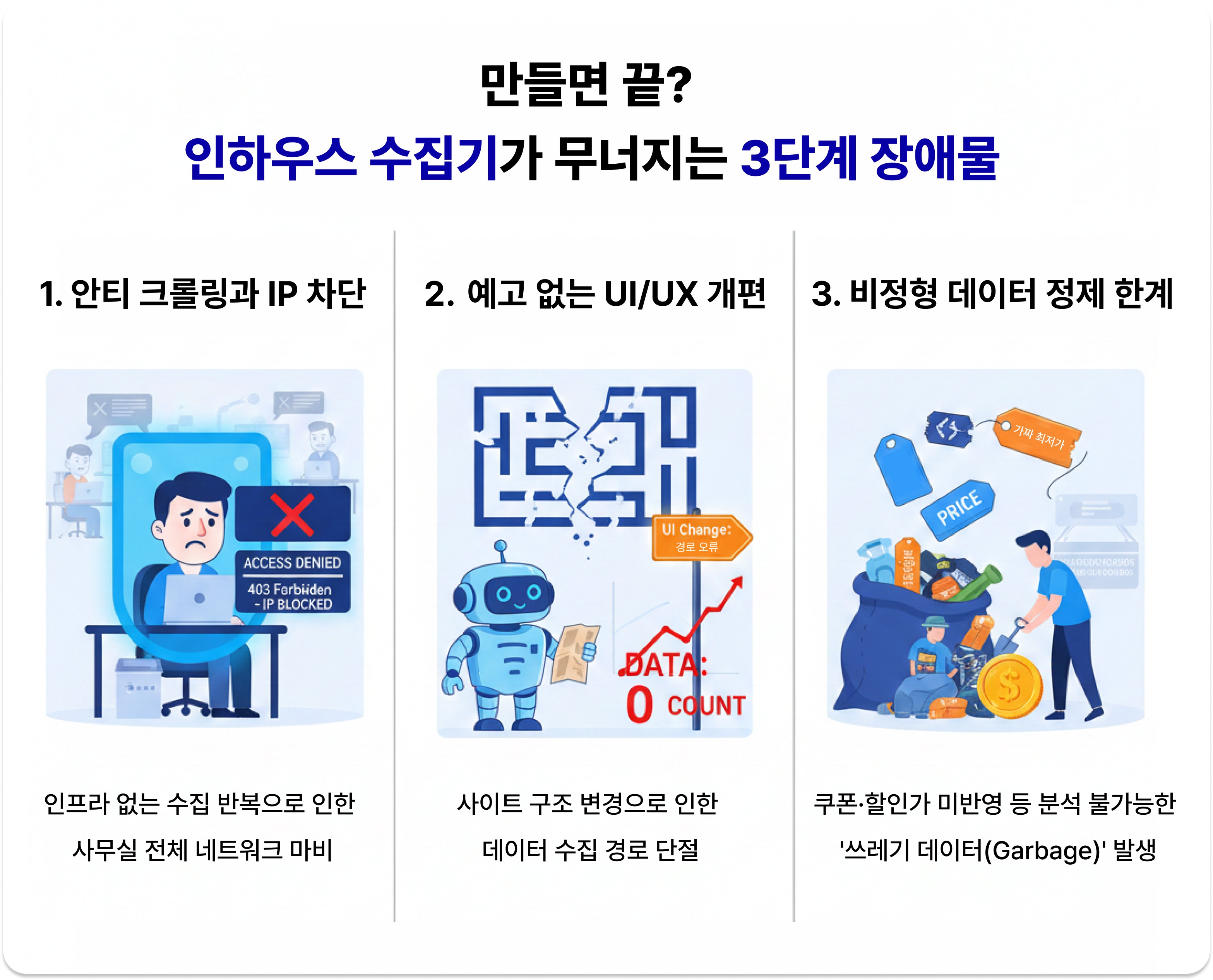
Ultimately, in-house projects lacking such precise management capabilities get caught in an endless 'maintenance hell' trying to respond to variables popping up daily, which remains as a heavy 'technical debt' eating up organizational resources as time goes by.
But the truly serious problem does not end with the consumption of the development team's resources. The moment technical maintenance shakes, the reliability of the data built on top of it collapses together.
Strategies built on incorrect data are bound to collapse
Ultimately, all these processes of data contamination occur because they are only rushed to 'make' price collectors, while neglecting the value of verifying and 'monitoring' the collected data. Most companies merely regard crawler construction as a one-time development task and do not equip a system to verify and check the integrity of collected data in real-time. Since they do not even have dedicated operational staff, they are inevitably exposed at all times to consistency violation risks where actual market situations and the contents of collected reports do not match. Consequently, serious information asymmetry phenomena often occur, where distorted data due to collector errors is cited as is in executive reports. This means a gap in 'quality control' arises, where the technology exists, but there is no check on whether the output values produced by that technology are true.
The onslaught of 'fake lowest prices': Managerial misjudgments caused by data errors
This damage to data integrity directly leads to fatal business risks beyond simple number entry mistakes. Shall we assume a situation likely to happen in practice? Our collector misread the platform's discount coupon logic and reported that a counterfeit seller is selling a product much cheaper than the regular price. By parsing the price information incorrectly, it collected lowest price data at a lower price than actual, meaning it collected data different from the actual situation on the ground.
Seeing this report, a brand manager in a hurry might protest to the platform or make a decision to lower our product's price to not lose competitiveness. They commit the error of jumping into an unnecessary price-cutting war to respond to a lowest price that does not even exist. But what if this was not a change in the market, but a temporary error that occurred in the process of the collector scraping data? As a result, the brand ends up cutting its own operating profit margin to match a lowest price it did not have to keep, and at the same time, foolishly blows away normal sales opportunities. Furthermore, making unreasonable demands to the platform based on untrue grounds results in lowering the brand's data reliability and negotiating power accumulated for smooth channel management in the future.
Furthermore, missed data that fails to capture counterfeit sellers' clever price manipulation or anomalous exposure methods results in neutralizing the brand's pricing policy and leaving market prices to collapse. In an in-house environment, even if such data omission occurs, they lack the ability to distinguish whether it is an error of the collector or an actual change in the market. Ultimately, strategies built on unverified data are like a broken compass guiding business direction down the wrong path. It only becomes dangerous 'garbage data (Garbage In, Garbage Out)' that blinds working-level officials and hinders executives' judgments.
In the end, an in-house monitoring system with an unclear operating entity does not build up the brand's defensive power, but rather becomes the starting point of managerial risks that make them take dangerous gambles based on wrong information.
With things being this way, many companies feel the limitations of direct development and turn their eyes to show interest in commercial extension programs or scraping tools. They do so with the expectation, "Wouldn't this be a cost-effective alternative?"
Opportunity costs hidden behind simple subscription fees, invisible expenditures occurring when managing infrastructure directly
The trap of labor costs hidden behind 'cheap extension programs': Why seemingly cheap tools are actually the most expensive
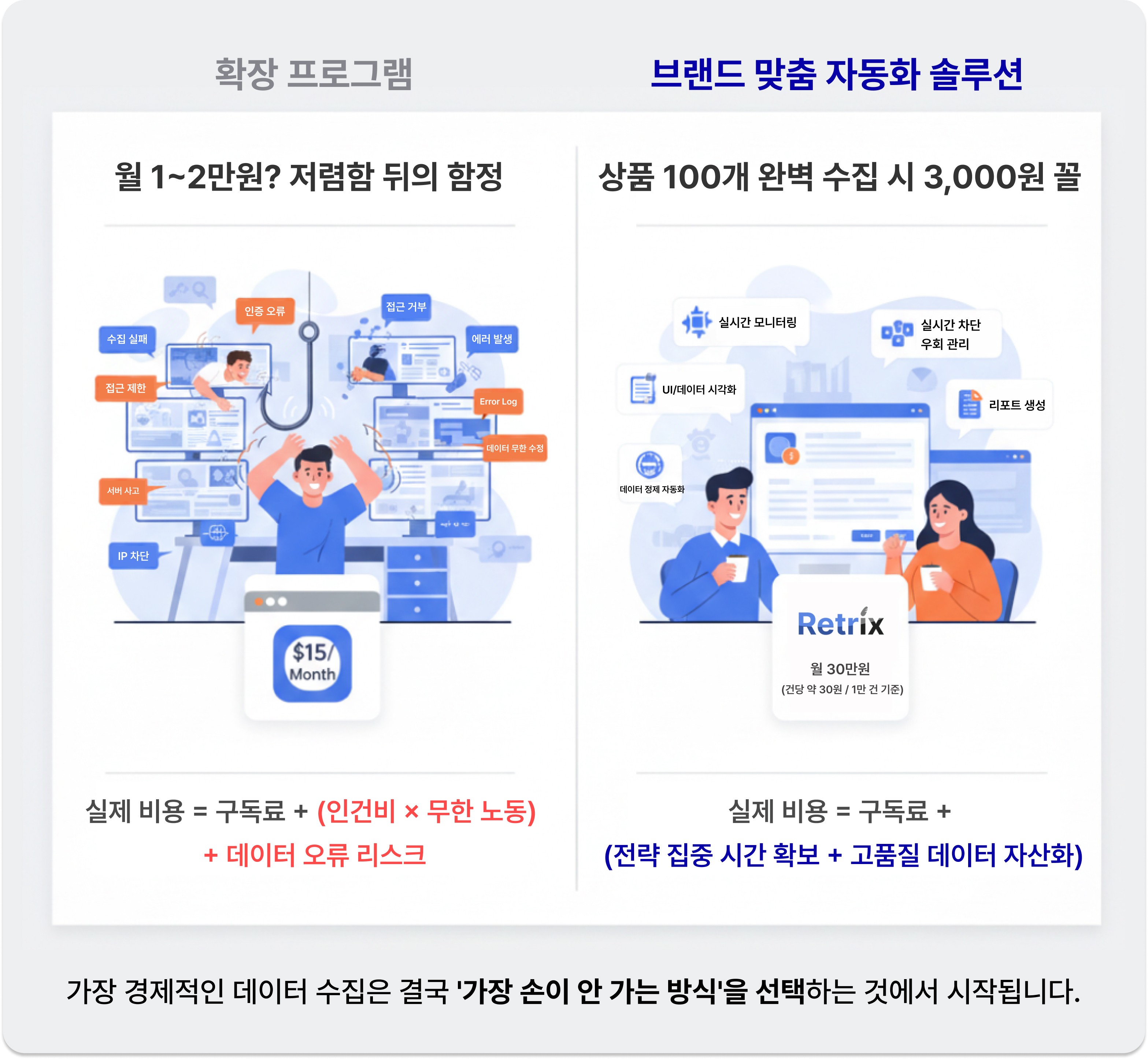
Once you enter the stage of previous worries, you will begin to compare in earnest options that require less development resources, meaning options that are easier to utilize and manage than in-house construction. Indeed, there are many scraping tools in the form of browser extension programs boasting cheap costs of 10,000 to 20,000 KRW per month, or free price collection solutions based on open source in the market. Companies sensitive to initial costs are easy to judge that these 'light tools' are reasonable alternatives. However, the moment they introduce this to business processes, they fall into the trap of 'massive operating costs' hidden behind visible subscription fees.
The first factor to consider is the consumption of human resources. Looking at the plans of famous extension programs, low-priced plans (around $15 to $16 per month) place strict limits on the number of collectable URLs or pages. A bigger problem is that these tools are fundamentally 'semi-automatic' methods that require human intervention. It seems like the program does everything for you, but in reality, the person in charge has to go to the site, click, specify collection targets one by one, check the list, and repeat the process of pressing the extract button. If they have to monitor 1,000 products, the person in charge is bound to be buried in consuming manual tasks of repeating hundreds of clicks instead of their original work. If you convert the working-level official's opportunity cost occurring at this time into a monthly salary, it already far exceeds dozens of times the tool subscription fee.
Why professional management services reduce the overall opportunity cost of the organization
On the other hand, Retrix completely reverses this cost structure through a fully automated pipeline. Retrix's standard plan is around 300,000 KRW per month for collecting 10,000 cases, which translates to only about 3,000 KRW to perfectly collect 100 products. You are buying several hours of the person in charge's valuable work time for less than the price of a cup of coffee.
It is not simply that the price is reasonable. Retrix is provided with the chronic problems of in-house development completely solved.
Anti-crawling response: Proxy server operation and block bypass technology, which you have to solve directly when using extension programs or building your own, are included as standard, so you no longer need to be anxious about office IPs being blocked.
UI change response: Since Retrix invests dedicated development resources instead to respond to platform structure changes, there is no need to fix settings yourself or repair collectors just because a site structure changed.
Data refining (unstructured data): The service scope even includes the process of refining into clean, highly consistent data that brands can use immediately, even amidst intricately tangled pricing systems and anomalous exposure methods.
All these headache-inducing 'maintenance war' costs and the person in charge's work time are melted into the solution's service. Since Retrix takes care of all troublesome and tricky things, clients no longer need to tear apart and fix code all night due to blocks or errors. With Retrix bearing the technical and management debt instead, clients only need to enjoy data consistency of 99% or higher.
Indeed, Retrix detects and responds to thousands of platform changes and price fluctuations in real-time, and supplies high-quality data reflecting accurate pricing systems by clearly separating intricately tangled discount prices and coupon prices. Thanks to this, the person in charge no longer needs to cling to manual Excel price collection tasks to fill in missed information. This is because Retrix systemizes the existing repetitive work of manually collecting prices in Excel files to build a stable data environment that can be used immediately for decision-making.
At the same time, Retrix delivers not only the processed outputs but also the raw data itself to the brand to guarantee data sovereignty. Through this, data is accumulated as a core asset of the business rather than a simple one-time report, and companies gain the power to control and expand data themselves.
In the end, it is the difference between "having a person suffer all day using a 20,000 KRW tool per month" and "introducing a proven management service and letting the person in charge focus on more important sales strategies." Do not just look at the subscription fee visible right now. If you add up the labor costs put in to maintain a seemingly cheap tool and the risk costs due to data errors, the method of having the entire infrastructure managed becomes a much more economical and smart investment from a business perspective. The most economical data collection eventually starts with choosing 'the method requiring the least hand'.
Infrastructure is a 'Constant', Strategy is a 'Variable': How to seize business sovereignty beyond data collection
Ultimately, we must think once again about what our real purpose of collecting data is. It is not to fix one more line of collector code or analyze why Excel figures broke. Data collection is an essential basic material for decision-making, but the act of collection itself does not become a brand's unique competitiveness.
A brand's true market dominance comes from 'strategic judgment' that keenly interprets collected data to establish pricing policies, analyze counterfeit sellers' penetration patterns, and ultimately defend sales. It is right in this process that we collect data to ponder, "How can we protect our brand's value and increase sales by even 1% more?" However, if you get too deeply involved in collection tools, situations where you spend more energy on secondary management than on the substance really often occur in practice.
Still, many companies lose the 'purpose' of using data because they consume core personnel in maintaining the 'tools' to gather data. A brand manager who should draw up sharp market strategies spends the entire morning exhausted finding missed data, and a senior-level developer stays up all night responding to crawling bugs or platform UI changes instead of their original product advancement or company core service updates. This is like a person who needs to go to a destination by car not even being able to start because they are studying the engine structure.
Now, a clear division of roles is needed. Leave the task of building and managing the complex and headache-inducing 'data collection highway' to experts. You only need to grab the steering wheel of the car called 'strategy' running on top of it and look only at the destination. And Retrix will become the partner laying down that highway most stably.
Data infrastructure must become an unshakable 'constant'. The organization's energy should be focused on managing 'variables' that create growth, rather than filling internal technical flaws. When infrastructure becomes a solid constant, only then will a brand have a practical foundation to immerse itself only in growth without being shaken by changes in the external environment.