Unofficial Seller Management
Price Management
Brands dragged around by Coupang's lowest-price algorithm vs. Brands that proactively defend their prices

💡 In this article, you can check the following content.
Why is it a problem if you sell cheaper than Coupang?
The essence of the problem: Coupang is just a 'mirror', the real problem is outside
Practical risks: Legal violation concerns, limits of speed, and why 'passive response' is dangerous
Solution: The '24-hour price defense system' that moves before Coupang makes it an issue
Conclusion: When to view Coupang's price pressure as a 'signal' rather than a 'problem'
Why Is It a Problem When Sold Cheaper Than Coupang?
Recently, a news report has been rapidly shared among business practitioners. The report stated that Coupang, taking issue with prices on other online shopping malls that are sold cheaper than its own platform, has been demanding suppliers adjust prices on other sales channels, such as Naver Smartstore.
The reason was that the price on Naver was lower than the selling price on Coupang. The supplier added that under Coupang's pricing policy, the selling price of the same product on Coupang must be the lowest in the market among all sales channels, but the current selling price on Naver Smartstore violated this standard. Consequently, this led to a specific demand to raise the selling price on Naver Smartstore to 6,000 KRW or higher.
Similar cases continued in the pet supplies industry as well. Testimonies emerged that they received requests from manufacturers to adjust their Naver selling prices because they were selling cheaper than Coupang. There were also statements that such demands have become more frequent recently. Some analyzed that as Coupang users decreased after the personal data leak incident, price management might have become more sensitive than before. Regarding this, Coupang stated that it was a supply/wholesale price negotiation to maintain the lowest price in a high-inflation environment.

In reality, most price issues on the field start with this flow. There is definitely a standard price intended by the brand, and operations with Coupang are also conducted based on that price. There was never a decision to sell cheaper than Coupang, nor is there any recollection of intentionally applying discounts to a specific channel. However, at some point, rumors that "it is being sold cheaper on external channels" arise first, and only then does the price issue surface in earnest.
In the end, the core of the problem is not the excessive demands of a specific platform, but that a price uncontrolled by the brand was formed in the market first, and that price began to operate as the standard.
By the time Coupang raises a price issue, the fact that "a lower price exists in the market" is already presupposed. Where and how that price was created does not matter. Once a price is exposed, it immediately becomes a standard for comparison, and from that moment, the brand is placed in a position of being asked for explanations and settlements based on the already formed price, rather than being in a position to design the price. This is the starting point of price issues repeatedly encountered in practice, and it is a scene encountered repeatedly the more channels are operated simultaneously.
At this point, one question remains. Where on earth do these price issues begin? Is it because Coupang raises the issue first, or has a crack already formed somewhere further upstream? Price issues usually originate much earlier than official adjustment requests, at points that are not easily visible. In this post, we will look into where the moment a price issue is first detected in the actual field is, why the brand gets dragged in late if they miss that signal, and how they can respond to this problem.
The Essence of the Problem: Coupang Is Just a 'Mirror', the Real Problem Lies Outside
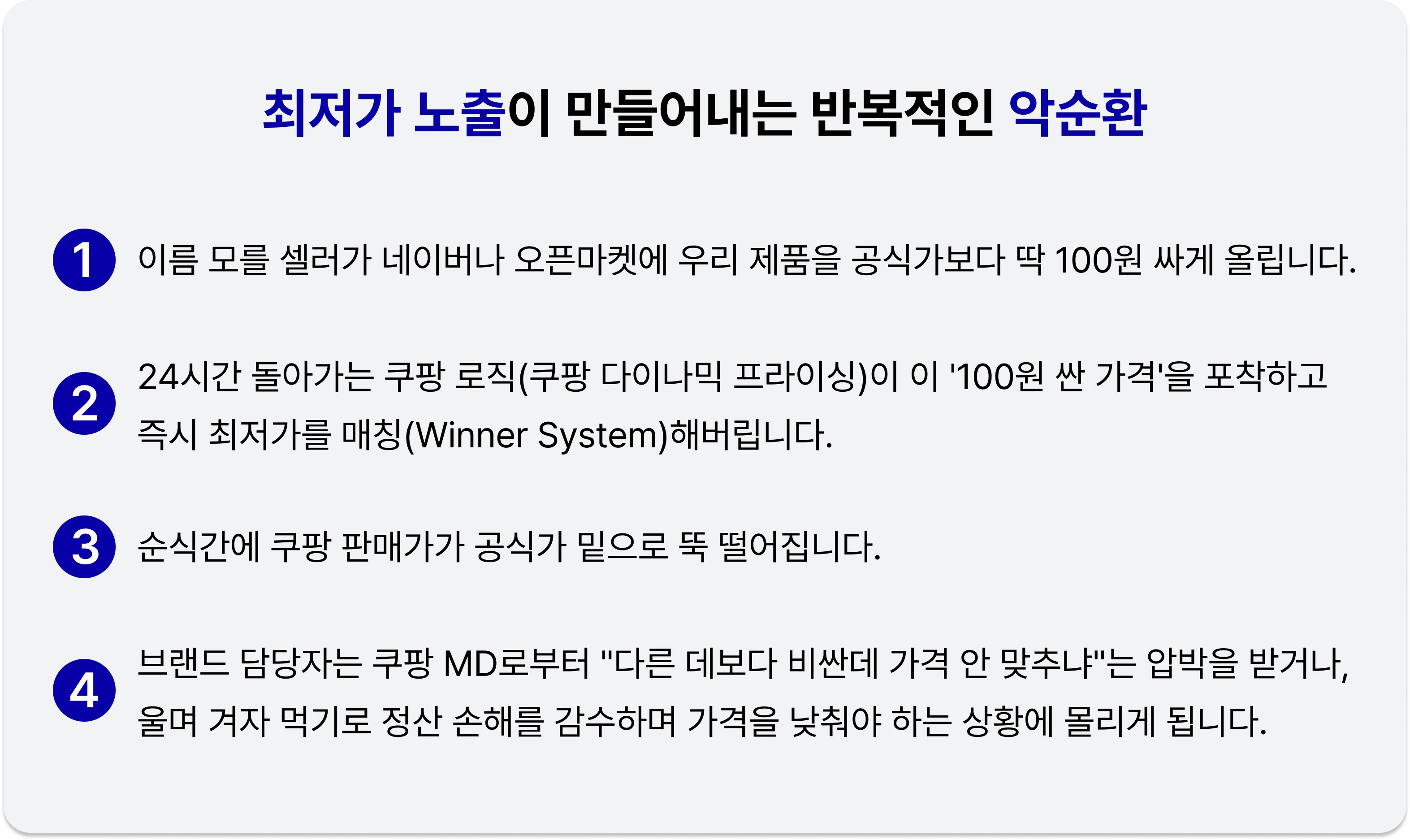
From a practitioner's perspective, the most frustrating part is when it feels like Coupang is arbitrarily cutting prices. However, in reality, Coupang does not create non-existent prices. Coupang's algorithm works strictly like a 'mirror' reflecting the market. Coupang's 24-hour logic (Coupang Dynamic Pricing) amazingly finds the lowest prices hidden somewhere in Naver Smartstore or open markets through web crawling, and simply transfers them to Coupang's screen. In the end, the fact that a Coupang MD has started to take issue with the price is, in itself, a signal that our brand has begun to lose control over market prices.
At this time, the entities breaking down the price are mostly in places out of the brand's control. They are unofficial resellers without formal contracts, parallel import sellers, companies dumping inventory for immediate clearance, or some deviating dealerships secretly lowering and selling prices for immediate sales. Although it is a price unintended by the brand, it is clearly exposed to the market, and that single price starts acting as the standard.
The problem is that this price difference is usually not very large. It is often a difference of a few thousand KRW, or even a few hundred KRW, compared to the official price. However, in the market, that small difference plays a decisive role. Especially by using options or bundle structures, the perceived lowest price is created much more easily. Even if the main product price looks similar, a "cheaper-looking price" is formed by inserting an option or changing the bundle configuration. While it is an ambiguous difference for a human practitioner, it is a clear lowest price for the algorithm.
Prices created like this spread quickly. They are exposed on Naver Smartstore or open markets and immediately become targets for crawling. At this point, Coupang does not judge. It does not look at the context, nor does it question the intent. Coupang merely accepts the result that "an already cheaper price exists".
From this moment, the structure changes completely. The problem is no longer a matter of negotiation between Coupang and the brand. The fact that a seller structure uncontrolled by the brand created the market price first becomes the core. Although the brand is not the entity that created that price, it stands in a position where it is first asked for an explanation because of that price.
Therefore, it is easy to miss the problem if you view the price issue with Coupang simply as 'pressure from the platform.' The actual structure is closer to a flow where price collapse starting outside the brand is revealed through Coupang as a channel. In this state, pricing strategy can no longer remain in the realm of 'design'. It changes character from a question of how to create prices to a question of how to defend already collapsed prices. Even if the brand has never proactively created the price, a structure of constantly having to respond due to prices exposed to the market is repeated.
In the end, blaming the mirror of Coupang will not change the situation. Because as long as that distorted reflection in the mirror—namely, that 'lowest price link' embedded somewhere in the market—is alive, this vicious cycle will not stop.
Practical Risk: Potential Legal Violations and Speed Limits, Why 'Passive Response' Is Dangerous
When the situation reaches this point, practitioners get impatient. They feel like immediately finding the seller who posted that price on Naver and calling them. They try pleading or sometimes warning, saying, "We have our official price, how can you sell it so low? Please match the price." Unfortunately, however, this approach carries two major practical risks.
The first is the legal dilemma. Under the Monopoly Regulation and Fair Trade Act in Korea, 'resale price maintenance' is strictly prohibited. The moment a brand forces a distributor or individual seller "not to sell below a certain price," a potential legal violation arises. Especially demanding price corrections from unofficial sellers with whom we have no direct contractual relationship lacks justification and is unlikely to yield actual effects.
The second is the limit of speed. The speed of humans manually searching, finding the lowest-price seller, getting their contact info, and making phone calls can never beat the speed of Coupang's algorithm. While we are struggling with one seller, Coupang's logic has already swept through dozens of other platforms and modified the price. Ultimately, relying on persuasion and requests is highly likely to be like pouring water into a bottomless vessel.
At this point, the core of practical work must completely shift from 'post-processing' to 'pre-detection'. It is too late to respond after the price has already been reflected on Coupang. The battlefield is recognizing the moment that price rears its head somewhere in the market before it reaches Coupang's algorithm. This means the character of the task must be changed from a homework of processing after a price issue occurs to an ongoing defensive battle of managing signs of occurrence.
Solution: '24-Hour Price Defense System' That Moves Before Coupang Takes Issue
In summary, most of the price problems encountered in practice do not start with Coupang. Coupang simply reflects prices already exposed to the market quickly, and the real problem is that there was a lowest price created without the brand's knowledge beforehand. If so, the perspective must also change. The key is not "how to match Coupang's price," but "how quickly we can capture price cracks that Coupang might react to."
Retrix focuses on exactly this point, namely, 'the moment prices collapse.'
We capture the point where the market's lowest price is created first
Before prices are reflected on Coupang, MDs contact you, and talk of price adjustment arises, Retrix shows where the lowest price is being created within the market first. At this very moment, it plays the role of allowing you to check in real-time on which channel and by which seller the price has started to fluctuate.
We capture early the points of price formation that the brand cannot control
We capture early the prices formed in areas not directly operated by the brand, including unofficial sellers, parallel import sellers, and even perceived lowest prices using option/bundle structures. Rather than simply showing "what the current lowest price is," you can check the flow of which seller started to break the price, with what structure, and from when.
We manage temporary price collapses so they do not solidify into the 'market standard'
The entities shaking market prices are not always just unofficial sellers. Official sellers (white sellers) in urgent need of clearing inventory also frequently become the starting point of price cracks unintentionally. The problem is not who lowered the price, but how long and how widely that price is exposed.
Based on the entire market flow including official sellers as well as unofficial sellers, Retrix manages both the points where prices temporarily fluctuated and where they were organized again. Thus, we can prevent situations where a single seller's short-term price deviation solidifies as Coupang's standard price or is misunderstood as the overall market price. Rather than 'reverting' prices, it is closer to the role of managing so that fluctuations do not become the standard.
We manage price damage and brand equity damage as a single flow
Another important point is that these sellers rarely damage only the price. Sellers who break prices often use product images or detailed content without authorization as well. Even though they are not official distributors, it is not uncommon for them to take official images, brand descriptions, and even content with copyright issues. The entity breaking the price damages brand equity at the same time.
Retrix handles both price monitoring and image/copyright monitoring through AI, allowing you to track sellers who damage both prices and brand equity in the same flow.
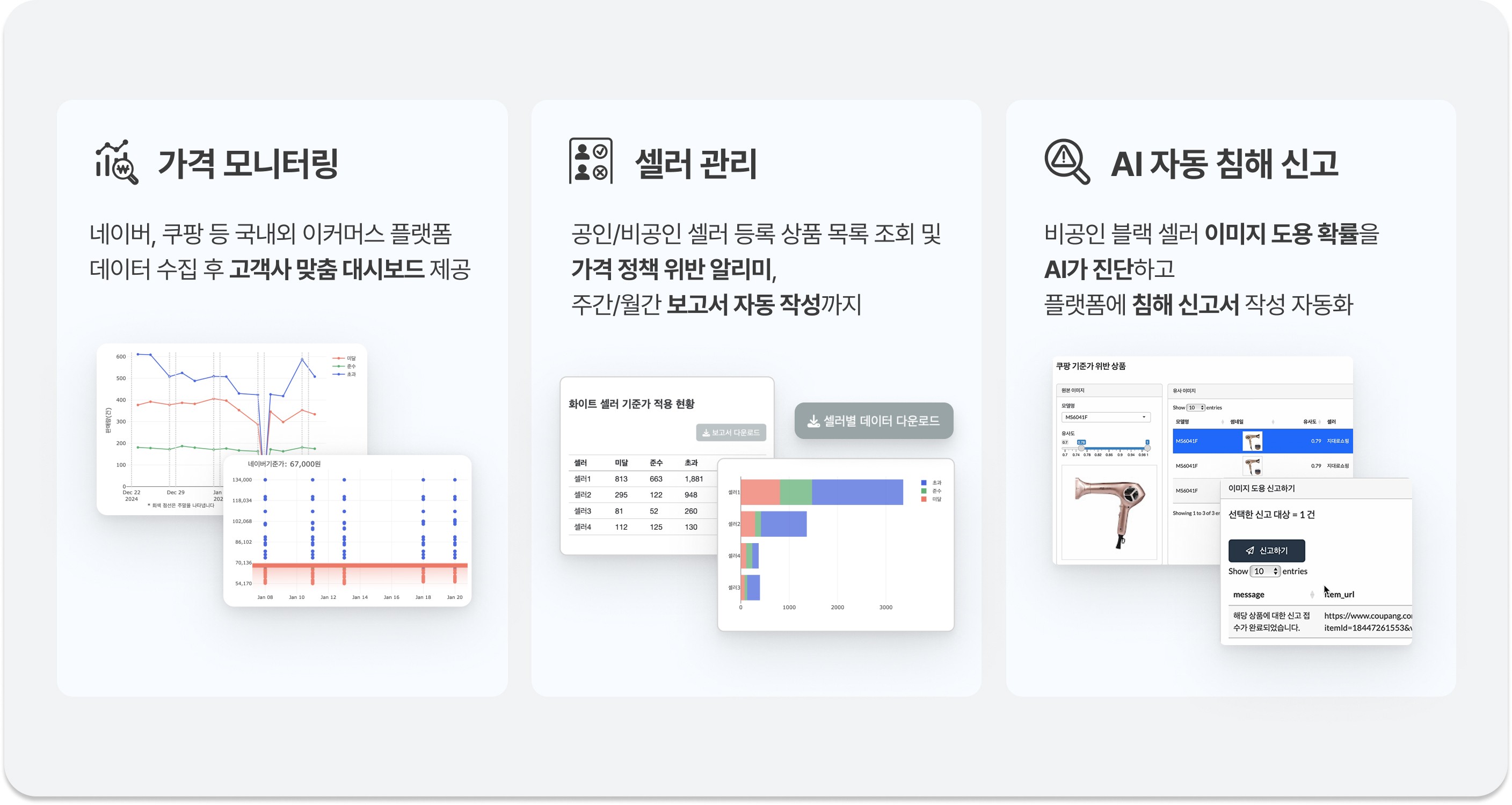
In this way, Retrix is a minimum management device that creates the visibility to detect and manage market fluctuations first before wrong prices solidify as standards. It moves brands out of the structure of explaining and clean-up only after Coupang takes issue with the lowest price, and places brands in a position to judge before problems grow.
Only when pricing can be brought into the realm of constant management rather than 'post-response,' and when price flows can be managed preemptively, can a brand finally stand in the position of managing price flows rather than reacting to price issues.
Conclusion: Time to View Coupang's Price Pressure as a 'Signal' Rather Than a 'Problem'
As examined in this article, the price pressure from Coupang encountered in practice does not occur suddenly one day. It is closer to the result of an unintended price already being created somewhere in the market, and that crack being revealed first through the channel of Coupang. This is because Coupang is a channel that reflects existing prices fastest rather than an entity that designs prices.
Therefore, the fact that Coupang has started to take issue with prices is closer to a signal that price management is a step behind, rather than the start of negotiation. What matters in this situation is not the attempt to 'adjust' the price. In a fair trade environment, brands cannot set prices at will, and that limitation will not change significantly in the future. However, brands can choose whether to leave the collapsing price flow unattended or to manage it before that flow solidifies as a standard.
Ultimately, whether to view Coupang's price pressure simply as a problem to be avoided or to utilize it as a precise 'measuring instrument' to check the market health of our brand depends on the brand's choice. Only when escaping from the yoke of post-response that cleans up after prices collapse, and equipping a 'systematic defense' that reads and responds to the market first with data, will a brand have the real power to protect its own value.