Price Management
The Minimum Advertised Price (MAP) policy: Can it also restrict the actual selling price?

💡 In this article, you can find the following information.
Is it illegal to restrict the selling price? Unraveling the boundaries of MAP policies through the Bullsone case
If a product is sold cheaper than the standard price set by the brand, can sanctions be imposed on the seller?
To what extent can MAP policies be controlled?
Summary of points frequently confused by practitioners: Advertised Price vs. Selling Price
Communication with sellers: How to do it to avoid confusion
Conclusion: MAP policies can only restrict the advertised price
Is restricting selling prices illegal? Solving the boundaries of MAP policies through the Bullsone case
Last May, the Fair Trade Commission issued a corrective order against Bullsone, a famous domestic car accessory brand, for violating the 'Resale Price Maintenance' regulation. This action caused a major stir among industry insiders and, at the same time, brought about practical confusion over 'How far can a MAP policy go?'.
Many brands want to manage distribution order through Minimum Advertised Price (MAP) policies, but if they do not clearly understand the legal difference between advertised prices and final selling prices, they may unintentionally be considered unfair trade. In this content, we examine the permitted scope of minimum advertised price policies and the core of practical design, focusing on the Bullsone sanction case.
If a product is sold cheaper than the standard price set by the brand, can sanctions be imposed on the seller?
The answer is 'No'. You cannot sanction a seller just because the actual payment price is lower than the standard price set by the brand. However, if the advertised price exposed to consumers is displayed lower than the standard price, this case is subject to sanctions.
Minimum Advertised Price (MAP) is a policy that manages the 'price displayed in advertisements'. Therefore, a brand forcibly controlling the final payment price (actual selling price) may constitute a resale price maintenance activity prohibited under the Fair Trade Act. The problem is that it is easy to confuse the boundary between the two in practice.
The Bullsone case sanctioned by the FTC clearly shows how this confusion can lead to illegal acts in practice. Bullsone informed online distributors that it would specify the 'minimum selling price of its products' and impose disadvantages, such as suspending product supply and withdrawing store entry, if they failed to comply. The FTC deemed that such actions substantially violated the seller's price autonomy, and under the judgment that it constituted resale price maintenance, imposed legal sanctions along with a corrective order.
Bullsone's advance notification document included the statement, 'Bullsone may suspend product supply and restrict future collaboration for channels that do not comply with the price policy.' The key to this case is not just a matter of managing simple advertisements, but that the brand attempted to directly control even the final payment price. The FTC judged this to be in violation of Article 46 of the Fair Trade Act (Prohibition of Resale Price Maintenance).
The FTC stated that this approach is clearly a violation of the law in that it limits consumers' price choice, hinders free competition among sellers, and can ultimately distort market functions. This served as a strong warning to other brands operating similar policies in the future, and awakened many practitioners to the need to clearly distinguish between "advertised price and selling price."
How far can a MAP policy control?
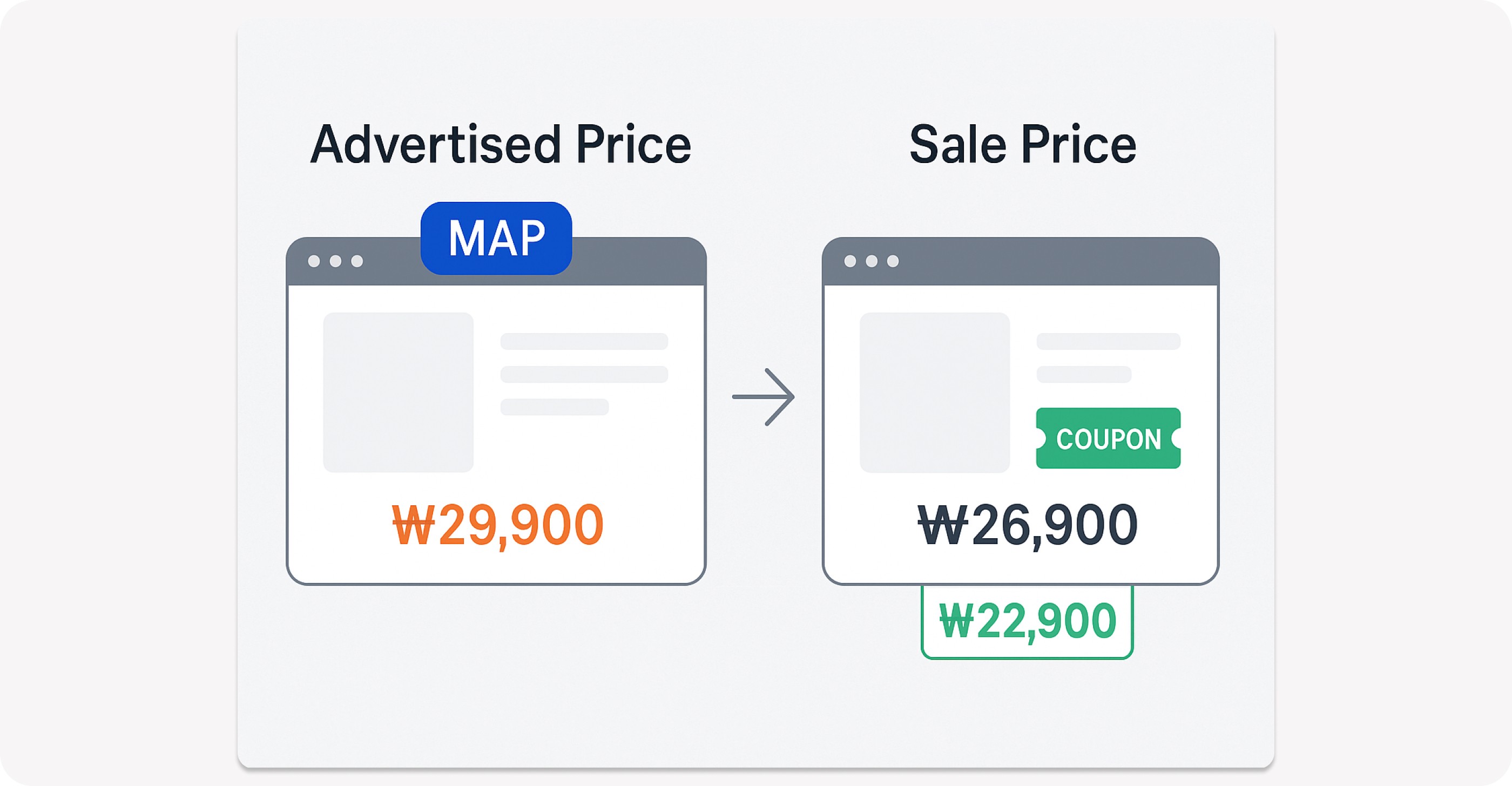
The Minimum Advertised Price (MAP) policy is the minimum reference price set by a brand based on the price displayed in advertisements (i.e., the price at the point where the consumer first becomes aware of the product). Here, 'Advertised Price' refers to the visually first exposed price information that consumers encounter before deciding whether to purchase, such as the list price, thumbnail, top of the detailed page, special exhibition page, banner, etc. MAP judges whether a violation has occurred based on this 'advertised price'.
For example, in Shopping Mall A, if the minimum advertised price specified by the brand is 29,900 KRW, but a seller displays it as 26,900 KRW on the thumbnail, this is a clear violation. However, if the thumbnail displays 29,900 KRW and a coupon is applied only at the payment stage, making the actual payment price 26,900 KRW, this is not a MAP violation.
In other words, situations where a brand can consider a MAP standard to be violated are as follows:
When the product thumbnail price is displayed lower than the standard price
When a price below the standard price is displayed on the first screen of the detailed page
When a price below the standard price is specified in an external banner advertisement

On the other hand, the following actions are not legally MAP violations:
Automatic application of coupons at the shopping cart stage
Application of discounts for specific member grades
Decrease in actual purchase price due to the use of reward points or mileage
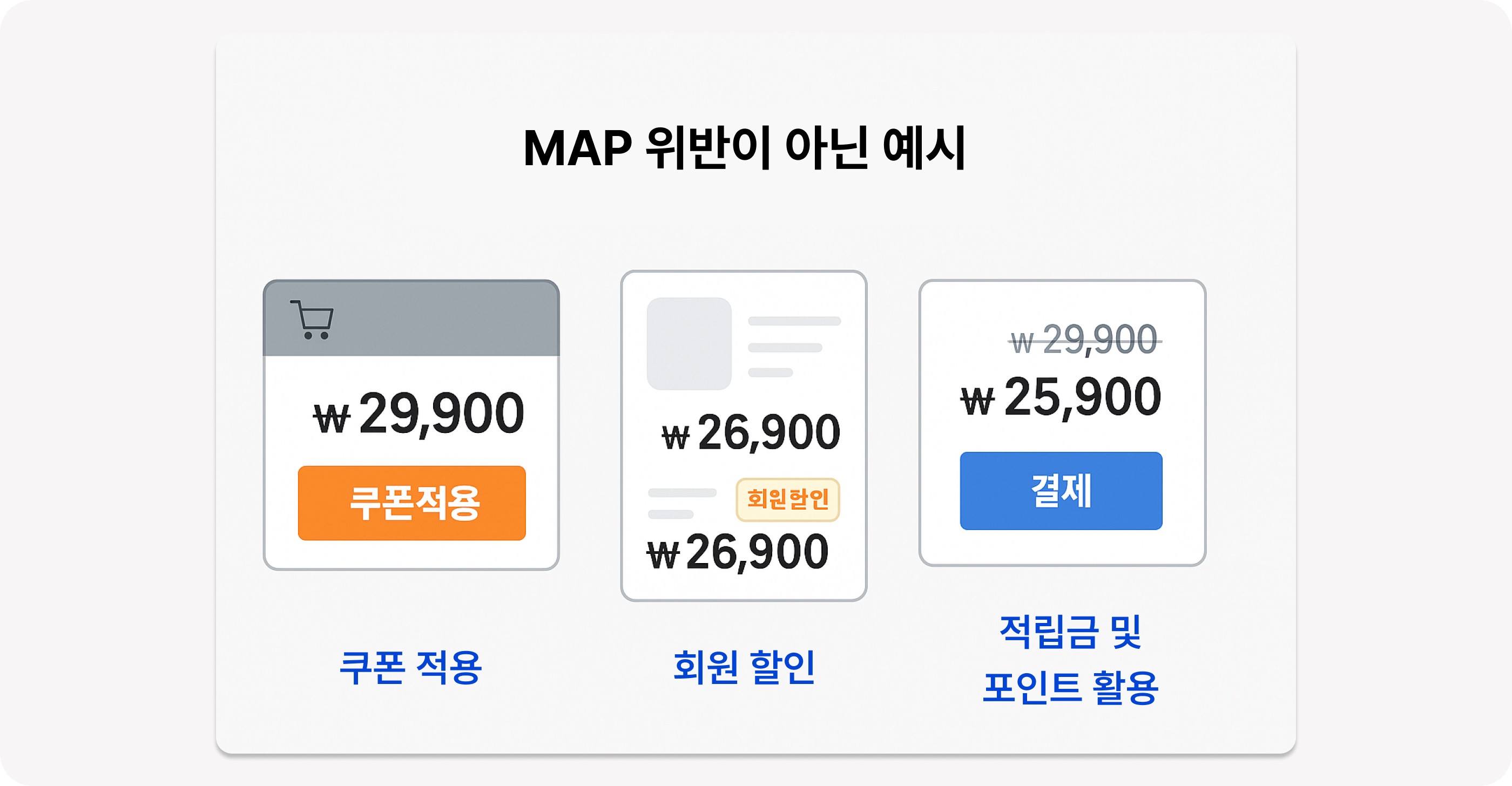
As such, the minimum advertised price MAP targets the 'price at the advertising stage' where consumers perceive the product, and the price at the actual payment stage is not subject to the brand's control. Therefore, whether a MAP violation occurred must be judged based on the displayed price information, and discount application methods, payment structures, and member-specific benefits are excluded from the judgment criteria of the MAP policy.
Practitioners should especially consider structures where 'exposure below the standard price' can occur through automated systems (e.g., automatic display of review coupons, real-time price comparison functions, etc.), and need to periodically review the standard price setting method in accordance with changes in the platform's exposure policies.
Summary of points that practitioners frequently confuse: Advertised Price vs. Selling Price
Let's organize the main concepts once again. The word 'selling price' is used very ambiguously in practice. To someone, it means the thumbnail price, and to another, it refers to the actual amount paid. However, from the perspective of the Minimum Advertised Price (MAP) policy, it must be understood separately as follows:
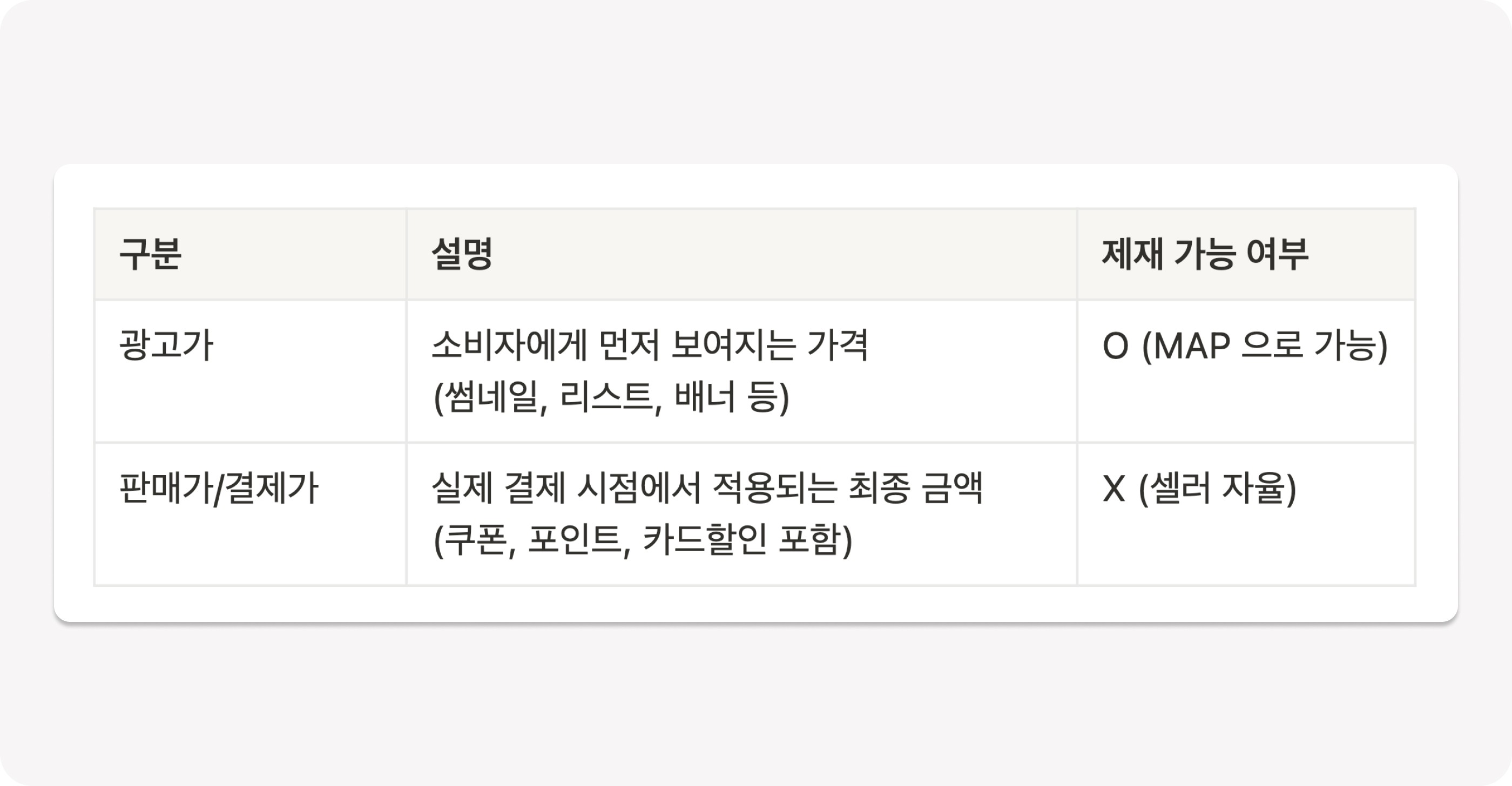
This distinction must also be shared in the same language when the brand communicates policies with sellers. In internal brand policy documents, standard price guides, and contract clauses, it is necessary to clearly distinguish and use 'advertised price' or 'payment price' instead of the expression 'selling price'.
For example, the phrase "The selling price must be maintained at 29,900 KRW or higher" is unclear. It must be specified as "The list/thumbnail/top of detailed page exposure price must be maintained at 29,900 KRW or higher" to enable consistent operation without disputes with sellers.
Additionally, even though the 'displayed price' was set as the MAP standard, there are many cases where the payment price is automatically displayed attached to the displayed price due to platform characteristics. Therefore, it is important to organize the exposure locations for each platform in advance and set up internal standards for what is considered advertising exposure.
Communication with sellers: Do it like this to avoid confusion
The effectiveness of the Minimum Advertised Price (MAP) policy begins with smooth communication with sellers. No matter how well the standards are organized, if the process of delivering and discussing them is insufficient, the policy may be distorted or invalidated in the field. To prevent this, you can apply the following communication principles to practice:
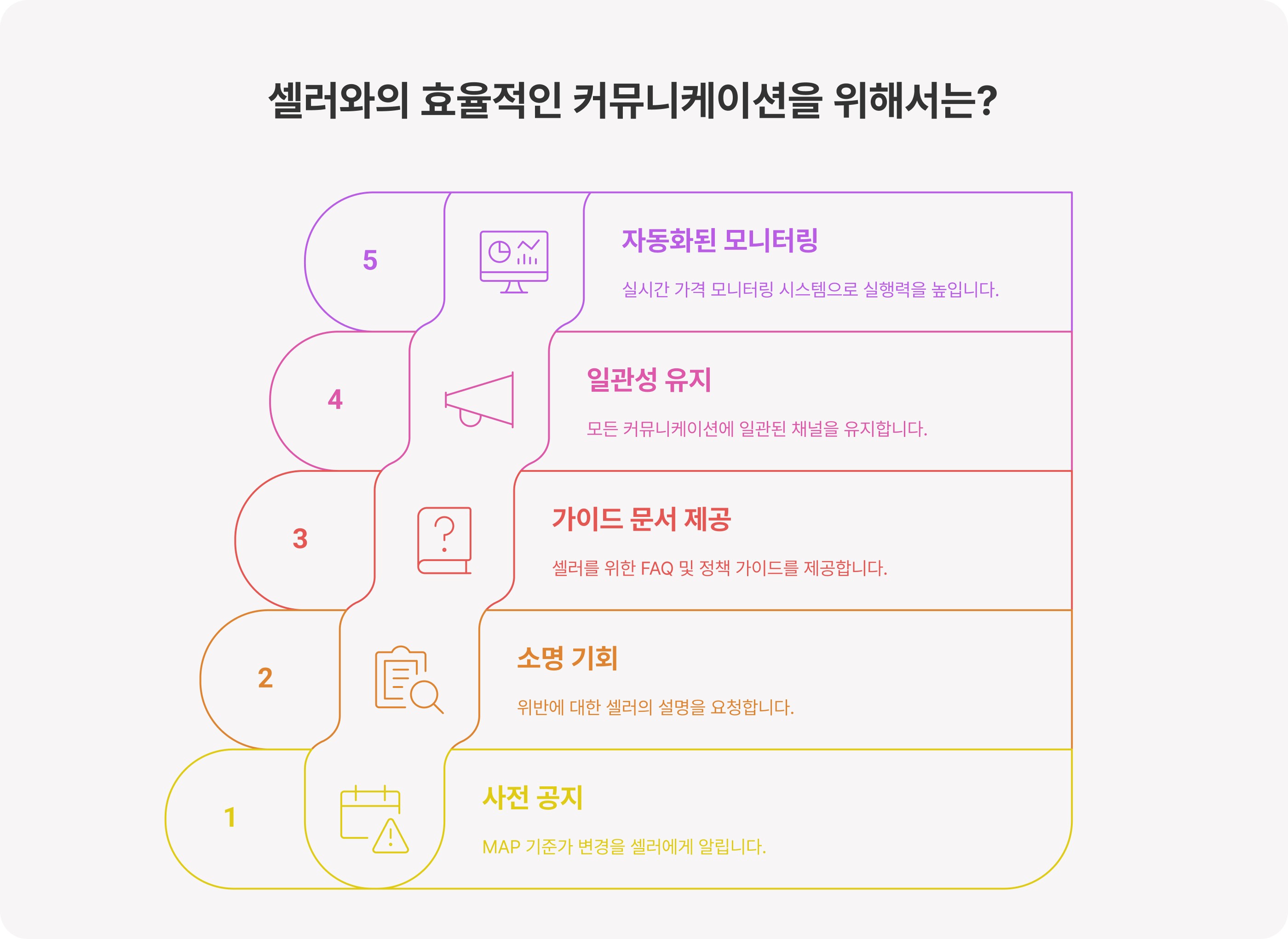
Advance notice is mandatory when changing MAP standard prices
The MAP standard price is not a simple means of price control, but must be operated on a foundation of trust with distribution partners. It is recommended to explain the reason for change, scope of application, and platform-specific exceptions clearly at least 3 to 5 days in advance, and deliver them together in the form of a PDF guide or organized sheet.
Do not immediately 'sanction' when a violation is detected, but provide an opportunity for explanation
If the advertised price is temporarily exposed below the standard, it may be due to a system integration issue on the seller's side or an operational error. In this case, step-by-step measures such as an advance warning, verification request, and providing an opportunity for explanation are necessary. It is also useful to prepare a step-by-step manual internally, such as '1st violation → grace period → sanction upon repetition'.
Provide FAQ or policy guide documents for sellers
Provide a guide in PDF or link form that summarizes frequently asked questions by practitioners, such as the difference between advertised price and payment price, exposure location standards for each platform, and exceptional situations of MAP violations. Sharing the document at the initial entry point or whenever MAP changes will significantly reduce confusion.
Maintain consistency in communication channels
Policy guidance, violation notices, and standard price changes should be consistently delivered through a single official channel (e.g., brand-dedicated email, Kakao Business Message, etc.) as much as possible to reduce confusion. Setting up message templates in advance is also useful for repetitive responses.
Utilization of automated MAP monitoring systems
Even if a brand shares a clear policy with sellers, violations of the Minimum Advertised Price (MAP) standard can occur due to various variables in the practical field. In particular, there is a limit to manually checking countless product pages, and there are many cases where the exposed price changes automatically depending on the platform structure. In this case, running a system together that can detect the advertisement exposure price in real-time and automatically detect exposures below the standard price is highly effective in increasing policy enforcement power.
Reaturns automatically collects price information from major e-commerce channels based on the standard price set by the brand and detects exposure cases that violate the standard price in real-time. Repeatedly violating sellers are automatically classified as 'black sellers', allowing the brand to take follow-up actions more quickly. This reduces the burden of manual monitoring and creates a practical foundation for stably operating MAP policies.
In this way, the key is to make the Minimum Advertised Price (MAP) policy perceived not simply as a 'notification' but as an 'agreed execution standard'.
Conclusion: MAP policy can only sanction advertised prices
The Bullsone case is not simply an incident where one company accidentally broke the law. It is also a warning that practitioners can be exposed to similar risks at any time if they do not clearly understand the working scope and limits of the Minimum Advertised Price (MAP). Furthermore, the purpose of introduction must be clearly recognized in that the Minimum Advertised Price (MAP) is not simple price regulation, but a strategic standard designed by a brand to maintain market price credibility and distribution order of its products.
The MAP policy is an effective tool for protecting a brand's pricing strategy, but without a 'clear understanding' of its limits and application methods, it can rather put both the brand and sellers at risk.
MAP operates based on the 'advertised price', not the 'selling price'.
The selling price (final payment price) is at the seller's discretion. Only the advertised price can be controlled, and adjusting the payment price is not subject to sanctions.
MAP standards are not changed arbitrarily by the brand, but must be supported by communication and structured execution.
If you clearly understand this principle and design your policy, the Minimum Advertised Price (MAP) can be a powerful tool to protect distribution order.