Counterfeit
“It's a bit more watery than what I originally used...” 3 Steps to Early Detection of Counterfeit Products Starting from Customer Reviews

💡 In this article, you can check the following content.
"Something is weird" The unexpected voice that notices counterfeits first
Step 1 — Catching counterfeit signals with CS text
Step 2 — Substantiating the feeling of "being different" into "what is different"
Step 3 — Confirming counterfeits with AI image analysis
Making CS the fastest anomaly detection channel
"Something's strange" - The unexpected voice that notices counterfeits first
I'd like to start today's post with a story that I think almost any brand manager will relate to. When is the first moment you realize that counterfeits of your brand have entered the market? In reality-based counterfeit response operations, the first concrete signal often starts from the voice of a customer who holds the real product in their hands and uses it.
The case of popular beauty brand 'Derma Factory' was no different. It was only after accumulating over ten inquiries such as "The container shape is different than usual" and "The formulation and scent aren't like the existing product" that they realized counterfeits were circulating.
Rather than the brand conducting a pre-market sweep to find them first, they began investigating in earnest thanks to repeat customers who frequently used the products letting them know "Something is strange."
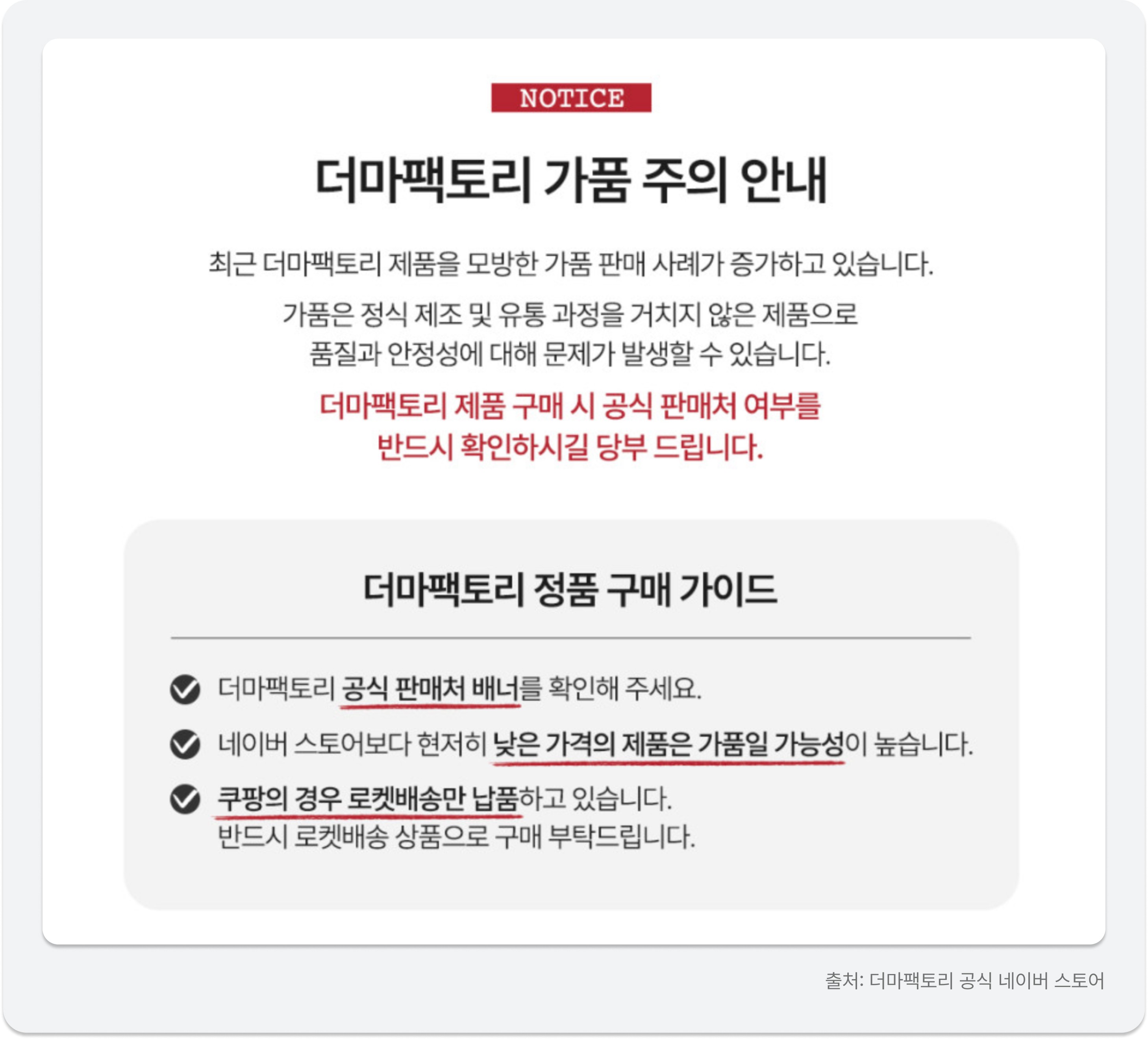
If you think about it, this might be only natural. The person comparing genuine and counterfeit products side by side every day isn't the brand manager, but the customers who buy that product repeatedly because they like it and use it in their daily lives. In the end, it is the customer who cannot help but be the first to notice the subtle differences in the feel of pressing the pump, the familiar scent, and the texture against the skin. These are often things that are hard to spot from a desk inside the brand's office.
That's why the next step is what really matters. The scale of the risk changes completely depending on how the brand acts after receiving this signal. Whether you dismiss a single inquiry as a simple complaint, or read it as an anomaly signaling the start of a risk—upon this single judgment, the speed of subsequent response is decided. The difference between one brand taking weeks to confirm a counterfeit and another moving quickly in just a few days after receiving the exact same inquiry stems right here.
Then, how can we specifically capture and respond to these valuable first signals in practice? The starting point, naturally, is the CS (Customer Service) channel where customer voices accumulate in text form.
Step 1 — Catching Counterfeit Signals in CS Text
Actually, the clues don't start out grand. Looking at a single inquiry, it's easy to dismiss it as just a particular customer being sensitive and move on. However, if the same feedback is consistently repeated, from that point on, it becomes a meaningful signal that needs to be counted as data. The text signal captured first in the customer service channel when a counterfeit is released is this word "different." While the expressions vary, such as "The scent is different from before," "The container is a bit strange," and "The formulation seems thinner," it ultimately boils down to a familiar product feeling unfamiliar.
The problem is that these inquiries come in scattered one by one across customer service channels. If approached only as individual cases, they are usually judged as simple complaints, responded to, and archived. As mentioned earlier, Derma Factory also only grasped the existence of counterfeits after accumulating more than ten of these inquiries. In other words, if they had collected and counted these inquiries as a single bundle instead of letting them slide as individual cases, they could have detected the anomaly much earlier.
For this reason, simply looking at the "content" of the inquiry is not enough in practice. You must look at "where" this inquiry data is concentrated. The key is to analyze which specific product and during what period the sense of incongruity felt in customer reviews is concentrated. If inquiries saying "different" have converged exceptionally on a single specific product within the last month, it is highly likely a clear early warning of counterfeits that is hard to dismiss as individual differences. In addition, it is helpful to look at the 'temperature' of the inquiries. If it goes beyond a simple "It's different" to "Please refund me" or "Is this a fake? I'm going to report you," and the intensity of dissatisfaction is growing, it could mean that the distribution of counterfeits within the same SKU has already progressed significantly. It is good to monitor the change in customer tone as much as the increase in the number of cases.
This pattern becomes even clearer when looking at the reviews of unauthorized seller stores. In the review sections of external open market stores, which are not directly managed by the brand, doubts such as "Is this genuine?", "I think the scent is a bit different," and "The packaging is a bit slipshod" are often repeatedly accumulated across multiple reviews. This means buyers are leaving trails of suspicion first, but because these reviews are outside of brand management, they simply don't catch the manager's eye easily. If the star rating is low and the reason for dissatisfaction is concentrated around "not seeming genuine" rather than product quality or effect, it is a good idea to note that store along with its sales page URL. This is because it serves as the starting point in Step 3 when verifying if these stores are using the same images as each other.


💡 Suspect a counterfeit? Try this right now
Search for keywords like "different", "strange", and "genuine" in CS records from the past 3 months, as well as on your own mall and open market reviews. Then, check if the data is concentrated on a specific SKU or a specific period. If you spot a noticeable concentration, you have a solid basis to move on to the next step.
Counterfeit Response Process: Step 1: Read signals in text → Step 2: ? → Step 3: ?
Once you have narrowed down the suspicious product lines and timing through text data, it's time to visually confirm the reality of that incongruity yourself.
Step 2 — Substantiating a "Different" Feeling to "Where is it Different"
This is where the real fork in the road of practice lies, which determines the speed of counterfeit response. The "different" inquiries piled up in the CS channel only point out the direction of the risk; they do not by themselves constitute written evidence to raise issues with the seller or report to platforms. This is because sensory expressions like a different scent or a strange texture are highly subjective areas where the criteria differ for everyone. Since submitting report documents as-is makes them easy to get rejected, you must ultimately convert this vague sense of incongruity into visual, objective differences.
Fortunately, the differences between counterfeits and genuine products actually circulating in the market are not as vague as you might think. Looking at the identification points disclosed by Derma Factory, the areas where differences are clearly captured are mostly concentrated in areas that can be compared visually, such as containers, labels, and packaging. In the case of 'Niacinamide 20% Serum', the counterfeit featured a longer pump neck length, a larger inner diameter, and thinner container walls compared to the genuine product. The PET recycling mark stamped on the bottom of the container was also a point of divergence from the genuine one. The difference in the 'PDRN 4% Ampoule' was even more intuitive. The carton height was shorter than the genuine one, and the top color was printed in orange, unlike the black of the genuine product.
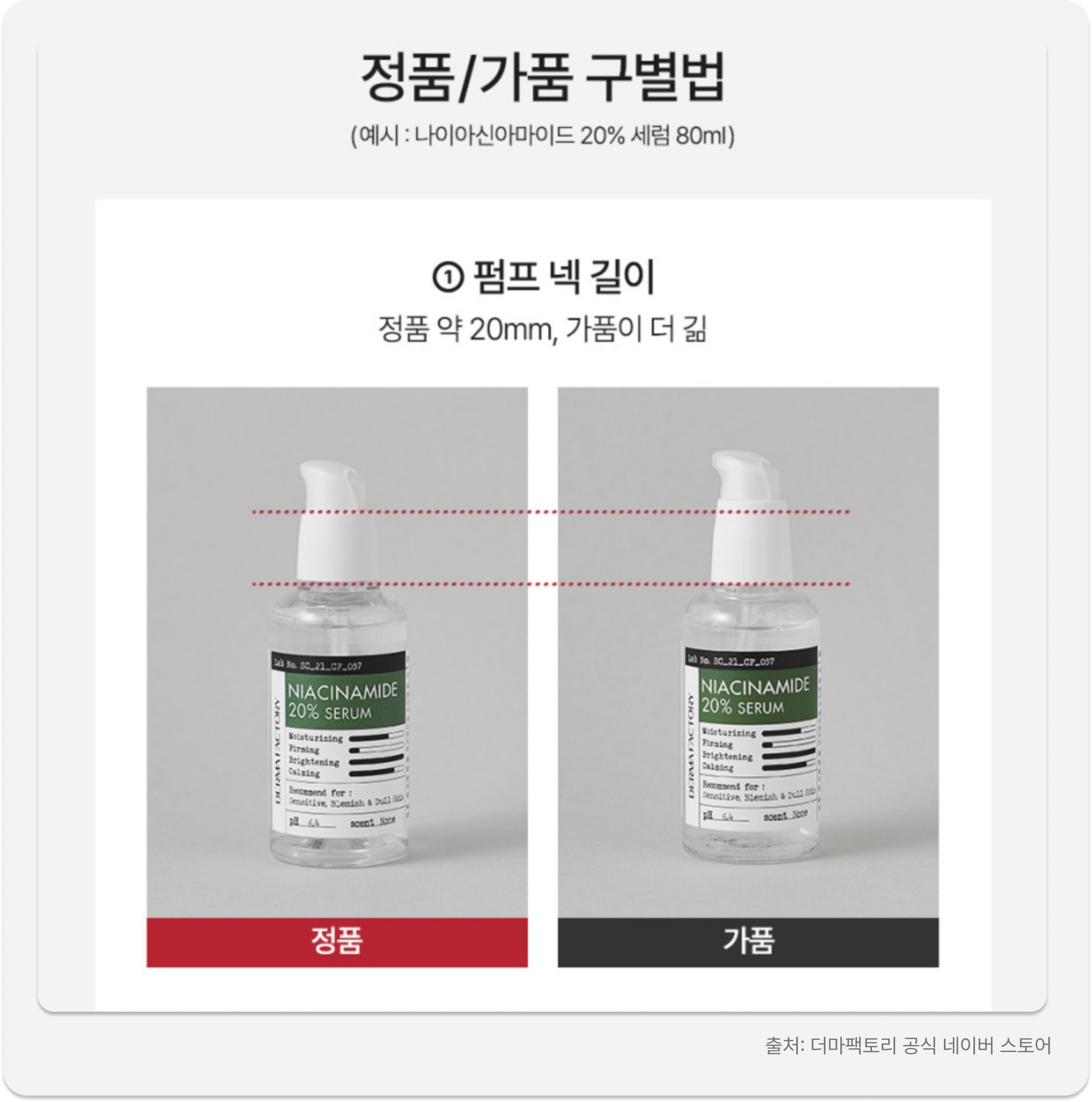
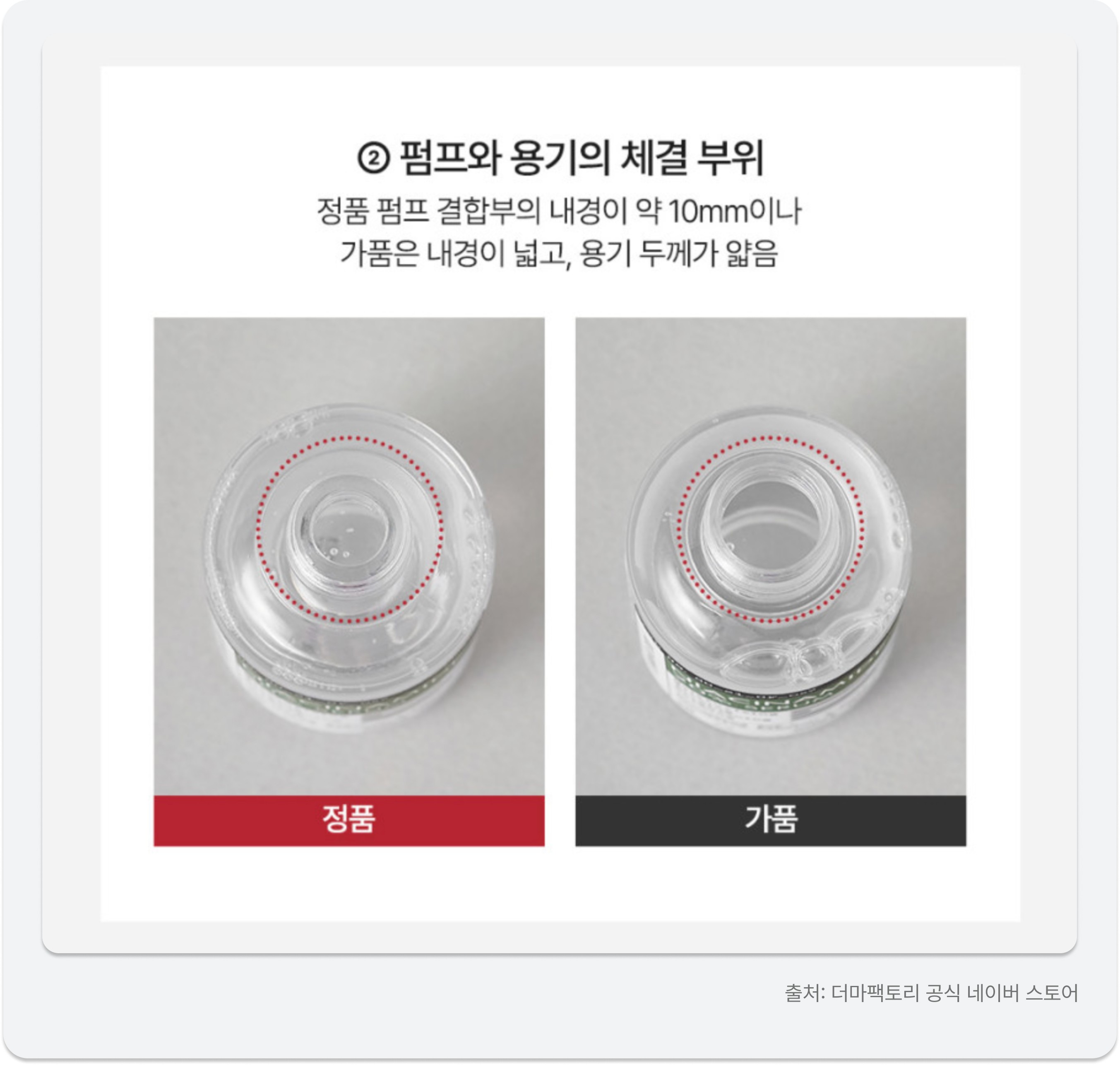
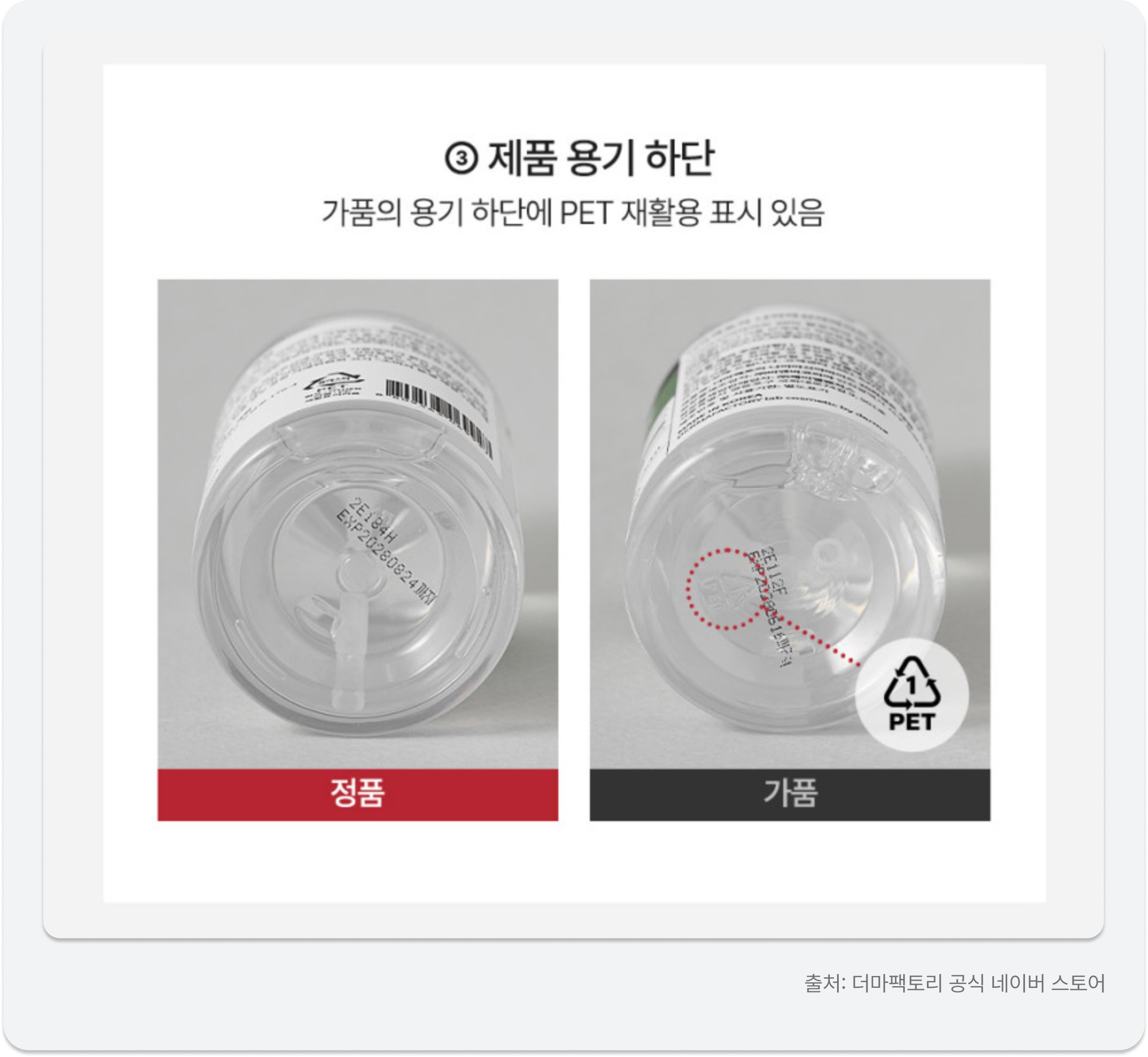
Differences can also appear in even finer details. According to reports, there were cases where the text under the ingredients section was printed incorrectly as 'So.dium DNA' instead of the original 'Sodium DNA', where the packing at the opening of the container was completely omitted, or where the glossy finish of the dropper material was distinctly different from the genuine product. Taken individually they might seem minor, but when multiple mismatching items overlap, it's hard to see it as a coincidence.
What practitioners should note here is that these differences are divided into two categories by nature.
Image-type differences: Areas that are immediately revealed through a single photo on an online sales page, such as color mismatches or print typos.
Physical-type differences: Areas that can only be verified after actually purchasing and receiving the product, such as neck length, wall thickness, or the presence of packaging.
It is beneficial to distinguish in advance whether the clues we've grabbed are differences identifiable through online images or differences known only by securing the physical product. This will make the next stage of evidence collection much easier.
But there is an interesting point here. While the reason the customer first raised an issue was the 'scent' and 'formulation', the clear differences found by the brand actually emerged from the product's 'container' and 'labeling'. While scent and texture are difficult to prove logically or show to a third party, differences in container structure or print mistakes are solid weapons that can be shown to anyone by simply taking a single photo side-by-side with the genuine product. In a manner of speaking, it is the work of turning a subjective "feeling" into objective "evidence."
Therefore, if you have confirmed that CS signals are concentrated on a specific product, do not hesitate to prepare the physical genuine product and cross-match it item-by-item with the information of the suspicious product. Check the container shape, label printing, carton color and height, and printing condition one by one. Rather than holding onto elusive clues like scent, finding visible shape and typographical errors will make response speed much faster. As an extra tip, it is recommended to keep this comparison result as an itemized checklist. Clearly organizing the caught items like "different neck length / orange misprint on carton / ingredient typo" will serve directly as your evidence list in subsequent seller appeals or platform report documents.
💡 Suspect a counterfeit? Try this right now
Prepare the actual genuine product selected in the previous Step 1, and compare the container shape, label marking, carton color/height, and print condition item-by-item with the suspicious product. The key is to address visual differences verified with the eyes instead of scent or texture.
Counterfeit Response Process: Step 1: Read signals in text → Step 2: Compare with actual genuine product → Step 3: ?
Step 3 — Checking if There Are More Retailers Using the Same Image
If you have come this far, things are fairly well organized for one suspicious product. You because you have confirmed on which product and from when signals were concentrated (Step 1), and even created an itemized checklist of where the container and labeling differ (Step 2). This is sufficient ground to raise disputes with the seller or report them to platforms.
The problem is what comes next. Counterfeiting is rarely limited to a single retailer. When you take one down, the same product goes up on another open market, or reappears weeks later with just a change of account. If you are a practitioner who has handled counterfeit response, you've probably experienced tackling one report and completing it, only to have the exact same CS inquiry come in again two months later.
So, the question to ask at this stage is not "Is this counterfeit genuine?" but "Is this the only one here?"
Here, the product page image serves as a clue. Since retailers coming from the same distribution channel often share product images, scanning other channels based on the confirmed sales page image can bundle scattered retailers into one. However, this task must be conducted across all channels and images are often edited slightly, making it an area hard to verify one by one with human eyes. This is the point where you get help from tools like AI image similarity analysis.


If you have marked stores separately in Step 1 due to a concentration of "not seeming genuine" reviews, bring that list out again. If overlapping parts emerge among the marked stores, there is a high possibility that they are not a coincidence of problems arising at the same time, but products originating from the same place.
💡 Suspect a counterfeit? Try this right now
Reopen the list of suspicious stores marked in Step 1 and check if there are places where the sales page images overlap with each other. If overlapping sellers appear, you can organize the report targets as a bundle rather than case-by-case.
Counterfeit Response Process: Step 1: Read signals in text → Step 2: Compare with actual genuine product → Step 3: Find retailers using the same image
Making CS the Fastest Anomaly Detection Channel
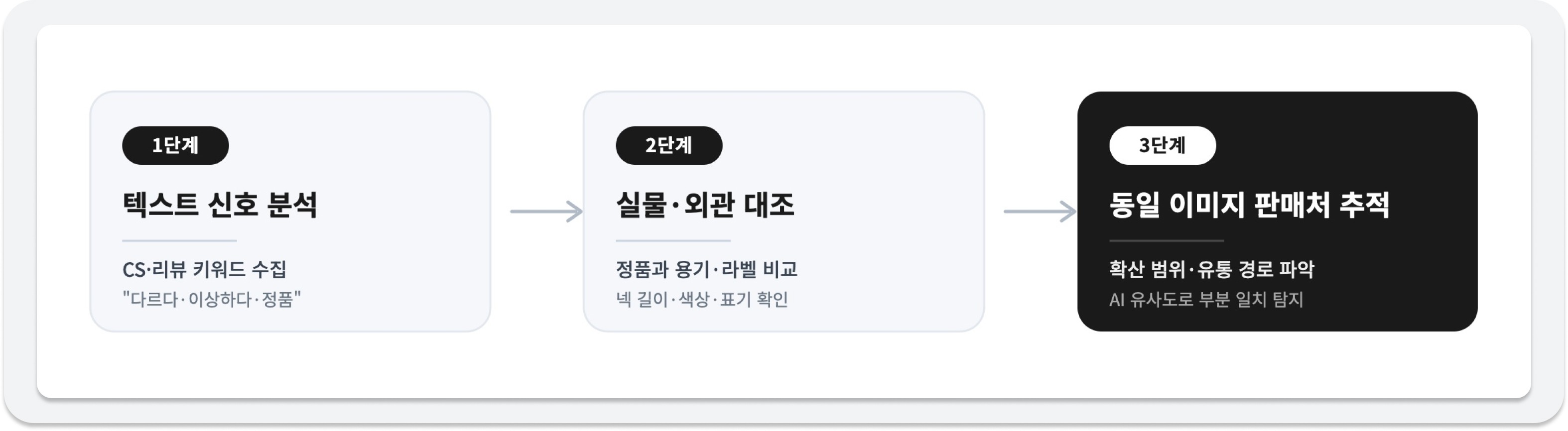
Summarizing the practical workflow from capturing counterfeit signs to setting the scope of response ultimately comes down to three steps. Counting the repeated "different" text signals in the customer service and review channels based on specific products and periods (Step 1), cross-checking the specific differences in container, label, and marking behind those inquiries against the physical genuine product to verify them (Step 2), and finally, bundling other retailers using the same image based on that sales image to check the scope of spread (Step 3). It is a process of starting from a single customer inquiry and broadening the perspective to the entire distribution channel.
Going back to the beginning, the core shown by the case of Derma Factory is that it was the customer who actually used the product, not the brand's surveillance system, who noticed the counterfeit first. This mechanism will not change significantly in the future. If so, the CS channel where the customer's voice reaches first can become a channel that detects anomalies the fastest, rather than just a place to handle complaints.
Of course, a single inquiry does not immediately mean counterfeit distribution. It could be a simple renewal or a subtle difference between product manufacturing lots. However, if a perspective of reading those inquiries as risk signals instead of letting them slide as individual cases takes root, CS will serve as the first button of risk management. A single inquiry points to one retailer, and that retailer's image points to other retailers in turn. It is a matter of how quickly the brand understands the signals the customer is already sending. Perhaps at this very moment, important signals that we have yet to read are accumulating in the CS channel.