Price Management
Why Do Tents Get More Expensive in Winter? The Secret Behind Seasonal Pricing Strategies
💡 In this article, you can find the following information.
Why is the exact same tent more expensive in winter?
Seasonal pricing strategy: Why you should look at demand, not the calendar
Step 1 of Strategy Design: Defining our brand's 'Three Seasons (Peak-Off-Shoulder)'
Step 2 of Strategy Design: Setting 'upper' and 'lower' limits of pricing
3 things you must organize before designing a seasonal pricing strategy
The final step to complete the seasonal pricing strategy through 'operations'
Next year's pricing strategy: Things to check before 'discounts'
It's the same tent, so why is it more expensive in winter?
From Black Friday to Christmas, and onto the subsequent year-end clearance sales, the e-commerce market in December was a fiercer 'price battlefield' than ever. Consumers look for opportunities to buy products they've kept in their shopping carts at the lowest prices, while brands busy themselves clearing out the year's inventory or achieving sales targets.
However, if you take a step back from this fierce price war and observe the market, an interesting phenomenon emerges. That is, the standard for determining prices moves according to 'seasonal demand' rather than 'product cost'. Consumer purchasing patterns are not constant throughout the year. Even for the same product, there are times when purchases are made without much regard to price, and other times when even a small price difference triggers a sensitive reaction.
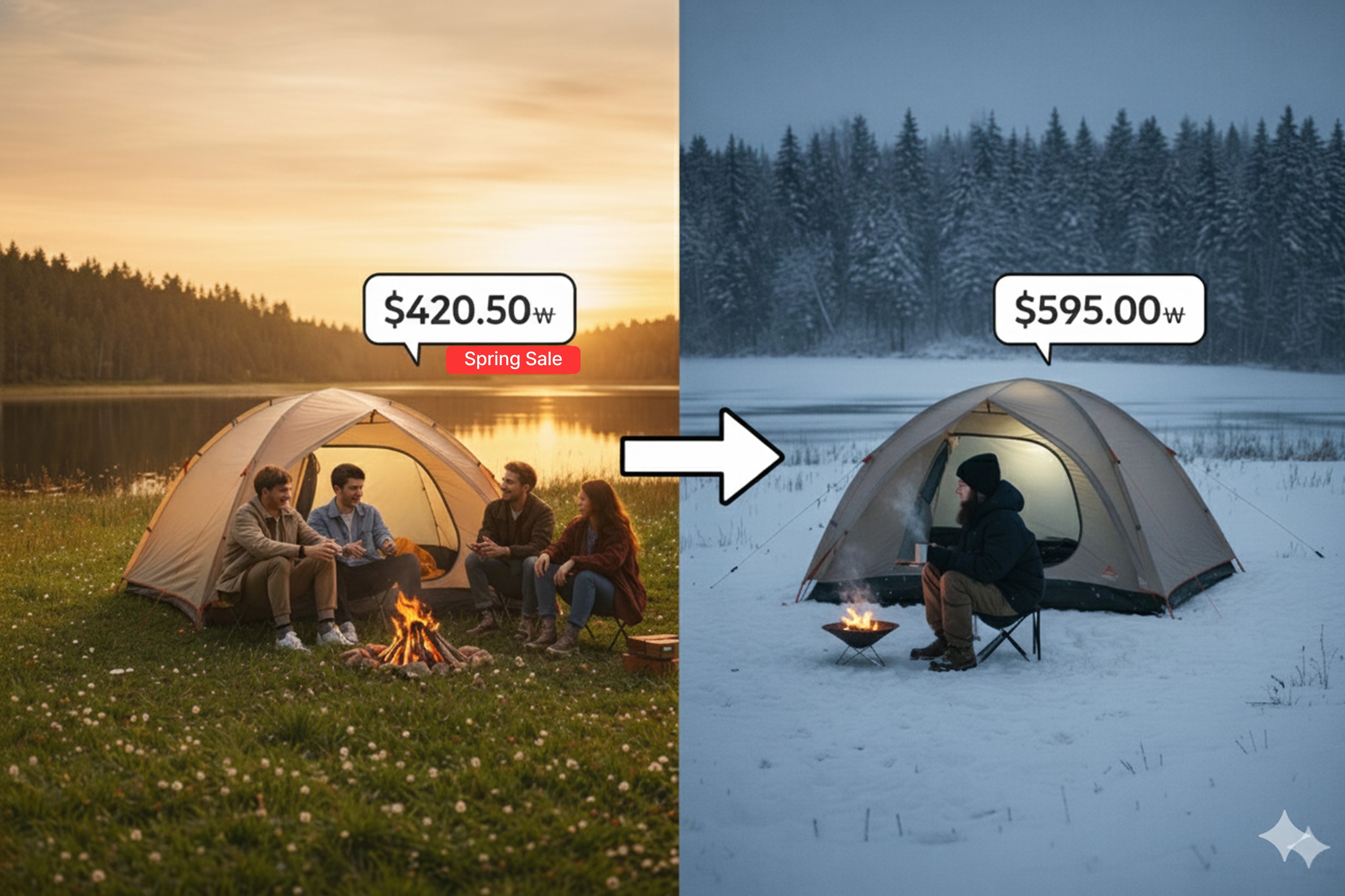
Data from global market analysis firm Wiser Solutions reveals a very interesting case. By tracking the price of a specific brand's two-person camping tent, an essential item for summer vacations, they found a price difference of more than 20% between winter and spring. Common sense suggests it would be cheaper in winter when demand is low to clear inventory, but the reality was quite the opposite. In spring and summer, when camping demand explodes, they applied more aggressive seasonal pricing (discounts) to secure market share, whereas in winter, when demand plummets, they normalized prices to protect profitability.
As such, price is not a flat indicator of simply being 'expensive' or 'cheap'. The core of the strategy is how flexibly and multi-dimensionally it moves in alignment with the point where market demand shifts, namely the demand inflection point.
This approach, long established in the airline and lodging industries under the name of 'peak season rates,' has now become an essential survival strategy for e-commerce and consumer goods brands alike. As we design a new year past the year-end peak season, the first thing our brand needs to examine is not 'how much more we should discount.' It is time to look into whether the value of our products is strategically designed according to season and demand, and how this pricing policy optimizes the brand's annual revenue structure.
Seasonal Pricing Strategy: Why You Should Look at Demand, Not the Calendar
When people think of 'seasonal pricing,' it is easy to think only of physical weather changes, such as air conditioners being expensive in summer and padded coats being expensive in winter. However, from the practical perspective of e-commerce and consumer goods brands, 'season' is closer to 'a specific point in time when consumer purchase intent changes rapidly' rather than a calendar date. In other words, a seasonal pricing strategy is not a weather response strategy, but a demand inflection point response strategy.
From this strategic perspective, seasonal pricing is not just a discount technique of changing price tags at specific times. It is a 'revenue management strategy' aimed at optimizing the annual revenue structure by clearly separating periods of concentrated demand from periods of declining demand and adjusting prices accordingly. Indeed, during peak demand periods, customers' price sensitivity is relatively low, whereas in off-peak seasons when demand decreases, price has a decisive impact on purchasing decisions. Brands must design prices based on this psychological flow.
In reality, this 'season' manifests in very diverse ways depending on the industry.
Event-driven seasons: Demand for roses and chocolates right before Valentine's Day, or mini-fridges and laptops right before the new school semester, explodes around specific dates.
Lifestyle-driven seasons: This includes accommodations or delivery food near stadiums during major sports event seasons, or health functional food gift sets right before traditional holidays.
Paradoxical seasonality: As seen in the tent example mentioned earlier, strategic choices exist to secure margins by raising prices when demand is low, and to capture market share through high-volume, low-margin sales by lowering prices when demand is high.
When does price become 'sensitive' and when does it become 'insensitive'?
The fundamental reason brands use this strategy is clear: to target customers' price sensitivity, which is inconsistent throughout the year. At certain times, customers develop a willingness to pay higher-than-usual prices just to purchase a product, while conversely, they may only attempt a brand switch when powerful discount benefits are provided.
This difference in price sensitivity is observed more clearly in certain industries. The airline and lodging industries are prime examples. While bookings continue even at high prices during vacation seasons or major events, price acts as a key variable in purchasing decisions during the off-season. This structure is not much different for e-commerce or consumer goods brands. In periods of concentrated consumption, such as year-end, holidays, back-to-school, and vacation seasons, purchasing itself becomes the priority, and price is often pushed aside as just one of many comparison factors. Conversely, when demand is dispersed, even small price differences split reactions.
For example, even customers who usually stick to a specific brand of shampoo will willingly add a new brand's product to their shopping cart when a seasonal event like a 'Year-end Clearance 1+1 Event' occurs. From a brand's perspective, strategically adjusting prices during this period not only maximizes revenue with the same product but also serves as an opportunity to attract a large number of new customers who previously had no touchpoint. Because purchases at this time often act to lower the barrier to entry for brand experience through price, they create opportunities for subsequent repeat purchases as well as short-term sales. That is why many brands utilize seasonal pricing strategies not merely as a sales boosting tool, but as a mechanism to expand customer touchpoints.
Particularly, the year-end is when the character of this strategy is most clearly revealed. Since it is the period when purchases are most concentrated throughout the year, price becomes a signal fire that creates a 'clear reason to buy now' rather than just a means to 'look cheap'.
Ultimately, Seasonal Pricing Strategy Is Not Just a 'Discount'
Looking at this flow, seasonal price adjustments do not function simply as