Price Management
After the Year-End Promotion: Why Missing the Price Drop Will Shake Up Your Whole Year

💡 In this article, you can find the following information.
The year-end promotion has ended, so why does the price remain the same?
3 typical patterns where prices are not restored to original after the promotion ends
Why missing price deviations at the beginning of the year shakes the standard for the entire year
The perspective needed to avoid missing price deviations after the year-end
Price management after the year-end is not an 'option' but a basic check-up for the next year
The year-end promotion has ended, but why does the price remain the same?
When the year-end promotion ends, this thought usually comes first. “At least the pricing is all sorted out.”
The coupons are gone, the special exhibitions have ended, and the year-end special price banner is no longer visible. From an internal standpoint, it seems like there is nothing more to take care of. However, when you actually scan the market, it makes you feel a bit uneasy. On some platforms, the prices seen during the year-end are still visible, and for some sellers, the perceived price remains largely unchanged. It's not exactly breaking the lowest price, nor does it look like a prominent violation. That's why it's even more ambiguous.
In times like this, the judgments commonly made by practitioners are similar. “It must be temporary because it’s the year-end.” “It might be reflected a bit late due to automatic settings.” It often seems like something that doesn't need to be touched right now.
Especially at the turn of the year, there is hardly any luxury to just look at prices. Performance closing, next year's planning and budget alignment, and internal reporting all pile up at once. It is a period when checking prices one by one naturally gets pushed down the priority list.
The problem is that the price remaining at this point is not at a stage where it can be seen as just a temporary trace of a year-end promotion. Although the promotion has ended, that price continues to be exposed and compared in the market, slowly beginning to solidify like a standard. Because it is neither conspicuously cheap nor clearly wrong, it lingers longer.
Most price issues after the year-end start like this. It is not a matter of how much the price was lowered, but the moment when the price thought to be finished actually remains unfinished.
3 representative patterns where prices do not revert after the end of a promotion
Looking at the prices remaining after the year-end, extreme dumping or blatant violations are fewer than expected. Rather, the problem often starts in a much quieter way. It is a situation where the condition remains like a price even though the condition was thought to have ended.
Pattern 1. The coupon or auto-discount condition has ended, but the perceived price is the same
Even after the year-end promotion ends, you might encounter this scenario. From the brand's standard, the coupon has expired, and internally it is judged as "now normal price," but looking at the actual product page, the perceived price doesn't seem to have changed much. This happens when coupons applied during the year-end period remain in some sellers' accounts, or when auto-discount conditions overlap with other discounts, resulting in the price the consumer sees remaining almost the same as before. It is also a structure that is not immediately revealed unless you open up each setting.
The important point here is that this price is not a price intentionally lowered by someone. The brand has certainly ended the promotion, but due to the platform's discount structure or differences in seller settings, a "price that looks like it is on discount" consequently remains.
Thus, internal and external perceptions begin to diverge. From the brand's perspective, it is an ended condition, and from the consumer's perspective, it still looks like an active price. If this state continues for days or weeks, that perceived price naturally begins to be accepted as a single price.
This is usually the first point where price deviation quietly begins after the year-end. The price was never lowered again, but a state where the signal that the discount has ended is not clearly communicated to the market continues to remain.
Pattern 2. The selling price has reverted, but the exposed price is stuck in the year-end
The second pattern is closer to a problem of the visible price rather than the price itself. After the year-end special exhibition or deal ends, the price has clearly reverted internally, yet something strangely keeps bothering you. In search results, product lists, or advertising areas, the price seen during the year-end is still visible first.
In fact, when you enter the product detail page, the price may be normalized. However, on the screen the consumer first encounters, the previous deal price or special exhibition price is exposed as is. In this case, a subtle difference arises between the actual selling price and the exposed price.
If this gap is repeated, it becomes difficult for consumers to judge which price is the 'real price'. And comparison is always made based on the price that catches the eye first. The price exposed in this way begins to function not as a discount price, but as a reference price, and further, as a baseline price.
The reason this situation is dangerous is because internally, there is a feeling that the prices have already been sorted out. A gap arises between the perception that "the selling price has reverted, so there is no problem" and the price constantly exposed in the market. The longer this gap persists, the year-end price quietly remains in the market and becomes the baseline for the next judgment.
Pattern 3. The baseline price is blurred by options, bundles, or set configurations
The third is structurally the most difficult pattern to notice. It is the situation where single items, options, bundles, and set products are operated together, making it difficult to judge which price is the normal price. For example, the price of a single item is normalized, but the year-end conditions remain maintained in sets or bundle products. At this time, from the consumer's perspective, the price that looks the cheapest is easily perceived as the price of the product itself. In this process, the single item price suddenly starts to look expensive. Although the price was never actually raised, it is the result of a change in the comparison baseline.
The biggest problem with this pattern is that there is almost no signal that a price deviation has occurred. No one set the price incorrectly, nor is it a blatant discount. It just creates a blurred state of which price should be viewed as the baseline as configurations and conditions blend.
Entering this stage, a situation where it becomes difficult to explain what the baseline was comes first rather than the fact that the price has deviated. And this flow solidifies particularly easily after the year-end.
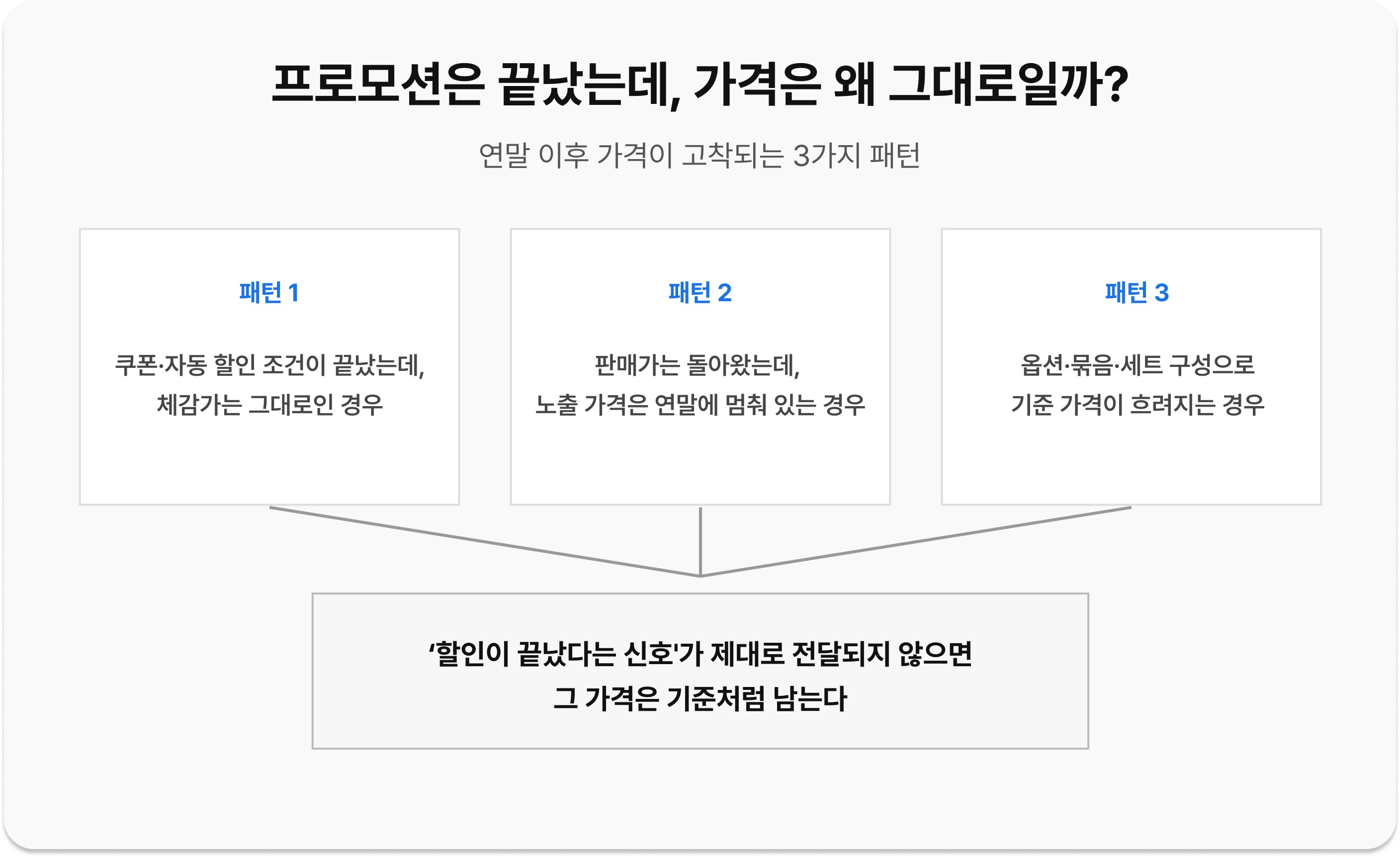
The three patterns above share one thing in common. Although there was no significant price drop or intention to violate policies, the price remains like a baseline because the signal that the condition has ended was not sufficiently communicated. And this small misalignment begins to lead to the next problem faster than expected, past a certain point after the year-end.
Why a missed price deviation at the beginning of the year shakes the baseline of the entire year
It is rare for prices remaining after the year-end to cause a major problem immediately. Therefore, at the beginning of the year, it is easy to accept this situation like this.
“It's only like that for some sellers, so it will be sorted out soon.”
“It must be temporarily remaining because it’s the year-end.”
However, the price deviation starts to become a problem from the moment this situation is no longer treated as a 'temporary exception.'
Deviation starts from a single seller, but spreads as a market standard
Price deviation usually starts from a very small point. It happens in a way where the price of a seller with remaining year-end conditions is continuously exposed in search results or product lists. What matters here is not how many products were sold at that price, but how often it was 'seen.'
In an environment where price comparison is easy, sellers also check the prices of competing sellers frequently. In this process, if a specific seller's price is repeatedly exposed, that price naturally becomes a reference point. The moment the judgment of “it is already selling at that price” attaches, that price is no longer an exception but becomes a price flow circulating in the market.
This flow is often far from intentional price cuts or violations. From the perspective of other sellers, they simply referenced the "price visible in the market," and as a result, a situation is created where they match the price to a similar level or the perceived price becomes similar even without additional discounts. In this way, the price escapes from being a single seller's problem and begins to spread like a baseline shared by multiple sellers.
Entering this stage, price deviation is no longer a management issue of a specific seller. As the entire market begins to recognize that price as a normal range, the price gradually becomes a premise rather than a 'subject of adjustment'. The price that temporarily remained during the year-end ends up becoming the comparison baseline every time prices are adjusted thereafter.
That price starts to be treated as a 'baseline' rather than an 'exception'
Once the price remaining in the market starts to be repeatedly exposed, the internal way of judging prices also changes little by little. At first, it is simply "at a level of referencing the current market situation," but over time, when reviewing prices, it easily changes to a structure that considers the currently exposed price first rather than the baseline originally set.
This change is not easily noticeable. This is because the price was not officially modified, nor did the policy change. However, in the process of judging whether to revert the price or not, "is it okay to change this price again now" starts to be reviewed first rather than "does it fit the existing baseline." It is the moment the starting point of judgment changes.
Past this point, returning to the normal price is no longer a simple cleanup but becomes a decision that requires additional review. Although the price was never actually increased, timing, external reactions, and internal burdens must be considered together simply because a price already exposed in the market exists. The discussion cost to adjust a single price grows larger.
If this process is repeated, the price remaining at the year-end suddenly becomes the premise of internal price operation. Even when discussing promotions or pricing policies later, the starting point is always this price. Consequently, the price that failed to be sorted out at the beginning of the year operates as a baseline that quietly drags along the price judgments throughout the year.
If the baseline is blurred, design becomes difficult from the next promotion onward
Prices not sorted out at the beginning of the year manifest as problems first in the next promotion planning stage. When preparing for discounts or special exhibitions, a baseline price is always needed. This is because the starting point must be clear to judge where and how much was cut, and whether the discount rate to be applied now is excessive or not.
However, with the year-end price remaining like an implicit baseline, this starting point is blurred. Even when trying to calculate "what percentage discount compared to the normal price," a discrepancy arises between the normal price conceived internally and the price already familiarized in the market. From this point, setting the discount rate changes from a simple arithmetic to a task requiring interpretation and explanation.
In this process, promotions are designed increasingly conservatively, or conversely, lead to discounts more excessive than intended. This is because it is difficult to judge what a 'proper discount' is when the baseline is unclear. Ultimately, the price remaining at the year-end acts as the starting point for all subsequent planning, affecting the overall price operation throughout the year.
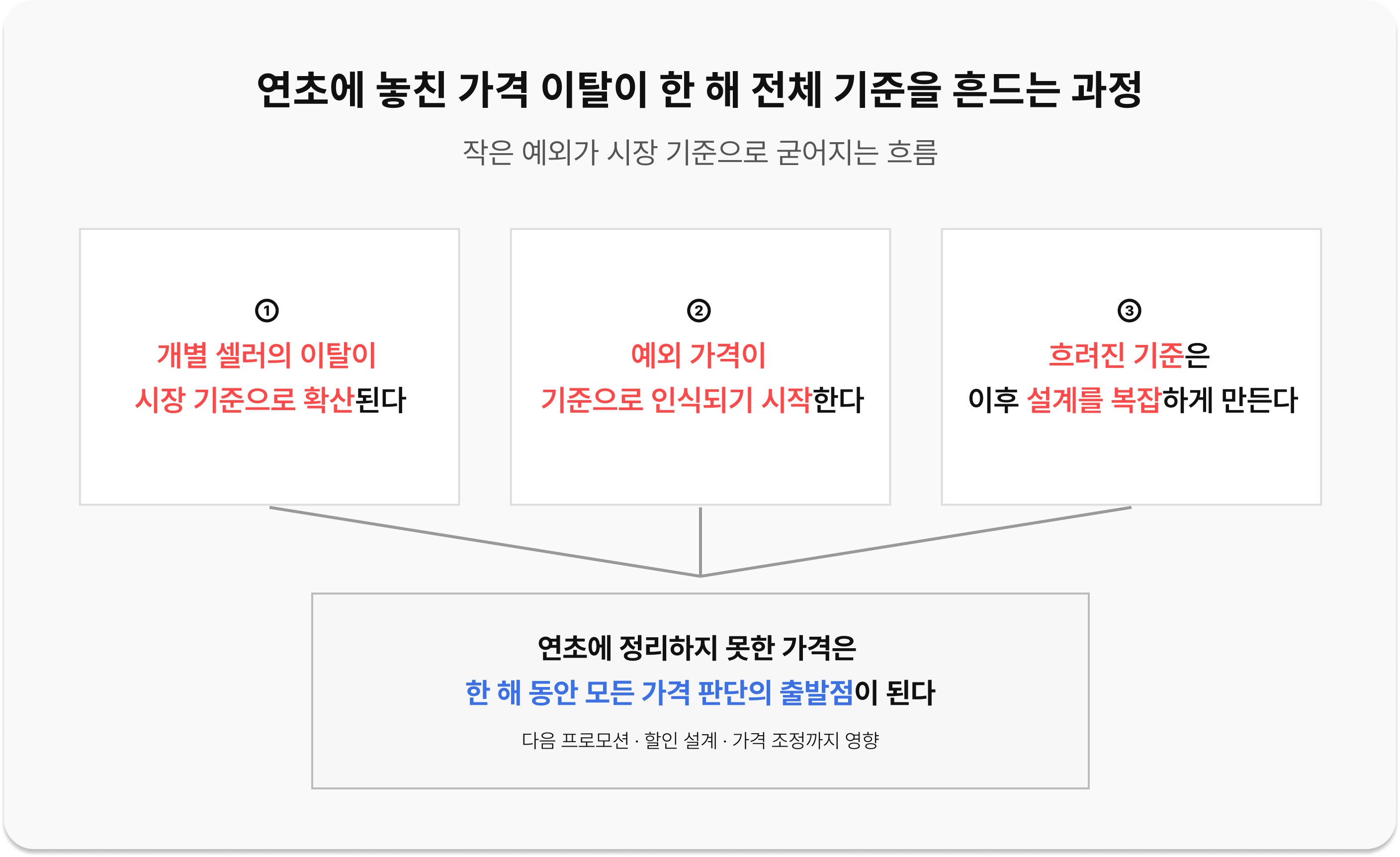
Looking at it this way, a price deviation not sorted out at the beginning of the year is not just a problem of a single moment. It leads to a structure where all subsequent discounts, special exhibitions, and price adjustments are repeated on top of an already shaken baseline.
Therefore, viewing the post-year-end period simply as a 'time to clean up' is not enough. This interval is not a time to strip away discount conditions, but is closer to a recovery interval where shaken price baselines must be re-established. If the baseline is not grabbed again at this time, even if the visible price seems maintained, a state requiring constant explanation and adjustment continues in actual operation. Changing a single price becomes increasingly heavy, judgment is delayed, and the next decision is always held back by the previous price.
A price deviation missed at the beginning of the year does not end as a small exception. Over time, that price becomes the baseline of judgment, the starting point of comparison, and eventually establishes itself as the standard that quietly drags along price judgments for the entire year. The problem is that the baseline is not a strategy made on purpose, but a result of failing to clean up.
The perspective needed to not miss price deviations after the year-end
The most frequently mismatched point in post-year-end price management is the question, “did we control the price?” In actual practice, eyes often go first to whether the price was lowered, raised, or if policies were violated. However, following the patterns and flows examined earlier reveals that the prices becoming problematic after the year-end are much more often not prices intentionally adjusted by someone, but rather states where prices that should have reverted failed to do so.
Therefore, the important question at this point changes. Rather than how strongly the price was controlled, it is how quickly the non-reverted price was noticed.
The reason prices are easy to miss after the year-end is closer to a structural problem rather than the brand's negligence in management. In an environment where coupons, auto-discounts, special exhibition prices, and option/bundle prices operate simultaneously, prices do not return to the 'normal price' all at once. States where some conditions have ended, some remain, and some prices remain only in the exposure area overlap. In this situation, manually checking the prices of all sellers and all channels one by one is realistically not easy. Because how much omission occurs depends on the brand and structure, it is also difficult to generalize exact figures. However, it is clear that the environment makes it easy to repeat the situation of "thinking we checked everything, but finding some remaining later."
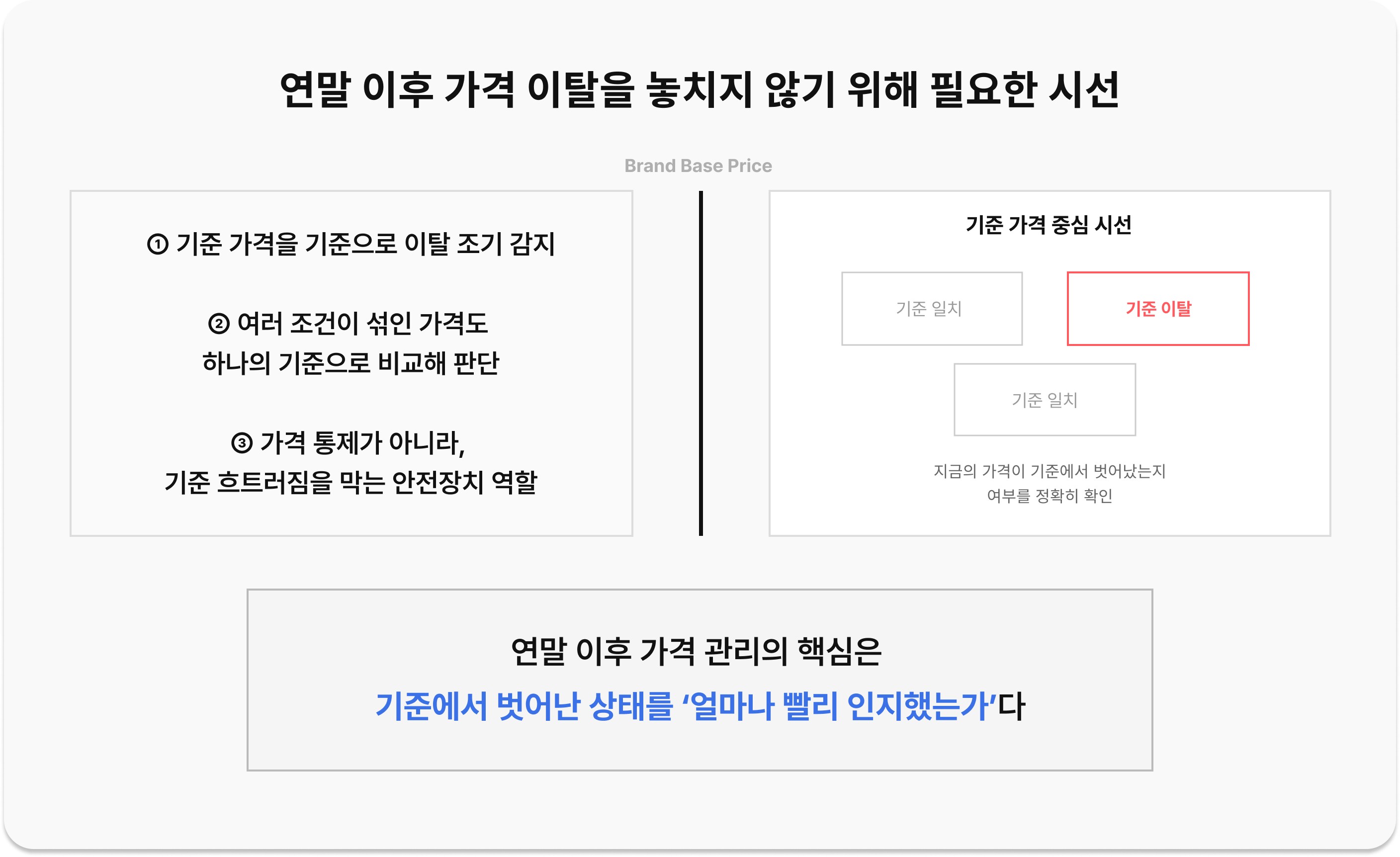
A perspective is needed that centers on the baseline price to quickly identify 'deviations' and notice the 'stage before the problem grows'
At this juncture, Reatrichs provides a structure to quickly compare and early recognize where and how the currently exposed market price is deviating, centered on the baseline price set by the brand.
At times when conditions are complexly entangled like after the year-end, tracing "why this price looks this way" one by one takes a lot of time. Reatrichs shortens this process, helping to quickly identify sellers and channels where deviations from the baseline price remain. Whatever the condition, it is a method that allows checking first where the price deviating from the baseline remains as a result. Thanks to this, brands can secure a point to intervene before the baseline is blurred, rather than a situation of explaining the reasons after the price has already solidified.
Right at this point, another characteristic of post-year-end price deviation is revealed.
The biggest problem with post-year-end price deviation is that it is left untouched until it becomes conspicuously wrong. After a price is exposed to the market for a long time and becomes the premise of internal judgment, reverting that price requires more burden and explanation.
The point where Reatrichs intervenes is much earlier than this. It is the stage of recognizing deviations that still remain in a 'cleanable state' before the price completely solidifies.
By quickly checking in which seller, on which channel, and in what form a price different from the baseline remains, you secure time to respond before the price spreads as a market standard. It plays the role of preventing a price that temporarily remained from growing into a big problem.
Prices mixed with various conditions must be viewed again under 'one standard'
The reason post-year-end price deviation is difficult to manage is because price does not exist as a single number. As multiple conditions operate simultaneously, such as coupons, auto-discounts, special exhibition exposure, and option/bundle configurations, even the same product appears with different prices. In this situation, it is not easy to judge "whether this price right now is normal or a deviation." This is because each condition must be checked individually, and it is also hard to immediately know how far it extends as a promotion.
Rather than interpreting these complex conditions individually, Reatrichs provides a perspective to compare currently exposed prices all at once, centered on the baseline price set by the brand. Whatever the condition, its role is to make it possible to check first where the price deviating from the baseline remains as a result.
By looking again centered on the baseline this way, you can first judge "whether this price right now deviates from the baseline or not" before explaining "why it looks like this."
Not a tool to 'control' prices, but a safety device to guard the recovery interval is needed
The position of Reatrichs in post-year-end price management is slightly different. Rather than a control tool to forcibly match prices, Reatrichs is closer to a safety device to early detect the most easily missed price deviations after the year-end.
In a recovery interval where prices must return to the baseline, it can be seen as a perspective to notice abnormal signals before the baseline is completely blurred. This is because the core of post-year-end price management ultimately lies not in "how strictly the price was managed," but in how quickly the state deviating from the baseline was recognized.
Post-year-end price management is not a 'choice' but a basic checkup for the next year
Year-end promotions definitely end. Coupons are taken down, special exhibitions end, and from an internal standard, a time comes when we can say "it's over now."
However, the prices remaining in the market do not disappear immediately at that moment. How the conditions applied during the year-end remained can act as a baseline naturally referenced when discussing prices throughout the following year. Therefore, rather than treating the year-end price as an 'already ended event,' it is closer to the 'starting line of price judgment for the next year.'
A price deviation neglected at the beginning of the year may not look like a big problem right away. It might look like a problem of some sellers, or feel like a temporarily remaining trace. However, the moment that price is repeatedly exposed to the market and becomes the premise of internal judgment, the price deviation begins to operate not as an exception but as a factor shaking the baseline.
Therefore, price management after the year-end is not a matter of agonizing over whether to do more discounts or not, but is closer to checking whether the price that should have already ended remains like a baseline. If this check is missed, all subsequent price adjustments and promotion planning will be carried out on top of a shaken baseline, carrying more explanation and burden. Rather than an optional management item, post-year-end price management is closer to the most basic checkup stage to reduce unnecessary costs and confusion that may arise in the next year's price operation.
This is also where the role of Reatrichs lies in the recovery interval after the year-end. Helping to quickly notice states deviating from the baseline, rather than controlling prices. Depending on whether that perspective is secured, the price remaining at the year-end could end as a temporary trace, or it could become the baseline dragging along the entire year.