Industry Cases
Counterfeit
Counterfeits threatening the health of pets—is our brand safe?

💡 In this article, you can find the following information.
Similar packaging and unauthorized sellers: consumers believe they are genuine
Too cheap pet food, is it really genuine?
Similar products: consumer damage accumulates on the brand
Two eyes to filter out counterfeit pet food: images and seller history
Protecting genuine products is protecting pets
Similar Packaging and Unauthorized Sellers: Consumers Believe They Are Genuine
An increasing number of pet owners treat their pets as family members rather than simple animals. This shift has led to pet supplies such as food, treats, and toys being perceived not as mere consumer goods, but as essentials directly linked to health and safety. This is why they meticulously check quality, ingredients, and manufacturing history when choosing even a single bag of food or a toy. However, in the online market, counterfeit and similar products that undermine this caution still exist.
The counterfeit Royal Canin cat food case on the Chinese e-commerce platform Taobao is a prime example. According to the court ruling, the defendant 'Yao' produced and sold fake cat food, where the packaging, QR codes, and authentication codes were identical to the genuine product, but the contents contained different ingredients. Mars Inc., which owns Royal Canin, and Taobao submitted the suspected products for laboratory testing, confirming they were counterfeit. Taobao cooperated with the investigation by submitting evidence to the police, and the court ruled that Yao defamed Taobao's reputation, ordering him to pay 120,000 yuan (approximately 180 million KRW) in damages within 10 days and to publish an apology in major print and internet media for one week.
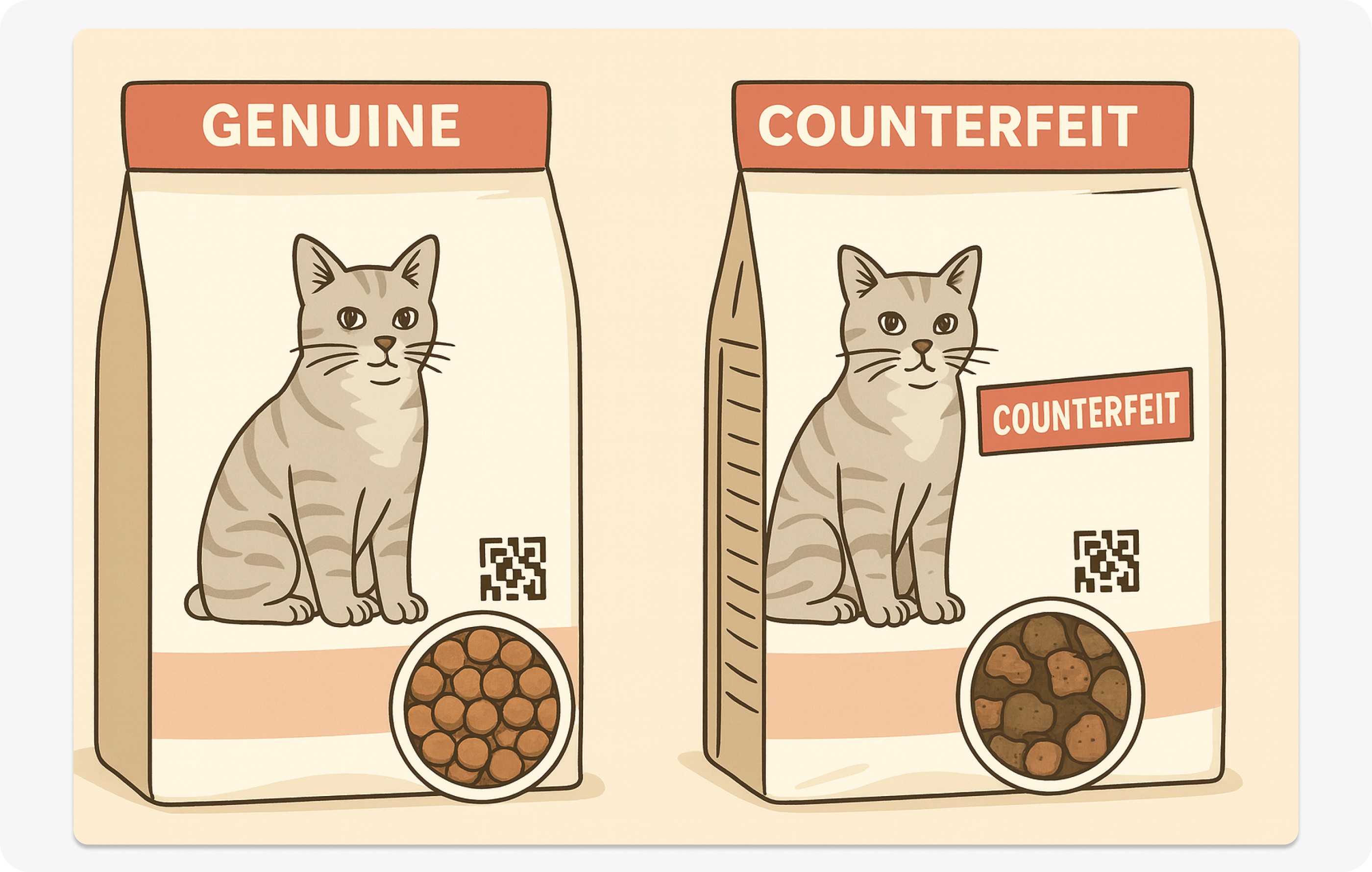
Because brand names and logos are exposed directly online while sales and reviews accumulate, consumers easily perceive quality issues as 'brand issues.' In fact, in the Taobao Royal Canin counterfeit food case, the court ruled that counterfeit sales damaged the platform's reputation and ordered compensation. This is a legally confirmed case showing that counterfeit distribution can be directly linked to a brand's reputation and trust.
As such, the problem of counterfeit and similar pet products goes beyond mere appearance imitation. Consumers purchase them with peace of mind based on the brand name and packaging, but in reality, they may contain ingredients that have not undergone safety verification. The problem is that these products are often sold at 'unbelievably low prices.' The price clouds the consumer's judgment, creating a sense of relief that 'it should be fine' even before they consider whether it is genuine. Ultimately, to understand the dangers of counterfeits and similar products, we need to examine how the signal of price misleads consumers first.
Is Extremely Cheap Pet Food Really Genuine?
When products of the same brand are sold online at prices excessively lower than the average market rate, various risks lurk behind them. While it could be a legitimate inventory clearance or promotion, there is a high possibility of counterfeit/similar product distribution, or an 'unofficial seller' who has not gone through official distribution channels. Particularly for items directly related to safety, like pet supplies, price becomes a major signal that causes consumer confusion.
Consumer Reports, a US consumer advocacy media outlet, warned in April 2025 that some pet supplies sold online were trading at prices 40 to 60% lower than market prices. According to the investigation, many of these were selling points disguised as international direct purchases rather than official distributors, or fraudulent sites inducing payment with non-existent inventory as bait. Among the damage cases, there were instances where pet food was ordered but completely different products were delivered, or delivery was not made at all after payment.
Melanie McGovern, a spokesperson for the BBB (Better Business Bureau), warned, "If it's out of stock elsewhere or the price is higher, but it's sold very cheaply on a website you've never heard of, it's highly likely to be a scam or a counterfeit product." This statement shows that price is not just a simple discount signal, but can be a tool used to deceive consumers.
Particularly, when similar packaging products are sold at low prices to match the timing when genuine products are out of stock, consumers are highly likely to purchase those products due to limited options. However, in such cases, the ingredients, manufacturing environment, and distribution history of the product can rarely be verified. McGovern also warned, "If the pet supplies are not actually the product you thought, there is a risk of ingesting toxic ingredients or harming their health," recommending that purchases always be made from trusted sellers or channels directly operated by the manufacturer.
In the pet supplies market, such 'low price + inventory securing' strategies are repeatedly leading to cases that break down consumers' vigilance, resulting in damage and confusion. The reason prices are formed excessively low is not simply 'to sell cheaply.' Low prices also serve as a psychological device that causes consumers to let their guard down. Particularly when exposed through social media advertisements or price comparison sites, consumers focus on the 'price merit' first rather than whether the selling point is an official channel. The problem is that when customers attracted this way suffer damage, the brand's trust and reputation are damaged together, as described in the previous section.
Similar Products: Consumer Damage Accumulates on the Brand
When counterfeit and similar products enter the market, the victims are not just the consumers who bought the wrong item. In the long run, the brand itself bears the damage. Especially in the pet supplies field, where damage is deeply connected to the emotions and trust of consumers, it is difficult to recover trust once it is broken.
While the global pet supplies market has grown to a multi-billion dollar scale, the possibility of unverified, unsafe products being distributed has also increased. Canada's Champion Pet Foods officially announced that counterfeit versions of its flagship brand 'Orijen' were being sold in overseas online markets, urging consumers to be cautious. In particular, as low-priced counterfeit sellers leverage price competitiveness, cases of consumers purchasing without verifying whether the seller has authorized distribution rights are increasing.
This environment easily leads to actual consumer damage. PetSmart, a major US pet retailer, received over 1,000 consumer reports of dog deaths after consuming specific jerky treats. Following an FDA investigation, the agency warned that the product category could pose risks to pet health, and some products were recalled. Since this incident, distrust regarding the overall product type has spread among consumers, and related brand products began to be mentioned as targets of avoidance in online communities and reviews.
The issue with counterfeit and similar product damage is that it is difficult for consumers to accurately distinguish the cause. If the packaging and appearance are similar to the genuine product, the experience of damage immediately leads to a negative perception of the brand. For example, in the previously mentioned Royal Canin counterfeit food case, many victims thought, "I bought the genuine product, but a problem occurred," which led to a decline in the brand's reputation.
In fact, in an independent survey of UK consumers commissioned by Corsearch, 76% of respondents stated they would be less willing to buy from a brand if that brand were associated with counterfeit goods. 44% of consumers responded that brand reputation is 'very important' in online shopping, while only 3% responded that it is not important. This shows that brand reputation has an absolute influence on consumer purchasing decisions.
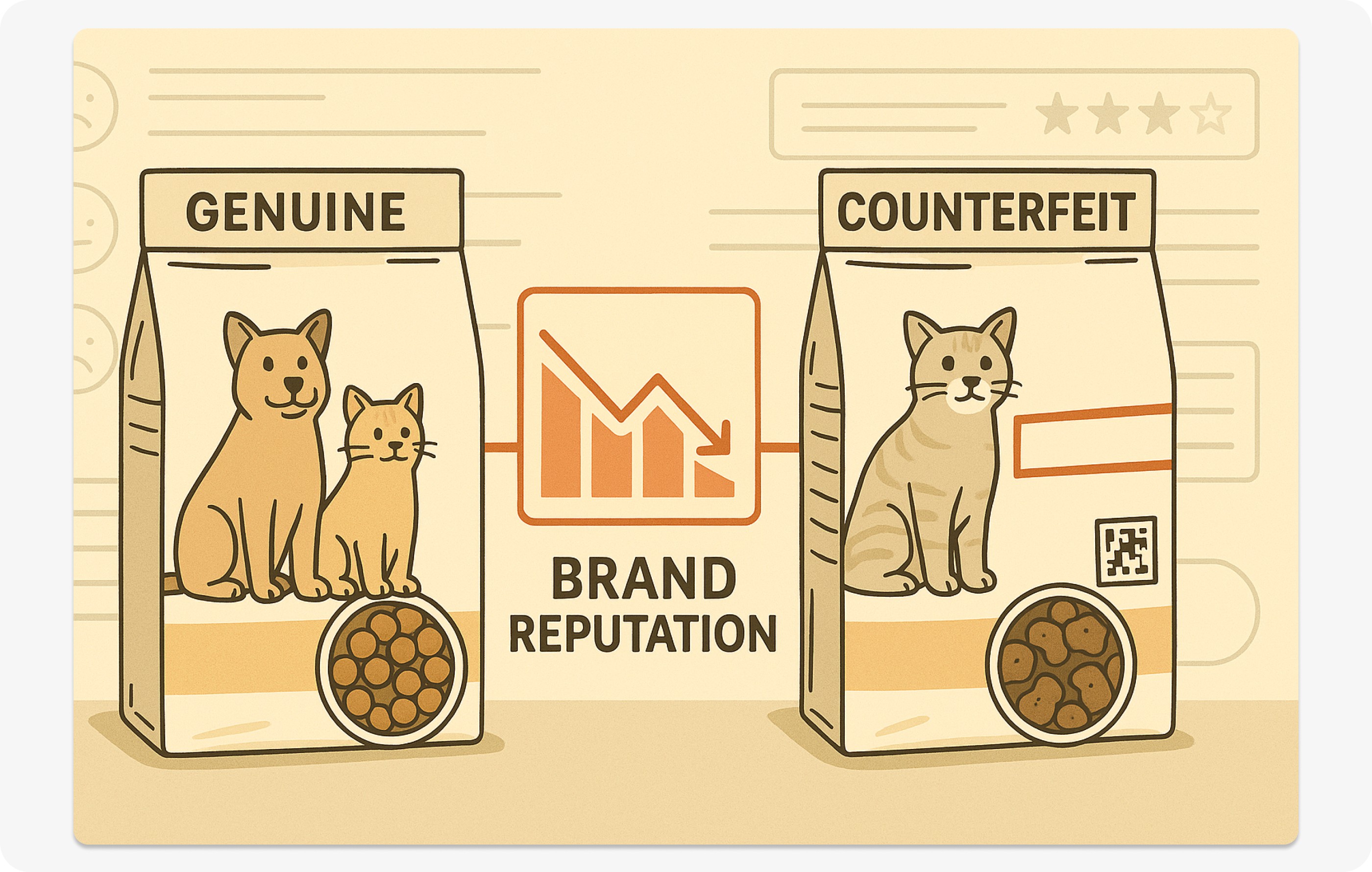
Association with counterfeits can lead to long-term revenue loss beyond simple image damage. According to the survey, 66% of consumers who unintentionally bought a counterfeit and were scammed stated they would never buy from that brand again. Furthermore, 34% stated that if they perceived a brand's products could be counterfeited on other online channels, they would be less likely to purchase even from the brand's official website. In other words, a single exposure to counterfeiting can shatter trust even in official sales channels.
According to Alibaba Group (Taobao's parent company), one counterfeit product sold on Taobao causes the loss of about five customers. For this reason, global e-commerce companies invest approximately 100 billion KRW annually to detect and eradicate counterfeit goods, and set up dedicated teams to crack down on counterfeits to restore brand reputation. Similarly in the pet supplies market, consumer groups constantly warn against the spread of counterfeit and fraudulent goods, and if safety issues arise, negative reviews spread online along with the brand name, posing a high risk of accelerating the decline in trust.
This decline in trust goes beyond short-term revenue reduction and leads to the loss of long-term brand equity. When a vicious cycle of falling repurchase rates and decreasing influx of new customers begins, the effect of increasing marketing expenses becomes negligible. Ultimately, to reduce damage, a system is needed to detect and block counterfeit and similar products at an early stage, in addition to responding after the damage has occurred.
Two Eyes to Filter Out Counterfeit Pet Food: Images and Seller History
Although pet food and treats are clearly distinguished by brand-specific packaging colors, logos, and ingredient labeling, it is difficult to tell the difference through online photos alone. Particularly, because pet owners often search for a product name and purchase based only on price and images, they can easily be deceived if counterfeit sellers steal genuine photos.
For example, some counterfeit pet food sellers use images of large-capacity packaging products registered on official malls as they are, but actually repackage and sell small-capacity products that are near their expiration date. Consumers believe it is genuine after seeing the identical packaging image on the screen, but when opened, the packaging material and sealing state are different, and parts of the ingredient table are often covered. These differences can be caught through AI-based image similarity analysis. This method identifies elements different from the genuine image early by determining package print smudging, subtle misalignment of logo placement, and repetition of background patterns.

Seller history tracking is particularly useful in the pet supplies market. Since food and treat sellers can easily enter online markets without brand approval, counterfeit sellers often operate for a long time by changing accounts. For example, if account A sells 'lowest price pet food' and gets reported, they close the account and resume with the identical product, photo, and price pattern under account B. Tracking sales history allows for identifying these repetitive patterns to quickly prevent re-emergence.
As such, image theft prevention and seller history tracking in the pet supplies market are not just simple counterfeit detection technologies, but the first line of defense to prevent consumer damage and protect genuine pet food. Combining this with 'lowest price monitoring' increases the response effect even further. This is because products sold at excessively low prices compared to genuine ones can be detected in real-time, allowing for priority inspection of the respective seller and product. Particularly, as seen in the previous cases, 'cheap price' is a strong signal of counterfeit and fraudulent goods, so operating price monitoring along with image and history analysis can block the spread of counterfeits much faster.
Protecting Genuine Products Is Protecting Pets
Pet food and supplies are not just consumer goods, but products directly linked to the trust of pet owners. The cases examined above show that counterfeit and similar products can damage overall brand trust in the long run, going beyond one-off damages. When products with excessively low prices or appearances similar to genuine ones appear online, consumers easily mistake them for genuine products, and when problems arise, the arrow of responsibility points to the brand.
To reduce this vicious cycle, proactive detection is more important than reactive response. Technical means such as AI image similarity analysis, price fluctuation monitoring, and seller history tracking are already being utilized in various industries and can be fully applied to the pet supplies market. Through this, risk signals can be discovered before consumers purchase products, and problematic products can be blocked at the exposure stage.
Ultimately, a brand's goal is not simply to find counterfeits, but to ensure that consumers have the confidence that "I can trust and buy from this brand." Professionals must not forget that even a single quality issue can become a lifetime of anxiety and worry for a pet owner. Trust is difficult to restore once broken, but it can be protected through constant monitoring and transparent communication. Now is the time to contemplate strategies to protect both brands and consumers from counterfeits and similar products.