Official Seller Management
Price Management
Internal Cracks Undermining Brand Strategy: Price Deviations by Authorized Sellers and Countermeasures

💡 In this article, you can find the following information.
Reasons why official sellers deviate from the price
The structural damage caused to brands by official sellers' price deviations
Why it is difficult to control official sellers' price deviations
Strategic responses possible with a Minimum Advertised Price (MAP) policy
MAP policy alone is not enough: Why price detection automation is necessary
Strategies you can start right now to respond to official sellers
Conclusion: A relationship without standards cannot be a strategy
😩 “Seller A is exposing prices 15% lower than the advertised standard price again. How should we respond?"
This is a story shared by a cosmetics brand manager last month. This brand experienced standard price violations in as many as 8 out of 12 official sellers who had signed official contracts, and as a result, the brand's overall online sales prices fell by an average of 12% compared to the originally set price.
According to a Harvard Business Review study, about 20% of official sellers violate the Minimum Advertised Price (MAP). What is more serious is that brands that experience price deviations face complaints when recruiting new sellers, such as "Why do only we have to keep the standard price when other places sell at lower prices?"
A marketing manager of a fashion brand lamented, "Every time I find a price deviation, I contact the seller, but they often act confidently, saying 'everyone else does it too.' Since the legal enforcement measures are not clear, practical response is difficult."
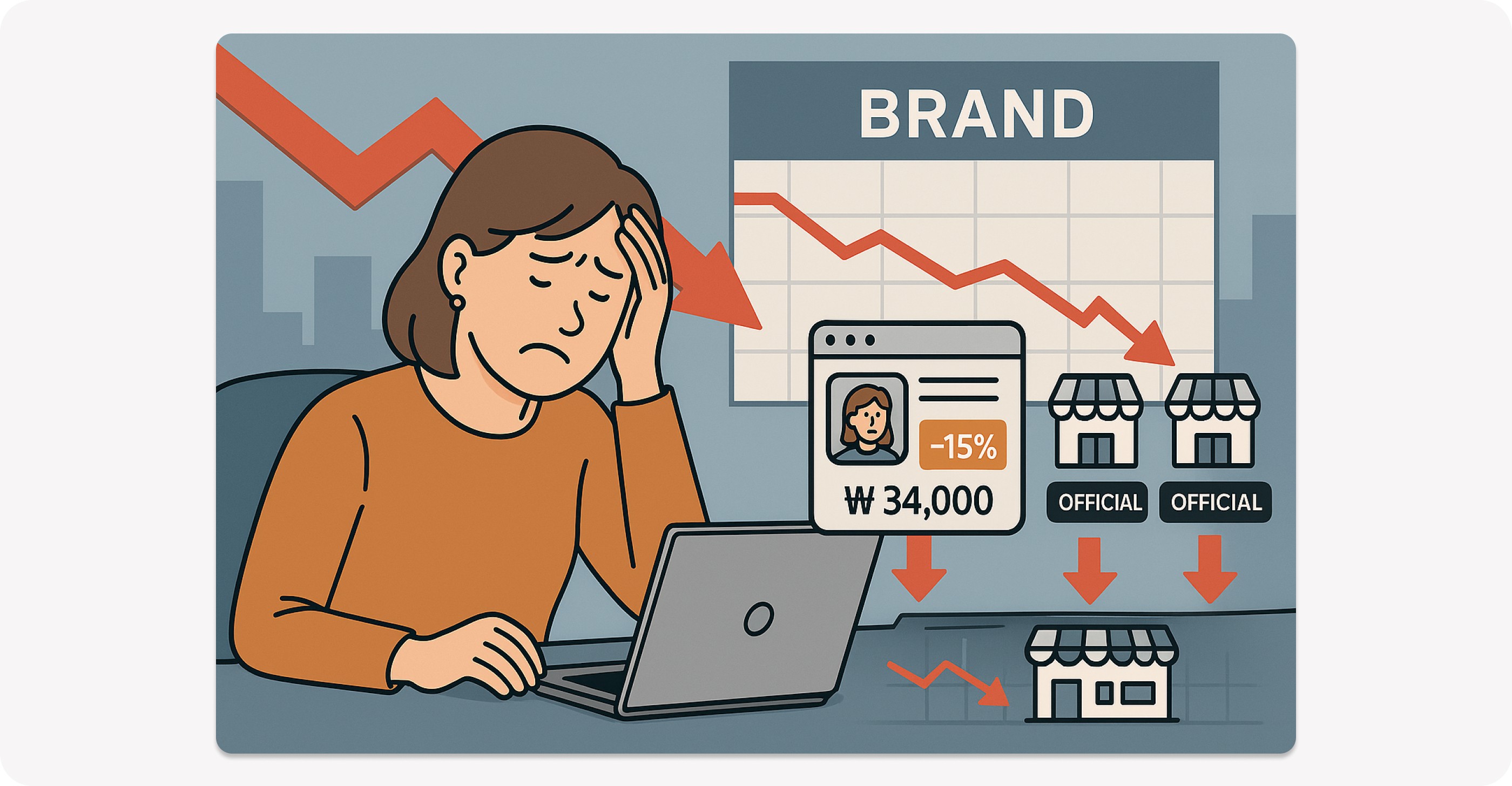
The problem is that even though they are sellers with official contracts, they frequently ignore the brand's advertised standard price and expose products on their own mall or open markets at lower prices. This phenomenon goes beyond a simple breach of contract and leads to structural problems that fundamentally shake the brand's pricing strategy and distribution order.
In this content, we will specifically analyze why official sellers deviate from prices, what structural damage brands suffer as a result, and organize step-by-step response strategies that practitioners can execute directly in the field.
Why Official Sellers Deviate from Prices
Even though official sellers have official distribution contracts with brands, cases of exposing products at prices lower than the standard price often occur. This price deviation phenomenon is not a simple act of deviance, but from the seller's perspective, it is also a strategic choice for survival and securing sales. Below, we will look at why official sellers deviate from the standard price and the structural causes behind it.
(1) Price Exposure Competition to Secure Traffic
One of the reasons official sellers sell products at lower prices than their own malls is the competition to secure incoming traffic. Many sellers use a strategy of lowering prices for top search exposure, which neutralizes brand standard prices and causes consumer confusion. Practitioners continuously consume resources by handling consumer complaints about price differences and repeating communication with sellers.
(2) Defensive Discounts to Restrain Competitor Sellers
Competition among official sellers distributing the same brand's products is another cause. Once a seller deviates from the standard price first, other sellers have no choice but to follow suit to protect their sales. This chain reaction neutralizes the price strategy set by the brand and leads to price-cut competition. In this process, the brand may even lose trust among distribution partners.
(3) Pressure on Individual Seller Advertising Performance
Some official sellers run their own advertising campaigns and voluntarily lower prices to meet performance indicators (click-through rate, conversion rate, etc.). This price-cutting strategy, carried out without the brand's permission, goes beyond a single seller's issue and becomes a factor that can affect the brand's overall pricing strategy. Especially in a structure where a seller's advertising performance depends on price, conflicts between the brand and the seller can intensify.

The Structural Damage of Official Sellers' Price Deviation on Brands
The price deviation of official sellers does not stop at individual seller issues, but has a significant impact on the overall brand's price policy, distribution strategy, and furthermore, brand trust and customer expectations. This problem is not a temporary phenomenon, but acts as a structural risk factor that shakes the brand strategy itself as it repeats.
Distortion of Platform Exposure Structure
Major domestic open markets and price comparison platforms basically adopt a 'lowest price priority exposure' algorithm. In this structure, if even one seller exposes a product below the standard price, that price affects search priority and is recognized as the consumer's standard price. As a result, sellers who maintained regular prices experience relative reduction in exposure, decrease in traffic, suspension of advertising, and additional damage such as inflow of complaints.
Decline in Brand Trust and Distortion of Consumer Expectations
If different prices are exposed for each distribution channel, consumers will perceive that the brand does not have consistent standards. This leads to a decline in trust in the brand, and sellers who followed the regular price policy also give up on the standard price. Consequently, the brand's pricing strategy is weakened, and instability can grow not only in relationships with sellers but also in terms of consumer loyalty and distribution order management.
Why It Is Difficult to Control Official Sellers' Price Deviation
There are clear reasons why many brands fail to practically control price deviations despite their repetition. The core lies in the lack of legal enforcement power and the lack of response measures in practice.
Blind Spots in the Contract Structure
According to the standard distribution contract form proposed by the Korea Fair Trade Mediation Agency, price-related clauses often exist only in the form of 'recommended retail price.' This has no legal enforcement power, and in most cases, measures of sanction upon actual price violations are not specified in the contract. As a result, it is difficult to impose sanctions beyond simple recommendations or verbal warnings upon price violations. In addition, in many contracts, the penalty clause for price violation itself is omitted, so practitioners do not secure a justification to respond strongly despite repeated violations. This can send a signal that sellers can continue their business without any disadvantage even if they ignore the brand's pricing policy, which can be a mid- to long-term burden in maintaining distribution order.
Absence of Minimum Advertised Price (MAP) Policy
The Minimum Advertised Price (MAP) policy is a system that allows brands to specify the minimum allowable advertising price in advance and impose step-by-step sanctions if it is violated. Although it is a common system in the US and Europe, its legal basis is unclear in Korea or its introduction is insufficient due to distribution practices. For this reason, even if practitioners set standard prices, if sellers protest saying "there is no legal issue," the response logic weakens, making practical response to repeated violations difficult. In particular, without a MAP policy, it is impossible to sanction sellers who bypass prices by distinguishing advertising and sales prices to lower them indirectly, which becomes another channel to neutralize brand strategies. In a structure without MAP, sellers who maintain regular prices may be relatively disadvantaged, and it may become difficult for the brand's pricing strategy to be consistently maintained within the market.
Strategic Responses Possible with a Minimum Advertised Price (MAP) Policy
Establishment of Standards and Warning Systems
By introducing a Minimum Advertised Price (MAP) policy, brands can clearly set the lowest allowed advertising price and include it in contract clauses. Step-by-step sanctions become possible in case of price violations, and internal practitioners also secure standards for response. (e.g., verbal warning for 1st violation, official written warning for 2nd violation, holding off on contract renewal or suspension of supply for 3rd violation, etc.)
Global Enterprise MAP Operation Case
BluBird Industries (RMX Industries) is a global company that manufactures and distributes premium hoses and industrial equipment in North and South American markets. BluBird enforces a clear and strict MAP policy to protect fairness in the distribution market and brand value.
BluBird's MAP policy strictly regulates that resellers cannot set advertising and sales prices below specific minimum standards. In particular, BluBird takes immediate quantitative sanctions after warnings upon policy violations, which include suspension of supply, withdrawal of negotiated prices, transaction registration, and restriction of advertising budgets.
The effects of this MAP policy are as follows:
Establishment of Distribution Order: Creates a fair competitive environment in the market through pricing policies and prevents price-cut competition among resellers.
Protection of Brand Value: Prevents the value and image of premium products from being diluted due to low-price sales, thereby maintaining brand trust and reputation.
Strengthening Reseller Responsibility: Leads resellers to voluntarily comply with brand policies through clear price standards, and drives practical behavior change through immediate and effective sanctions upon policy violations.
Core Conditions of Minimum Advertised Price Policy
For a MAP policy to work practically, several core conditions are required.
First, it must be clearly distinguished that the Minimum Advertised Price (MAP) policy applies only to prices displayed in advertisements. It is separate from the final selling price (SRP) actually paid by consumers, and effective enforcement is possible only when bypass methods such as coupons, set discounts, and shopping cart promotions are included in the control target.
Second, when establishing a policy, it must include detailed practical clauses such as target products (SKU), distribution channels (online/offline), advertising formats (e.g., prohibition of strikethrough displays, restriction of price comparison phrases, etc.), and step-by-step response systems upon violation, and must be designed as a practically executable policy rather than a simple recommended standard.
Third, for practical measures against Minimum Advertised Price violations, brands must strengthen consistent enforcement and violation record management. Systematically managing the history of repeat violator sellers makes more strategic operations possible, such as adjusting supply conditions or excluding advertising collaborations in the future.
Fourth, legally, directly fixing sales prices instead of advertising, or operating in the form of collusion among sellers may violate the Fair Trade Act, so it is desirable to clarify that it is an advertising price standard and design the policy based on legal advice.
Lastly, introducing a structure that provides incentives such as joint marketing benefits, advertising cost support, and preferential negotiation rights to policy-compliant sellers, and allows exceptions only for regular promotions (e.g., Black Friday) can increase sellers' incentives to participate.

MAP Policy Alone is Not Enough: Why Price Detection Automation is Needed
Although the MAP policy is effective in presenting clear standards, in reality, it is difficult to grasp in real-time who violated these standards, when, and how. In particular, prices on online platforms can change on an hourly basis, and there are many cases where sellers bypass them through non-advertising areas (e.g., coupon-applied prices, set bundle discounts).
The method of manually checking the prices of dozens of sellers every day, leaving screenshots, and recording history not only places a heavy workload but also lacks accuracy.
Therefore, price detection automation solutions are needed. Automated systems collect price data from major open markets in real-time, determine whether standard prices have been violated, and provide notifications to managers. In addition, by accumulating violation histories, repeat sellers can be identified, and it can be linked to automatic warning email sending, securing practical 'policy execution power.'
These systems go beyond simple efficiency improvement and can be an executable control device that protects the brand's distribution order.
Official Seller Response, Strategies You Can Start Right Now
To control the price deviation of official sellers in the long term, a structural response system such as the introduction of a Minimum Advertised Price (MAP) policy, improvement of contract structures, and establishment of automated systems is essential. However, as preparing such systems requires time and resources, practitioners must arrange measures that can be executed immediately. Below are realistic response strategies that can be applied starting today.
(1) Preparing to Revise Contracts to Include Standard Prices
: It is important to explicitly include the 'lowest price allowed for advertising exposure' item in the contract phase with official sellers. Reflecting specific sanctions such as supply restrictions, suspension of advertising support, and holding off on contract renewal in the contract in case of violation is necessary to secure effectiveness. In the case of existing sellers, ways to retrospectively apply standard price clauses through supplementary agreements or additional written consent via email can be reviewed.
(2) Preparing Warning Email Templates
: It is necessary to prepare warning email templates in advance so that immediate warning measures can be taken against sellers who violate advertising price standards. Preparing step-by-step response phrases in the form of '1st verbal warning → 2nd official written warning → 3rd sanction notification' and preparing them in platform-specific versions tailored to various communication channels, such as Smart Store messages and store announcements as well as email, increases efficiency in repetitive responses.
Template Example – 2nd Written Warning Email:
Subject: [Official Guide] Warning regarding your company's price standard violation
This email is the second official warning regarding your violation of our brand's official pricing policy. As of MM/DD, a price below the advertised standard price was confirmed on [Sales Channel Name] operated by your company, which violates Article 8 (Minimum Advertised Price) of the contract concluded with us.
Please be advised that if this violation continues, disadvantages such as future supply restrictions and holding off on contract renewal may occur. Please reply after completing corrective actions within 3 business days.
Thank you. – Brand Distribution Management Team

(3) Manually Organizing the List of Repeat Violators
: Even without an automated system, it is very important to manually organize the history of repeat violators. Using Excel or Google Sheets to record seller names, violation dates, violation details, and whether response measures were taken in a table is useful as supporting data during contract renewal negotiations or for prioritizing marketing collaboration targets. In particular, tracking patterns of repeat violators allows differentiating warning intensity or supply strategies.
(4) Aligning Internal Policies and Sharing Communication
: It is important to share the brand's basic response principles and procedures regarding price standard violations in advance with related departments such as the marketing team, advertising team, and customer support team in addition to the distribution team. If messages between departments are inconsistent when responding to sellers, it can cause confusion, and pre-communication can establish the perception internally that 'the brand is managing advertised standard prices importantly.'
(5) Internalizing Initial Response Standards into Documents
: To respond with consistent standards even when practitioners change or handovers between departments occur, it is necessary to organize 'Guidelines for responding when price deviations occur' in writing. For example, documenting a flow such as "verbal warning on first violation, official email on second violation, review of supply restriction on third or more violations" reduces the response burden on practitioners and increases the likelihood of settling as an in-house policy.
Conclusion: Relationships Without Standards Cannot Be a Strategy
The price deviation of official sellers is not a simple exceptional case, but a structural problem combined with platform algorithms, competitive structures among sellers, and the absence of internal sanction systems. If this situation is left unattended, brand standard prices will be neutralized, and both consumer trust and distribution order will inevitably be shaken.
For a brand to practically protect its pricing strategy, a MAP policy, clear contract standards, and a real-time price detection system are absolutely necessary. In addition, practitioners must arrange measures that can be executed right now to respond to repetitive problems with consistent standards.
The relationship with official sellers is not a simple contract, but a partnership to realize brand strategy together. Relationships without standards will eventually collapse the brand's strategy itself, and re-establishing standards and principles starting from this very moment will be the starting point to protect the brand's distribution strategy.