Industry Cases
Counterfeit
Even the 'National Cream' with 85 million units sold was hit: how to protect brand trust from the threat of counterfeits
💡 In this article, you will find the following information.
"Could mine be fake too?" The crisis of the national cream that sold 85 million units
Counterfeit products of unknown ingredients: A fatal poison that ruins brand trust
The paradox of the genuine product verification guide: Responsibility shifted to consumers and sophisticated counterfeits
Why systems, not people, must monitor counterfeit goods
Conclusion: Proactive defense protects brand equity
"Could mine be fake too?" The crisis of the national cream that sold 85 million units
"Could the Madeca Cream I bought be a fake?" Dongkook Pharmaceutical's Centellian24 Madeca Cream, which is called Korea's 'national cream' with a cumulative sales volume of 85 million units, has recently faced an unexpected crisis. Last January, Dongkook Pharmaceutical posted an emergency notice through its website and official channels. It was confirmed that counterfeit products of its main flagship products, from 'The Madeca Cream', the face of the brand, to 'Mela Capture Ampoule Pro', were being openly distributed mainly in online open markets, and a consumer warning was issued.
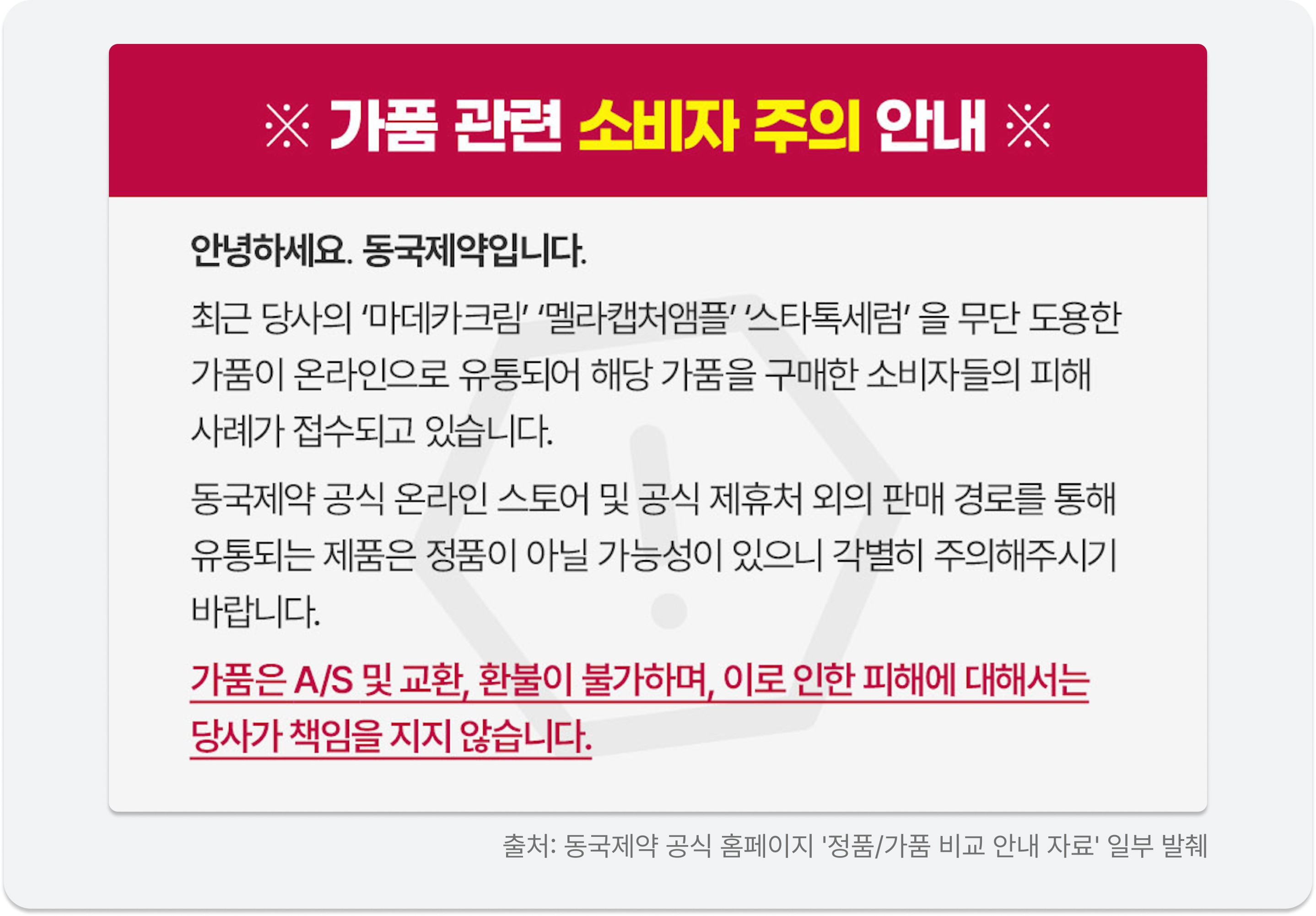
The shock this incident has dealt to the industry does not stop at the level of simple imitations of popular products. According to the data released by Dongkook Pharmaceutical, the confiscated counterfeits are in the form of ultra-precise fakes that are almost impossible to distinguish from genuine products with the naked eye, even down to the font of the package, the location of the logo, and subtle differences in color. This shows that counterfeiters are now going beyond simple imitation and elaborately replicating the visual assets that the brand has painstakingly built, as if they had the schematics. However, there is another, more fatal threat that the brand must guard against than these physical replications. It is the 'unidentified ingredients' hidden inside the shell of the genuine product.
Counterfeits with unknown ingredients, a fatal poison that destroys brand trust
The reason why 'ingredients', rather than appearance, are at the core of the threat lies in the unique nature of the beauty industry. Why is the issue of counterfeit goods in the beauty industry particularly fatal compared to other industries? It is because it directly touches and affects the consumer's 'body'. Even if the design is similar in fashion or home appliances, it may only result in functional inconvenience, but cosmetics applied to the skin are directly linked to safety issues.
The point that experts are most concerned about in this incident is also the serious side effects that could be caused by the uncertainty of the ingredients. In the end, the most fatal threat to a beauty brand starts from the 'ingredients', which are the essence of cosmetics. In general, correct ingredient information cannot be verified for counterfeit products, and using them directly on the skin poses a high risk of causing unexpected skin diseases or side effects. The brand trust built over years, along with sales data of 85 million units based on pharmaceutical engineering, is at risk of being damaged in an instant by fake products containing unidentified ingredients. While the brand's core value is to safely deliver highly concentrated active ingredients based on pharmaceutical technology, counterfeits are disrupting the market by completely ignoring that essence and replicating only the outer shell.
Unlike genuine products, these counterfeits do not go through rigorous clinical trials or quality control systems. They are often manufactured with unverified raw materials in facilities where a hygienic environment is not guaranteed. In fact, looking at analysis cases of counterfeit cosmetics, cases are frequently reported where safety-unverified heavy metals or banned ingredients are included to lower manufacturing costs, causing skin inflammation and permanent damage. Products with unknown ingredients have now become a frightening risk that directly threatens consumer safety, going beyond mere trademark infringement.
Such physical damage ultimately leads to a strong rejection of trust in the brand, which in turn causes a rapid rise in brand churn rate. Especially since pharmaceutical-based brands are required by consumers to meet much higher safety standards, even a few cases of side effects from counterfeits can rapidly damage the brand equity built over decades. Even actual research data shows that brands experiencing counterfeit issues see a sharp decline in customer repurchase intent; we must take heavily the fact that the churn rate is much higher than that of general service dissatisfaction cases. Several reports confirm that counterfeit cosmetics cause consumer dissatisfaction and side-effect experiences, which negatively affect brand trust and can lead to a decline in repurchase intent.
The paradox of the authenticity guide: Responsibility shifted to consumers and sophisticated counterfeits
Dongkook Pharmaceutical also took active countermeasures to prevent the spread of consumer damage by disclosing detailed 'genuine/counterfeit comparison guide materials' for each product on its official website. It precisely contrasted and showed subtle external differences in main items such as Madeca Cream and Mela Capture Ampoule at a professional level.
For example, in the case of cream products, the differences in the ejection structure inside the cap and the finishing form of the outlet were specified,
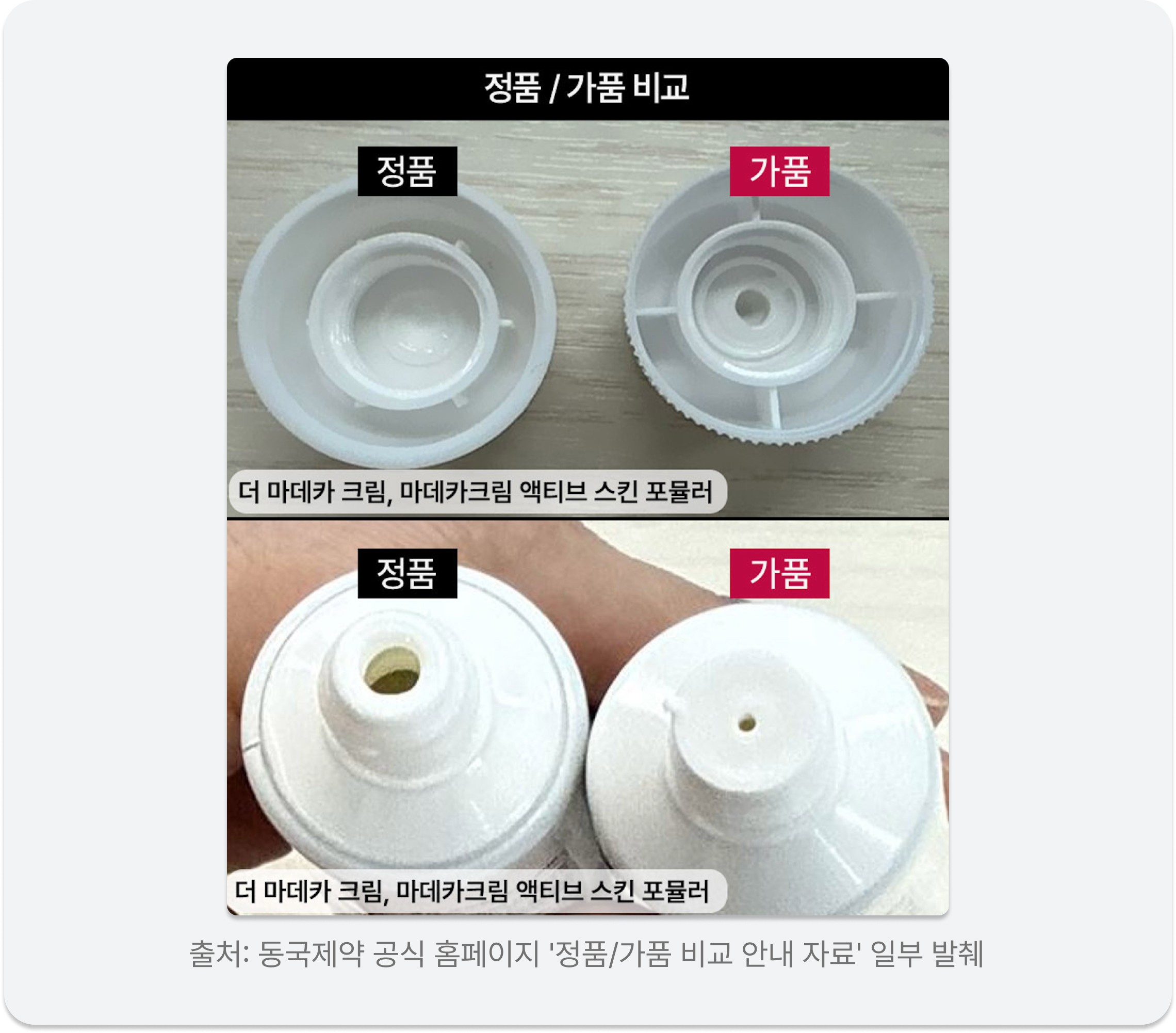
and for ampoule products, the difference in the matte/glossy texture of the dropper cap and the disparity in the text font and serial number marking format engraved on the back of the container were presented as criteria for identification.
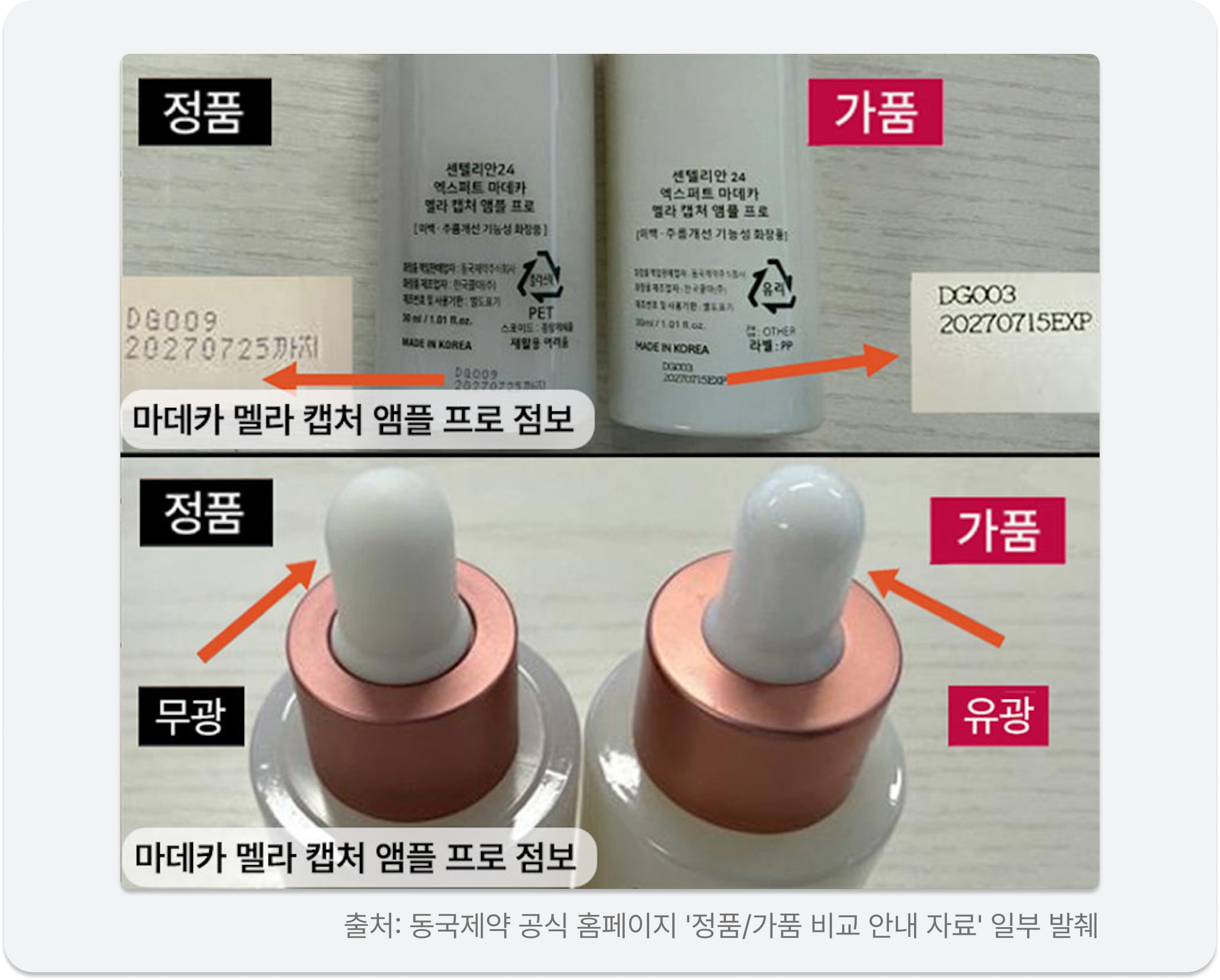
Furthermore, for serum products, a guideline reflecting professional insight was provided, using even the curvature of the bottom of the container and the sophistication of the printed text as comparison points. This shows Dongkook Pharmaceutical's efforts to protect brand assets and provide consumers with a practical tool for identification.
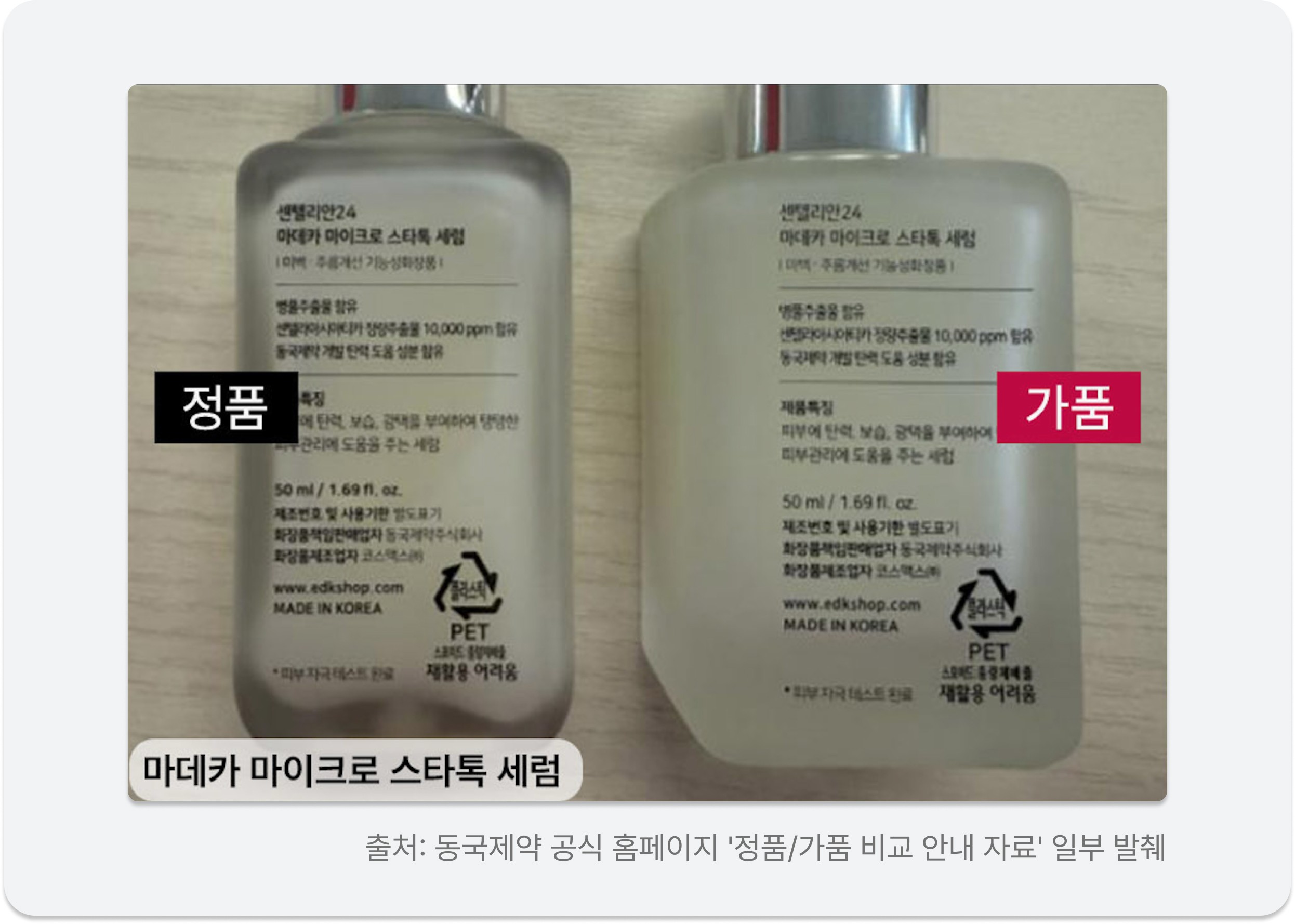
However, this method of information disclosure has a structural limitation in that it relies on post-facto awareness—'fixing things after a problem erupts'—rather than fundamentally blocking counterfeit distribution. The most concerning point is that the precise identification points disclosed by the brand can paradoxically be used by counterfeiters as a 'guide to sophisticated counterfeiting'. If counterfeiters analyze the announced identification criteria in real-time and immediately correct the pointed-out cap internal structure or back engraving font in the next production batch, the surveillance network created with much effort is neutralized in an instant. The method for distinguishing genuine/counterfeit products made to protect consumers ironically becomes the optimal 'guideline' that improves the quality of the fakes.
Also, due to the nature of online shopping, consumers cannot verify these physical differences until they receive the product. How can we prevent black sellers beforehand, who upload proper photos of genuine products and certification marks on the product detail page, but send fakes in the actual delivery? It is a structure where you have no choice but to be scammed, no matter how well you know the distinction, until you open the product and check the inside of the cap. Simply asking consumers to "check and purchase more carefully" has clear limitations.
Realistically, not all consumers can hold a magnifying glass and compare font thickness or engraving depth every time they receive a product. In the end, the approach of leaving the responsibility of identification solely to individual consumer attention is not enough to keep up with the increasingly intelligent counterfeiting methods and the enormous speed of distribution.
Most of all, the most dangerous point from the brand's perspective is that the responsibility for remedy due to counterfeits is virtually being shifted to the consumer. As specified in Dongkook Pharmaceutical's notice, counterfeits are absolutely ineligible for A/S, exchanges, or refunds, and the brand does not bear legal responsibility for any damages such as skin side effects caused by them. Responses like "there is nothing we can do because it was purchased from an unofficial distributor" may avoid immediate legal risks, but in practice, they lead to fundamentally damaging the customer trust asset that the brand has built over a long period.
Ultimately, the negative experience of consumers left in a blind spot without protection shifts to critical public opinion against the brand itself, rather than the counterfeiters. In the long run, this destroys brand loyalty and labels the brand as having "no after-sales care," becoming a fatal risk that weakens the brand's market control.
Therefore, we must now move beyond whack-a-mole responses, and an intelligent system that reads the abnormal activity patterns of sellers in advance and fundamentally blocks distribution routes must be backed up. Protecting brand trust is no longer in the realm of consumer 'insight' but is moving to the realm of 'preemptive technology' based on data.
Why systems, not people, must monitor counterfeits
24-hour surveillance, how to 'preemptively block' counterfeit distribution
As seen in the case of Dongkook Pharmaceutical, a systematic approach beyond individual crackdowns is essential to respond to intelligent counterfeit distribution networks. The method where humans manually type in search boxes cannot keep up with the speed of flooding counterfeits. While we are asleep, counterfeits are being sold, and clever sellers even grasp the brand's crackdown patterns to exploit loopholes in the surveillance network. Reatrics monitors on your behalf 24 hours a day across numerous shopping malls, conducting a complete census of all distribution channels to capture in real-time even the blind spots that brand managers are likely to miss.
Reatrics does not suspect counterfeits based simply on low prices. It tracks the data traces left by counterfeiters, such as their unique habits when registering products, image variation patterns, and abnormal distribution channels. It is especially excellent at catching 'trickster' sellers who try to avoid platform detection by subtly changing the thumbnail background color or blurring the area around the logo. Through AI-based image similarity analysis, it naturally finds the link of the main distributor who hides behind multiple fake accounts and recycles the same original image.
However, even if you catch the tail of a counterfeit like this, the 'punishment' process of deleting the actual sales post is another problem. This is exactly the moment when field practitioners feel most frustrated—when a platform report is rejected because "infringement is certain but evidence is insufficient." In this process, Reatrics translates the practitioner's 'intuition' into 'objective data language' that the platform can immediately accept.
The core is to provide a combination of 'Similarity Score', which converts image matching into a value between 0 and 1, and 'Heatmap', which shows which points are different from the genuine product through color distribution. For example, by presenting quantitative evidence such as "similarity score 0.94, heatmap analysis results show the product body is identical but only the background was modified," it blocks the subjective intervention of the platform reviewer and boosts the report approval rate.

Furthermore, Reatrics bundles price fluctuation trends, image comparison results, and the seller's past violation history to generate a single 'evidence package report'. It does not stop at a temporary fix like deleting a single sales post, but helps to request strong sanctions from the platform based on the collected data or to use it as basic data for establishing future brand policies. It overcomes the practical limitation of "insufficient time to organize evidence" and completes a powerful brand protection system that inflicts a real blow on counterfeiters through structured data.
Conclusion: Preemptive defense protects brand asset value
As seen in the previous case of Dongkook Pharmaceutical, the reality is that even large enterprises with solid distribution networks are not free from the threat of intelligent counterfeit distribution. Post-responses, such as warning consumers after an issue has occurred, may reduce some immediate damage, but recovering the collapsed price order and damaged customer trust consumes greater resources that overwhelm the cost of introducing a system.
Now, brand protection must be recognized as an essential business investment to defend the company's core asset value, going beyond simple crackdown work. An intelligent constant monitoring system like Reatrics operates as a preemptive defense mechanism that detects and responds to subtle signs before the external risk of counterfeiting spreads. What a brand truly needs is not the ability to clean up after an accident, but data-based 'preemptive deterrence' that prevents counterfeit sellers from setting foot in the market in the first place.
In the end, the most efficient crisis management is to technically block problems before they become visible. When the brand directly takes the initiative in responding to counterfeits through Reatrics, practitioners can break free from the cycle of consuming crackdown work and focus entirely on strategic tasks that enhance the intrinsic value of the brand. Establishing such a preemptive system will be the most certain proof of trust a brand can show its customers in a rapidly changing distribution environment.