Counterfeit
The Secret of "New Items Received as Gifts": How to Catch Fake Product Distribution Networks on Karrot and Bunjang

💡 In this article, you can find the following information.
Our brand's "unopened new product received as a gift" listed on Karrot—was it really received as a gift?
Evading surveillance to head to Karrot and Bunjang... Why counterfeit sellers have gone into hiding on secondhand platforms
Even after reporting, it is like running in place; the limitations of 'whack-a-mole' style crackdowns
Going beyond detecting single cases to identifying hidden 'common patterns'; how AI breaks the core links of counterfeit distribution
Secondhand transaction platforms are no longer a blind spot for crackdowns
Is the “unopened new product received as a gift” of our brand posted on Karrot really a gift?
If you are a brand manager, you have probably searched for your brand name on a secondhand transaction platform at least once. In the search results, posts saying 'new product received as a gift' are particularly lined up. Phrases like "I received it from an acquaintance but sell it cheap because I don't use it" or "It is genuine but I don't have a receipt."
From the manager's perspective, there are moments when it is hard to pass off such posts as simple secondhand transaction posts. This is because suspicious circumstances are captured, such as it being a best-selling model that our brand is already suffering from counterfeit distribution issues, or a product that is clearly a limited edition and hard to find on the market but is uploaded in large quantities in an unopened state only in specific areas. If you look closely at the photos here, you get the impression that the font weight is strangely different from the genuine packaging, or the finish of the actual product is subtly awkward. Although there is a strong suspicion that 'could this be a systematic release of counterfeits?', it hides behind the perfect alibi of a 'gift', making it difficult to catch crucial evidence for enforcement, and frustration only grows.
If it were one or two cases, it could be seen as an individual's transaction, but if these suspicious posts are uploaded simultaneously on multiple platforms every day, the story changes. However, even if you are confident, there is not much a working-level staff can do. This is because it is close to physically impossible to click on hundreds of posts one by one to compare sales history and determine whether they are counterfeit. Since each post has a different ID and lives in a different area, they often close the monitoring window with only the question, "Is it really a seller who systematically sells counterfeits?"
The problem is that consumers believe this alibi of 'new product received as a gift' too easily. The trust that the brand has built through official channels is being eroded by a single photo of an unopened box from an unidentified individual seller. Now, rather than a 'whack-a-mole' response of simply catching one counterfeit post by luck, it is time to capture the 'common movement' cunningly hidden among the scattered sales posts.
Fleeing surveillance to Karrot and Bunjang... Why counterfeit sellers hid in secondhand platforms
While counterfeit distribution in the past was centered on large open markets or specific websites, the recent trend is rapidly shifting to consumer-to-consumer (C2C) platforms. This change began to appear as a clear statistical signal a few years ago. According to data from the Dispute Mediation Committee of the Korea Internet & Security Agency (KISA), the number of counterfeit disputes that occurred in the three major domestic secondhand transaction platforms between January and August 2024 has already recorded a monthly average of 16.1 cases, a sharp increase of more than 37% compared to the previous year. In particular, the fact that disputes began to concentrate on highly accessible platforms such as Karrot (61 cases) and Bunjang (57 cases) proves that counterfeit sellers have moved their distribution bases to the blind spot of 'individual transactions' instead of large shopping malls where surveillance networks are strict. This explosive increase in disputes, which became full-fledged around 2024, is a decisive indicator showing that C2C platforms have now completely solidified as a key channel for counterfeit distribution.
The situation abroad is even more serious. According to the Guardian, a famous British media outlet, 1 in 3 secondhand transaction users experienced fraud, and many of these were damages caused by receiving counterfeit goods. On some platforms, the proportion even exceeded 50%, making counterfeit risk already a global phenomenon.
From forged authentication tags to 'box swapping', increasingly clever counterfeiting methods
As the situation stands, counterfeit sellers' deception strategies have also advanced to an unimaginable level. "You can tell if it's fake just by looking closely at the detailed page photos" is now an old story. Today's counterfeit sellers do not just copy the product identically, but they are also forging the entire 'psychological evidence' that makes consumers believe it is genuine. The most representative example is the case of forging the genuine authentication tag of 'KREAM', a famous resale platform. They reassure consumers by saying, "I received it as a gift but sell it because I don't use it. It's a genuine product that has even been inspected by KREAM," and then sell it with a cleverly made fake authentication tag attached. The counterfeiting technology has become so sophisticated that it was even revealed that a Chinese factory mass-produces only this tag separately, and KREAM directly urged consumers to be cautious.
Furthermore, counterfeit sellers are even mobilizing the 'box swapping' method, leaving the genuine box and components as they are and replacing only the product inside with a counterfeit. In the current situation where forged authentication labels, packaging, and even the platform's inspection marks are replicated, it is not easy to get recognized as a counterfeit or lead to blocking even if you report based on mere intuition like "Is the photo a bit strange?"
From the brand manager's perspective, the most embarrassing part is that even if there are guidelines from the platform, resolution is not easy on site. If a counterfeit seller presents a forged certificate of authenticity or refuses a refund to drag out time, the brand company faces a structural defect where it is difficult to directly intervene while watching its product credibility drop. Under the guise of personal collections, systematically distributed counterfeits shake the brand's official market price and eventually emerge as a serious management risk that degrades the quality of customer experience.
Now that even the platform's authentication system is being abused as a marketing tool for counterfeit sellers, we must be able to find the 'common methods' and 'suspicious traces' unique to sellers who hide behind appearances and move systematically.
Standing still despite reporting, the limitations of 'whack-a-mole' enforcement
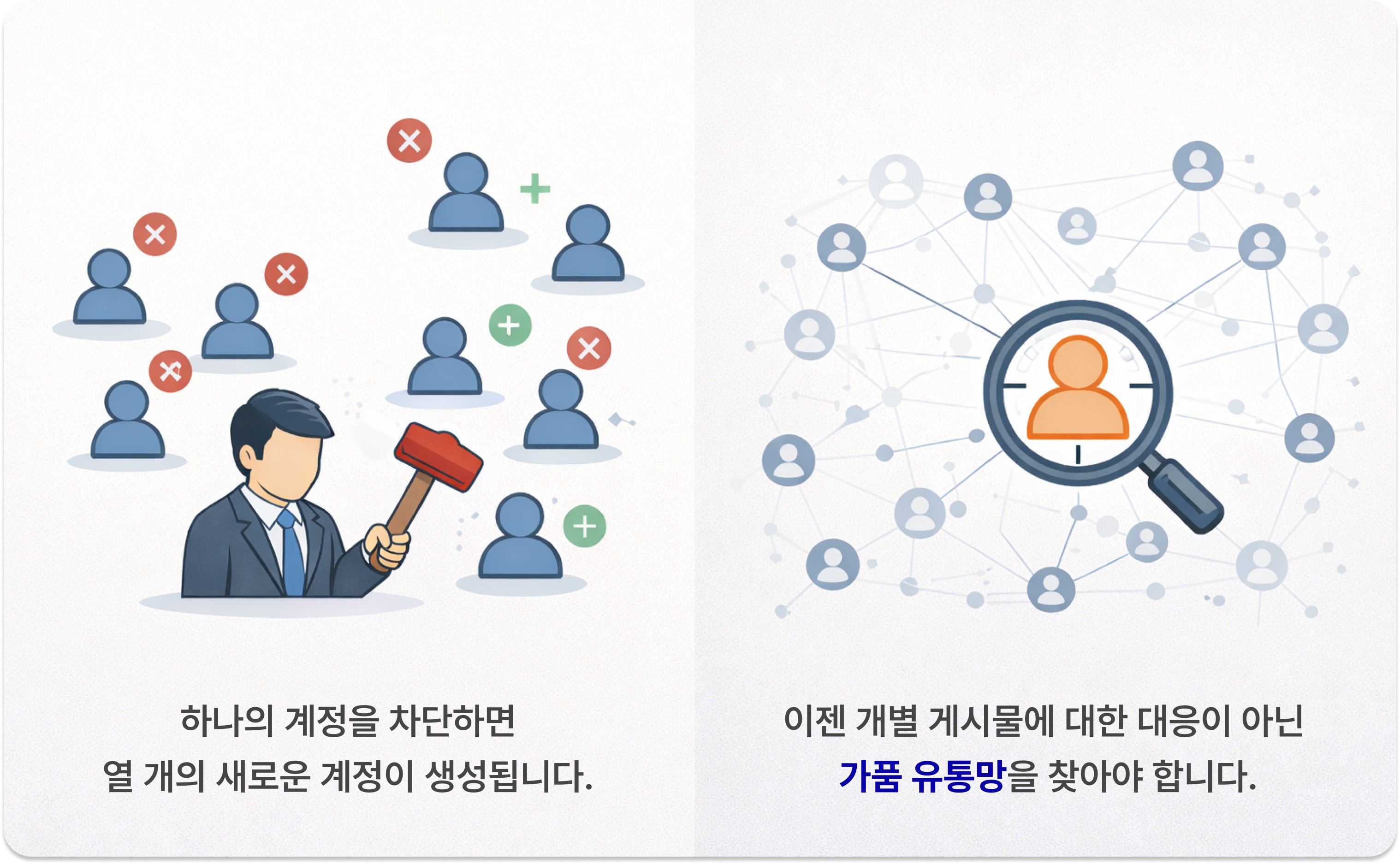
When faced with these counterfeit issues, the first response many brands choose is to report suspicious posts one by one and request the platform to block them. However, due to the nature of C2C platforms, this method inevitably has an infinite repetition structure of so-called 'whack-a-mole'. This is because the head of counterfeit distribution prepares tens or hundreds of ghost accounts in advance in preparation for one account being blocked, and moves quickly by uploading posts again with a new account as soon as enforcement appears. The most unfair part of this fight is that the time it takes for a counterfeit seller to create a new account is much shorter than the administrative time a brand spends suspending a single account.
Particularly in cases where the items are vast and the product lineup is complex, like cosmetics brands, the manual monitoring method drastically drops in efficiency. If a manager investigates thousands of posts pouring in during a new product launch or promotion period, the labor costs and time consumed in the process accumulate directly as corporate operational losses. Even for just one popular lipstick type, there are dozens of colors, and there is a mountain of products to manage from basic to makeup. While clicking on thousands of products scattered all over secondhand markets and worrying, "Is it really a gift?", the time to plan brand marketing or sales strategies that should be focused on disappears.
In the end, a method that is only busy deleting each post, which is a 'result', cannot shake the root of the head seller, which is the 'cause' of distribution. Rather, it can even teach counterfeit sellers the patterns of how brands enforce based on what criteria. Without a strategic system that can find the common distribution network hidden behind numerous accounts and respond at once, breaking the vicious cycle of counterfeit distribution is close to impossible. While working-level staff are exhausted from organizing and verifying data, the brand value continues to be eroded in the invisible blind spot.
Beyond single detection to identifying hidden 'common patterns', how to break the core link of counterfeit distribution with AI
After all, what is needed in today's secondhand transaction enforcement is not a magnifying glass but a 'net'. This is because, in a situation where thousands or tens of thousands of posts are pouring in, picking out systematic counterfeit sellers one by one is as frustrating as finding a needle in a huge sandy beach. Now, we must completely move away from the old method of checking and blocking each post. What is more important than whether a single post is counterfeit is analyzing the connection between fragmented data to find the huge distribution network hidden behind it.
Letrix focuses on the 'relationship between data' at this very point. Beyond simply checking whether an individual post is counterfeit or not, it tracks whether the same 'head of distribution' is hidden behind numerous posts scattered across different platforms. This is because posts that appear to be uploaded by thousands of different individual sellers are often actually tightly managed by a single head seller.
For example, let's assume that seller 'A' living in Seoul and seller 'B' living in Busan posted completely different photos. To human eyes, they seem like unrelated separate posts, but Letrix's AI captures subtle features hidden in the photos. If the angles at which the products are placed match above a certain level, or if the details of tiny props taken in the background are repeated, there is a high probability that this is not a coincidence. On top of this, analyzing the seller's writing habits, the unique tone that induces counseling, and even habitual typos clearly reveals that all these posts are moving under one 'organization'.
Letrix gathers this found information to draw a huge map where you can see the flow of distribution at a glance. Brand working-level staff no longer need to go around looking at hundreds of posts and clicking the report button one by one. They just need to execute a stronger and more fundamental response strategy based on the evidence of this 'systematic distribution network' grouped by AI. Finding the head hidden behind the system, not the individual accounts that are just tails, to uproot counterfeit distribution. This is the beginning of real brand protection proposed by Letrix.
Secondhand transaction platforms are no longer blind spots for enforcement
The reason counterfeit enforcement in the secondhand transaction market is particularly tricky is not simply because of the large volume. It is because the meticulous distribution strategy of counterfeit sellers is cleverly hidden behind extremely personal everyday words like "unopened genuine product received as a gift." If enforcement so far has been busy filtering out pouring 'fake products' one by one, now we must change the framework of response to a way of reading the systematic movements shown by 'fake accounts' disguised as ordinary sellers.
Although systematic distribution heads can discard accounts from time to time to avoid enforcement, they cannot completely hide their unique selling habits or visual patterns of taking photos. Finding subtle connections among these fragmented data is not just a matter of operational efficiency, but the most secure way to protect our brand's pricing policy and customer trust. Rather than being relieved by blocking a single post, we must have a strategic system that can prove the roots of distribution moving in invisible places with data.
Do not let a single photo of an unopened box uploaded on a secondhand market vainly damage the value that the brand has painstakingly built. When reading and responding to signals of crime with technology, brands can finally regain clear initiative in the C2C market, which seemed uncontrollable.