Price Management
The moment it fails to maintain its retail price, a premium brand is no longer premium.

💡 In this article, you can check the following content.
The 'list price' is the identity of a luxury brand
The infiltration of unauthorized sellers does not end with a single price deviation
Risks faced by luxury brands: Losses greater than image damage
Brands that protect prices are brands that monitor prices
Another variable threatening premium image: Image counterfeiting and brand equity damage
Conclusion: List price is a brand's promise and weapon
‘Fixed Price’ is the Identity of Luxury Brands
In luxury brands, a fixed price is not just a price tag. For consumers, it is a symbol representing the brand's class and value, and for the brand, it is the benchmark that maintains the identity built over decades. This is why global luxury brands such as Chanel, Hermes, and Rolex do not hold regular discount events. A price lowered once remains in consumers' memory for a long time and can be a turning point where the brand is perceived as a 'discount brand' rather than 'premium'.
In order to defend their fixed price strategy, some luxury brands attempt to indirectly adjust price exposure by strengthening contract terms or sales guidelines with distribution partners. Rather than uniformly restricting discounts themselves, this can be interpreted as a strategy to prevent indiscriminate price exposure that could negatively impact the brand image.
However, along with the expansion of the online market, instances of this fixed price system being shaken are increasing. Products that have not been discounted by the headquarters appear as the 'lowest price' on Smart Stores, open markets, and price comparison sites, changing consumer perception and quietly eroding the premium image.
Infiltration by Unauthorized Sellers Does Not End with a Single Price Deviation
A premium brand's pricing strategy can be shaken by a single 'unauthorized seller.' They register products on open markets, Smart Stores, and private shopping malls without any official contract with the brand, selling them at prices significantly lower than the fixed price. As a result, consumers form the perception of "Why is the official mall more expensive when it is the same product anyway?", and the premium image that the brand has built over a long time can be quickly damaged.
Such price deviations are not one-offs. Once one seller lowers the price, it quickly spreads through price comparison platforms, and that price begins to function as the 'market benchmark price.' Seeing this, other sellers lower their prices in turn, and some even attempt additional discounts to clear out inventory. Consequently, the price order across all channels collapses in just a few days, and it becomes difficult for the brand to be perceived as a 'brand that keeps its fixed price' anymore.
The bigger problem is that it is difficult to grasp in real-time when and where the deviation began. Most brands notice the deviation later through customer inquiries or internal monitoring, and by that point, it is highly likely that the price collapse has already spread to multiple channels.
Working-level staff often find themselves spending time on repetitive responses, such as contacting resellers, writing internal reports, and verifying with distributors, without clearly understanding the root cause. However, relying solely on such reactive responses can make it difficult to prevent recurrence.
More than the fact that a single seller broke the price, the state in which the brand cannot detect this in real-time or structurally track it can be a greater risk. Especially in industries that adhere to high-pricing policies like luxury brands, once the price order breaks down, it can take months or more to recover, and during that time, customer perception is also likely to gradually adjust downwards.

Risks Faced by Luxury Brands: Losses Greater Than Just Image
Price deviation goes beyond simply confusing consumers and causes substantial damage to brand equity. Especially for luxury brands, because price functions not merely as a number, but as a means to express status, scarcity, and differentiation, failures in pricing strategy can lead to the erosion of brand identity.
📉 Case Study: The Backlash of Burberry's Outlet Discount Policy
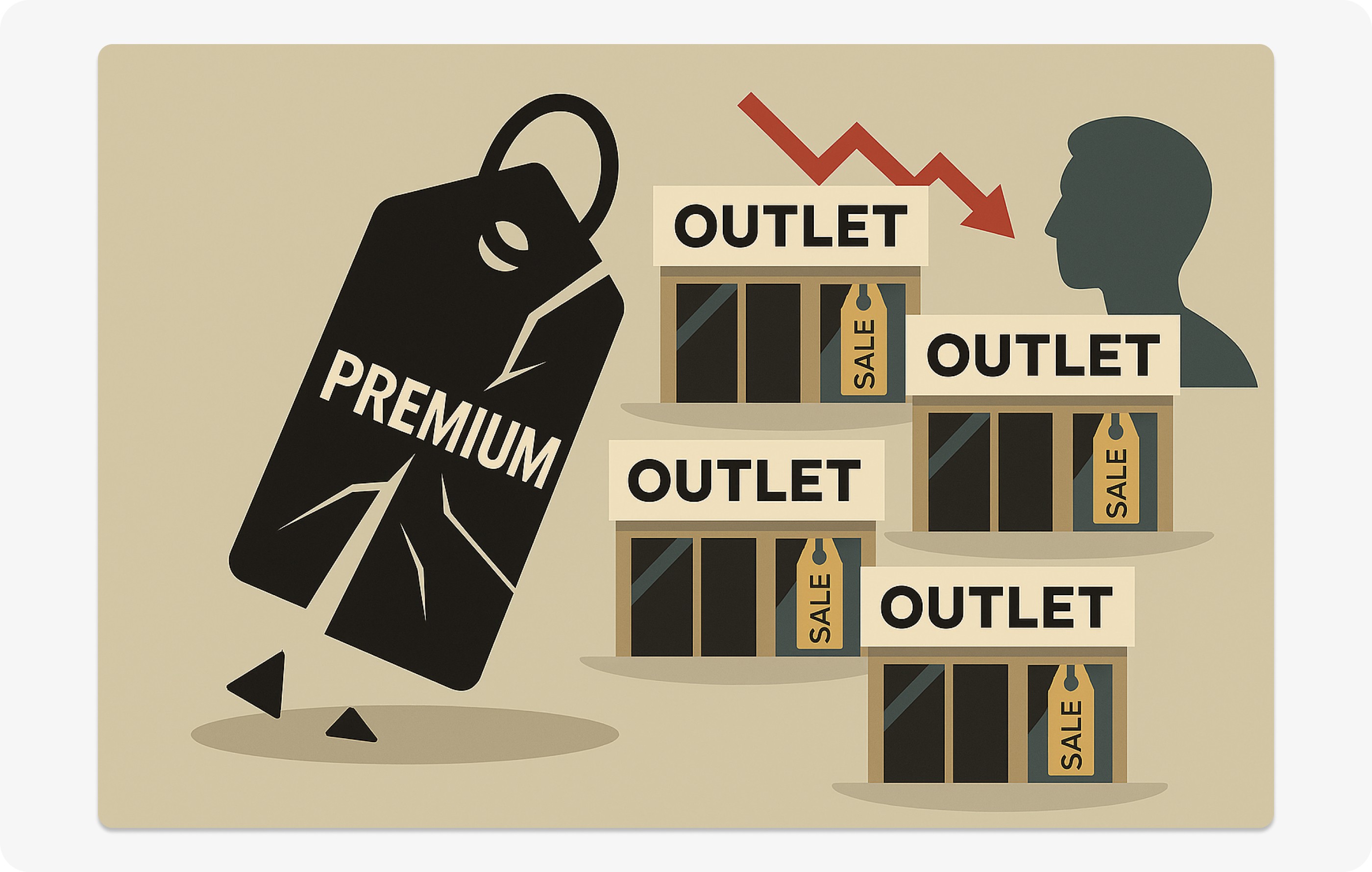
In November 2024, Reuters reported that Burberry's CEO Joshua Schulman expressed concern over the rising share of outlet sales, stating that it "dilutes the luxury image." This is a representative case showing that short-term sales expansion strategies can weaken the brand's luxurious perception and, in the long run, lead to the defection of loyal customers.
Why Is It a Bigger Risk for Luxury Brands?
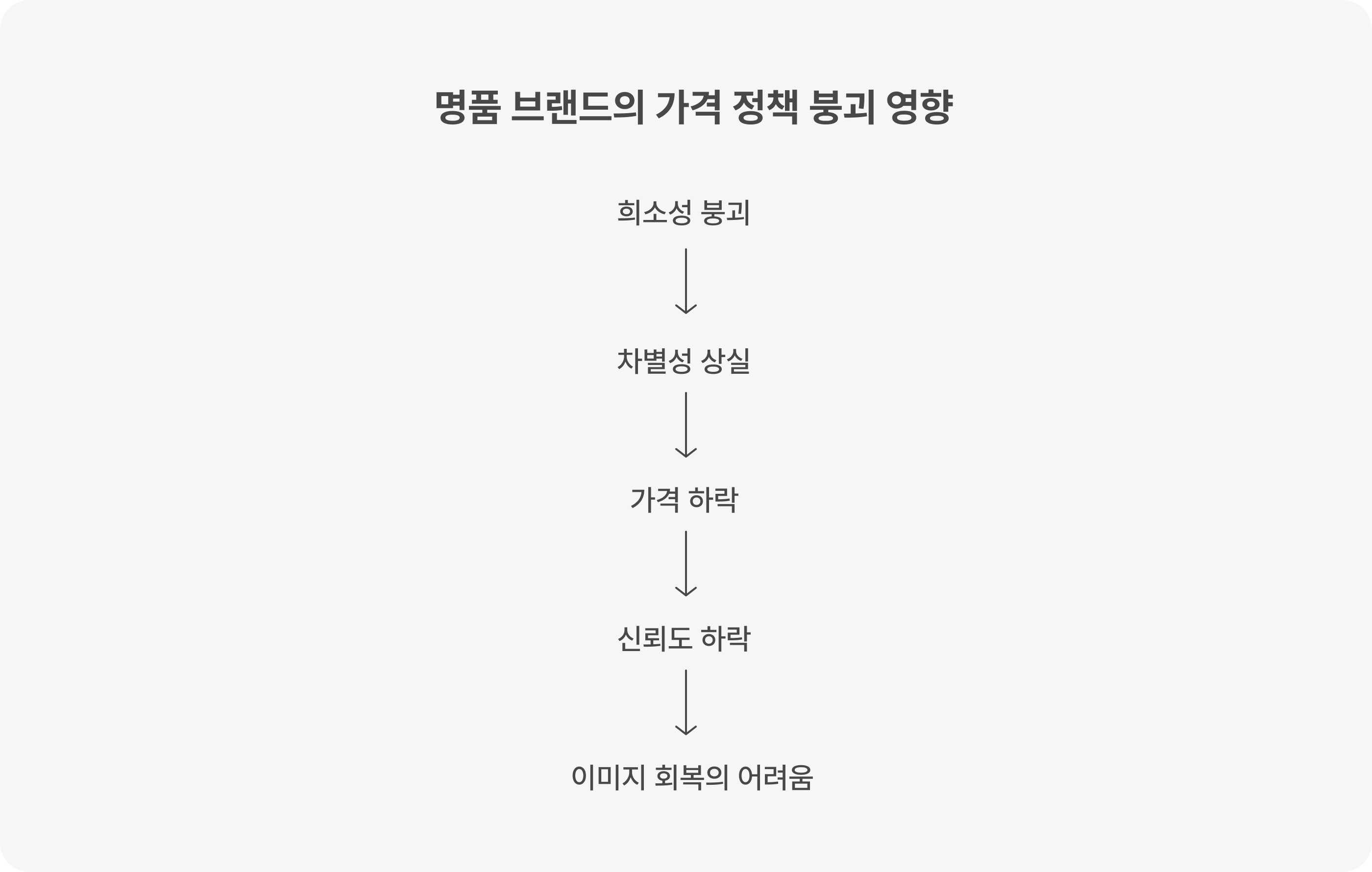
Collapse of Scarcity → Loss of Differentiation
Luxury brands build their 'premium' status through high pricing and limited distribution. However, selling below the fixed price at outlets or indiscriminate discounting breaks this scarcity, and from the consumer's perspective, the brand's 'value' is perceived to have declined.
Price Drop → Decline in Trust
Consumers indirectly judge a brand's quality, authenticity, and status through its price. When prices lower than those of official distribution networks are exposed, consumers begin to think, 'This brand eventually does sales too,' and their motivation to purchase at full price drops sharply.
Difficulty in Image Recovery
Once ruined, a premium image is not restored simply by raising the price. Particularly in recent times, as the customer base that consumes and compares information quickly has grown, they no longer view a brand whose fixed price exposure has collapsed as premium.
As such, price deviation in luxury brands is not a simple loss of sales, but acts as a structural risk that threatens the brand identity itself. Maintaining fixed pricing is not merely a declaration of 'no discounting,' but must be a strategic choice to sustain the brand in the long run.
Therefore, luxury brands must establish a more thorough brand equity management system that encompasses pricing structures, distribution strategies, and visual asset protection rather than focusing on short-term sales performance. Simple price monitoring is not enough; controlling unofficial channels and early detection systems for risk signs become core strategies to protect brand value.
Luxury Brand Strategies Controlling Even Distribution Channels
To prevent these situations, some luxury brands maintain policies that block or strictly restrict online distribution entirely.
For example, Rolex sells its products offline only through officially certified retailers, and does not allow any direct online sales whatsoever. This policy is so strongly enforced that it even resulted in a fine of approximately 91.6 million euros imposed by the French competition authority (Autorité de la concurrence) for restricting online distribution. This shows that even if it means restricting online distribution, this is a strategy chosen by the brand to minimize price exposure and maintain its brand image.
Patek Philippe also traditionally restricts online sales, with only extremely limited cases where online sales were temporarily permitted for a select few official dealers during the pandemic, and they continue to adhere to a conservative distribution policy to this day.
Thus, strategies to thoroughly control distribution networks and price exposure function as a fundamental means for premium brands to maintain their fixed price system and scarcity, and to protect brand equity.
Brands That Defend Prices Are Brands That Monitor Prices
Monitoring is no longer an option but has become the minimum strategy to protect brand identity. There is a need for an automated price monitoring system that can check and report in real-time where unauthorized sellers broke the price, in what patterns it repeats, and how frequently they appear.
Retrix supports brand working-level staff's pricing strategies in the following ways:
Detecting abnormal prices across major platforms like Smart Store and Coupang
Automatically collecting seller information when benchmark price deviation occurs
Managing seller risk based on historical repeat violations
Generating automated reports for internal brand reporting
When such a system is established, you can obtain information that is far more important than just the fact that 'someone broke the price.' For example:
Who the seller was that first broke the price
During which time slots deviations repeatedly occurred
Who the sellers were that failed to comply with the MAP policy
This information goes beyond simply blocking distribution and serves as core data that can adjust the brand's overall distribution strategy.
Another Variable Threatening the Premium Image: Image Counterfeiting and Erosion of Brand Equity
If price deviation is the most direct threat undermining a luxury brand's identity, the spread of counterfeit products is another variable that crumbles brand trust from within. Indeed, the reason luxury brands have defended their unique designs, packaging, and logos is not merely for symbolism, but because visually perfected brand equity itself is the core of being premium.
In May 2025, according to a Maeil Business Newspaper report, 19.4% of the approximately 220,000 counterfeit items detected on domestic online platforms were Chanel brand products. This is the highest figure for a single brand, demonstrating how easily Chanel's image, logo, and product designs become targets for counterfeiting.
Most counterfeit products were distributed through open markets like Coupang, Smart Store, and Gmarket, where consumers purchased products in environments where it was difficult to clearly identify authenticity. When low-priced products with similar appearances are distributed through non-official channels, it is easy for consumers to mistake them for 'genuine.' Consequently, although the brand cannot control the quality, it ends up bearing the responsibility for the decline in customer trust.
This type of counterfeiting goes beyond a simple logistics issue and leads to infringement on the visual assets (design, logo, package, etc.) that the brand has built over many years. Especially for luxury brands, because each product image is a core means of conveying the brand's identity and value, visual similarity directly translates into brand loss.
Recently, an increasing number of companies are adopting AI-based image similarity analysis technology to protect their brands. This technology does not simply compare file names or image URLs, but analyzes the main advertising images used by the brand and the detailed page images of each distribution channel on a pixel level to quantify visual similarity.
Through this, unauthorized sellers registered in non-official channels using images similar to the genuine ones can be automatically detected, allowing the brand to establish a foundation for managing not only pricing but also image asset infringement.

Conclusion: Fixed Price is a Brand's Promise and Weapon
The competitiveness of a luxury brand depends not on simple pricing, but on whether it has a structure in place to control that price on its own. A single deviation can shake the brand trust built over years, and counterfeit products can slowly erode the brand's value in the consumer's mind.
To respond to these risks, it is worth considering data-driven real-time monitoring and structural response strategies. Equipping a system that detects price deviations in real-time, senses counterfeiting risks at the image level, and tracks even the recurring patterns of unauthorized sellers makes a more preemptive response possible.
Fixed price is not just a standard to be kept, but a strategic asset that constitutes the brand. In a changing distribution environment, establishing a monitoring and protection system based on technology and data will help maintain long-term brand value.