Unofficial Seller Management
Price Management
‘Data Gaps,’ More Fearful Than Price Errors: How to Turn Coupang's System Risks into Brand Assets
💡 In this article, you can find the following information.
What the 140-won Yukgaejang and 3,800-won Coco Balls left behind
Even if platform errors are uncontrollable, ‘data’ must remain under the brand's control
The golden hour of incidents, ‘first-party owned data’ holds the answer
Strategic assetization: Changes that occur when transforming flowing data into knowledge information assets
Re-trix: A brand's own ‘price black box’ that is not swayed by platforms
Conclusion: Ultimately, the data owner reads the market trends
What a 140 KRW Yukgaejang and a 3,800 KRW Cocomon Left Behind
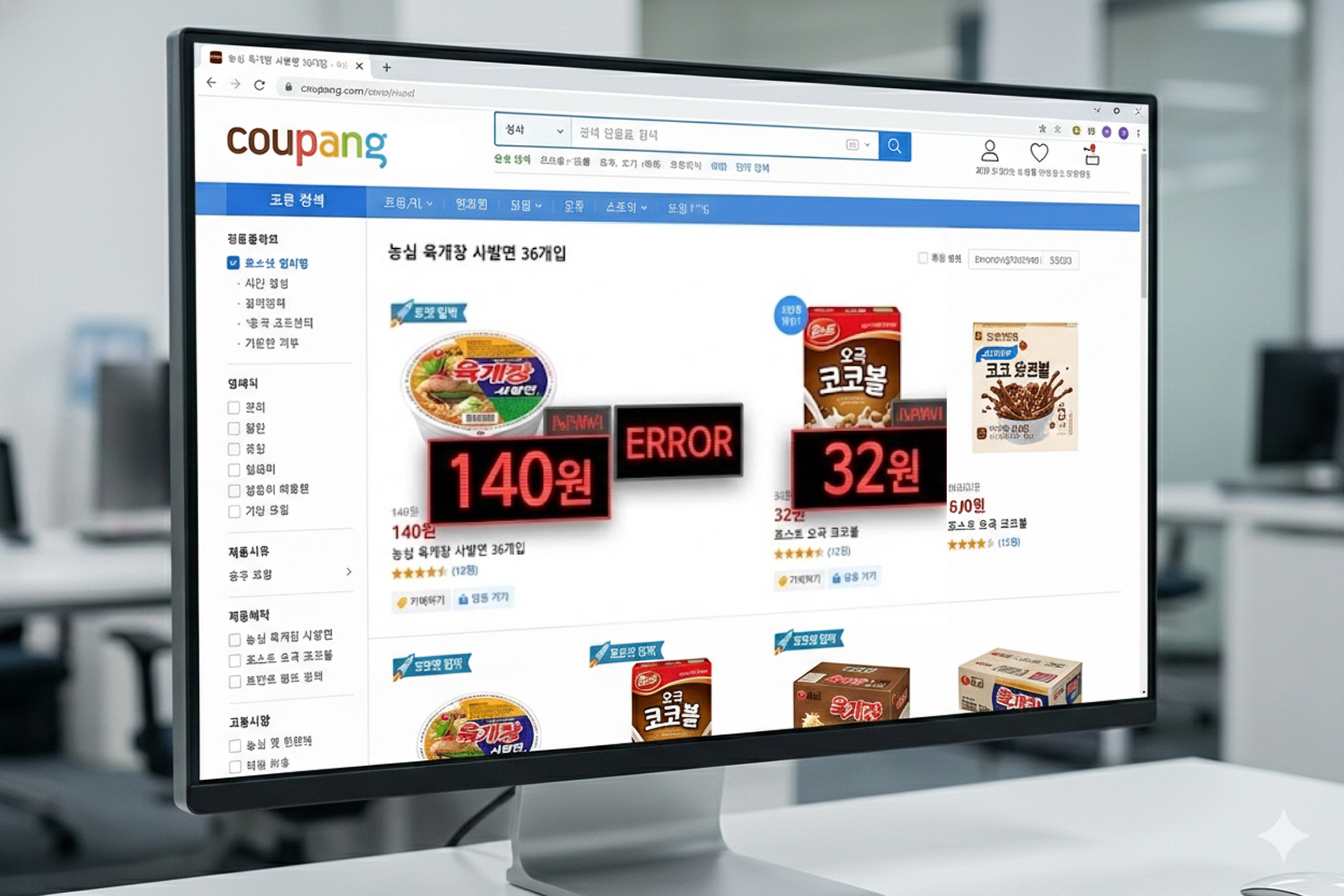
In May 2025, an explosive reaction poured out among Coupang Rocket Delivery users. A box of 36 Nongshim 'Yukgaejang Bowl Noodle' was listed for just 5,040 KRW. Converted to the price per unit, it is about 140 KRW. Just two months later, in July, 'Post Five Grain Cocoball Cup' 118 units were listed for 3,800 KRW. At an unrealistic price of 32 KRW per unit, 40,000 orders flooded in just 5 hours.

This kind of news spreads very quickly through online communities. While it may be a lucky chance for consumers to grab a great deal, the feelings of the brand practitioner watching this from the other side of the screen are quite different. This is because the brand's pricing policy and the trust built with great effort crumble as fast as the order button is pressed.
Coupang explained this phenomenon as a temporary error in the service upgrade process or a difference in the system input method, and issued an apology notice. In fact, the platform's response is relatively quick, as the search failure and price error situation that occurred on November 14 were restored in about an hour.
However, one question remains here. "Just because the platform's system has been normalized, can we consider our brand's price trust to have been normalized as well?"
It is difficult to recall quantities released due to a brief error, and the practice of not charging additional costs for already delivered products goes straight to the brand as an operational burden. Most painful of all is the 'once-collapsed standard of price'. Consumers who have experienced price errors look at pages restored to normal prices and harbor doubts like "Is this price really correct?", which often leads to a sharp increase in customer service inquiries and a decline in brand image.
At this point, we must ask cool-headed questions. Are these incidents simply accidents of specific brands that had bad luck? Or are they structural risks that every brand entering the giant ecosystem called Coupang must face every morning?
It is time to think deeply from a practitioner's perspective on whether there is a way to protect and capitalize on our brand's price information ourselves, rather than simply waiting for errors to be fixed. While we cannot do anything about Coupang's system, we do not need to give up on the 'data' generated within it.
Even if platform errors are uncontrollable, 'data' must be within the brand's control
Among online distribution practitioners, Coupang is known as both a 'land of opportunity' and the 'most difficult target to manage'. This is because there are too many variables that are hard for a brand to control, such as the Item Winner system, Dynamic Pricing, and rocket delivery direct purchase logic that changes frequently. In such an environment, price errors are not accidents that happen once in a while, but are closer to 'constants' that can happen at any time in the process of the complex system's gears meshing.
In practice, the following situations occur frequently.
Error in unit input: When the box unit and single item unit prices are switched and matched on the system
Overlap of discount conditions: When the platform's own coupons and the brand's instant discounts overlap unexpectedly, creating a price close to a negative margin
Auto-matching algorithm: When an abnormal price is recognized as a normal price in the process of automatically matching prices by tracking the lowest price of other e-commerce sites
The problem is that when such errors occur, the measures brands can take are extremely limited. Most of the enrolled brands realize belatedly that prices are being abnormally exposed only after seeing a flood of consumer inquiries or community posts. During that 'blank time' from the moment of the accident to the moment of recognition, and until the correction is requested to the platform and actually reflected, the brand is thoroughly alienated from information.
"What changed, exactly when, and by what logic?"
Even if you ask because you are frustrated, the platform does not show detailed data in real time. Usually, after the situation calms down, all you get is a short reply saying "it was a system error" or a post-event result report. From the brand's perspective, there is no way to know how and why the price of our product was distorted and collapsed in the market. This is because data remains only within the platform's server and is out of reach of the brand.
Of course, we cannot overhaul the platform system. But 'recording' and 'capturing' what happens inside it is a completely different matter. If there is a system to catch flowing data in real time and build it as a brand's unique knowledge information asset, the brand no longer has to respond blindfolded even if a platform error occurs.
Taking control of data from the platform and accumulating it as an internal asset of the brand is why it becomes the only defense mechanism to protect the brand's identity amid repeated price risks. Then, let's see how this data is actually used in the field when an accident occurs.
The golden time of incidents, 'first-party data' knows the answer
When a price error accident occurs, what embarrasses practitioners the most is the platform's 'silence'. Orders flood in by hundreds per second, but the information we can see is limited even if we access the admin page to grasp what went wrong. While helplessly waiting for the platform system to be restored or for the customer service center's reply, the brand's price trust is quickly consumed.
If there is data history directly owned by the brand during this 'golden time' of accident response, the situation changes. Instead of waiting for the platform's notification, the brand can immediately find the 'answer' through its internal records.
(1) Tracking exact normal prices and times of change
The key to responding to price errors is proving "from when and what went wrong". If a brand accumulates price change logs as its own data, it can immediately verify the normal price right before the accident and the exact timeline when the error started. This allows the brand to present 'data evidence' rather than simple 'conjecture' when requesting the platform to correct errors, thereby speeding up action. In fact, the clearer the data evidence, the more communication resources with the platform tend to decrease and decision-making speed increases.
(2) Establishing evidence-based CS and consistent compensation standards
The point where controversy grows in communities after an accident is the 'uncertainty of response'. Once complaints start coming out like "someone received delivery and someone had their order canceled", the brand image takes a hit. At this time, if you utilize brand-owned data, you can clearly define specific time slots and target products where system errors occurred, allowing you to present transparent explanations and consistent standards to consumers. A firm and transparent response based on data can give the impression that the brand is fully in control of the situation even in an accident scenario.
(3) Identifying patterns of repeated risks
When accident data is accumulated as an asset, 'vulnerabilities unique to our brand' that the platform does not tell us begin to appear. If the brand directly holds patterns where errors repeat at specific update times of the week or in specific bundled products, this becomes strategic knowledge beyond simple accident records. The data-based judgment that "this product group has a high probability of price matching errors in the platform algorithm" enables practitioners to defend preemptively, such as adjusting promotion intensity or raising monitoring levels in advance.
Ultimately, data becomes the most powerful 'evidence' when an accident occurs, and at the same time, a 'preventive measure' to block the next accident. Brands that only wait for the platform's action results experience the same confusion every time, but brands that have accumulated data as an asset can proactively clean up situations with clear standards even in the middle of an accident.
Strategic Assetization: Changes that occur when building flowing data into knowledge information assets
To take a step further in crisis management, we must pay attention to the 'flow of data' that we have been letting slip by. Even at this moment, millions of price data points are generated and extinguished on Coupang's servers. All that information about competitors lowering prices, item winners changing, and rocket delivery badges being attached and detached. Most brands just let this slip away, but the moment you capture and store this, it can become a powerful 'knowledge asset'.
Simply watching flowing data versus internalizing it as our company's asset. This difference changes the constitution of a brand.
Securing clues to decipher the platform's 'black box'
Coupang's algorithm is like a giant black box. The platform does not kindly explain why exposure suddenly decreased or why prices collapsed at a specific moment. However, if a brand steadily accumulates logs of price changes, invisible causal relationships begin to surface.
"If competitor A lowers their price by 100 KRW, our product's automatic price matching operates 15 minutes later."
"During a specific promotion period, the discount rate calculation logic for bundled products is applied differently than usual."
As such, accumulated data becomes a clue to trace back the internal logic of the black box. It becomes possible to predict and respond to platform movements based on data, not on hunch or conjecture.
Relying on the company's 'system', not the manager's 'hunch'
In the distribution industry, there are many cases of relying on the 'hunch' of the MD or marketer in charge. Conjecture based on experience, such as "prices tend to bounce around this time," is helpful at that moment, but has a fatal drawback in that if the manager leaves or changes, that know-how evaporates with them.
On the other hand, if you build price data as the company's knowledge asset, the know-how remains in the system. Because past price flows and response histories remain as data, the brand can maintain a consistent pricing strategy even if the manager changes. This is an important process of replacing individual experience with the capability of the entire organization.
Securing initiative in strategy formulation and clear standards
Brands with data do not blindly get swept away by the platform's waves. Instead of responding in a flurry whenever external environments or logics change, they can guard their own 'price baseline' based on assetized data.
"As a result of analyzing past data, promotions that go below this price range damage brand value in the long run, even if they increase immediate sales volume."
With these objective indicators, a brand can clearly distinguish what to do and what not to do. Making decisions that consider profitability and brand image based thoroughly on data, rather than lowering prices swept by vague anxiety. This is the real strategic initiative that data provides.
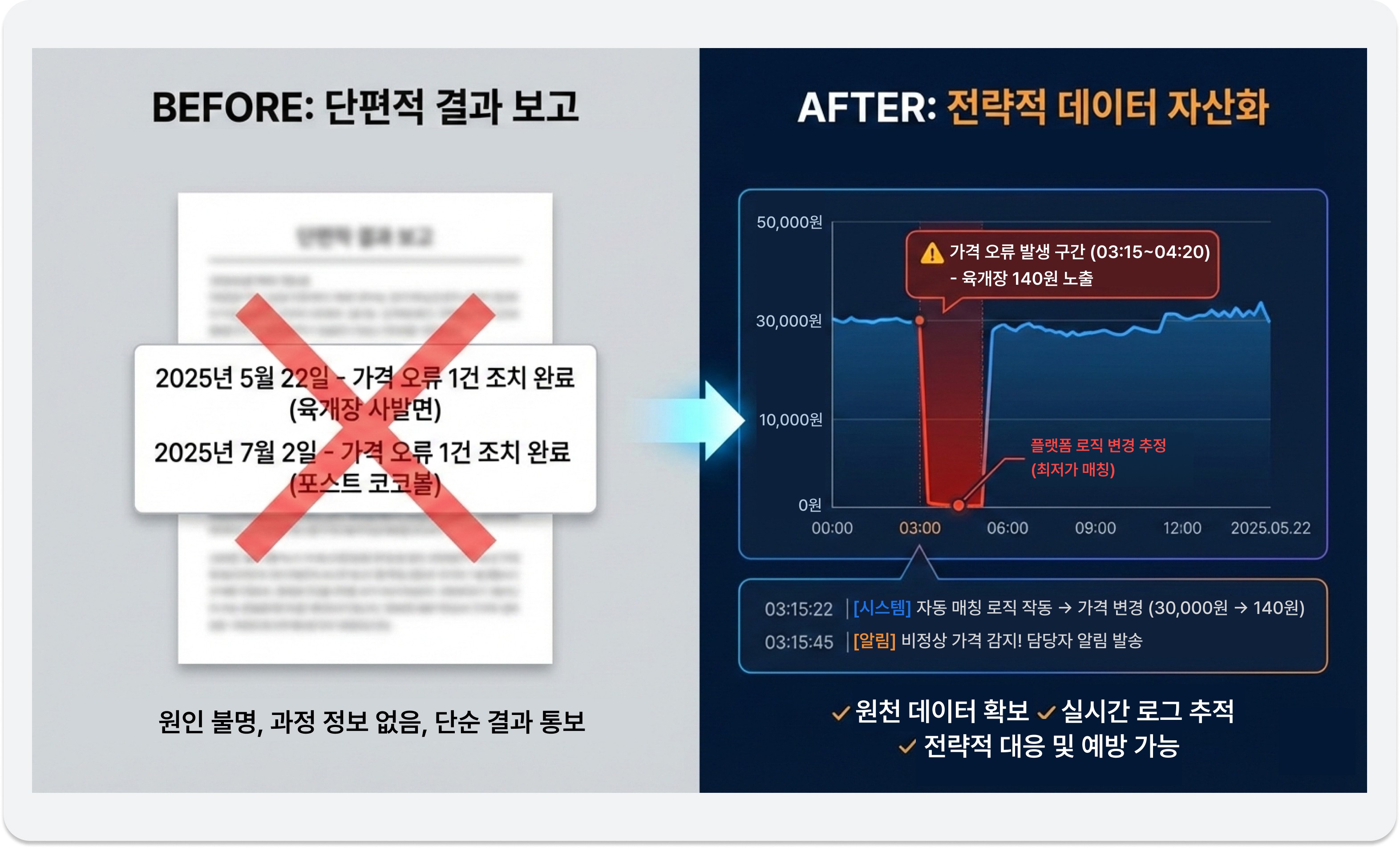
In the end, assetizing data is akin to a brand holding its own steering wheel on the rough waves of the platform. It goes beyond simply defending today's price and lays the foundation for recording the brand's past history and designing future strategies. Of course, humans cannot record this vast data one by one. That is why a 24-hour awake system is needed.
Retrix: The brand's unique 'price black box' that is not swayed by platforms
A system that does not sleep and records every moment is already called by the clear name of 'black box' in other industries. When an accident occurs in an aircraft or car, the first thing people look for is the black box. This is because only objective data recorded on mechanical devices can prove the truth of that moment, rather than eyewitnesses at the scene or external assumptions.
The role that Retrix aims for is also like this. When a brand gets lost in complex platform algorithms or suffers an unexpected price accident, Retrix becomes the most reliable 'price black box' the brand can lean on.
Retrix is not simply a notification tool that checks and tells you how much the price is. The essence of Retrix lies in 'recording' and 'ownership'.
Records 'behind-the-scenes data' that platforms do not show
The shopping mall screen we see is only the final result value. Retrix looks at the flow of change happening behind it. The moment prices change, the moment out-of-stocks occur and get resolved, and the split-second moments when item winners are replaced, are detected in real time and recorded in log format. Retrix's system closely fills the data blanks that humans cannot help but miss even if they watch the monitor 24 hours a day.
Internalizes external data into internal 'core assets'
Many solutions process data on their own servers and then provide only refined result reports to clients. However, as mentioned earlier, real power comes from raw data.
Retrix supports brand companies to directly own and manage collected price information and change data. This means that brands can capture market data through the tool Retrix and combine it with their internal systems (ERP, BI, etc.) to produce independent insights. The difference between 'renting a service' and 'making data ours' directly translates to the difference in response capabilities a brand can exhibit in a crisis situation.
Builds a system that can 'predict' beyond responding
Data accumulated through Retrix is the brand's past and future.
"Around this time last year, a price matching error occurred in channel A."
"Competitors' price reduction patterns are concentrated on specific days of the week."
When this data is accumulated as a brand asset, practitioners can move based on clear predictions instead of vague anxiety. Retrix serves as a compass helping brands operate prices stably within a predictable range without being passively dragged around by platform changes.
The more uncontrollable the environment is, the clearer the subject of recording must be. This is because even if the platform's server stops or data disappears, the brand's black box must still be running.
How will market responses differ in the future between brands that have this black box and those that do not?
Conclusion: Ultimately, the data owner reads the market flow
Giant platforms like Coupang throw new homework at us every day, but at the same time, they are stages that give us the most certain opportunities for growth. Large and small price issues occurring here are like unavoidable waves, but whether to get swept away by those waves or ride over them depends entirely on the brand's response capability.
When a price error occurs or market prices fluctuate, the minimum role the brand must perform is 'accurate grasp of the current situation' and 'swift and evidence-based response'. And the most necessary weapon to perform this role properly is data held directly by the brand, not notifications from the platform.
If most response methods remain at 'result processing' for what has already happened, now is the time to change the perspective. Even after the accident is settled, all records and flows of price changes that occurred in the process must remain as assets of the brand company.
When a brand directly owns data, that data holds value beyond a simple accident log.
Reading minute trends in the market,
Predicting platform price algorithm flows,
It becomes a core asset to establish our brand's robust pricing strategy.
Ultimately, brands with data can go beyond simple 'response' and set 'strategies'. No matter how the platform environment changes, the power to keep balance and cope flexibly through accumulated data is created.
Now is the time to change the question. Beyond the passive stage of worrying about "how to prevent errors," we must worry about "how to make currently generated data mine and what strategy to establish." On the journey to find the answer, Retrix will be with you with the most accurate data.