Industry Cases
Counterfeit
“I thought it was genuine, but then came the side effects…” Why health functional food brands are shaking

💡 In this article, you can check the following content.
What if you consumed a product thinking it was genuine, but a health issue occurred?
Health functional food brands, the point where customer complaints begin
More dangerous because it looks real, brand image theft
Counterfeits are not always the 'lowest price'.. how to reduce blind spots
Dual-monitoring strategy to protect the trust of health functional food brands
If You Ate What You Thought Was Authentic but Ended Up with Health Problems
In 2023, a consumer in the US purchased a supplement from the famous health functional food brand 'NOW Foods' on Amazon. The bottle design and label looked just like the familiar genuine product, and the ingredient label also seemed reliable. However, after taking it, they had doubts about the product and contacted the brand's customer service, and an investigation confirmed that the product was a counterfeit that NOW Foods had never distributed.
Afterwards, through further investigation, the brand discovered 11 counterfeit supplements masquerading as their products on Amazon. These included psyllium husk, magnesium citrate, and men's multivitamins, all of which were found to be distributed by a single seller. Although the counterfeits looked very similar to the authentic products on the surface, they actually differed in several details, such as the color and shape of the bottle cap, the label corners and logo proportions, and the presence or absence of a manufacturing number on the bottom of the bottle. From a consumer's standpoint, these details were difficult to identify with the naked eye, making it equally hard to realize that the products were counterfeit.
This case is not simply a matter of 'buying a fake product.' It is an incident that revealed a structural threat where health functional foods that look genuine but are not managed by the brand are distributed in the market, resulting in consumer confusion as well as the collapse of brand trust.
With the expansion of online distribution today, the health functional food market is exposing both consumers and brands to risks due to information asymmetry and the rampant proliferation of unofficial sellers. Particularly for health functional foods, where consumers have high expectations regarding product efficacy and safety, the cycle of blame concentrating on the brand whenever a problem arises—regardless of authenticity—is repeating itself.
Where Customer Complaints Begin for Health Functional Food Brands
Health functional foods are a product category that relies on trust more than any other consumer goods. Consumers ingest these products expecting results and decide to purchase believing that there will be no adverse reactions. Unlike pharmaceuticals, where side effects are disclosed as a prerequisite or consumers take them with caution, this consumption is based on the premise that 'it will be fine.'
However, as the market has grown, unofficial sellers and counterfeit products have begun entering online distribution networks, and a distribution structure that brands cannot control is now shaking trust in their products. The problem is that consumers cannot easily tell them apart. Counterfeit products, which are configured almost identically to authentic ones in terms of packaging, ingredient labeling, brand name, and images, are not significantly different in price compared to the retail price, making it easy for consumers to perceive them as 'normal products.'
The fundamental issue is that when products from unverified distribution channels enter the market, brand control becomes extremely difficult.
Fungi Perfecti Counterfeit Case: 23 Sellers Offering Counterfeits
In April 2023, Fungi Perfecti (Host Defense Mushrooms), an organic mushroom supplement brand, discovered counterfeits of four capsule products on Amazon: MyCommunity, Stamets 7, Lion’s Mane, and Turkey Tail. 23 sellers were offering counterfeits under the same brand name, and differences from the authentic products were confirmed in various aspects, such as spelling errors (using 'Muiti' instead of 'Multi'), packaging structures (black plastic wrapping), and container printing (bearing a '200 CC' mark).
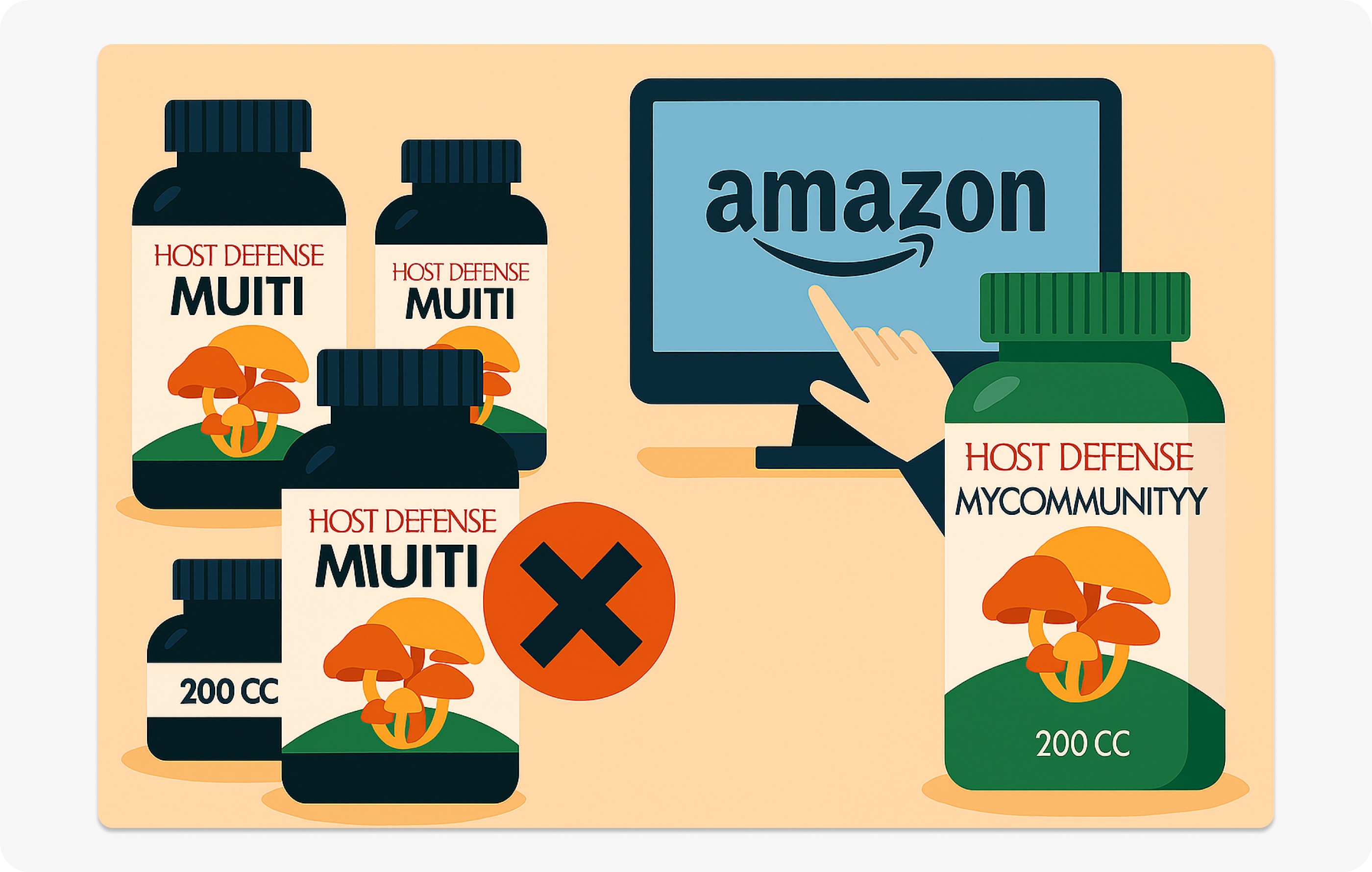
A more critical problem was that gluten and soy allergens were detected in some of the products. While the authentic products were designed to be free of these allergens, their presence in the counterfeits posed a direct threat to consumer health. This demonstrates how counterfeit distribution, entirely unrelated to a brand's quality control standards, can impact brand safety. Fungi Perfecti immediately reported the cases to Amazon and the FDA, and Amazon subsequently blocked the sellers.
In this case, consumers likely perceived the products as authentic simply because the packaging and brand name were the same. In reality, however, the brand was unaware of the counterfeit transactions beforehand and had no choice but to respond by blocking sellers through consumer reports after the issues occurred.
Surge in Unofficial Distribution and Adverse Events, Risk Shifted to Brands
As seen in the Fungi Perfecti case, counterfeit products impersonating a single brand being distributed through multiple unauthorized sellers is by no means an isolated incident. Recently, reports of adverse reactions across health functional foods have been steadily increasing, and behind this trend lies an unofficial distribution structure that brands cannot control.
According to data from the Ministry of Food and Drug Safety's 'Food Safety Nara,' the number of reported adverse cases for health functional foods in 2024 totaled 2,316, representing a 61% increase compared to 2023. Notably, 506 cases have already been registered in January and February of 2025 alone, and if this trend continues, it is highly likely that more than 3,000 cases will be reported annually.
However, a more fundamental problem than this statistic is that many of the products causing these adverse events are mysterious products sold through 'unofficial distribution channels.' In fact, in 2024, purchase locations classified as 'Others' accounted for 69% of all adverse cases, which includes overseas direct purchases, SNS markets, unregistered sellers on Smart Store, and unofficial shopping malls. Products distributed through these channels fall outside basic quality control systems such as raw material verification, ingredient labeling, and dosage information, yet consumers ingest them perceiving them as 'genuine.'
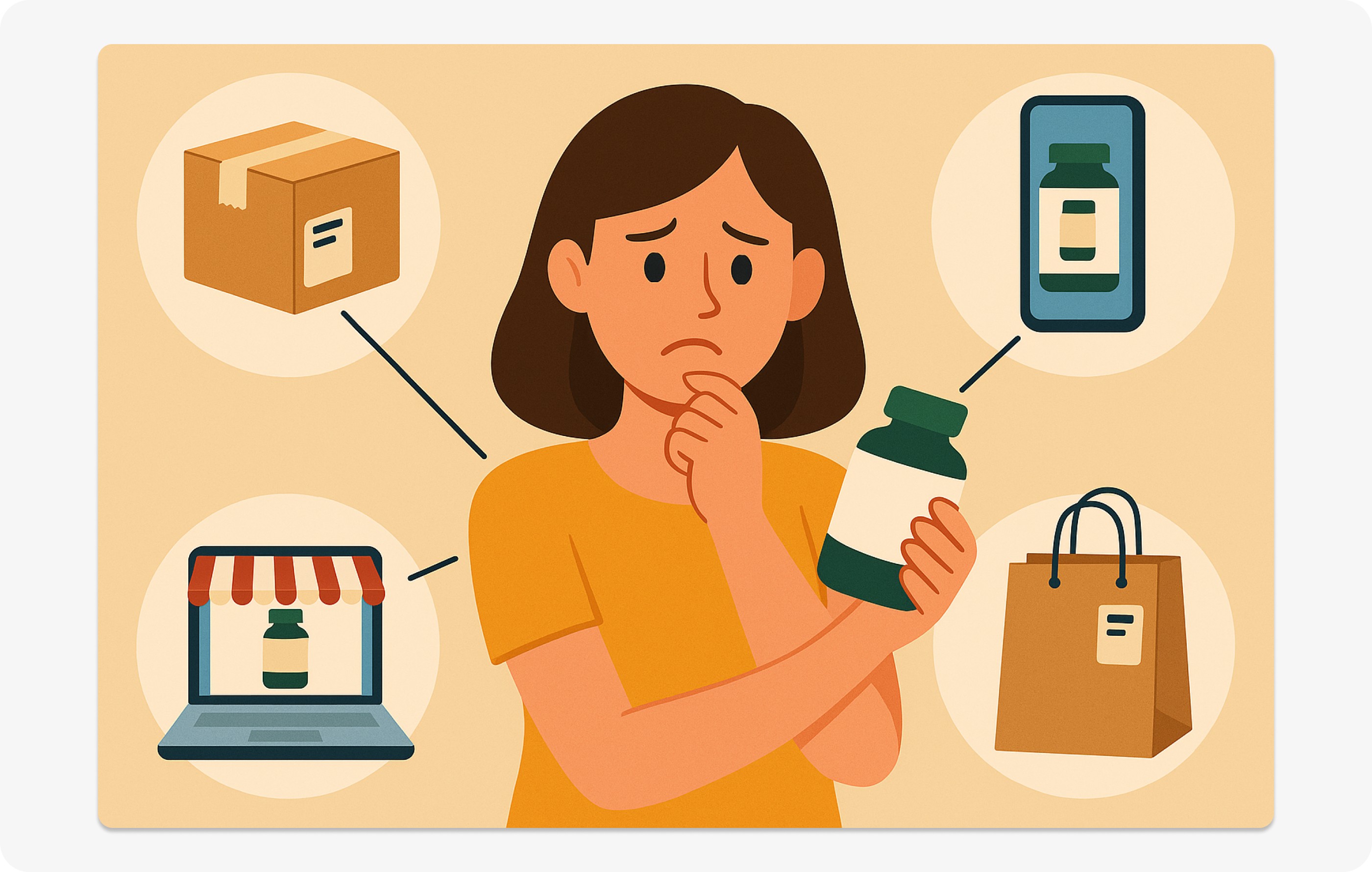
The issue is that the adverse events arising from this ultimately return to the brand as complaints. Consumers assume a product is authentic based solely on its appearance or description, and file complaints with the brand's customer service if it is ineffective or causes issues. However, because the brand did not directly distribute the product, there are limits to verifying its source or authenticity. Despite this, customers misunderstand, thinking the brand is ignoring their health concerns or avoiding after-sales support.
As a result, brands face a situation where CS burdens increase and their image and trust are simultaneously damaged due to problems with products they did not even sell. Given that the surge in adverse events is not merely due to increased consumption or the popularity of functional foods, it is now time for brands to seriously consider implementing real-time monitoring systems for unofficial distribution and controlling their distribution channels to protect their products.
More Dangerous Because They Look Real: Brand Image Theft
As emphasized earlier, the most critical element in health functional foods is the 'belief in efficacy.' Rather than reading instructions meticulously, customers make purchase decisions based on brand reputation, product appearance, and product introduction images. After consumption, they judge whether the effects they expected have appeared.
Consequently, when an unofficially distributed product causes an issue, consumers retain the memory that "the brand's product was strange" longer than the fact that "it wasn't authentic." If the packaging design, product images, and description texts are similar to the authentic ones, consumers remember and judge based on the brand, not the seller. The problem is that this perception itself is not wrong; the consumption structure is already built that way.
Particularly, because it is difficult to verify immediate efficacy or adverse reactions with health functional foods, decisions are predominantly driven by trust and reviews. For this reason, a blind spot arises where 'if it looks authentic, people trust it as authentic,' even for products of mysterious origin, creating a structure where counterfeit distribution directly impacts brand reputation.
In this way, even if a problem originates outside the brand, if there is 'image theft' or 'packaging similarity,' consumers have no choice but to believe it is authentic. Because counterfeiters closely mimic brand names, logos, ingredient lists, and even social media advertising images, counterfeits do not just infringe on brand quality, but ultimately erode actual reputation in the long term.
Ultimately, even if a brand draws a line saying, "We did not sell that product," consumers have no criteria to distinguish them, so complaints continue, and brand trust is gradually depleted. The problem is that if there are no practical standards or monitoring systems to address this, misunderstandings are left neglected, and reputation losses accumulate
.
Counterfeits are Not Always the 'Lowest Price'.. How to Reduce Blind Spots
A common characteristic revealed in the cases discussed above is that counterfeits are not necessarily cheap. Rather, the common tactic is to sell them at prices similar to the authentic products, making it less likely for consumers to suspect anything. In fact, both the Fungi Perfecti and Nature's Bounty counterfeit supplement cases distributed on Amazon involved products that copied the packaging and brand names exactly, and because the prices were not excessively low, consumers believed they were authentic. In this way, products that 'look authentic and are close to the regular price' cause deeper and more critical damage to the brand.
In this context, relying solely on simple lowest-price detection has limitations in filtering out counterfeit distribution. No matter how tightly a brand designs its pricing policy, counterfeit products priced similarly to normal prices escape detection. Especially in the health functional food industry, 'visual trust' from package design, ingredient displays, and dosage information directly translates into product trust. Under these circumstances, counterfeit products utilizing similar images exist in a blind spot that is difficult to identify through lowest-price detection.
To counter these structural risks, a sophisticated distribution detection system that monitors not just prices but also images is required. Recently, some brands have begun adopting image similarity services to automate this process.
Reatrics introduced an AI-based image similarity diagnosis system to solve the aforementioned problems. This feature automatically detects images visually similar to brand products and reports them along with the history of suspicious sellers and price deviations. In other words, going beyond simple lowest-price monitoring, it provides a structure to detect 'fakes that look authentic' in advance.
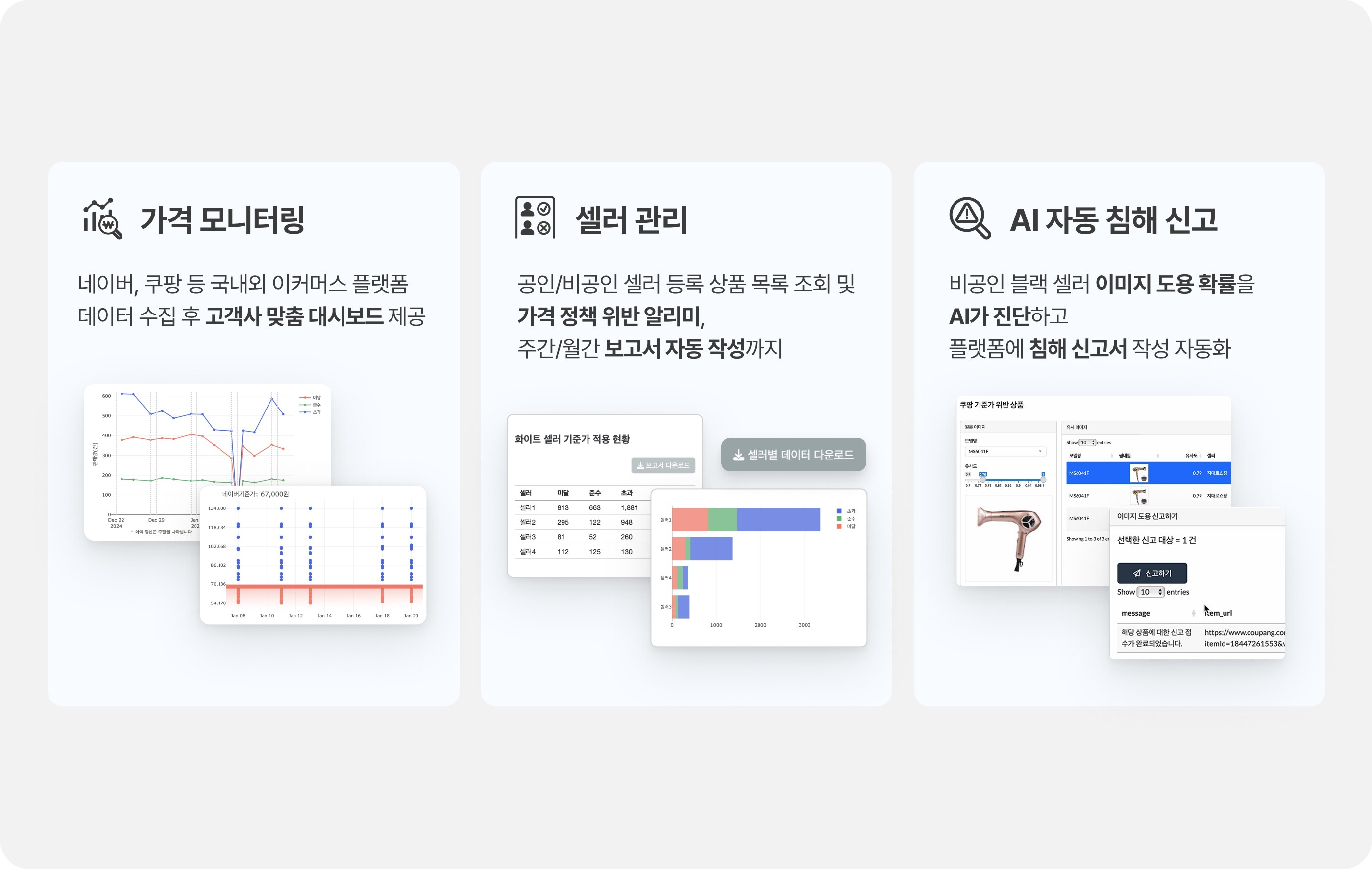
As a result, in industries based on consumer trust like health functional foods, 'images' can be a more important signal than price, and it is more effective to set image similarity detection as the primary criterion for counterfeit response. From the brand's perspective, this allows them to reduce CS costs and establish a risk management system focused on proactive prevention rather than reactive response.
A Dual Monitoring Strategy to Protect the Trust of Health Functional Food Brands
The counterfeit distribution issues facing health functional food brands go beyond simple product infringement, leading to a structural risk that breaks down trust in the entire brand. Particularly, counterfeits that sophisticatedly mimic packaging and images are difficult for consumers to distinguish from authentic products, making it easy for the brand to be blamed when problems arise.
In such circumstances, a single-approach response has clear limitations. Simple price monitoring makes it difficult to identify counterfeit distribution hiding in price ranges similar to regular prices, and given the nature of health functional foods where purchase decisions are based primarily on appearance, practical defense is only possible when image similarity detection is run in parallel.
Reflecting the unique characteristics of the health functional food industry, Reatrics supports a dual detection system that provides both lowest-price deviation detection and AI-based image similarity analysis. Through this, brands can achieve the following structural responses:
Detection of distribution channels where regular price deviation occurs
Identification of counterfeit sellers based on similar images
Securing proactive monitoring and action reports before problems arise
The key is not 'how to eliminate counterfeits,' but whether you can control the distribution structure so that only authentic products are distributed in the market. Regular price policies alone are not enough. Only when you can manage the distribution structure from two perspectives—price and image—can health functional food brands practically protect their customers' trust.