Industry Cases
Counterfeit
My child uses it... Why should I start by checking if it's authentic?
💡 In this article, you can find the following information.
Why counterfeit risks are more critical for baby products
Be suspicious of excessively low prices
Counterfeits are sophisticated: 'They look genuine, but they are not'
Checking prices alone is not enough: You must look at the image and price simultaneously
Conclusion: A double-monitoring strategy to protect the trust of infant and toddler brands
Children's Products: Why the Risk of Counterfeiting is More Fatal
“It's for my child, but what if it's not genuine?”
For infant and toddler products, whether a product is genuine is not just a matter of 'brand image'. It is directly linked to the safety of the product. Strollers, car seats, and baby bottles, which are in close contact with children, must go through strict certification procedures, and failure to meet safety standards can lead to actual accidents.
However, recently, counterfeit products that look genuine are being easily distributed through online distribution networks. Since they are difficult to distinguish from the outside and are cheap, the barrier to purchase is low, so not a few consumers choose them without suspicion. The problem arises when the fact that it is a counterfeit is revealed too late. For some, it might not be a simple price issue, but a situation that could threaten the child's safety.
Until an actual accident occurs, it is difficult for both consumers and brands to detect counterfeiting. However, if a problem arises, the expectations of consumers who trusted the brand and chose the product may eventually be shaken. Especially in sensitive product categories like baby products, simple quality issues can lead to a shift in perception of the brand. In the infant and toddler products market, safety equals trust, and even for products the brand did not sell, responsibility and damage to trust will follow.
What kind of distribution structure does this counterfeiting issue occur in? And how can we distinguish counterfeits that look genuine?
Be Suspicious of Excessively Cheap Prices
"The biggest warning sign is a super cheap price," Pfotenhauer said.
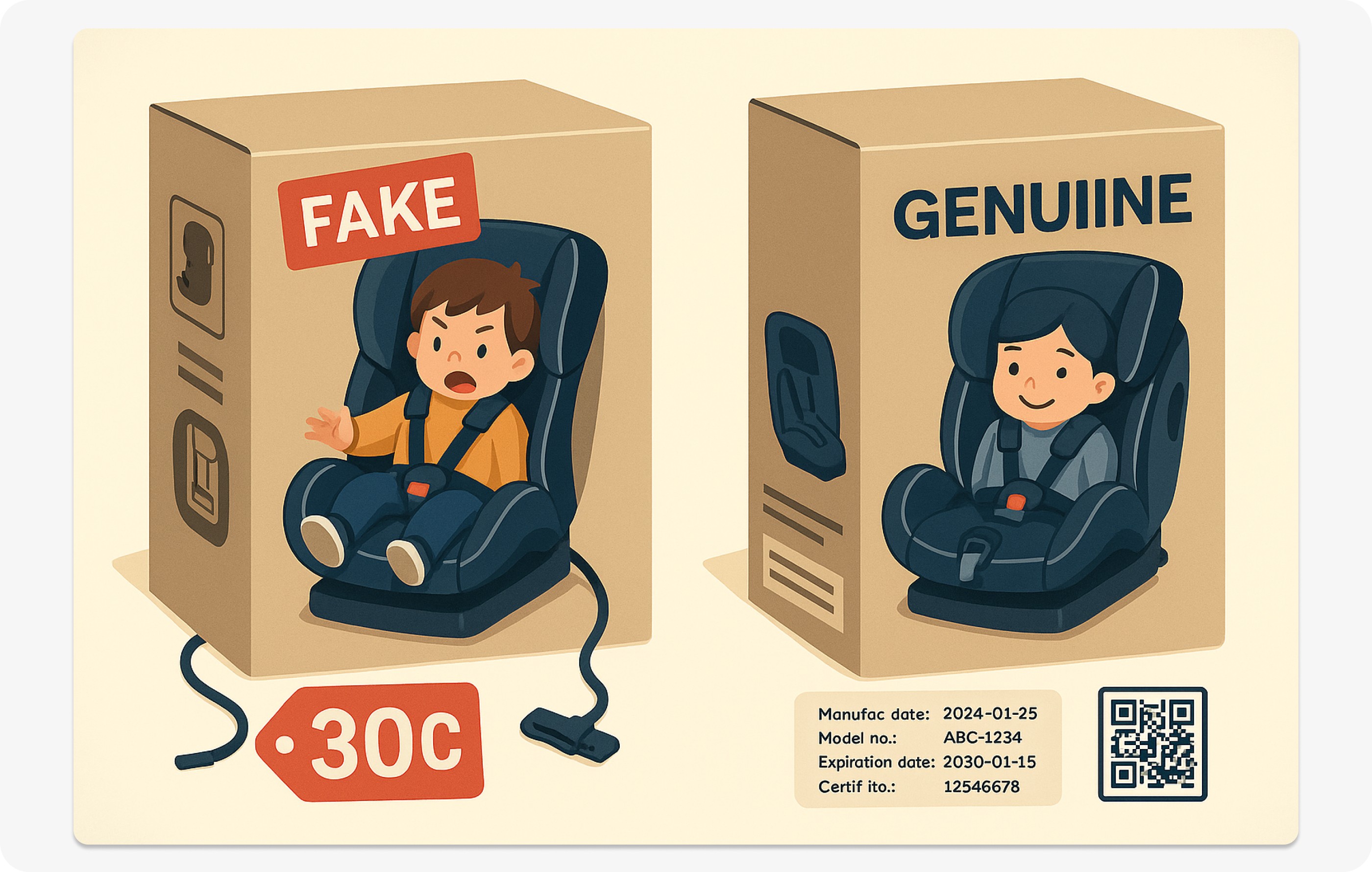
One of the most obvious commonalities of counterfeit car seats is that "the price is excessively cheap." In fact, according to an ABC7 Chicago report, Clare Pfotenhauer, a car seat safety coordinator with the Illinois Department of Transportation, revealed that one of the seized counterfeit car seats was being sold for just $30.
Genuine car seats can only be distributed if they meet the Federal Motor Vehicle Safety Standards (FMVSS), which are strict safety standards of the National Highway Traffic Safety Administration (NHTSA), and are typically sold for $100 to over $300 depending on the brand and specifications. On the other hand, many cases have been identified where counterfeits mimic only the appearance but are sold at prices more than 70% cheaper than the retail price. If you see a product being sold at an excessively cheap price compared to a genuine product, you must suspect that it is highly likely a counterfeit with unsecured safety, rather than simple price competition.
Dr. Alisa Baer pointed out in an interview with ABC News that those counterfeit products "failed to meet any US safety standards." This means that a product chosen simply because of its low price actually carries the risk of failing to protect a child's life in the event of an accident.

This situation is not just a matter of 'cheap price', but caution is needed in that the price itself can be an important signal suggesting the possibility of counterfeit. Especially on large platforms like Amazon and Temu, since numerous sellers post the same product at different prices, it is difficult for brands to track all prices directly.
Furthermore, some counterfeit products deceive consumers with marketing phrases that look like 'genuine discount'. On large platforms like Amazon and Temu, multiple sellers sell the same product at various prices, making it uneasy for consumers to judge whether a product is genuine based on price alone. If a product that consumers trusted based on price is not genuine, the damage will inevitably affect the brand's image and trust.
In the end, for infant and toddler brands, price monitoring should be recognized not as simple marketing management, but as part of risk monitoring activities to protect safety. If there are products repeatedly exposed below a certain price, a system is needed to suspect the possibility of counterfeiting or unauthorized distribution and quickly detect and take action.
Counterfeits are Sophisticated: 'Looks Genuine but Isn't'
In fact, most counterfeit baby products are cases where they 'look genuine but are not'. Since they sophisticatedly copy genuine product packaging designs, logos, and even certification marks, it is difficult for consumers as well as the distribution process to easily identify counterfeiting.
According to a report by 6ABC, a news channel in Philadelphia, USA, fake car seats distributed on online platforms looked very similar to genuine ones in appearance, but in reality, they were products that failed to meet federal safety standards (FMVSS) at all. Although the packaging boxes were similar, the products did not have manufacturing date labels, did not connect to the official site even when scanning the QR code, and the safety anchor was also much longer than the standard, resulting in an unstable structure.
In another report, an article from People.com, several practical criteria for distinguishing counterfeit car seats were also suggested. If the manufacturing date, model number, and QR code, which must be on the bottom of the product, are missing, or if the lower anchor length is excessively long, the possibility of counterfeiting should be suspected. Experts warned, "Cases where the anchor is too long or the seat belt width is abnormally thin are also characteristic features."
In the investigation by ABC7 Chicago, counterfeit car seats did not seem to have a big difference in appearance from genuine ones, but crucial information was often missing, such as the lack of a manufacturing date sticker or product info QR code, or being written with false information. Clare Pfotenhauer of the Illinois Department of Transportation explained, "A real car seat must have a label attached with the manufacturing date, model name, expiration date, and certification number, and these days you can check whether it's genuine by connecting to the manufacturer's website through a QR code. But counterfeits don't have this at all."
In addition, common characteristics were also confirmed where the fixing anchors of counterfeit products were abnormally long, or the plastic material was excessively thin and rough. Pfotenhauer directly demonstrated the counterfeit on-site, explaining, "The straps are thin and weak, and even the touch is different." These small differences can have a significant impact on shock absorption in an actual accident.
The reporter who covered the case said, "It is difficult to even realize these products are counterfeits until an accident occurs." Especially since it is a car seat for a child, they emphasized that safety defects can lead to a serious threat to life beyond a simple quality issue.
As such, the risk of counterfeit baby products is greater in that they look real on the outside, but are fundamentally different products when looking at the internal safety structure or certification labels. Especially in product categories like car seats where safety standards must be met, a precise monitoring system is needed where the brand first recognizes these differences and can respond preemptively.
Therefore, brands need to constantly monitor whether unofficial products with product images or label designs similar to existing genuine products are being distributed, beyond simply detecting price anomalies. To identify sophisticated counterfeits that cannot be filtered out by simple price comparison, linking with image-based analysis tools can be effective.
Checking Prices Alone is Not Enough: Must View Images and Prices Simultaneously
Synthesizing the contents of the counterfeit baby product cases reviewed above, it is difficult to accurately judge counterfeiting by checking only one of appearance similarity and price anomalies, and the detection accuracy can be improved only when both pieces of information are considered together. Especially, counterfeits that copy genuine packaging, labels, and images easily deceive consumers' eyes in the online distribution environment.
As can be seen from the cases of ABC7 Chicago and People.com, some counterfeit car seats are designed to look like actual genuine products, making it hard to distinguish authenticity at first glance. However, manufacturing date stickers, QR codes, and model names were often missing or filled with false information, and fixing anchors or straps were often composed of materials significantly weaker than genuine ones.
The problem is that this information is often not included in product description images or detail pages, or is exposed in a falsified state. Especially in a structure where multiple sellers register products like Amazon and Temu, it is close to impossible for a brand to review all individual registered images or check the prices of all sellers.
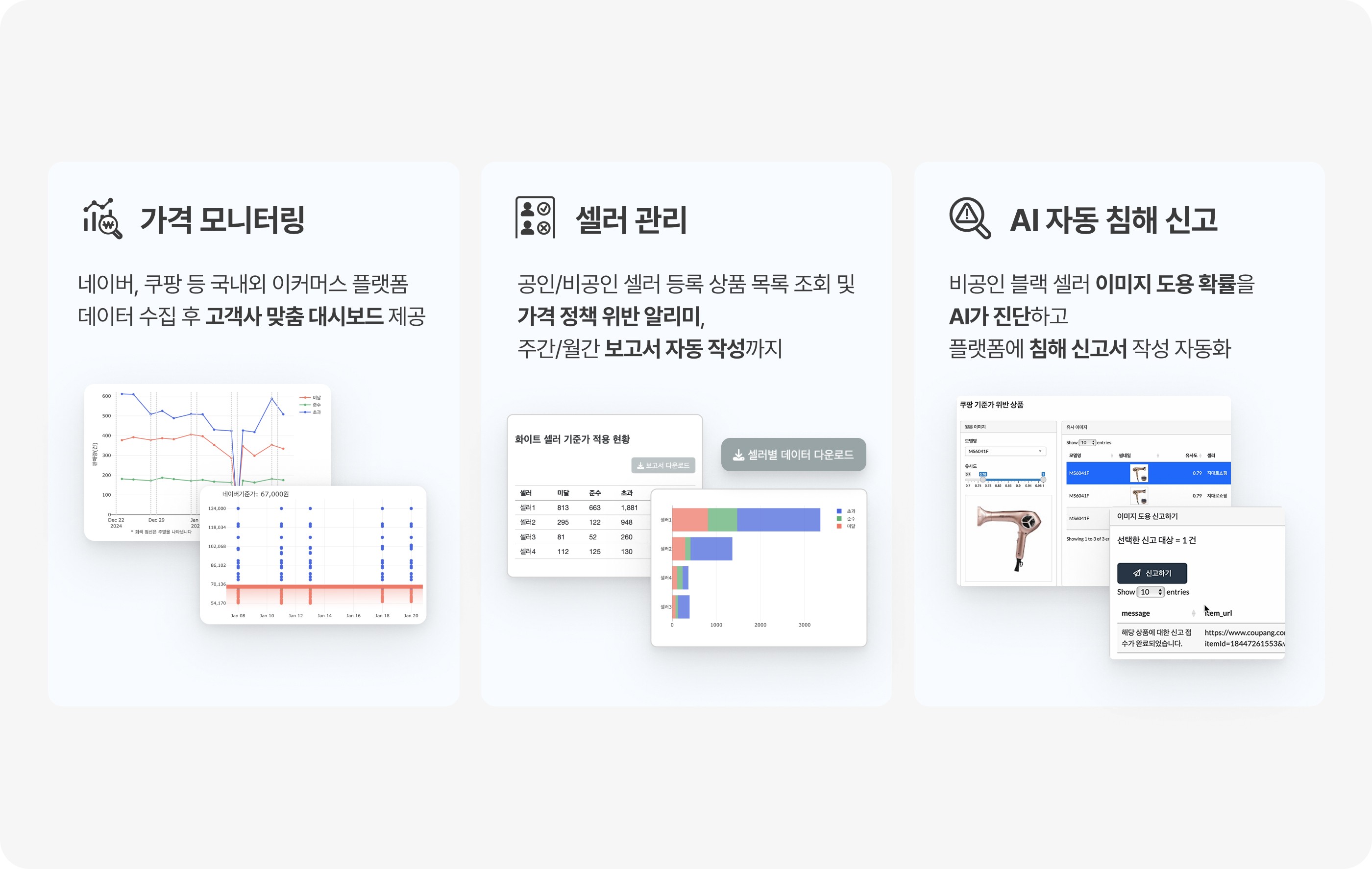
What is needed in this case is an AI analysis tool based on image similarity. It is a method of training the packaging design and label structure of genuine product lines so that when images with similar characteristics are newly distributed, they can be automatically detected. Indeed, many brands have price monitoring systems, but few possess image analysis-based counterfeit detection frameworks.
Therefore, going forward, we must reduce the blind spots of counterfeit distribution through systems that can monitor images and prices simultaneously. Especially in product categories directly related to safety like baby products, continuous monitoring can become a key means of brand protection.
Conclusion: Double Monitoring Strategy to Protect the Trust of Infant and Toddler Brands
The issue of counterfeit baby products is a structural risk that threatens both brand trust and consumer safety, beyond a simple quality issue. In a situation where counterfeits that look genuine on the outside but fail to meet safety standards are spreading through online distribution networks, it is difficult to fully protect brand value with conventional passive responses alone.
The cases reviewed above show that it is time for brands to build a 'double monitoring system', which is a strategy to monitor both images and prices simultaneously, given that appearance copying, price deviation, and information manipulation are occurring at the same time. To find counterfeits that copy genuine packages and label designs, AI-based image analysis technology must be combined with automated price monitoring systems to detect products distributed at abnormally low prices. When vision-based detection using AI image analysis technology and a monitoring system that grasps price anomalies in real-time work together, counterfeit distribution can be blocked more precisely and quickly.
Especially in product categories directly linked to safety like baby products, securing trust directly connected to the lives of consumers is key, beyond simple brand protection. We are in an era where equipping a precise detection framework that monitors and analyzes both images and prices simultaneously becomes the brand's responsibility and competitiveness.