Industry Cases
Counterfeit
[Distribution Crackdown Guide #03] "I bought it trusting the brand name, but a moldy sofa?" 3 Key Standards for Cracking Down on Sellers Violating Furniture Disclosure Regulations

💡 In this article, you can find the following information.
"I thought it was a new sofa, but there are scratches on the bottom?" A 'used sofa' packed in an authentic box
What are the 3 major enforcement points for illegal distribution sellers that serve as the basis for platform sanctions?
"I bought it trusting only the brand name, but it's a moldy sofa?": Damage cases in the famous domestic furniture industry
Data mismatch that cannot be found by eye, how does Re-Trix identify 'ghost sellers'?
Only when honest data reaches the customer's living room is the brand's credibility truly complete.
"I thought it was a new sofa, but there are scratches on the bottom?" A 'used sofa' inside a genuine product box
In the furniture and living industry, brand trust is determined not only by product design and thorough quality control, but also throughout the entire process up to its placement in the customer's space. However, in the recent e-commerce market, methods of repackaging and selling products returned due to simple changes of mind or model house exhibition items in genuine boxes have been increasing. The problem is that sellers take advantage of the fact that it is difficult to distinguish them from new products with the naked eye, distributing the products without notifying the information 'refurbished' anywhere on the detail page. These malicious sellers hide subtle signs of use that are not easily noticeable and interfere with consumers' rational judgment.
Since furniture is not an item that can be returned lightly like clothing or cosmetics, the concerns of brand practitioners are bound to deepen. This is because, due to the nature of the product, the share of logistics and installation costs is extremely high compared to other industries. In fact, if a customer discovers a defect after delivery is completed and a return is processed, the direct losses, such as round-trip shipping costs and labor costs, are several times higher than those for general goods.
An even more serious problem than this is that consumer resentment caused by the deceptive acts of unofficial sellers eventually turns toward the brand headquarters. This is because consumers tend to make purchasing decisions based on the name value and worth of the brand, regardless of who the seller is. In fact, there are cases where consumer damage caused by malicious sellers has led to the tarnishing of the brand headquarters' external image. We will look into the specific aspects of how this manifested in more detail below.
Ultimately, the opaque distribution methods of sellers that brands fail to control damage the unique identity built over a long time, leading to the departure of loyal customers. Since the collapse of brand value is a matter directly related to survival, this is no longer simply about managing individual sales pages, but has become a core task that must be resolved.
What are the 3 major crackdown points for illegally distributing sellers that serve as the basis for platform sanctions?
The most objective and reliable way to protect brand assets in the e-commerce market is to utilize the legal guidelines called [Notification on the Provision of Information on Goods, etc. in Electronic Commerce, etc.]. As a brand manager, even if you suspect a counterfeit or abnormal distribution and report it to a platform, you might often experience situations where it is rejected due to insufficient evidence. What serves as powerful physical evidence at this time is this information provision notification data. In particular, since the fields of furniture and home appliances are directly related to consumer safety and after-sales management, the items to be legally labeled are highly subdivided, and the regulations themselves are more demanding and stricter than in other industries.
The representative notification systems that furniture and appliance brand practitioners should check to increase the efficiency of distribution crackdowns include Furniture (No. 6), as well as Video Appliances (No. 7), Electrical Products (No. 8), Seasonal Appliances (No. 9), and Office Equipment (No. 10). Although malicious sellers can make thumbnails or detailed page images look like genuine products, it is practically difficult to perfectly match the consistency of detailed data according to laws and regulations. Therefore, we have summarized three key items that can be immediately utilized as evidence of illegal distribution in practical fields.
First, has the 'reason for re-supply' been specifically stated, such as simple change of mind products, exhibition products, etc.?
According to Article 6, Paragraph 9 of the Notification, refurbished products must specify the reason for resale and the defective parts in detail. This means that they must not only disclose that it is a used product, but also provide detailed information on specific reasons, such as whether it is a model home exhibition product or a product returned due to a simple change of mind, as well as the defective parts like scratch locations. For example, a clear description like "Model house exhibition product with minor scratches on the table legs" is required. Sellers who pass off refurbished products as new products deliberately omit this information or use ambiguous expressions like 'Refer to the bottom of the detail page' to avoid legal liability. This is an act of violating the 'obligation to present specific reasons' stipulated in Article 3 of the General Principles of the Notification.
Second, does the 13-digit KC certification number match the official data?
The 'KC certification information' commonly applied to home appliance and electrical product notifications is an essential item directly related to consumer safety. In accordance with Paragraph 6 of the General Principles of the Notification, KC certification information must be displayed together with the KC mark and identification code (certification number, notification number, etc.), and in the case of exempt items, that fact must be clearly communicated to consumers. Malicious sellers only emphasize the phrase "KC Certified," while omitting the identification code, which is essential data, or stealing numbers from other products. There are even cases where they falsely state 'certification exempt' even though it is not a 'foreign purchasing agency' subject to certification exemption. Such data errors become a strong justification for the platform to take immediate sales suspension measures.
Third, is the listed AS number a 'non-existent number'?
The last item of all living and appliance notifications stipulates that the person responsible for after-sales service and their contact information must be transparently disclosed. Black sellers, who must hide their distribution channels, often leave clues in this section. They infringe on consumers' rights by writing unverified company names instead of official service centers, or by writing ghost numbers that cannot be reached at all. According to Article 3 of the General Principles of the Notification, labeling that simply claims it is difficult to confirm is not accepted. Writing a false number is a clear violation of regulations, not just a simple operational mistake, so this data mismatch is reliable ground for brands to request preemptive actions from the platform.
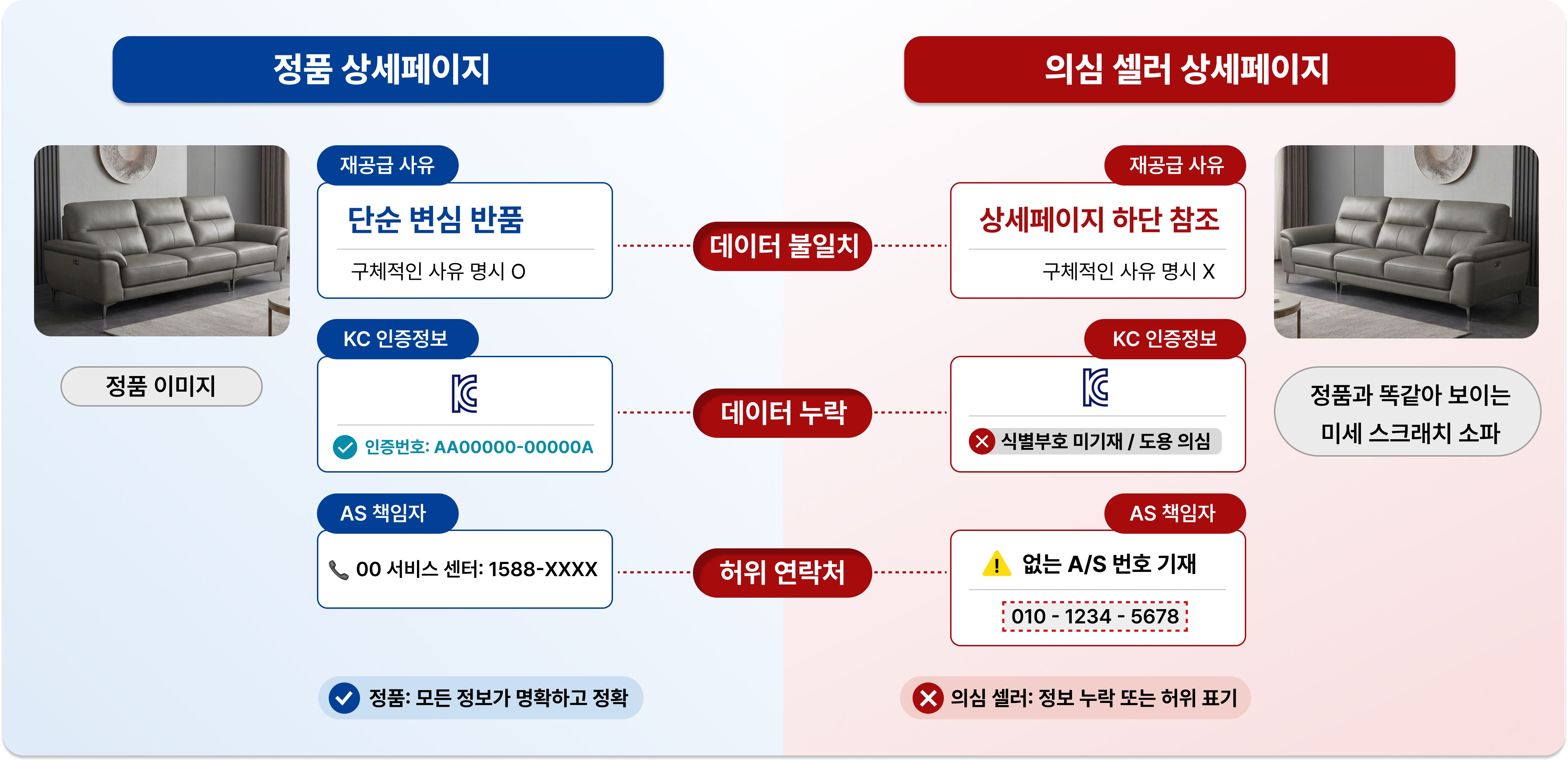
"I bought it believing only in the brand name, but it's a moldy sofa?": Damage cases in the famous domestic furniture industry
The notification items reviewed above are not simple administrative procedures, but indicators showing how transparently a brand manages its distribution process. In the actual domestic furniture market, cases frequently occur where notification data is cleverly omitted or falsely stated, causing serious damage to consumers and consequently damaging brand value.
As a representative case, there was an incident where a sales company acting under the trademark of H, a famous domestic furniture brand, repackaged defective returned products and disguised them as new products. According to reports, the company had delivery drivers without professional knowledge repair products returned due to torn leather or broken frames, and then sold them in genuine boxes without any information disclosure. There was even a confirmed case where a product was delivered to a customer with mold growing on the bottom. According to Article 6, Paragraph 9 of the Furniture Notification, the reason for the refurbishment and the defective part must be clearly written as text data, but they ignored their legal obligations and deceived customers.
What is noteworthy is that the illegal activities of these unofficial companies directly led to a crash in the credibility of the brand company (Company H). This is because, even though a separate Company A was in charge of manufacturing and distribution, consumers made purchasing decisions trusting the name and reputation of the 'No. 1 brand.' The brand explained, "We only lent the trademark, and manufacturing and distribution are the responsibility of the company in question," but consumers' reactions were cold. In fact, one customer who bought the suspected returned product thinking it was new expressed anger and distrust, saying, "I am a regular customer who has been buying for over 5 years believing in the brand name of Company H alone, and as such suspicions have been raised, I hope they thoroughly verify the facts." Consumer groups also criticized, saying, "Since it is highly likely that Company H's brand reputation acted as a decisive factor in customers' purchasing decisions, they cannot evade responsibility simply by claiming they were not involved in manufacturing and distribution."
Ultimately, the unmanaged seller's intentional concealment of information and deceptive acts led to the brand company's apology and corrective measures, and the brand equity built with great effort over a long period was damaged in a short period of time. As such, it is important to keep in mind that leaving the data consistency of detailed pages neglected is not just a problem for a single seller, but can be a prelude to the collapse of the entire brand's distribution governance.
Data discrepancy that cannot be found with the naked eye: How does Retrix identify 'ghost sellers'?
The root cause of the 'moldy sofa' incident experienced by famous brand H was that the seller intentionally distorted the data. However, it is virtually impossible to go into thousands of product pages one by one and check "Is this number real?" and "Does the call connect?" At this point, Retrix becomes the eyes and hands of practitioners to find lies hidden inside images.
1. 'AS Unavailable' text secretly hidden in the corner of images, OCR technology finds it
According to regulations, the furniture and home appliance sectors must transparently disclose manufacturer and importer information. Clever black sellers fill out the text notification area plausibly, but put phrases such as "Official service center unavailable" in small text deep inside the detail page image. Retrix utilizes advanced OCR technology to extract all of these escape clauses hidden inside images. Through this, it immediately identifies sellers who have written manufacturing information different from the brand master DB, and captures data contradictions where information in the image conflicts with the text notification area, utilizing it as evidence of illegal distribution.
2. Mismatched certification numbers between text and images are verified by real-time cross-referencing
The identification code written along with the KC mark is an area where verifying authenticity is extremely difficult. Retrix automatically extracts the certification number from the image and performs real-time cross-validation with Korean Agency for Technology and Standards data. Going beyond simply checking the presence of a number, it analyzes whether the number has stolen from another product or whether the certification information search page is working normally. Through this, it accurately captures data integrity errors that are difficult for humans to find.
3. Listing sellers who use fake contact information to protect brand CS channels
The decisive reason why complaints from customers who purchased products from unofficial sellers transfer to the brand headquarters is that the AS contact information provided by the seller is false. When a customer attempts to contact the seller due to a product defect and fails to connect due to reasons such as a non-existent number, they eventually demand a solution through the brand's official customer center. Retrix conducts a full investigation of unlisted patterns used by malicious sellers to conceal distribution routes, such as ghost numbers that cannot be reached or arrangements of meaningless numbers. By turning these after-sales service risks into data and requesting preemptive sanctions from the platform, it reduces the workload burdened on the official brand CS team and increases the transparency of the distribution environment.
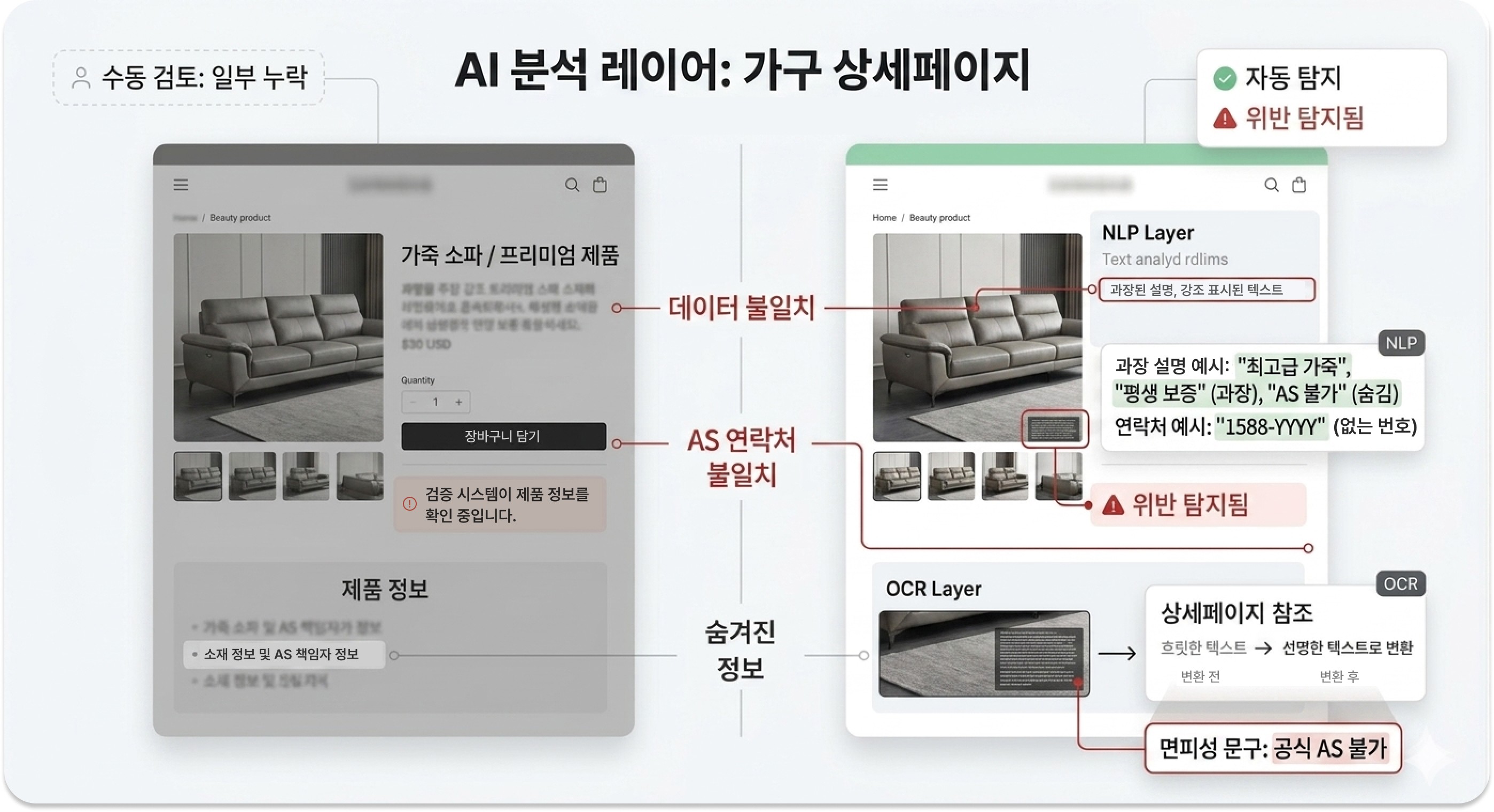
When honest data reaches the customer's living room, the brand's credibility is finally complete.
The beginning of rectifying the distribution order in the furniture and living market lies in keeping the essence of 'transparent information disclosure' after all. As shown in the cases reviewed above, the deceptive acts of malicious sellers show that a single piece of data has become a key variable determining the survival of the entire brand. The moment information that deceives customers, such as hiding fatal product defects or falsely writing certification numbers, is neglected in the market, the brand equity built over a long time is bound to suffer a serious blow.
Retrix's detection solution, which preemptively blocks such risks, does not stop at simply uncovering violations, but acts as a driving force to purify the distribution environment by sending a signal to the market that the brand is thoroughly managing even the consistency of notification data.
Now, brand companies must go beyond individual product monitoring to build healthy distribution governance where only honest sellers can survive. When securing the transparency of the distribution network based on the objective indicators and legal grounds provided by Retrix, brands can finally escape from the risks of consuming CS disputes and image tarnishing. Preserving the integrity of data is keeping a promise to customers, which will serve as a solid foundation that allows brands to focus on product competitiveness and long-term growth.