Price Management
We Have the Data, So Why Can't We Trust It: How a 1% Error Ruins Your Pricing Strategy
💡 In this article, you can find the following information.
The 1% blind spot, scarier than a 99% collection rate, and data distrust
The trap of "100% collection success": Is the data you brought 'real'?
"We scraped the data, but..." Why are we still struggling with Excel?
Why did major domestic companies choose Re-Trix instead of in-house solutions?
How to escape the swamp of data management and focus on the essence of your business
The 1% Blind Spot and Data Distrust That Are Scarier Than a 99% Collection Rate
The core of business intelligence lies not in the mere existence of data, but in its 'integrity'. Especially in the e-commerce market, price reports updated every morning are the most objective indicators that determine a brand's pricing policy and distribution strategy. However, despite investing budget to build collection systems and introduce external tools, many companies face situations where they cannot fully trust the figures in the reports at crucial decision-making moments.
The situation always starts similarly. When opening the report right after arriving at work, it clearly seems that the lowest prices of all core models are being stably defended within the brand's guidelines. However, the moment you access the platform and type in the search bar to double-check, you discover 'bait products' or sellers who have subtly lowered prices being exposed at the top, which were not in the report. Although the report indicates that all models are being sold within the guidelines, accessing and searching the actual platform reveals quite a few violations that the report missed.
This mere 1% accuracy discrepancy does not just stop at the fact that 'one or two items were missed'. When the experience of the report's figures not matching the actual screen results is repeated, practitioners eventually conclude, "I cannot be sure of data I haven't seen myself." Consequently, despite having automated reports, an inefficiency arises where managers spend their entire morning accessing platforms one by one to recheck selling prices. Instead of work efficiency, which is the purpose of automation, it actually increases the 'workload to be verified'.
Even if the data collection rate reaches 99%, if there is a 1% blind spot that deviates from the actual situation on the ground, that data loses its function as a strategic tool. This is because decisions based on incomplete data not only slow down market response speed but also result in shaking the brand's price governance itself. Where does this 1% error that destroys trust mainly originate? The first barrier lies in the increasingly sophisticated defense systems of platforms.
The Trap of "100% Collection Success": Is the Data You Brought 'Real'?
Today, the asset protection strategies of major platforms, including Naver and Coupang, have evolved beyond simple 'access regulation' to the stage of 'inducing information asymmetry'. In the past, when abnormal access was detected, they mainly used methods to physically stop the collector by immediately blocking the IP or displaying a CAPTCHA. However, the latest anti-crawling systems employ a 'Deceptive Data' strategy, where they let the collector appear to be operating normally while intentionally providing response values with incorrect price information or missing key data.
In other words, the collection process is displayed as completed normally, and the collector reports, "Ah, I brought all 100 data points today as well!" But when checking the actual stored values, the price information is distorted or essential option data is missing in large quantities. Instead of directly blocking the collector, the platform contaminates the analysis data itself by feeding false information.
Many companies might think, "These days, if you ask AI to write code, you can build a crawler in no time, right?" However, the real barrier lies not in the code, but in 'reproducing the connection environment'. Platforms like Naver and Coupang do not just check the user's IP; they analyze thousands of variables—how the user moves the mouse, the screen resolution, and even what fonts they are using—to determine 'whether it is a human or a robot'. This is called 'Browser Fingerprinting' technology, and no matter how pretty the code the AI writes for you, bypassing such sophisticated surveillance is close to impossible. Although writing collector code has become easier through generative AI, this fingerprint analysis technology requires a sophisticated connection environment that cannot be imitated with static code alone.
Ultimately, an in-house collector running conventionally without a sophisticated bypass infrastructure is exposed to the risk of indiscriminately accepting 'contaminated data' thrown by the platform's sophisticated bot detection algorithms. This is far more critical than stopping data collection altogether. This is because unverified false data enters the analysis system, undermining the foundation of the pricing policy and consequently distorting the entire strategic decision-making path of the company.
🔍 The Secrets of 'Real-Time Price Fluctuations' on Coupang and Naver That an In-House Collector Can Never Know
Major platforms do not just stop at blocking; they employ highly sophisticated psychological warfare to confuse collectors.
1. Coupang's Dynamic Pricing Structure
Major e-commerce platforms, including Coupang, operate a dynamic pricing structure that displays prices, discounts, and exposure order differently based on the connection environment, user history, and login status. Due to this personalization logic, even for the same product, different prices may be collected depending on the collection timing and environment.
Example of Defense Method: When a regular user accesses, it shows the normal price of 19,800 KRW, but when an IP suspected of being a robot (collector) accesses, it subtly displays 22,000 KRW or out of stock.
Result: The collector reports that it has successfully retrieved the data, but our company ends up establishing a reverse-margin policy based on the wrong market price.
2. Naver's Structure Change-Based Crawling Defense
Major platforms such as Naver Shopping frequently change page structures, class names, and data loading methods to prevent crawling. As a result, even if a collector based on fixed logic appears to operate normally, problems of misidentifying or omitting price or option information can actually occur.
Example of Defense Method: If the name of the section containing price information was
price_infoyesterday, it changes toa1b2_c3today. Furthermore, although it looks identical to a human, they even hide fake price data within the code read by robots.Result: The fixed code written by the AI becomes meaningless overnight, and it ends up collecting absurd text by recognizing it as the price.
🕵️♂️ Data Integrity Diagnosis: A 3-Step Verification Method to Determine If Your Collector Is Fetching Contaminated Information
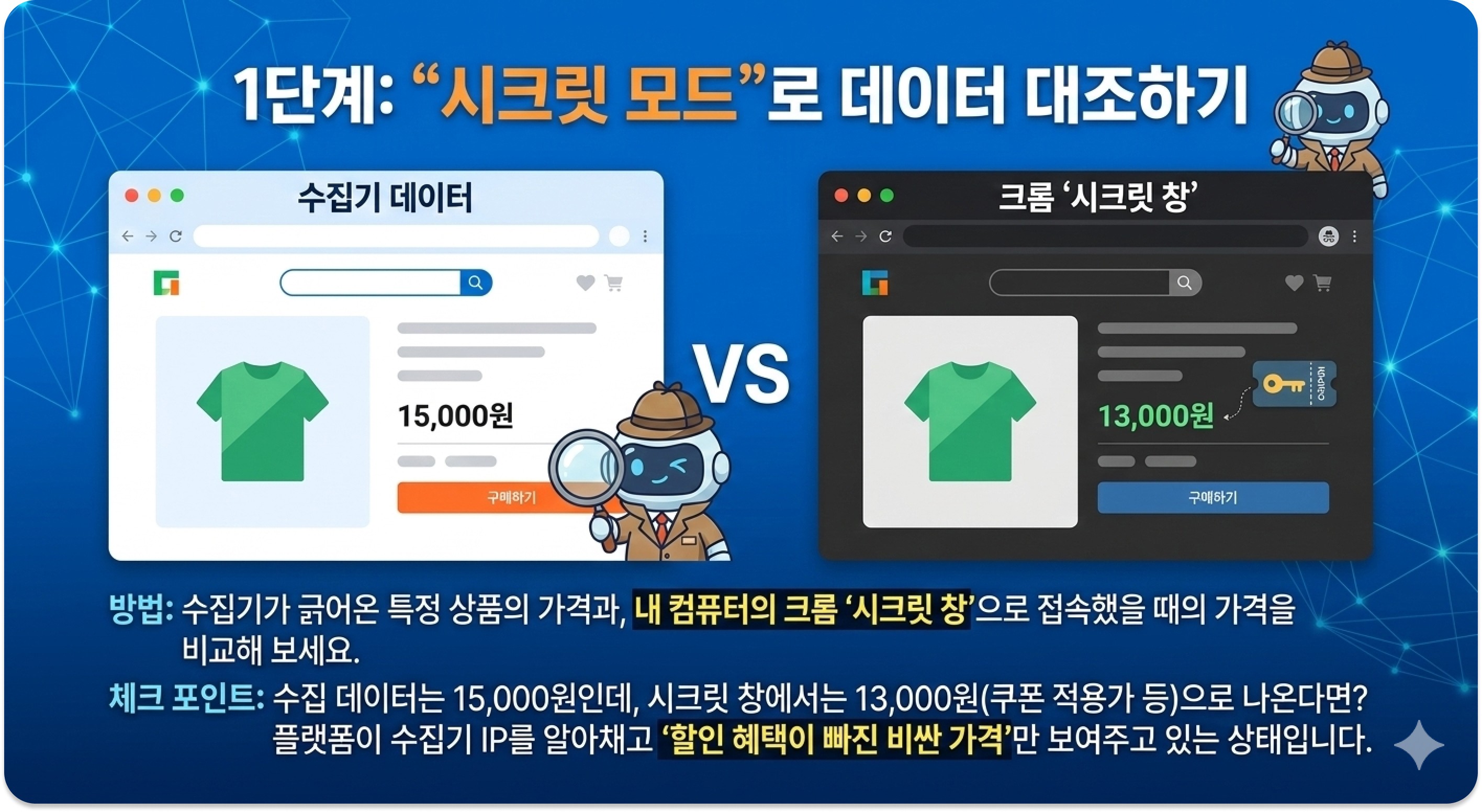

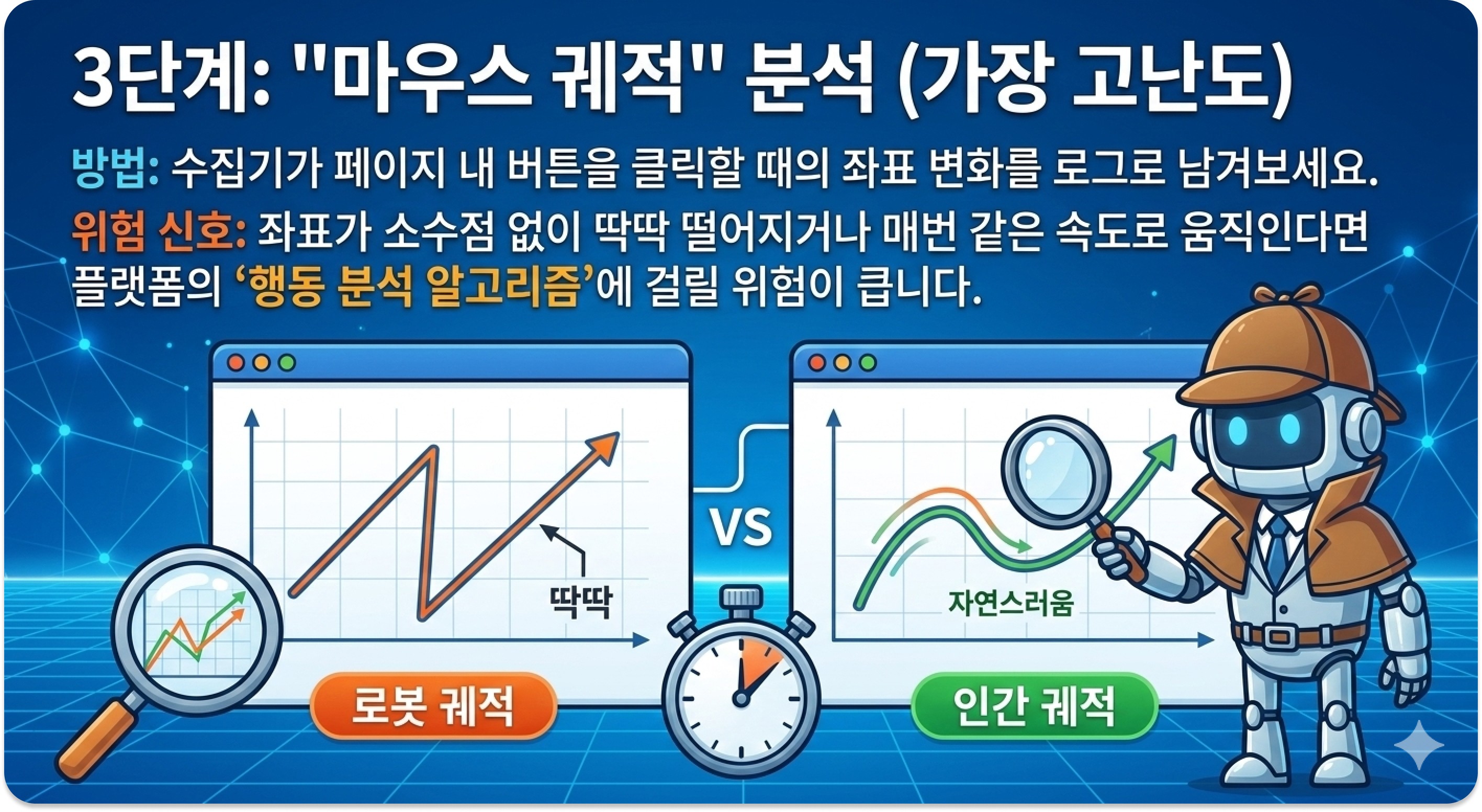
The factors threatening data integrity are not just the platform's external defense walls. The internal processing of aligning the collected information with our brand's standards is also like a giant maze.
"We Scraped the Data..." Why Are We Still Battling Excel?
"We scraped all the data, so why does it take another half day to organize it in Excel?" This is a wall that anyone who has built an in-house collector will inevitably face. The biggest wall faced when operating an in-house collector is not the collection itself, but the process of organizing the collected data. Even if you succeed in retrieving the price information exposed on the web screen in text form, the system cannot clearly distinguish whether the product is a single item, a bundle configuration, or a planned set that includes free gifts.
In fact, the point where the highest technical load occurs in e-commerce data analysis is not simply the stage of scraping data, but the 'data normalization' stage, which aligns the collected raw data into an analyzable format. The process of extracting unstructured information scattered across tens of thousands of product names and options and matching it 1:1 with the brand's standard model must be supported by a calculation system far more advanced than simple collection. There is a clear difference in the qualitative completeness of data between simply scraping text from a detail page and interpreting the meaning contained within to make it immediately usable for brand decision-making.
In reality, the systems sellers use to label product names are highly diverse, and option configurations are also complex. For example, even for the identical product, one seller labels it "Ampoule 50ml" while another writes "50ml*2ea (Total 100ml)". From the collector's perspective, a logic to determine whether to compare these two products based on the same standard or treat them as separate products with different capacities is essential. The moment a practitioner has to manually classify bundles and single items because this judgment cannot be automated, the purpose of introducing an automated system is inevitably diluted.
Automation That Breeds Manual Work vs. Integrity Data Trusted 100% by Practitioners
To compare this accurately, a precise parsing logic must be supported that goes beyond simple keyword matching to identify core variables of 'capacity' and 'quantity' within product names based on Natural Language Processing (NLP) technology, and automatically convert them into 'price per unit'.
Ultimately, automated collection without such logic leads to a swamp of manual work where, even if data exists, practitioners must visually check and organize Excel sheets again. This is also why global solutions are evaluated to have low data accuracy in the Korean market. If they cannot sophisticatedly interpret the complex option systems and combined discount structures unique to domestic e-commerce, they will inevitably fetch incorrect data no matter how good their technology is.
The true value of data lies not in the 'quantity' collected, but in how accurately it converts and displays fragmented information according to the brand's standards. Unrefined data is nothing but a list of unusable numbers, and automation that omits sophisticated matching logic will ultimately only breed another form of manual work.
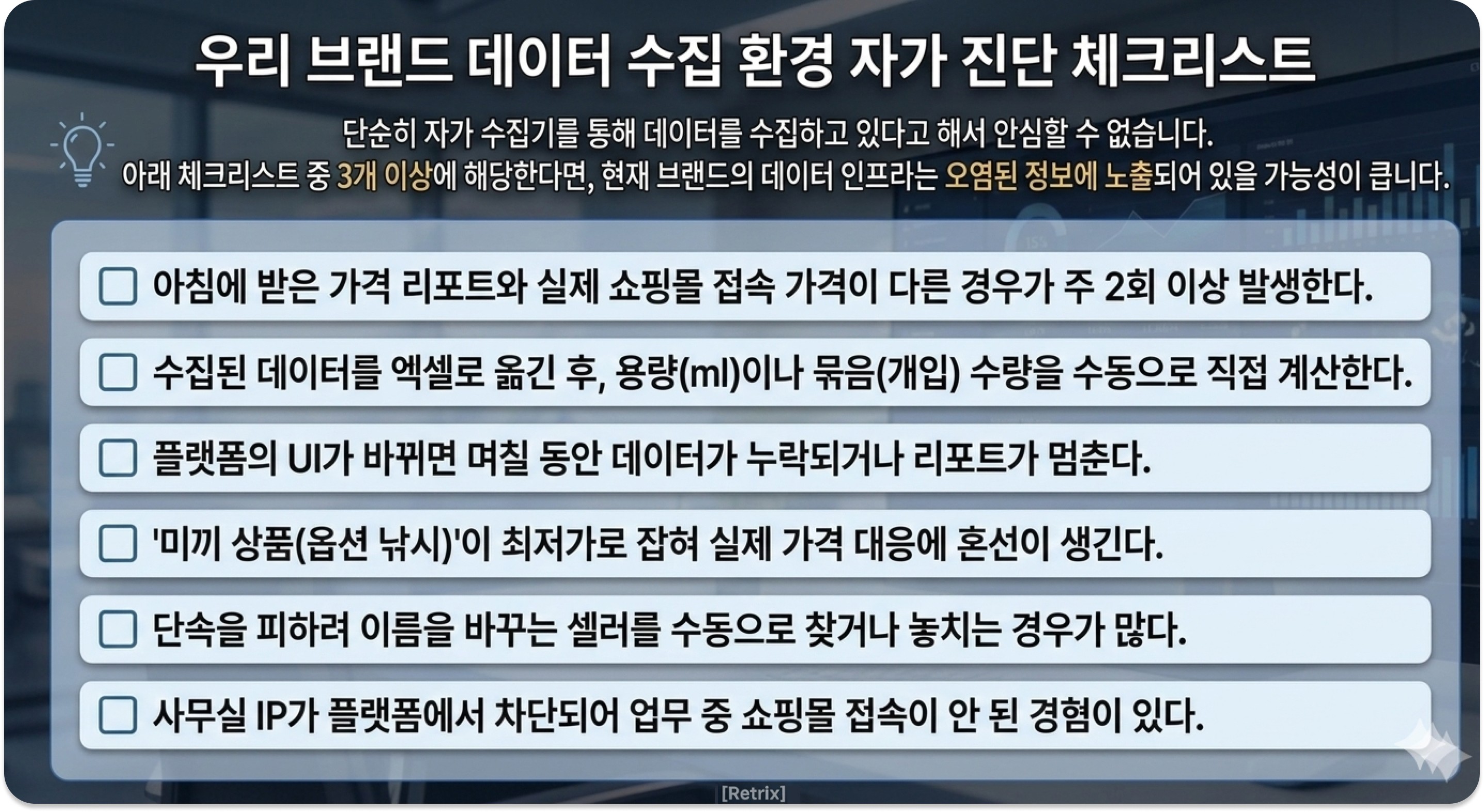
Then, how can we secure data that practitioners can trust 100%, transcending platform defenses and the limitations of unstructured data? Reatrichs took the direct approach of 'integrity of results' right at this point.
Why Did Major Domestic Companies Choose Reatrichs Instead of In-House?
The reason major domestic companies choose Reatrichs over building in-house is not simply due to the volume of data collected. It is because Reatrichs resolves the technical challenges of platform defense logic and unstructured data refinement through its 'operational integrity system', completely transforming the anxiety felt while comparing report figures with actual screens into confidence in the data. An environment where practitioners can believe and act on the report itself as fact without having to verify it directly—that is the operational integrity Reatrichs provides.
(1) Intelligent Verification: Automatic Filtering to Weed Out Fake Platform Data
Deceptive data (fake data) or bait information for bot detection provided by platforms is difficult to identify with general collectors. Reatrichs activates an automatic verification layer that compares collected data with average market price trends and historical records immediately after collection. If an abnormally low price or omission of essential option information is detected, the system immediately identifies it and performs re-verification. Through this, practitioners are unaffected by distorted information and check only the refined results reflecting actual market conditions.
(2) Smart Matching: NLP Technology to Align Unstructured Option Information into a Single Standard
Different product naming conventions by sellers and complex bundle configurations are major causes of decreased efficiency in data utilization. Reatrichs precisely extracts actual capacity, quantity, and component information from tens of thousands of unstructured texts to match them with the brand's standard model. By providing variables such as 'bundle of 2' or 'includes gift' automatically converted into unit price or standard specifications, practitioners can immediately grasp whether pricing guidelines are violated without additional processing work.
(3) Path Optimization: Self-Healing Pipeline That Keeps Going Despite Platform UI Changes
Platform UI changes or strengthened defense logic are the biggest causes of collection disruption. Moving away from reading data only through fixed paths, Reatrichs operates an infrastructure that detects platform structural changes in real time and flexibly reorganizes collection paths. Through this self-healing pipeline, the risk of technical failure is minimized, and brands can utilize uniform quality data as a business constant 365 days a year.
(4) Seller Profiling: Advanced Identification Technology Tracking Even Anomalous Activities Hidden Behind Names
Anomalous sellers who evade monitoring by changing names and business information are a challenge in brand price policy operation. Going beyond simple account tracking, Reatrichs applies profiling technology that combines various digital footprints and activity patterns left by sellers to identify whether they are the same person. By integratedly managing scattered violation cases as a single risk group, brand companies can secure more effective legal and sales response grounds.
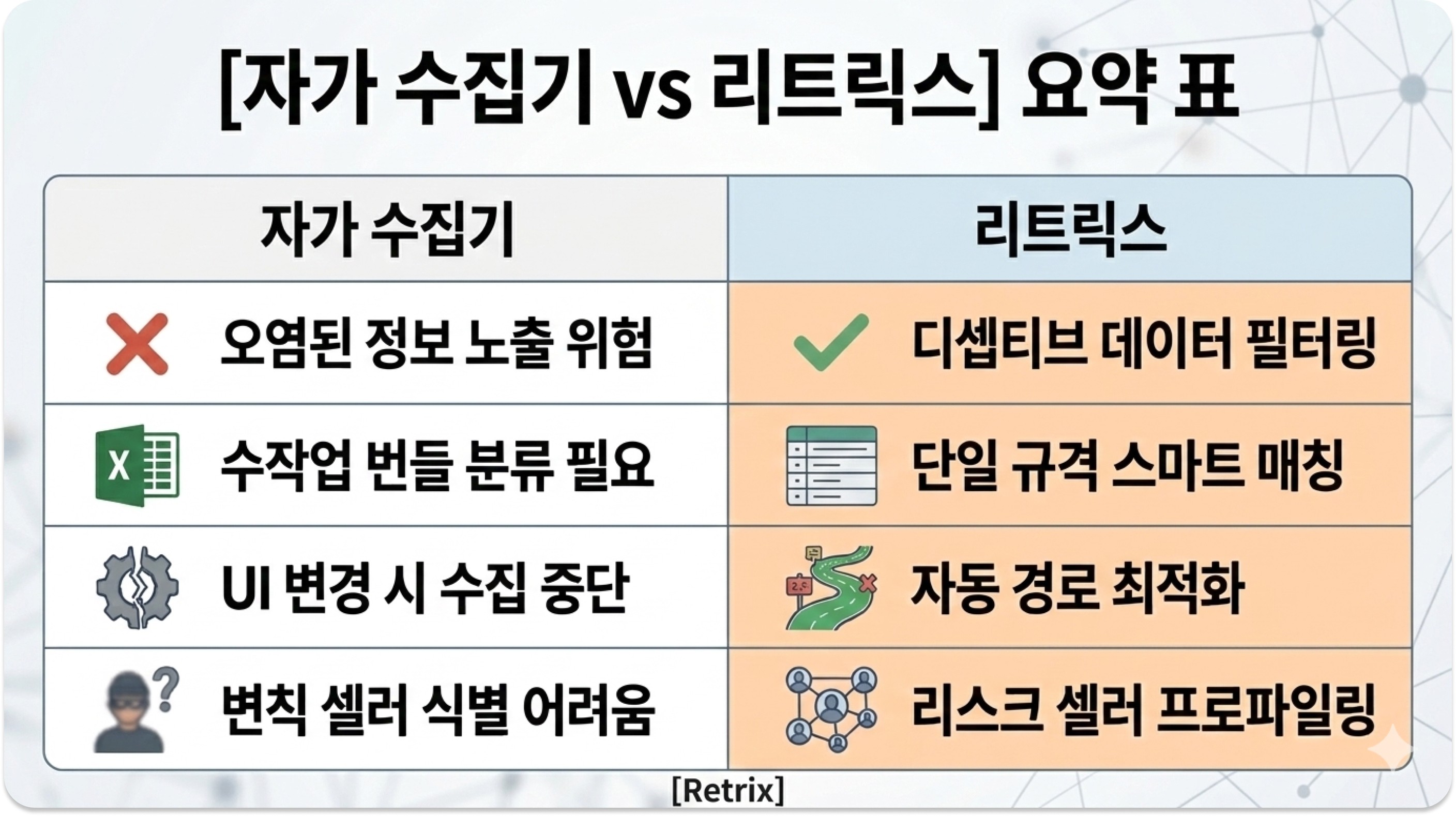
Ultimately, Reatrichs secures data reliability by combining a stable collection infrastructure with sophisticated data alignment technology. On top of this infrastructure, brands can finally break free from the technical debt of data collection and establish an environment where they can focus solely on core tasks that strengthen market strategy.
How to Escape the Swamp of Data Management and Focus on Business Essence
Now, we must examine once again the essential purpose of collecting data. Precious resources should not be spent on fixing bugs in collectors or finding errors in Excel figures. Data should exist only as a tool to contemplate "how to defend brand value and increase sales by even 1%". However, many companies spend excessive energy on the management and maintenance of collection tools, repeatedly failing to focus on the core tasks of interpreting collected data and establishing strategies.
Operating an always-on monitoring system directly to prepare for unexpected collection errors is a highly inefficient choice from a business perspective. The wisest alternative is ultimately to introduce a system where practitioner intervention is minimized. Data collection must not be a 'work variable' whose results vary depending on management, but an infrastructure provided with uniform quality under any circumstances—a 'constant'.
Reatrichs will take full charge of the complex technical challenges arising in the data collection process. Brand managers, devote all your capabilities solely to essential strategic tasks that increase market share and drive brand growth using the flawless data guaranteed by Reatrichs. Establishing an environment where you can break free from the hassle of data management and fully focus on the essence of business—that is the most definitive value Reatrichs aims for.