Industry Cases
Counterfeit
[Distribution Crackdown Guide #04] "They are both genuine, so why are the widths different?" 3 types of public notice data for catching fashion counterfeits

💡 In this article, you will find the following information.
"They said it was a genuine parallel import, so why is the material like this?”
The legal weapon to turn suspicion into certainty: The 4 major fashion notification data
From damaged labels to falsified materials... Clever cases of counterfeiting in the fashion market
Traces of counterfeits missed by the naked eye: Why automated data comparison is necessary
The unwavering power of a brand comes from 'data integrity'
"They said it was a genuine parallel import, so why is the material like this?”
"It's definitely our brand's product, but why is the review full of complaints about the finishing being a mess?"
If you are a fashion brand practitioner, you have probably felt frustrated at least once between the reckless sale of counterfeit goods by unofficial sellers and the pouring in of customer complaints. In the fashion industry, a brand's identity is completed through a design philosophy built over a long period of diligent effort, as well as the texture of materials directly felt by customers and strict processing. However, the recent e-commerce ecosystem is suffering greatly from intelligent counterfeits that instantly neutralize these values built by brands.
While counterfeits in the past were easily identifiable by crude finishes or clumsy logo copies, today's counterfeits disrupt the market's distribution order by using subsidiary materials that are difficult to distinguish from genuine products and adopting a high-price strategy of up to 90% of the genuine price. Brands spend countless hours selecting materials and modifying patterns to complete a collection for a single season, but counterfeit sellers duplicate that effort with a few clicks. Before the carefully planned new product is even launched, 'S-class counterfeits' that appear from somewhere establish themselves first in open markets and deceive consumers, causing anger beyond frustration.
Even if brand managers detect suspicious signs of counterfeits, they are forced into wasteful manual work of visually comparing thousands of detail pages every day due to the structural limitations where the burden of proof lies with the brand and the difficulty of securing clear physical evidence. Brand loyalty, which is slowly being damaged out of sight, and the enormous administrative costs invested to defend it, are acting as major obstacles preventing fashion brands from focusing on long-term growth strategies.
In this way, in the process of conducting a complete census of countless sellers one by one, doubting authenticity, and performing repetitive monitoring tasks to find evidence, the essential values that the brand must protect are gradually blurring. Then, what clues can we find to break this exhausting cycle in this endless war against counterfeits that repeats daily? Surprisingly, the answer lies in 'data' that all sellers are obligated to provide.
A Legal Weapon that Turns Suspicion into Confirmation: The 4 Major Fashion Notification Data
If counterfeit crackdown based solely on images on the monitoring screen remains in the realm of subjective 'suspicion', the legally mandated 'Product Information Disclosure' data is in the realm of objective 'confirmation' that can logically pressure malicious sellers. Although thumbnails and model photos can be used to deceive by stealing genuine images, detailed indicators written as text at the bottom of the detail page always leave traces of discrepancy when compared with the brand's master database.
From clothing (Notification No. 1), shoes/footwear (Notification No. 2), bags (Notification No. 3), to fashion accessories (Notification No. 4), there are three decisive crackdown points hidden in the text data that we casually pass by, which will end the wasteful manual war.
First, have you compared the 'material blend ratio' at the bottom of the detail page with the brand's official data?
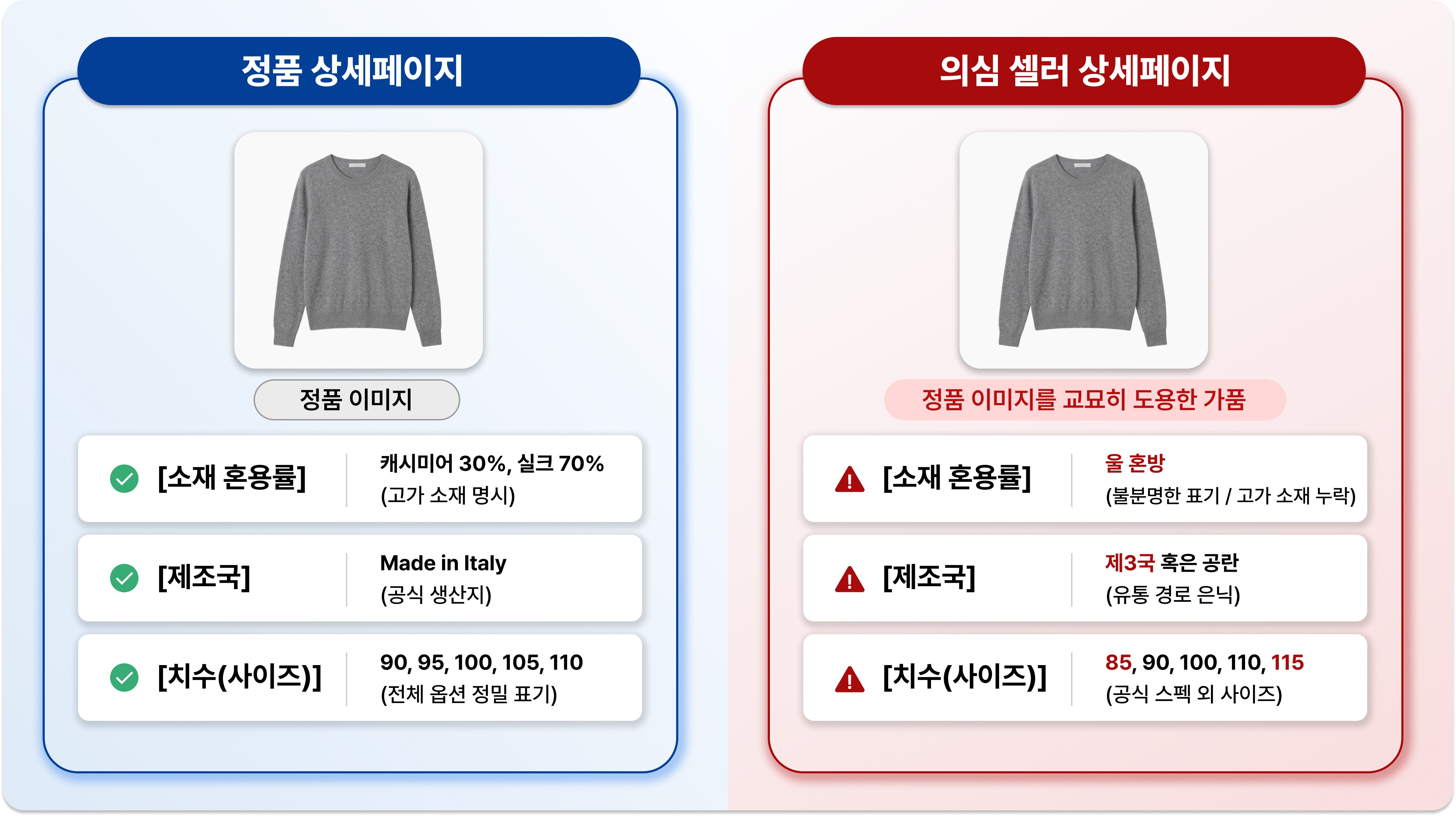
The 'composition of fiber or blend ratio' required by the clothing (No. 1) notification is the most powerful legal indicator to filter out counterfeits. In particular, expensive materials used by premium brands (e.g., cashmere, silk, specially processed fabrics) are items that counterfeit sellers frequently cheat on to reduce costs. For example, if the genuine product is '90% wool, 10% cashmere' but the seller lumps it together as 'wool blend' or lists an absurd ratio, this is a clear sign of violation. Writing the blend ratio ambiguously and unclearly, or writing figures slightly different from the brand's official specifications, is a direct ground for violation of the Electronic Commerce Act.
In the case of shoes or footwear (No. 2), if the outer and lining materials are not written separately or the type of leather is falsely stated, this is judged not as a simple typo but as a 'deceptive provision of important information,' becoming a strong justification for platform sanctions.
Second, be suspicious if the 'country of origin' field is blank or different from reality.
In all fashion category notification items (Product Information Notification No. 1 to 4), 'country of origin' is a mandatory entry. Attention should be paid to cases where the official country of manufacture of a specific model is Italy but is indicated as a third country, or where the manufacturing country information itself is omitted to avoid tracking the distribution route. According to Article 3 of the General Principles of Notification, if information cannot be provided, a specific reason must be presented. Leaving the country of origin information blank without a justifiable reason or stating a false country is a violation of regulations that causes confusion to consumers, and is a key crackdown point where brand managers can immediately file a claim.
Third, 'dimensions and sizes' data that differ from genuine specifications become decisive evidence of counterfeits.
Counterfeiters may be good at copying designs, but it is difficult to perfectly implement the unique specifications and design data of genuine products. In the case of the shoes (No. 2) notification, 'parallel writing of domestic size (mm) when writing overseas size' is mandatory, and fashion products must clearly state the dimensions and size according to notifications 1 to 4. From the total length of the clothes to the horizontal and vertical width of the bag, and the mm unit notation of the shoes, the numbers written in the notification area must align precisely with the genuine data held by the brand.
Therefore, if a size that does not exist in the genuine master DB is included in the option, or if the actual measurement data on the detail page deviates from the official spec within the error margin, the discrepancy in that numerical data is indeed the legal limit line that intelligent sellers can never cross.
From Damaged Labels to Material Misrepresentation.. Subtle Counterfeit Cases in the Fashion Market
The notification data items discussed earlier go beyond simple information entry and serve as objective criteria for determining whether a product is genuine. However, taking advantage of the fact that it is difficult for practitioners to compare these detailed indicators one by one, acts of subtly manipulating notification information occur frequently in the distribution field. In fact, on the brand's official CS channel, customers' questioning inquiries due to discrepancies between the notification information and the actual product are endless.
"They say the label is cut because it's a parallel import, but can I really trust this?"
These CS questions faced by fashion brand managers are dangerous early warnings that brand trust is shaking. Data discrepancy is not a simple notation error but the starting point of deceptive behavior that systematically damages brand value. We will look once again at the importance of data management through cases where unofficial sellers in the actual fashion industry manipulated notification information or destroyed identification information to disrupt the distribution order.
Case 1. Disappeared Internal Label: Is it a custom of parallel imports, or a trick to hide identity?
One of the most cunning tactics is to deliberately destroy the internal label, which can be called the fingerprint of the product, to hide the distribution route. Recently, KREAM, a limited-edition trading platform, completely suspended transactions of products with 'internal labels removed' from major brands such as Moncler and Stone Island. This is because some parallel importers committed 'label cutting,' cutting off or erasing with a pen authentication labels containing RFID, QR codes, and barcodes to hide bypass securing routes from overseas boutiques. Importers deliberately damage identification codes in advance so that it is impossible to know from which country and which store the product was shipped.
Products with damaged labels cannot be verified as genuine, and even inspection platforms cannot be 100% sure of authenticity, transferring the damage entirely to consumers. Malicious sellers claim that this is a custom for price competitiveness, but in fact, it is just a trick to hide that it is counterfeit or to avoid origin tracking. The moment the label disappears, the brand's genuine guarantee system becomes useless.
Case 2. Advertised as Goose Down, but Actually Duck Down? Material Misrepresentation Caused by Absence of Channel Management
Errors in notification data occurring in sales channels that the brand does not directly control are as threatening as the distribution of counterfeits. According to a recent survey by the Korea Consumer Agency, many of the 24 types of paddings sold online and advertised as 'goose down' fell short of quality standards or falsely stated materials.
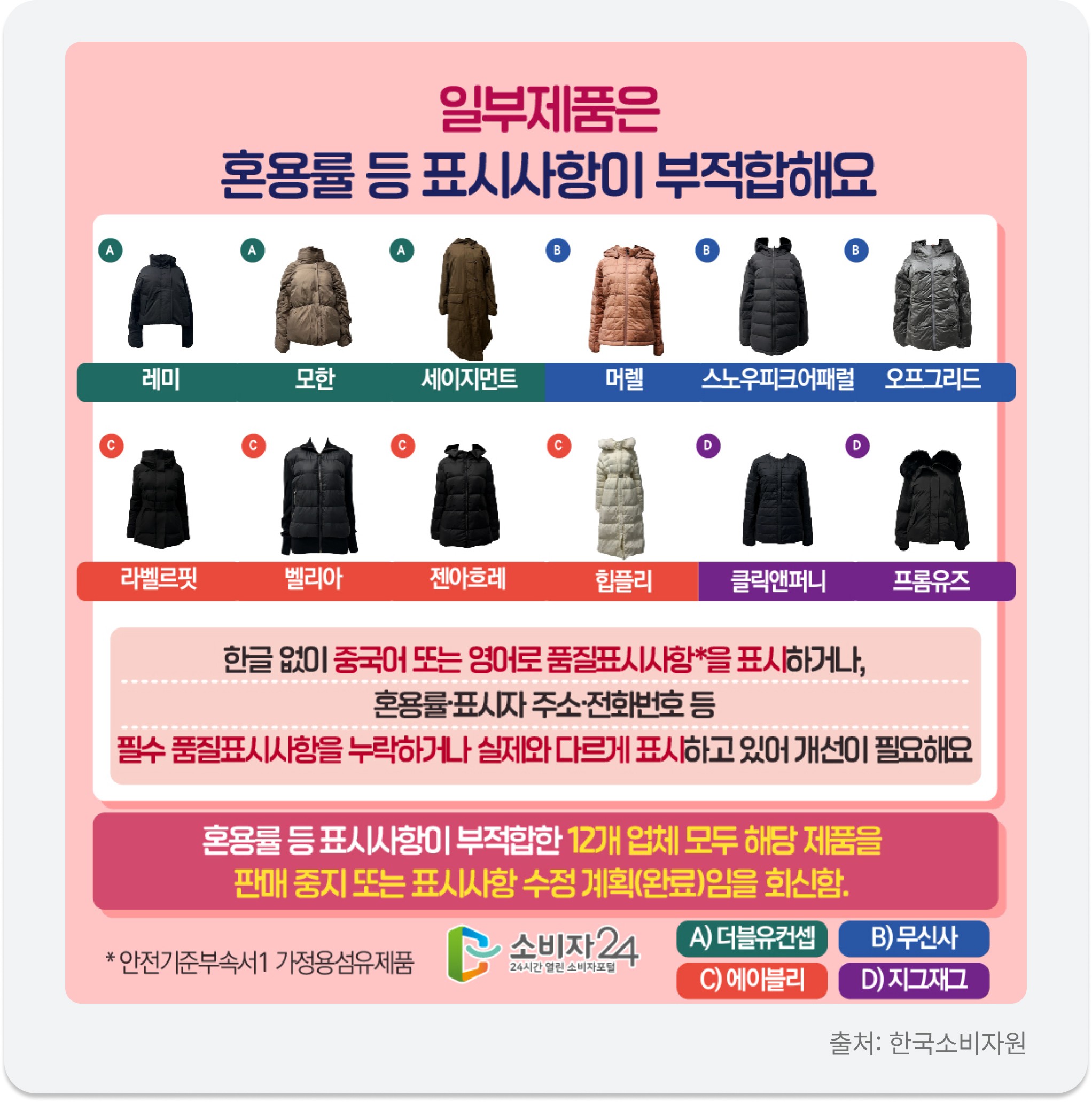
Even if this is a simple mistake by the brand or the seller, poorly managed text data is delivered to consumers as deceptive information. Ultimately, the resulting requests for refunds and the decline in brand image fall entirely on the headquarters.
Case 3. Large-scale Smuggling Even Faking the Country of Origin: Counterfeit Gang Penetrating Customs with Forged Documents
Counterfeit distribution is now expanding beyond the misbehavior of individual sellers into the realm of organized and meticulous crime. According to a case detected by the U.S. Department of Homeland Security (DHS), a gang that distributed $250 million worth of counterfeit Nike and UGG boots showed boldness by stealing the domain of an actual importer and forging documents. They passed through the customs network by submitting false country of origin information or distorting related documents.
Similarly, in Korea, premium paddings known to be made in Europe were controversial as they were distributed with the place of production marked as 'Made in China'. Counterfeits that do not go through official channels like this cannot even register QR codes for genuine authentication, ultimately leading to damage to consumers, and brands are faced with a decline in public image and authenticity inquiries from customers due to products they did not sell directly.
Traces of Counterfeits Missed by the Naked Eye, Why Automated Data Comparison is Needed
The methods of hiding information by intelligent counterfeits and unofficial sellers have reached a critical point where it is difficult to defend solely through manual monitoring with the naked eye. Based on the genuine master DB held by the brand, Reatrich re-establishes distribution governance by cross-verifying notification data scattered across e-commerce in real-time.
1. Lies Hidden in Deceptive Phrases and Labels, Reatrich OCR Technology Finds Them
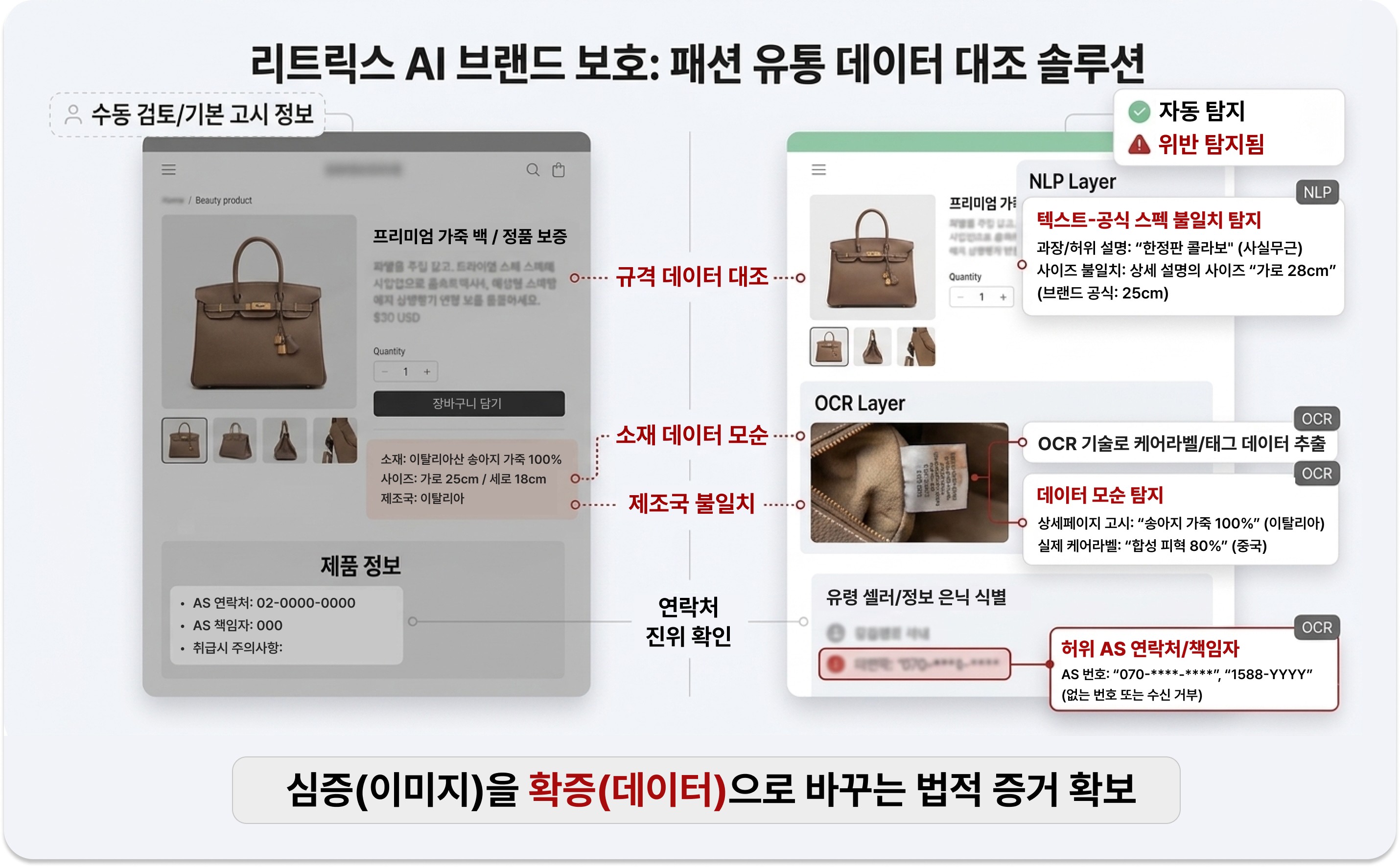
To catch 'material misrepresentation' and 'label damage,' which are the most frequent violations, Reatrich utilizes advanced OCR (Optical Character Recognition) technology. Even if '100% goose down' is written in the text area of the detail page, if the actual care label or tag information exposed in the corner of the product image contains conflicting information such as 'duck down' or 'Country of manufacture: China,' it is immediately captured. This data contradiction between the image and the text becomes the most objective confirmation to immediately request the platform to stop selling.
2. Precision that Doesn't Miss a 1cm Difference, Verified by Automatic Comparison with Official Data
🤔 What if our brand bag's width is 25cm, but the seller wrote it as 28cm?
🤓 Or what if they are selling an XL size that is not in the official lineup?
What counterfeit sellers can never imitate is the brand's unique design data. Reatrich compares and automatically scans the official dimensions (total length, shoulder width, etc.), material blend ratio, and manufacturing country data provided by the brand company with the seller's sales page in real-time. Size options that do not exist in genuine products or figures that deviate from official specifications are immediately classified as 'danger signals,' which serve as a weapon to logically pressure malicious sellers based on the consistency of the legally mandated notification data.
3. Blocking Information Errors on Unofficial Channels, Boosting Brand Trust and Work Efficiency at the Same Time
As shown in the cases examined earlier, data errors occurring during the distribution process are easily perceived as poor management by the brand, regardless of intent. Reatrich fully investigates and lists sellers who use false customer service numbers that cannot be reached or incorrect manufacturing information. Through this, we preemptively block consumer complaints arising from unofficial distribution networks from transferring to the brand's official CS channel, and create an environment where brand managers can focus on their original creative and strategic work.
The Power of an Unshakable Brand Comes from 'Data Integrity'
Ultimately, what we wanted to protect was not simply the sales volume of a single piece of clothing, but the 'trust' that customers feel when they trust and choose our brand's name. However, the illegal acts of unofficial sellers, which eat away at brand value in the blind spots of distribution, discourage the brand's passion and cause distrust among customers. This is precisely why brands must directly control and manage the seemingly dry number and text data at the bottom of the detail page.
Reatrich automates the exhausting monitoring task of visually inspecting tens of thousands of detail pages. When honestly managed data is delivered to customers, brand trust is finally completed. The process of correcting data discrepancies and increasing distribution transparency through Reatrich solutions goes beyond simply detecting counterfeits and is also a process of protecting brand assets and pride.
Now escape from the exhausting war of attrition with counterfeits. Based on the objective evidence and technology provided by Reatrich, we support you to focus again on your original value and growth where the brand can be most like itself.