Counterfeit
What materials should working-level staff prepare in advance to increase the success rate of reporting counterfeit goods on Coupang?
💡 In this article, you can find the following information.
🤔 “Can this actually be reported?”
Why aren't reports processed immediately?
✅ 'Essential general materials' required when preparing a report
How can we reduce the time spent gathering report materials?
The core of reporting is 'preparation', not 'judgment'
🤔 “Will this be reported successfully?”
If you are a brand manager, you have probably experienced a moment like this at least once. While checking a product page, you find a product where the thumbnail looks strange or a suspicious image that is clearly unrelated to the brand is mixed in. In such cases, most first reactions are similar.
“If I report this… will it be taken down immediately?”
But when you actually file a report, the results always turn out differently. Some are processed within a day, while for others, you don't receive a response even after several weeks. From a practitioner's perspective, it's natural to wonder, "Why do some happen right away, while others take so long?"
The reason for this difference is not as simple as you might think. When a report is received, the platform reviews only the parts that can be judged based on the submitted materials. In particular, for products like cosmetics where ingredients must be compared to make a determination, there are structures where verification is only possible if the reporter purchases the product directly and analyzes the ingredients. This process is time-consuming and expensive, making it difficult for practitioners to take immediate action.
In other words, whether the report result comes out 'quickly or slowly' is not an area that the brand can control, but is more closely related to what evidence the platform requires. Some can be reviewed immediately with just the materials, but others require time. Therefore, the question “Will this be reported successfully?” is essentially close to an unpredictable question.
That doesn't mean there is nothing a practitioner can do. Even if you cannot control when a report will be processed, the speed and accuracy of preparing the report is an area that practitioners can improve. Preparing and submitting the necessary materials quickly and accurately can reduce unnecessary waiting times and lower the likelihood of review delays.
If you do that, the question naturally changes like this. Moving your perspective from "Will this be reported successfully?" → "How efficiently can I prepare for the report?", the burden felt by practitioners is greatly reduced.
Why aren't reports processed right away?
🧐 “Some reports are processed quickly, but why is there no response for some even after several weeks?”
To understand this question, it helps to look at how reports are reviewed from a 'process perspective'. Since internal procedures are not disclosed for each platform, it is difficult to clearly grasp the detailed criteria, but there is a common flow observed by brand practitioners as they experience multiple cases. Organizing the reasons why reports are difficult to process quickly based on that flow, they are as follows.
Q1. Why aren't reports processed immediately?
When a report is received, the platform reviews areas that can be judged based on the materials submitted by the reporter. Reports that are processed immediately generally meet the following conditions:
When there is a clear mislabeling or copyright infringement on the product page
When the unauthorized use of brand-owned images is confirmed through materials alone
When policy violations, such as prohibited items for sale, are clearly revealed
When phrases prohibited by policy are clearly included
Because the platform can process these types quickly 'without additional verification procedures', results often come out quickly.
Q2. Why is some information reviewed immediately while other information requires more time?
As mentioned earlier, items that can be reviewed immediately among the report materials are information whose truth can be judged through the online screen alone, such as the following.
When the product name or option name is configured unrelated to the brand
When the detail page image is clearly abnormal
When price or configuration information clearly carries a risk of policy violation
On the other hand, information that requires time due to additional verification is closer to the following types:
When the appearance, configuration, and label are almost identical to the normal product, making it difficult to pinpoint differences through images
When it is deemed difficult to meet the judgment criteria with only the materials submitted by the reporter
When a judgment can only be made by checking the differences in raw materials or performance of the product (when physical verification is required, such as ingredient analysis)
In particular, products whose differences are revealed only based on ingredients, materials, or raw materials, such as cosmetics, health foods, and household goods, are difficult to distinguish just by looking at the materials. In this case, the reporter must purchase the suspected product directly and analyze the ingredients to make a determination. Ingredient analysis incurs costs and requires actual testing time, making it difficult for practitioners to take immediate action. Since this process is an area that the reporter must bear, it also causes the entire reporting process to be prolonged.
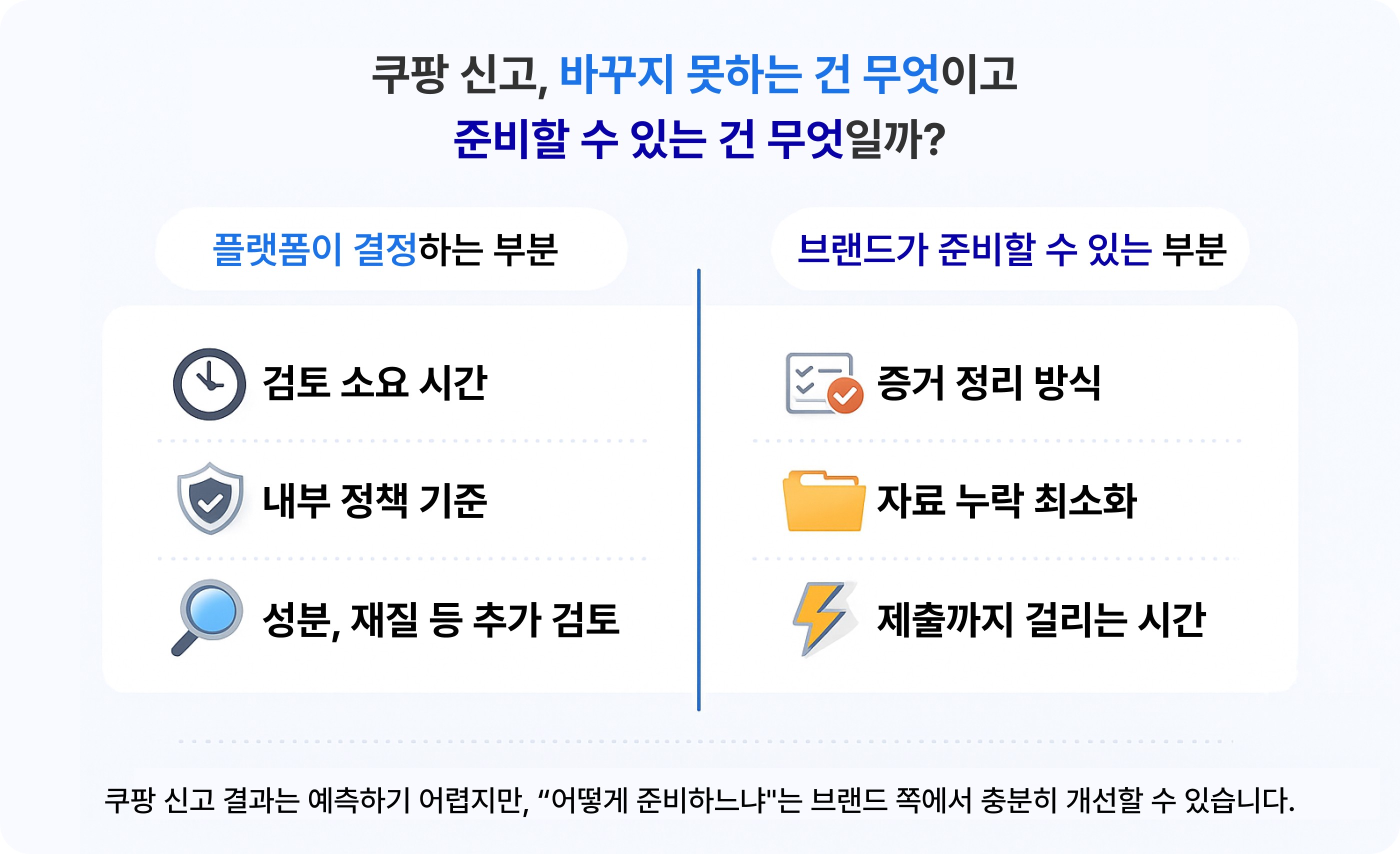
The important thing here is that the above differences are outside the brand's scope of control. In other words, no matter how quickly a practitioner files a report, if it is a type that requires time for the judgment itself, the processing speed is bound to depend on the platform's procedures.
Q3. Then, what are the areas that practitioners can control?
Although it is difficult to adjust when a report is ultimately processed, practitioners can directly manage areas that increase the report success rate. Representative examples are the following three.
1) Collecting accurate evidence quickly
: The materials at the time of submission are key to a report. The better accurate materials at the specific point in time, such as product URLs, price snapshots, and detail page images, are organized, the lower the likelihood of review delays.
2) Avoiding duplicate reports and submitting necessary evidence all at once
: If duplicate submissions, missing materials, or multiple requests for supplementation occur, the review process can naturally become longer. The clearer the information organized by the reporter, the more often the processing speed improves.
3) Narrowing down targets to minimize those with a 'high probability of counterfeiting'
: Items that require ingredient analysis, such as cosmetics, place a particularly heavy burden on the reporter. Therefore, in practice, the process of reducing the suspected targets themselves is important.
At this time, if you utilize an image-based AI detection system,
You don't spend time on unnecessary reports
You can pick out only the products you actually need to focus on, making the entire report preparation run much more efficiently.
In other words, although report processing speed is difficult to control due to differences in each platform's internal procedures, there are many areas where practitioners can fully manage the direction to increase the report success rate.
✅ 'General materials that must be prepared' when preparing a report
If the reason why a report takes long is because 'it is difficult to judge', the most realistic question for practitioners to prepare naturally leads to this.
“Then, what materials should I have to make the review progress quickly?”
The core of a report is ultimately the clarity of the evidence. It is consistently observed in practice that the clearer the information the platform can judge, the fewer review delays there are. Rather than defining actual cases or platform internal standards here, let's summarize only the basic materials generally required at the report preparation stage.
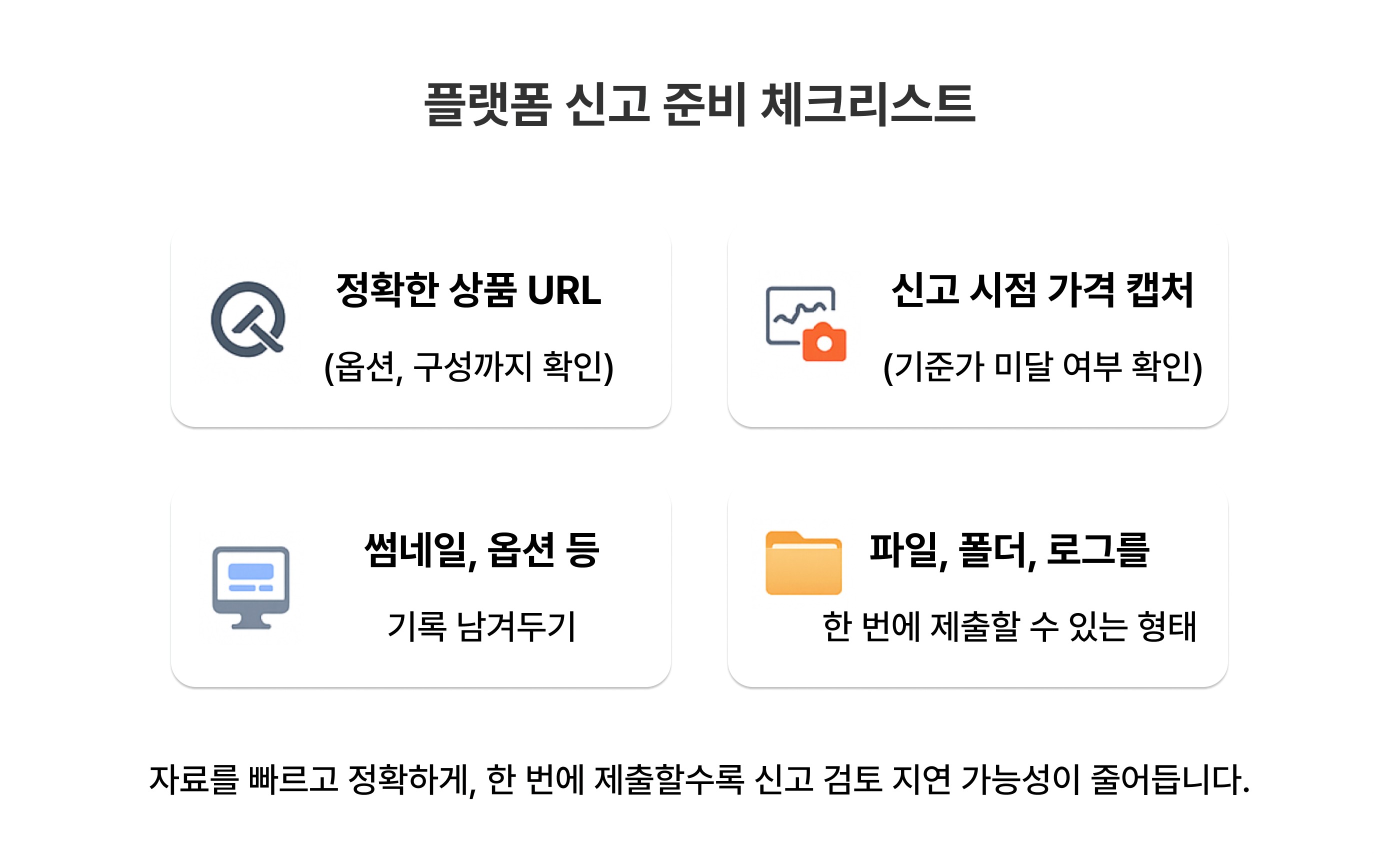
1) Product URL — Information that becomes the reference point of the report
The first thing you need is the product URL. Since the URL is the criteria by which the platform accurately identifies the problem product, if it is missing, the review will barely progress. Especially when there are multiple sellers using the same image or option, if the URL is missing, it becomes difficult to even judge which product was reported. In particular, Coupang sometimes has the same product duplicated and exposed in various configurations, so if the URL is not accurate, a situation can arise where the report connects to a different seller's page.
In practice, there are times when URLs are copied and submitted incorrectly, or pages connecting to specific options are missing. These small differences can also be a factor that delays time in the first step of the report.
2) Price Snapshot — Key material that leaves information of 'that point in time'
Prices can change instantaneously, so how important the price at the time of reporting is is frequently confirmed in practice.
For example,
At the time of the report, it was below the standard price
But at the time of review, the price has returned to the normal range, or
The seller has modified the option or configuration price
In such cases, without materials, it is difficult to explain "why it was a problem back then."
Therefore, leaving materials accurately in the form of screenshots, captures, and logs is the basis of reporting. This is because explaining simply that the price was low is often not convincing enough. Coupang has a short price fluctuation cycle and sellers tend to modify configurations and options quickly, so if you don't capture the price at the time of the report, it often becomes difficult to explain the 'point in time when it was a problem'.
3) Detail Page Screen Capture — Materials that help image-based verification
Detail pages change more often than you think. They change thumbnails, modify configuration tables, or delete some of the text to blur price or product information. Therefore, when reporting, the following materials are particularly important.
Full screen of the detail page
Option list
Configuration, capacity, and package information
Whether brand images or logos are used
These materials play a decisive role in helping the platform check the "appearance at the time of the report" rather than the "appearance seen now."
As mentioned earlier, there was a similar flow in the experience of reporting on Naver Smart Store. Even if you submit only the thumbnail, a "processing complete" guide is sent, but there were cases where the link remained as it was or the seller changed only the image and uploaded it again.
In other words, how clearly the image remains also affects the response stage after the report.
4) Whether the materials are organized all at once is also an important factor
For reports, "how well organized the materials are" is much more important than "whether there are materials."
The URL is separate
The price capture is in a folder
The detail page capture is in another chat room
The modification history is in notes...
If they are dispersed like this, you will waste unnecessary time when preparing materials for a report.
In the end, the key to increasing the report success rate is simple. Submitting materials "quickly" + "accurately" + "all at once." If you have this part well prepared, you can consistently check the flow of reduced review delays in practice. In particular, Coupang has large differences in page configurations by seller, so even if they look like the same product, the actual option and price structures are often exposed differently, making basic data collection even more important.
How can we reduce the time to collect report materials?
But... when are we going to collect all those materials? Going back and forth on the platform dozens of times a day to copy product URLs, capture prices, save detail pages... If there are many options here, just capturing takes several minutes, and even if the seller changes the image, a situation arises where you have to start over from the beginning.
“A day passes just collecting materials...”, “I can't catch the moment when the price moves, so the snapshot is empty.”.. In the end, rather than the report taking a long time, the feeling that the time spent on 'report preparation' is more of a burden increases.
Therefore, rather than hoping for quick report results, practitioners often have realistic concerns such as 'how can we reduce the time spent on preparation'. Reatrics is designed to greatly reduce the practical burden at this very point.
1) Automatically collects 'basic materials' needed for report preparation
I mentioned earlier that for the basic materials for report preparation organized above (product URL, price snapshot, detail page screen, image history), the record at the time of the report is key. Reatrics is structured to automatically accumulate these materials even if the practitioner does not capture them separately.
Product URL
Price logs by platform (including the time of change)
Detail page and image change history
From what point in time the price went down compared to the standard price
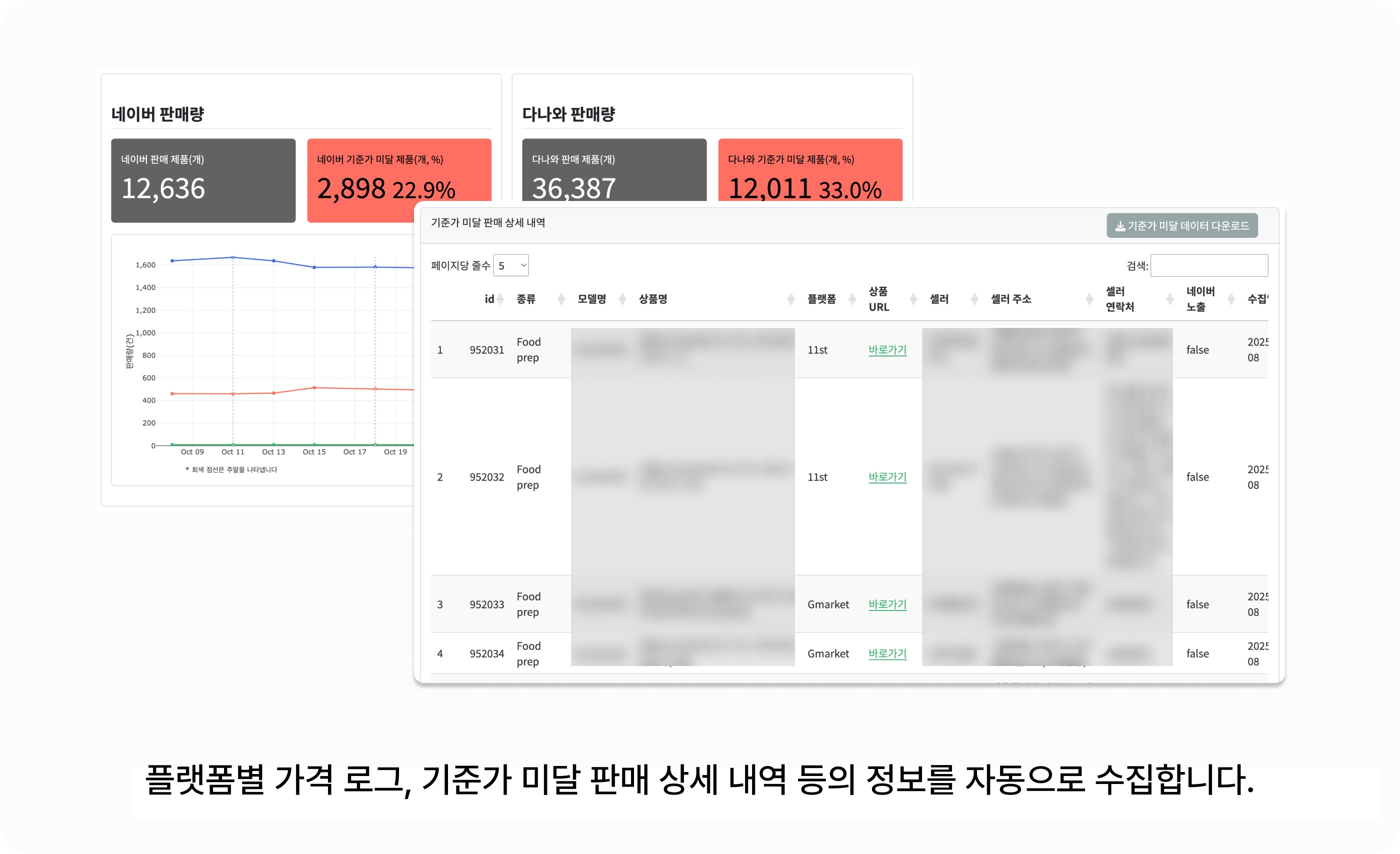
Because these records accumulate in real-time, there is much less worry about situations where materials are empty at the moment they are needed. For platforms like Coupang where screen differences occur significantly by point in time, this automatic accumulation function works particularly effectively in report preparation.
2) Price flows and even option changes are left by point in time
Among report materials, the most difficult to collect is 'when did the price change'. If a seller modifies an option or lowers the price briefly and then modifies it again, recording that is extremely difficult. Reatrics tracks
The point in time when the price fell below the standard price
Price changes by option
Price differences by platform
Change patterns by seller
And accumulates this flow chronologically.
Thanks to this, practitioners can check "since when this price was a problem" even a day or a week later. This also becomes important information when organizing report evidence. Especially in the case of sellers with fluctuating prices, you have evidence to clearly say, "It has been below the standard price since this point in time."
3) Image-based AI narrows down 'targets with high probability of counterfeiting' first
There is no need to report all suspected products. Especially for products like cosmetics that require ingredient analysis, the task of narrowing down suspected targets itself is half the efficiency.
Reatrics' image similarity-based AI detection distinguishes
Images that are excessively different from the brand's official images
Inconsistencies in label, package, and text configurations
Traces of abnormal editing and synthesis
These factors are clearly distinguished through heatmaps and similarity scores, and are used to filter out only the products that actually "require verification". Thanks to this, practitioners do not have to open every product one by one, and can start report preparation with only the targets that need verification narrowed down. This is also a part that actually saves a lot of time and money in the reporting process.
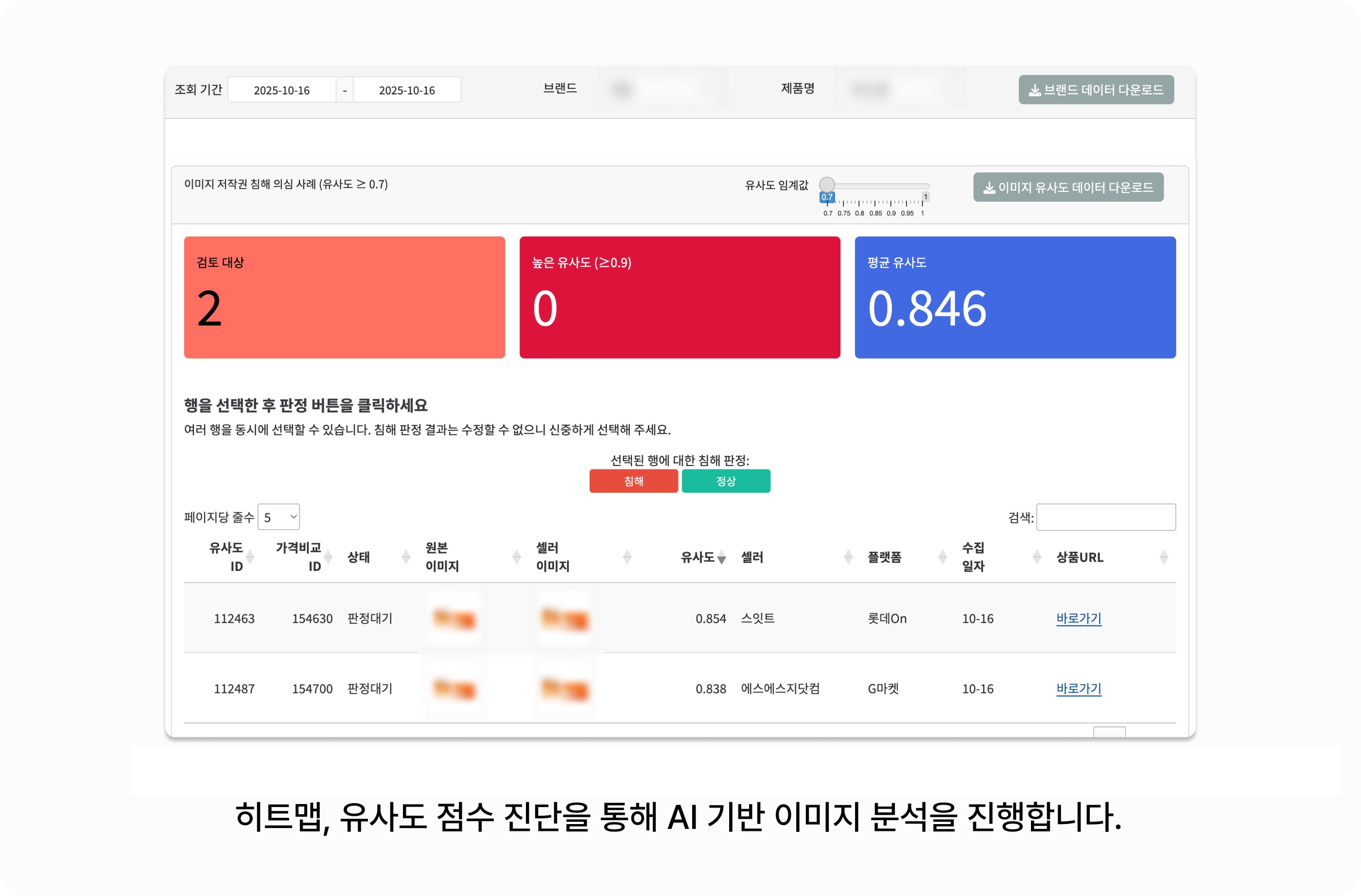
4) Materials are organized 'all at once' without being scattered
As mentioned earlier, one of the reasons reports are delayed is that materials are scattered in multiple locations.
Reatrics brings together
URLs
Price logs
Image change histories
Option information
Flow of changes compared to standard prices
All of this on a single model reference screen. From one screen, you can immediately check "when the problem started," "which seller changed the price first," and "at what point the image became different." For platforms with complex seller structures like Coupang, the effect of being able to check the entire flow on one screen is felt even more greatly.
In the process of submitting report materials, these pieces of information can also be extracted and submitted all at once, exponentially reducing repetitive captures and log organization time.
The key to reporting is 'preparation', not 'judgment'
As reporting experience accumulates, the greatest difficulty felt by practitioners is 'the time and uncertainty spent preparing the report' rather than "will this be reported successfully?". The process of manually collecting price logs, option histories, detail page changes, and image evidence takes longer than you think, and because materials change or disappear even if just a little time passes, it is not uncommon for key information to already be missing when entering the reporting stage. In the end, rather than the processing speed of the report itself, whether you can stably secure the evidence to support that processing process determines practical efficiency.
Reatrics is focused on realistically improving this very point. Because it automatically accumulates records necessary for report preparation, such as price changes, image modification histories, and differences in option configurations, practitioners can start reporting at any time "with all necessary materials already prepared." Just having materials organized by point in time reduces review delays and significantly lessens time wasted on repetitive captures or requests for supplementation.
Ultimately, the most realistic strategy that brand practitioners can take is not to predict report results, but to create a prepared state in advance. Reducing uncertainty through structured records and making the overall reporting process a clearer and more efficient flow. This is the point that leads to the most practical change in practice.